
The Propane Education and Research Council has put out some GREAT training resources that we can all use to better train our employees who handle propane. This little tidbit is from “Module 8 – Cylinder Safety”.
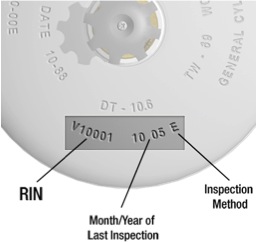
Depending on the requalification method and the propane cylinder’s specifications, it must be requalified every 5, 7, or 12 years. Refer to Title 49 CFR §180 to determine requalification deadlines for the type of cylinder you are requalifying. Never fill or use a cylinder that is beyond its requalification time limit. The most recent requalification date is either marked on the cylinder or on a label affixed to it. This marking includes:
- The month and year of the last requalification.
- The Requalification Identification Number (RIN).
- A single letter indicating the requalification method that was used (unless a hydrostatic test).
Since 2008, DOT has been issuing new and renewed RINs that contain a letter and six (6) numbers. This RIN may be on a label rather than stamped on the cylinder. If a company uses a RIN that contains a letter and four numbers, it does NOT qualify for the label exception and the RIN MUST be stamped on the cylinder. Keep in mind that when a cylinder is relatively new the most recent “requalification” date may be the manufacturer’s original test date.
There are three ways to requalify a cylinder. The requalification method used is stamped with the date on each cylinder.
- Hydrostatic Test: A date WITHOUT A LETTER indicates the cylinder was subjected to a complete water jacket hydrostatic test. The next requalification must be within 12 years. For example, a cylinder marked “10/08” tells us that this cylinder was hydrostatically requalified in October 2008.
- Proof Pressure Test: A date FOLLOWED BY THE LETTER “S” indicates a proof pressure test has been performed. The next requalification must be within 7 years. For example, a cylinder marked “03/08S” tells us that this cylinder was proof pressure tested and requalified in March 2008.
- External Visual Inspection (CGA Inspection Method): A date FOLLOWED BY THE LETTER “E” indicates an external visual inspection was performed. The next requalification must be within 5 years. For example, a cylinder marked “02/09E” tells the technician that this cylinder was requalified by the external visual inspection method in February 2009. Most propane companies use the visual inspection method for requalification.
Cylinders that require hydrostatic or proof pressure retesting are typically sent to a company specializing in these tests. After retesting, the requalifier marks the cylinder with a test date, type of requalification method used, the RIN number, and other important markings. Only cylinders with select specification designations may be requalified by using the external visual inspection method. These designations include:
- DOT-3A
- DOT-3AA
- DOT-3A480X
- DOT-3B
- DOT-4B
- DOT-4BA
- DOT-4BW
- DOT-4E.
External visual requalification inspections can be made ONLY by a qualified person working in a facility that has a current RIN. The RIN must be placed on the cylinder above, below, or before the date and type of inspection. Any cylinder found to be damaged or missing required markings MUST be condemned and placed out of service. Whether or not the cylinder passes requalification, you must record and keep a copy of the results. Those records must include:
- Date of inspection (month and year).
- DOT specification number.
- Cylinder identification (registered symbol and serial number, date of manufacture, and owner).
- Type of cylinder protective coating.
- Conditions of cylinder checked (any leakage, corrosion, gouges, dents, or fire damage).
- Disposition of cylinder (returned to service, returned to manufacturer for repair, or condemned).
Required requalification markings must be legible and readily visible at all times. They may be placed on any part of the upper end of the cylinder, excluding sidewalls, unless specifically permitted. Additional dates may be marked on the external surface of the foot ring.
CLICK HERE to download all ten (10) of the modules.