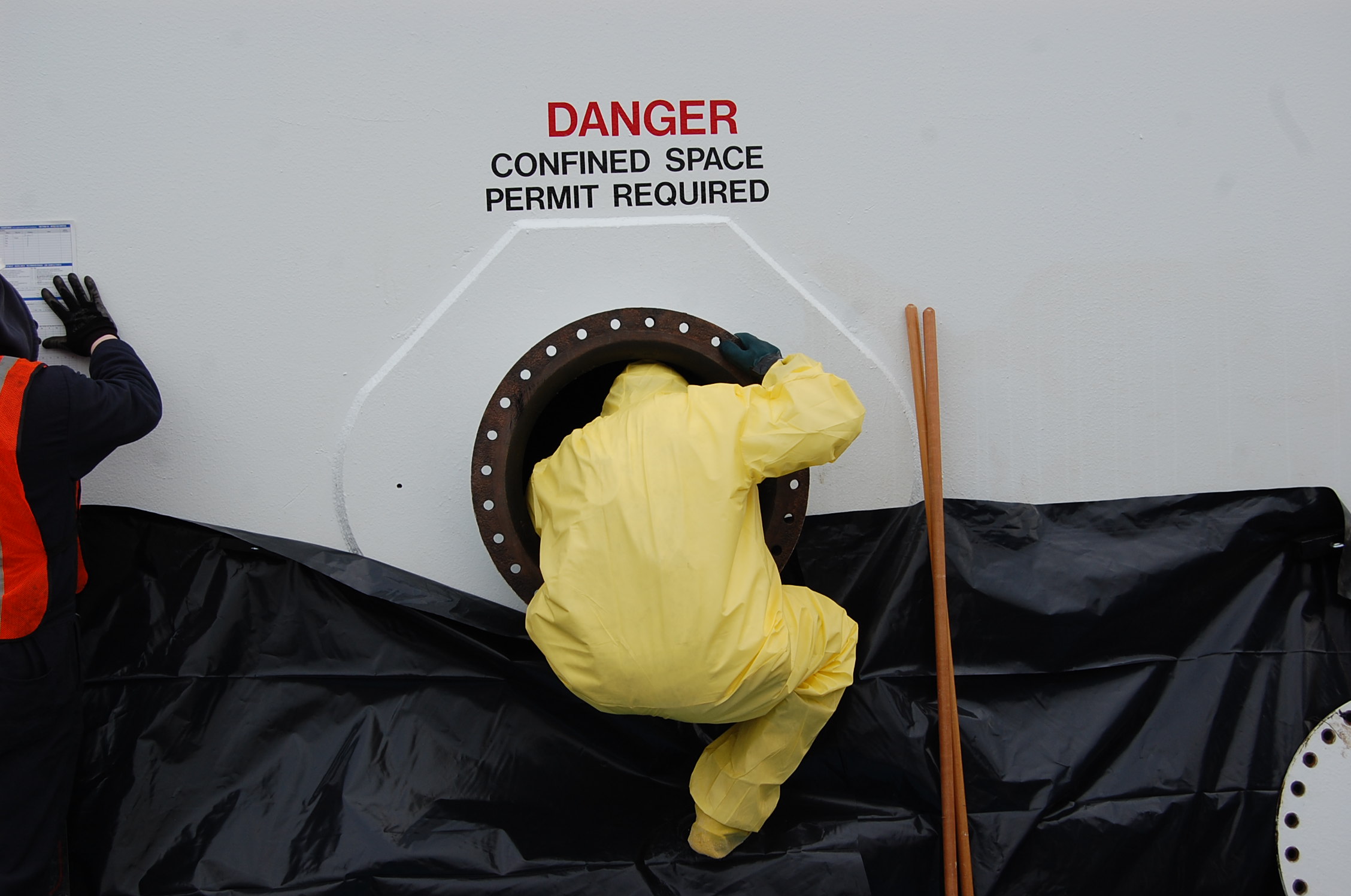
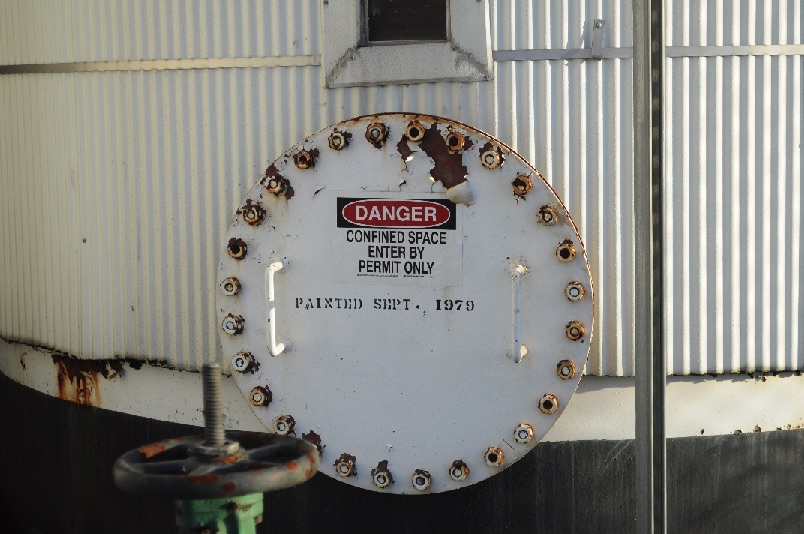
 Right after doing our site Confined Space assessment, OSHA says that we must identify spaces deemed to be Permit-Required Confined Spaces. Many facilities order hundreds of signs to put on their spaces at a pretty penny… in other words; it ain’t cheap to label these spaces! So one would think that the labeling/marking would be done properly. Take the image to the left… anyone see anything wrong with this picture?
Think in a futuristic way… As shown in the photo, most PRCSs are labeled with a sign on the entry portal cover. We tend to put the DANGER sign directly on the accessway cover/door for everything from a hatch door, manway, hatchway, etc. As it sits, as shown in the photo, we have no issue, but what happens when the tank is prepped for entry and the manway cover is opened/removed?
Now we have an OPEN PRCS without any identification as such, a serious unsafe condition, as well as a failure in compliance. Let’s take a look at what OSHA’s 1910.146 says about identifying PRCSs and preventing unauthorized entry into PRCSs.
1910.146(c) General requirements.
1910.146(c)(1) The employer shall evaluate the workplace to determine if any spaces are permit-required confined spaces.
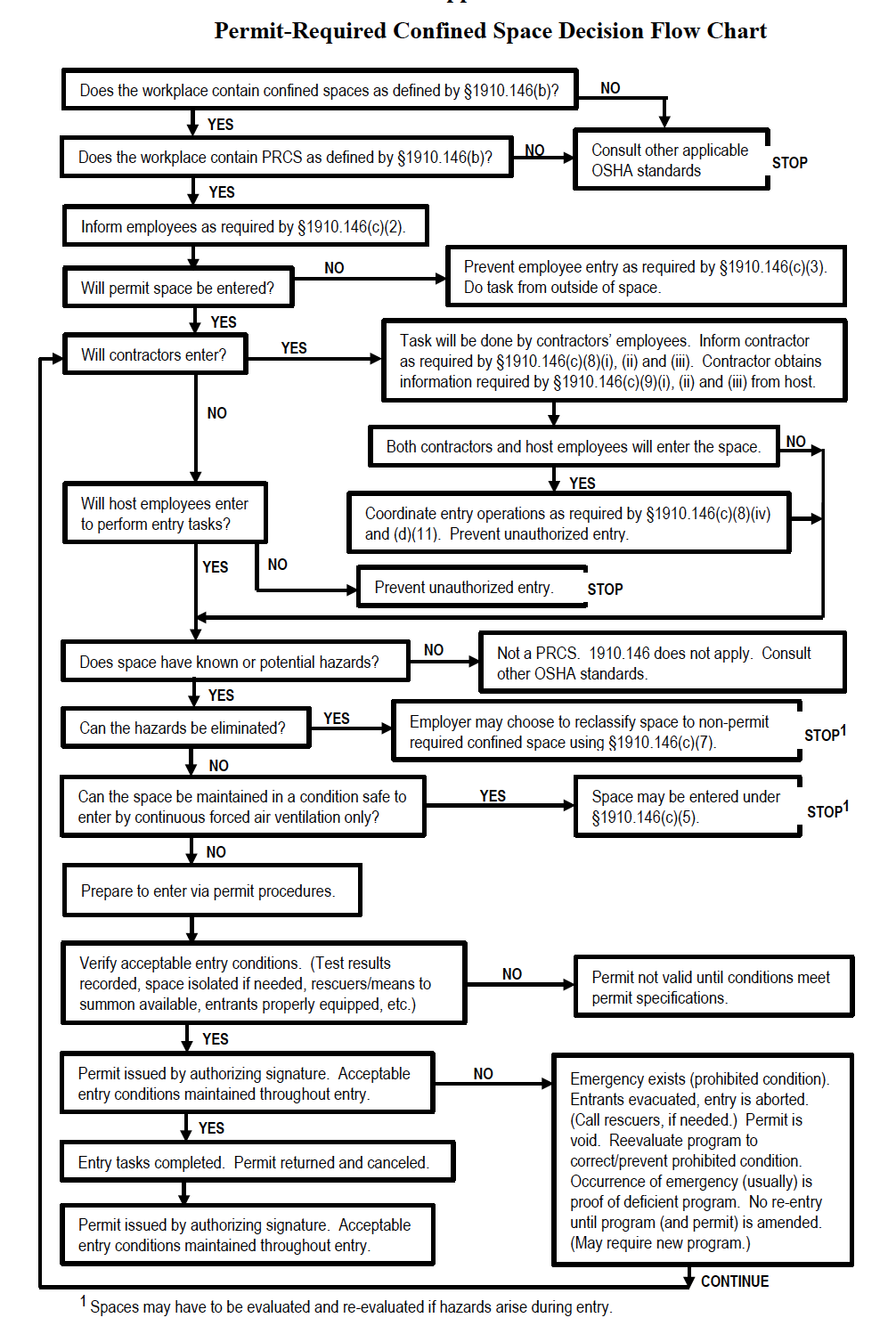
NOTE: Proper application of the decision flow chart in Appendix A to section 1910.146 would facilitate compliance with this requirement.
1910.146(c)(2) If the workplace contains permit spaces, the employer shall inform exposed employees, by posting danger signs or by any other equally effective means, of the existence and location of and the danger posed by the permit spaces.
NOTE: A sign reading DANGER — PERMIT-REQUIRED CONFINED SPACE, DO NOT ENTER or using other similar language would satisfy the requirement for a sign.
Here is some additional info regarding paragraph (c)(2) as it was interpreted in OSHA instruction [CPL 2.100, May 5, 1995] and is provided below.
How will OSHA interpret the language in paragraph 1910.146(c)(2) requiring employers to inform employees of permit spaces by posting signs or “by any other equally effective means?”
Ordinarily, information about permit spaces is most effectively and economically communicated through the use of signs. Consequently, signs would be the principal method of warning under the standard. Alternative methods, such as additional training, may be used where they are truly effective in warning all employees who could reasonably be expected to enter the space. It is the employer’s obligation to assure that an alternative method is at least as effective as a sign. In some cases, employers may have to provide training in addition to signs, to protect employees who do not speak English or who would have difficulty understanding or interpreting signs. (One method by which OSHA can gauge an employer’s effectiveness is through random interviews of affected employees.)
If a space has a locked entry cover or panel, or an access door that can only be opened with special tools, the use of signs may be unnecessary. If the employer ensures that all affected employees are informed about such spaces and know that they are not to be opened without taking proper precautions, including temporary signs, to restrict unexpected or unknowing.
So OSHA requires the space to be labeled, but here are the questions so many employers have:
- Do I have to label each space?
- Do I have to label each entry portal into a single space?
Do I have to label each space?
The simple answer is yes, but the honest answer is no when strictly speaking “compliance” with 1910.146. OSHA permits those spaces that require special tools, and I would like to mention “special permission” (i.e., safe work permit); the space does not have to be labeled as shown in the photo above. However, when an employer takes this route, they MUST use some “other equally effective means” to inform those who work around the space(s) that they are indeed PRCSs. It is my humble opinion that if the facility labels some closed spaces and doesn’t label others, they are setting themselves up for a serious accident. If a facility chooses to use “other equally effective means” in their PRCS program, there MUST be some clear-cut rationale and CONSISTENCY within the program AND their actions. It is not uncommon for us to come across a row of four (4) tanks; three (3) are labeled, and one is not labeled, and the facility is quick to point out this “labeling exception” to justify the single space being unlabeled. I am sorry, but it just does not work that way! Here’s a suggestion…
State in your program that CLOSED PRCSs with a locked entry cover or panel or an access panel that can only be opened with special tools (and safe work permit authorization) will NOT be labeled. Those PRCSs that are NORMALLY OPEN because they are not locked or there is no access cover/panel (e.g., a skirt on a tank as shown below) will be labeled. The program will also discuss the training aspect for ALL workers on site, including contractors, to ensure personnel understand this labeling aspect of the program. And remember, this may be a BIG issue with contractors on-site as some may not have their own PRCS program as they do not do entries, but we MUST inform them that some PRCS will NOT be labeled and how they can identify them. These contractors work at many different facilities, and most facilities attempt to label all their spaces, so they are very much used to seeing the DANGER signs on PRCS. Now, they are working at a site where the spaces will not be labeled as they are used to. This risk demands more than a 5-minute CS review in your contractor safety training!!!
Now, let’s look at the other side of the coin… I label all of my spaces.
I think the least number of PRCS access points I ever had at my facilities was somewhere shy of 1,000; our largest facility had more than 3,000 entry portals! That is a heck of a lot of signs to install AND maintain year after year. Most of my management teams urged me to implement OSHA’s exception to reduce $ and audit findings each year. Yes, it can be expensive to maintain the signs, and it is vitally impossible to ensure that 1,000+ signs/labels are in place and legible. I used the “annual review” and assigned each unit/department to inspect their spaces for proper labeling; this was one of their department safety metrics. I broke down the total number of spaces into four groups, and each quarter, they had to conduct inspections on these spaces to ensure the initial evaluation was still valid and that the space was still legibly labeled at EACH ACCESS PORTAL. But it never failed, we would still get hit during our annual safety (or PSM) audits because the auditor could find one space, usually in a remote area of the plant, where the sign fell off or we just missed the space in our site evaluation. I have even been dinged because someone signed off on a MOC and the PSSR to install new spaces within a unit, and no one ever evaluated the space(s) or labeled them! Talk about a major breakdown of a management system!!!!
I believe the written program needs to discuss who will and how they will label the spaces in their department/unit, as there are a lot of dynamics involved in how this aspect of a very serious safety and health program will be managed. As such, the program needs to have a labeling section so that the signage is CONSISTENT across the facility. The signs need to be DANGER signs that comply with 1910.145. I would like even to specify the size of signs we would keep in stock and provide guidance as to what size goes on what size space. Depending on the space, we specified the method of attachments the facility could use. Some were stickers, some were stenciled on, some were tack welded on, etc. Some options were very elaborate because the tank was an elevated temp tank, and it was impossible to attach the sign directly to it. But the one thing we did NOT permit was the sign/label/stencil to be placed on the access portal covering (e.g., manway cover). We even had a cautionary statement about what to do with the removable manway so that it would not find its way sitting against the space, covering the DANGER sign! If we permit the DANGER sign/label to be placed on the access portal covering, we end up with this…
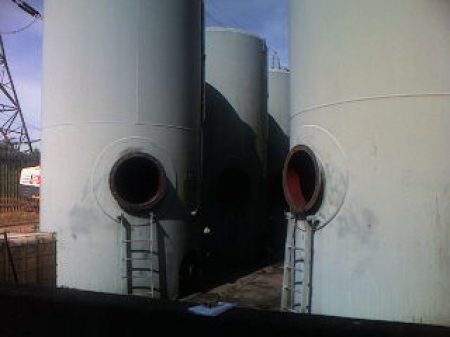
An open PRCS with no means to prevent unauthorized entry or communicate the hazards associated with the space!
Lastly, do I have to label each entry portal on each space?
Sorry, I do not have an answer as to whether OSHA requires each portal to be labeled. I can say that it is my opinion that each portal should be labeled. Yes, this adds to the number of signs/labels to install and maintain, but having a single 12” X 12” sign on a 500,000-gallon storage tank with four (4) access portals, including the top of the floating roof, is just ineffective. I have also seen situations where the tanks were labeled at ground level, but all the access portals were from the second level, and these were not labeled. Even worse, some of the spaces were PRCSs, and some were not even CSs, so workers on the second level were uninformed about which spaces were PRCSs.
Placing a DANGER sign at each entry portal ensures that all workers understand the space hazards and that an entry permit is required to enter the space. By placing the DANGER signs properly on the space, we can rest assured that they will be visible and serve their function at ALL times.