
On May 4, 2023, at 6:25 a.m., approximately 790 pounds of a hydrocarbon mixture containing about 7,000 parts per million (ppm) of hydrogen sulfide were accidentally released at a Refinery. Exposure to the toxic hydrogen sulfide vapor seriously injured one employee.
The facility’s investigation found that, on the day of the incident, pressure in a distillation column increased significantly. Three (3) field operators worked to open a valve to bypass flow around the distillation column’s overhead accumulator (“drum”) to reduce the pressure. While opening the bypass valve, the operators found that the field pressure gauge indication did not match the value reported by the pressure transmitter to the computer control system. When such an instrumentation discrepancy occurs, the facility expects its operators to replace field gauges during routine troubleshooting. To that end, a fourth operator brought a new pressure gauge to the top of the deck to replace the existing gauge.
Per the facility’s gauge replacement procedure, the operators closed two (2) valves to isolate the pressure gauge from the process. Additionally, the operators discovered a note on the pressure gauge that stated “Valve Issue” with an arrow pointing to the two valves on the drum. One valve was used to isolate the pressure gauge (blue rectangle), and the other was used to isolate the drum (blue oval).
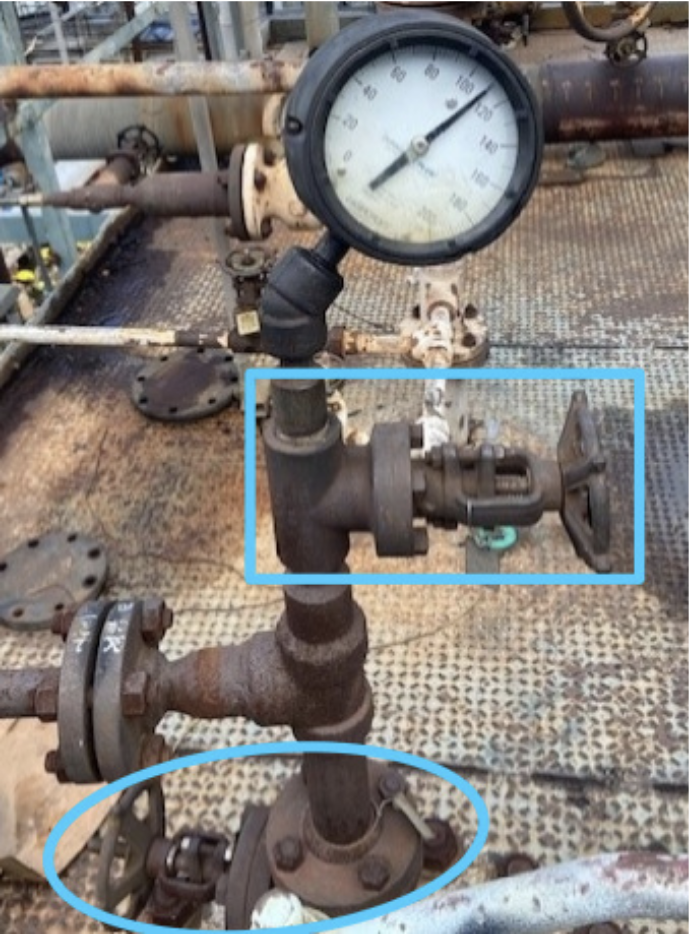
Because the valve used to isolate the drum was visibly broken, the operators assumed that the note referred to it. However, unknown to the operators, the valve used to isolate the pressure gauge could not fully close due to an internal obstruction. With the valve isolating the pressure gauge appearing to be closed, one of the operators began unscrewing the pressure gauge to relieve any residual pressure. The operator did not identify a potential leak, as there was no indication of residual pressure while unscrewing the last threads of the pressure gauge.
After the gauge was removed, however, the process pressure likely dislodged debris in the piping, causing the process stream to discharge into the atmosphere. This release of flammable hydrocarbons containing hydrogen sulfide exposed all four operators to the toxic gas. Post-incident, the facility found that the pressure gauge was plugged.
The facility’s investigation also revealed that none of the operators wore respirators to protect against hydrogen sulfide inhalation. As a result, exposure to the toxic hydrogen sulfide caused the four (4) operators to lose consciousness. Three (3) operators regained consciousness and climbed down from the drum deck. Emergency responders rescued the unconscious operator. The operator was transported and admitted to a hospital for medical treatment. Emergency responders also reinstalled the pressure gauge to stop the release. The investigation did not identify who wrote the note or find any work order to repair either valve.
Probable Cause
Based on the facility’s investigation, the CSB determined that the accidental release was caused by the facility’s failure to effectively isolate the piping before removing the pressure gauge. Failure to use PPE that could protect workers from hydrogen sulfide exposure contributed to the severity of the incident. The facility’s mechanical integrity program, which did not replace the broken valve after it was identified in the field, also contributed to the incident.
Source: https://www.csb.gov/assets/1/6/incident_reports_volume_2_2025-03-12.pdf