
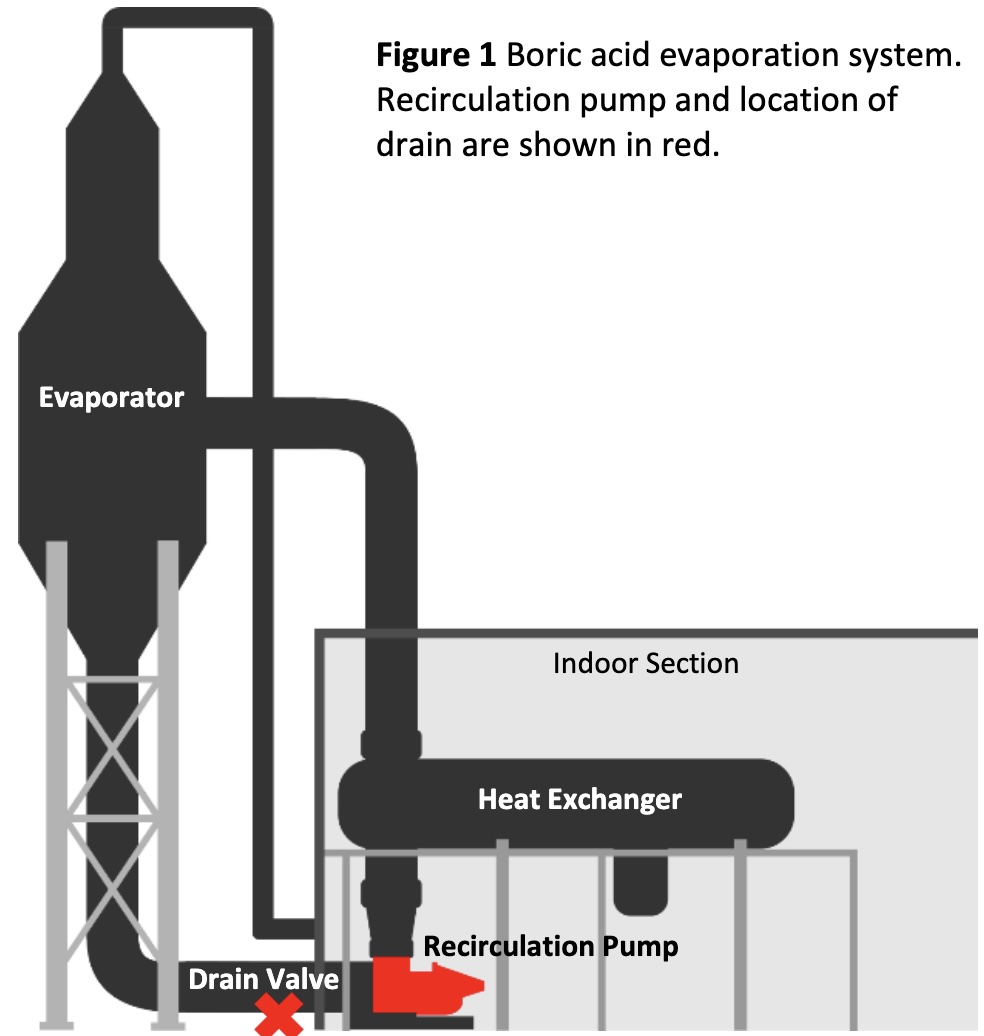
In July 2012, a 64-year-old maintenance mechanic at an aluminum foil processing facility died after being exposed to an approximately 180-degree Fahrenheit solution of boric acid and water while trying to remove a recirculation pump from its housing. The pump was part of a boric acid evaporation system. The system took several days to completely cool through draining and flushing before it was safe to remove the pump. Workers in another department reported that they had completed draining the system. As the victim and other workers used two 1.5-ton “come-along” puller devices to free the pump from its housing, a small amount of hot water/boric acid solution fanned out from around the seal. Seconds later, the force of the solution pushed the pump out of the housing, and hundreds of gallons of hot liquid flowed out. The victim fell to the floor and was covered with the solution. He was wearing no personal protective equipment other than safety glasses, and received severe burns to over 80% of his body.
Some of the workers were able to get him to an emergency shower and began removing his soaked clothing, while others called 911. Emergency responders arrived within fifteen minutes and the victim was airlifted to a burn trauma unit. He died two days later due to his injuries.
At the time of the incident, the plant was undergoing a scheduled facility-wide maintenance shutdown. The recirculation pump for the boric acid evaporation system had developed an oil leak and was scheduled to be removed the following day as part of the maintenance outage. Before removing the pump, the evaporation system needed to be drained of boric acid solution and flushed through with city water to cool it and remove the boric acid solids.
The recirculation pump had been removed using the same procedure approximately 10-12 times since it had been in use. There was no written procedure for removal of the pump. The victim had been involved in the original installation of the pump over a decade earlier, had removed and reinstalled the pump for maintenance purposes several times, and had trained newer employees in the pump removal process.
Drainage of the boric acid evaporation system was done by a work crew from the plant’s environmental operations department, not by the maintenance workers who would actually remove the pump. To empty the system, hoses were attached to drainage valves and the solution was drained into a holding area outside the building. Before draining and flushing, the system contained between 20,000 to 25,000 gallons of solution that was approximately 12-15% boric acid solids, at a temperature of around 220°-230° Fahrenheit.
Environmental crew workers reported that they had completed draining the system the night before the incident and checked to make sure that draining was complete. This check was done by confirming that no more solution was flowing out of the lowest ball valve in the system (photo 3). A worker ensured that boric acid solids were not blocking drainage by inserting a metal rod into the valve opening. There were no devices to measure the actual volume of fluid that had drained from or remained in the system.
At around 4:20 on the day of the incident, less than an hour before the end of their shift, the victim and another maintenance worker began to remove the recirculation pump from its housing. It is unclear why the victim decided to remove the pump ahead of the scheduled time the following day. The victim had trained the other maintenance worker in the pump removal procedure. Before beginning, they locked out the electric power supply to the pump. The victim’s co-worker, the other maintenance worker, reported that he checked that all drain valves for the system were open and that no solution was coming out before they began the pump removal procedure.
There was no mechanism to lockout the pump from other stored energy, such as fluid under pressure. When the victim and his co-worker initially attempted to remove the recirculation pump from its housing, it would not come loose. Four other employees were in the vicinity, and two came over to help. They attached two 1.5-ton manual lever pullers, or “come-alongs” to the sides of the pump (photo 4). The victim stood next to the pump and in front of the support column (photos 5 & 6). When they began to pull using the come-alongs, the pump loosened and a small amount of boric acid/ water solution sprayed out from around the pump housing.
Workers reported that it was not unusual for a small amount of residual solution to leak out during pump removal, and they stopped pulling to wait for the flow to stop. Seconds later, the pump suddenly slid several feet forward out of the housing, and 300-500 gallons of hot boric acid and water solution flowed out from behind it. The temperature of the solution was estimated to have been around 180° Fahrenheit. The area filled with steam as the workers rushed away from the flow. Everyone except the victim was able to get to safety. Standing in the tight space next to the pump, the victim was not able to quickly escape the flood of hot solution and was knocked to the floor. He had been wearing safety glasses, but no other personal protective equipment. The other workers could hear him screaming in pain. His co-worker ran back and found him sitting in hot solution. He helped the victim to his feet as another worker turned on the emergency shower. They moved the victim to the emergency wash and began to remove his clothing while another worker called 911 on his cell phone.
Emergency medical services arrived in 10-15 minutes. The victim was airlifted to a burn trauma unit with burns to over 80% of his body. He died in the hospital two days later as a result of his injuries. The death certificate listed the immediate cause of death as “Thermal burns (200 degree F aqueous boric acid solution) to 80% total body surface area.”
CONTRIBUTING FACTORS
– Incomplete draining of the evaporation system before pump removal.
– No method to identify the potential for solution to remain in the system after standard draining procedures were conducted.
– No way to adequately determine the level and temperature of solution left in system.
– No method to estimate the time needed for cooling of the system to a safe level.
– No mechanism to lock out the pump from other stored energy, such as solution under pressure.
– The pump was located directly behind the heat exchange support column, leading to limited access and egress for workers during pump maintenance.
– Not wearing appropriate personal protective equipment.
CLICK HERE for the full report
