
This week, we saw OSHA issue two willful and three serious violations totaling $122,602 to a sperm bank for bulls (cattle) after an employee was asphyxiated while filling freezers with Liquid Nitrogen. And back in 2017, we saw another sperm bank, this one for humans, have a Nitrogen incident which claimed the life of a Deputy Sheriff and critically injured the supervisor of the business. I have personally observed liquid nitrogen in businesses that I strongly suspected lacked the necessary safety programs, designs, knowledge, and training to manage such a hazardous material. I thought it would be helpful to show how a business that already uses, or is considering using, Liquid N2 should do so safely. Using one of my favorite sources, the International Fire Code, we can see the structure of a well-established plan for designing and handling liquid N2. This will be a three (3) part article as there is a lot to discuss.
First, for my disclaimer… The International Fire Code is the basis for many states’ fire codes, but not all states adopt it, and even among those that do, many revise it to meet their needs. In rare cases, this code is actually enforced – many of you reading this may have years of experience and may not have even heard of the IFC, much less actually had an inspection against its requirements. But I grew up in and spent my entire career in facilities that were located in areas where the IFC was the baseline, and being heavily entrenched in process safety, I was taught that the IFC, International Building Code (IBC), and the International Mechanical Code (IMC) are an excellent starting point for designing safe processes. So, although “the man” may never drop the hammer on you for not abiding by any of these codes, this article is intended to show those who are seeking ways to improve their liquid N2 (or any cryogenic, for that matter) storage, handling, and processing safety.
In the IFC, if we have 60 gallons or more of liquid N2 INSIDE our building, or 600 gallons OUTSIDE our building, we would need an operational permit from the local authorities.
PLEASE NOTE: many areas of the country do NOT go to these lengths! As noted above in my disclaimer, many states adopt a “revised code,” and many omit the “operational permits” section of the IFC.
105.6.10 Cryogenic fluids. An operational permit is required to produce, store, transport on site, use, handle or dispense cryogenic fluids in excess of the amounts listed in Table 105.6.10. 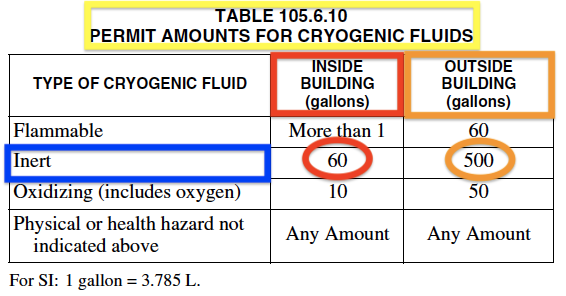 |
As a side note, 60 gallons equals 227 liters. So this means that we could have one (1) large dewar of liquid nitrogen inside a single building (regardless of how many floors the building may have!). What does a 227 Liter/60-gallon dewar look like?

This container will be around 61″ tall (4′-2″) and will be around 24″ in diameter. We have to remember that for every cubic foot of liquid N2, we make 696 cubic feet of gaseous N2 at 70°F (e.g., this is the “expansion ratio” for N2). This size dewar will have nearly 5,000 standard cubic feet of nitrogen gas.
We then turn to Chapter 55: Cryogenic Fluids (link to FREE access) for our design requirements. The first thing many will notice in IFC Chapter 55, is that the IFC requires us to also meet NFPA 55, Compressed Gases and Cryogenic Fluids Code (link to FREE access). The IFC also requires us to follow ANSI/CGA P-18, Standard for Bulk Inert Gas Systems (link to purchase – no free access) when our cryogenic liquid is inert, including argon, helium, and NITROGEN.
So, as we can see, the powers that write the IFC have clearly recognized the hazards associated with cryogenic liquids and have layered their approach by simply pulling in two (2) other world-class standards/codes from NFPA and CGA. In this article, I am ONLY going to cover the specifics found in Chapter 55: Cryogenic Fluids (2018 edition), but know there are some great additions found in NFPA 55 and CGA P-18.
| 5503.2 Pressure relief devices. Pressure relief devices shall be provided in accordance with Sections 5503.2.1 through 5503.2.7 to protect containers and systems containing cryogenic fluids from rupture in the event of overpressure. Pressure relief devices shall be designed in accordance with CGA S-1.1, CGA S-1.2, and CGA S-1.3. 5503.2.1 Containers. Containers shall be provided with pressure relief devices. 5503.2.2 Vessels or equipment other than containers. Heat exchangers, vaporizers, insulation casings surrounding containers, vessels and coaxial piping systems in which liquefied cryogenic fluids could be trapped because of leakage from the primary container shall be provided with a pressure relief device. 5503.2.3 Sizing. Pressure relief devices shall be sized in accordance with the specifications to which the container was fabricated. The relief device shall have sufficient capacity to prevent the maximum design pressure of the container or system from being exceeded. 5503.2.4 Accessibility. Pressure relief devices shall be located such that they are provided with ready access for inspection and repair. 5503.2.5 Arrangement. Pressure relief devices shall be arranged to discharge unobstructed to the open air in such a manner as to prevent impingement of escaping gas on personnel, containers, equipment and adjacent structures or to enter enclosed spaces. Exception: DOTn-specified containers with an internal volume of 2 cubic feet (0.057 m3) or less. 5503.2.6 Shutoffs between pressure relief devices and containers. Shutoff valves shall not be installed between pressure relief devices and containers. Exceptions: 1. A shutoff valve is allowed on containers equipped with multiple pressure relief device installations where the arrangement of the valves provides the full required flow through the minimum number of required relief devices at all times. 2. A locking-type shutoff valve is allowed to be used upstream of the pressure relief device for service related work performed by the supplier when in accordance with the requirements of the ASME Boiler and Pressure Vessel Code. 5503.2.7 Temperature limits. Pressure relief devices shall not be subjected to cryogenic fluid temperatures except when operating. 5503.3 Pressure relief vent piping. Pressure relief vent-piping systems shall be constructed and arranged so as to remain functional and direct the flow of gas to a safe location in accordance with Sections 5503.3.1 and 5503.3.2. 5503.3.1 Sizing. Pressure relief device vent piping shall have a cross-sectional area not less than that of the pressure relief device vent opening and shall be arranged so as not to restrict the flow of escaping gas. 5503.3.2 Arrangement. Pressure relief device vent piping and drains in vent lines shall be arranged so that escaping gas will discharge unobstructed to the open air and not impinge on personnel, containers, equipment and adjacent structures or enter enclosed spaces. Pressure relief device vent lines shall be installed in such a manner to exclude or remove moisture and condensation and prevent malfunction of the pressure relief device because of freezing or ice accumulation. |
The good news is that the container owner almost always takes care of the relief devices with respect to their design, sizing, and maintenance. We just need to ensure we don’t damage or tamper with them. But please note, the fatality in 2017 was due to the relief valve(s) discharging inside the building. Also, these requirements would be for ANY cryogenic containers, including fixed-bulk storage tanks, which again are almost always “leased” containers from the supplier. But we still have an obligation to our employees and the community to ensure the relief devices on these leased containers are PROPER!
| 5503.4.1 Identification signs. Visible hazard identification signs in accordance with NFPA 704 shall be provided at entrances to buildings or areas in which cryogenic fluids are stored, handled or used. 5503.4.2 Identification of contents. Stationary and portable containers shall be marked with the name of the gas contained. Stationary above-ground containers shall be placarded in accordance with Sections 5003.5 and 5003.6. Portable containers shall be identified in accordance with CGA C-7. 5503.4.3 Identification of containers. Stationary containers shall be identified with the manufacturing specification and maximum allowable working pressure with a permanent nameplate. The nameplate shall be installed on the container in a location provided with ready access. The nameplate shall be marked in accordance with the ASME Boiler and Pressure Vessel Code or DOTn 49 CFR Parts 100-185. 5503.4.4 Identification of container connections. Container inlet and outlet connections, liquid-level limit controls, valves and pressure gauges shall be identified with one of the following: 1. A permanent tag or label identifying the function. 2. A schematic drawing that portrays the function and designates whether the connection is to the vapor or liquid space of the container. Where a schematic drawing is provided, it shall be attached to the container and maintained in a legible condition. 5503.4.5 Identification of piping systems. Piping systems shall be identified in accordance with ASME A13.1. 5503.4.6 Identification of emergency shutoff valves. Emergency shutoff valves shall be identified and the location shall be clearly visible and indicated by means of a sign. |
These labels and sign requirements should not be a surprise for anyone. The NFPA 704 Diamond is STILL ALLOWED by OSHA (see my other article on NFPA 704 and OSHA Pictogram requirements) and is REQUIRED on fixed-bulk containers. The shipped (e.g., mobile/portable containers) must also contain labels meeting the OSHA requirements found in 1910.1200(f)(1), Labels on shipped containers, and of course, the DOT Labeling requirements, where applicable.
We have discussed the pipe labeling requirements per ASME A13.1 dozens of times; I even wrote an article explaining that A13.1 applies not only to PSM/RMP-covered processes but also to ALL our hazardous materials piping, per many state fire codes.
One of my favorite “rabbits I pull from my hat” during audits, PHAs, engineering reviews, etc. is that “Emergency Shutdown” activation devices must ALWAYS be labeled with a big and brightly colored sign indicating the location of the emergency activation device. Although this is not specifically called out in OSHA standards, we can use the IFC to drive this critical practice.
| 5503.5 Security. Cryogenic containers and systems shall be secured against accidental dislodgement and against access by unauthorized personnel in accordance with Sections 5503.5.1 through 5503.5.4. 5503.5.1 Security of areas. Containers and systems shall be secured against unauthorized entry and safeguarded in an approved manner. 5503.5.2 Securing of containers. Stationary containers shall be secured to foundations in accordance with the International Building Code. Portable containers subject to shifting or upset shall be secured. Nesting shall be an acceptable means of securing containers. 5503.5.3 Securing of vaporizers. Vaporizers, heat exchangers and similar equipment shall be anchored to a suitable foundation and its connecting piping shall be sufficiently flexible to provide for the effects of expansion and contraction due to temperature changes. 5503.5.4 Physical protection. Containers, piping, valves, pressure relief devices, regulating equipment and other appurtenances shall be protected against physical damage and tampering. |
You may have noticed I highlighted the “nesting” statement in red. This is because it has been a long-standing practice that “nesting” is ALLOWED ONLY at the facility(s) that fill the portable containers. NFPA 55 defines “nesting” as:
3.3.73 Nesting. A method of securing cylinders upright in a tight mass using a contiguous three-point contact system whereby all cylinders in a group have a minimum of three contact points with other cylinders or a solid support structure (e.g ., a wall or railing).
NFPA 55 also states the following about the practice of “nesting”
7.1.8.4.2 At cylinder-filling plants, authorized cylinder requalifier’s facilities, and distributors’ warehouses, the nesting of cylinders shall be permitted as a means to secure cylinders.
And yes, NFPA 55, Chapter 8, Cryogenic Fluids does in fact allow nesting without any limitations as to where the portable container is located. It states:
8.5.3.2 Nesting shall be permitted as a means of securing portable containers.
I am just not a fan of “nesting” within my facilities, as handling portable containers such as cylinders and dewars is not a common practice, and thus, almost always, nesting is found to be done improperly. I recommend leaving the practice of “nesting” to professionals who handle cylinders 8 hours a day, and let’s secure our portable containers/cylinders.
Please note the requirement to protect these portable containers. I am also a fan of IFC Section 312, Vehicle Protection, and the “bollards” we have discussed many times. And please remember, forklift forks extend out quite a ways from the body of the PIT so keep this in mind when selecting your storage areas and how to protect them from contact with mobile equipment.
If we are storing our cylinders outside and our “outside” is not segregated from the “general public”, we will need to use a cage or some means to secure our portable containers. Some of us have to comply with DHS’s Chemical Facility Anti-Terrorism Standards (CFATS) and this will require much more security than what the IFC is requiring. But either way, we can not allow the “general public” access to our portable containers of cryogenic liquids.
| 5503.6 Electrical wiring and equipment. Electrical wiring and equipment shall comply with NFPA 70 and Sections 5503.6.1 and 5503.6.2. 5503.6.1 Location. Containers and systems shall not be located where they could become part of an electrical circuit. 5503.6.2 Electrical grounding and bonding. Containers and systems shall not be used for electrical grounding. Where electrical grounding and bonding is required, the system shall comply with NFPA 70. The grounding system shall be protected against corrosion, including corrosion caused by stray electric currents. |
I don’t have a lot to add to these requirements, but I do have some crazy shocker photos in the SAFTENG member’s area to visually demonstrate why these requirements are actually written down in a code!
| 5503.7 Service and repair. Service, repair, modification or removal of valves, pressure relief devices or other container appurtenances shall comply with Sections 5503.7.1 and 5503.7.2 and the ASME Boiler and Pressure Vessel Code, Section VIII or DOTn 49 CFR Parts 100-185. 5503.7.1 Containers. Containers that have been removed from service shall be handled in an approved manner. 5503.7.2 Systems. Service and repair of systems shall be performed by trained personnel. 5503.8 Unauthorized use. Containers shall not be used for any purpose other than to serve as a vessel for containing the product that it is designed to contain. |
In other words, DO NOT MESS with your cylinders. All an end-user should be doing with their cylinder(s) is storing, moving, and connecting/disconnecting them. NEVER pressure test, paint, bang, or change the valves! Leave these tasks to the professionals. Please ensure workers do not use a compressed gas cylinder as a door stop to prop open a fire door. This has to be one of our Top 100 Audit Findings.
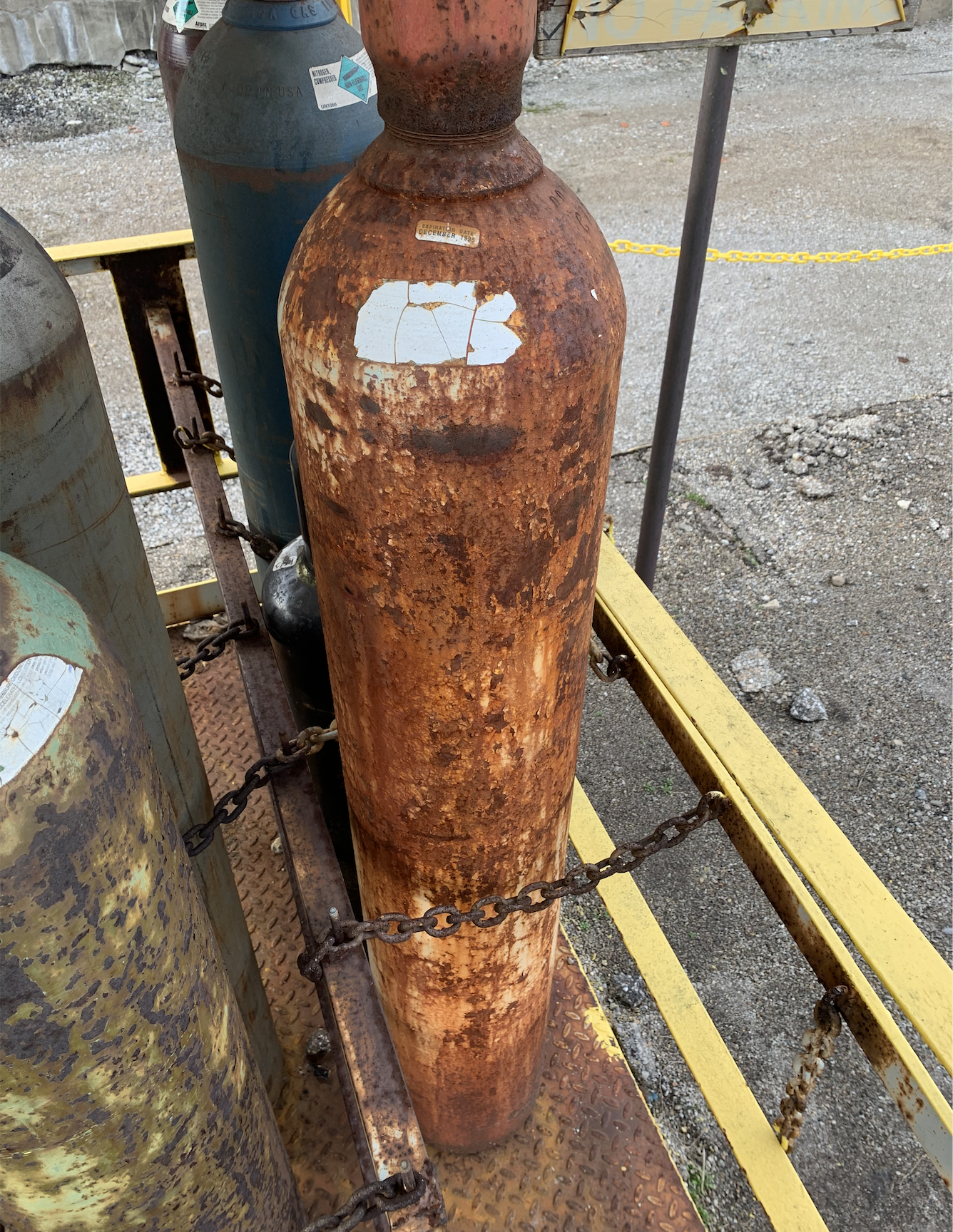
| 5503.9 Leaks, damage, and corrosion. Leaking, damaged, or corroded containers shall be removed from service. Leaking, damaged or corroded systems shall be replaced, repaired or removed in accordance with Section 5503.7. |
It should be self-explanatory, as it is just “common sense”. A failed attempt at some safety humor since our jobs are “just common sense”! But there is a good reason why this is written into code. Take, for example, this cylinder; so many things are wrong here, and yet the facility asked me to respond to the supplier’s concerns since they refused to refill the cylinder:
| 5503.10 Lighting. Where required, lighting, including emergency lighting, shall be provided for fire appliances and operating facilities such as walkways, control valves and gates ancillary to stationary containers. |
Another common sense item, but it reminds me of a fatality case I worked several years ago where an operator was doing his morning routine and reached inside a “dog-house” on the end of a CO2 tank and mistakenly opened the liquid fill valve, which was not protected by a check valve. He was killed when the force of the CO2 knocked him backward about 15′ and his head struck the pavement. The dog house had no interior lighting, and it was early morning.
Part II will cover Storage of Cryogenic Fluids, and Part III will cover Use and Handling. I hope to have these posted in the coming weeks.