
The client has approved this posting as they want to make sure others can learn from their incident. PLEASE discuss this incident with your teams if your LOTO practice(s) resemble theirs – what they did was VERY COMMON and I teach this method in all my LOTO courses at process plants. I have revised my training and written program as a result of this incident, and I hope many of you will do the same.
We were involved in an investigation regarding the release of HAZMAT during servicing and maintenance, and although the investigation was clear cut, the act that caused the release and injuries involved a VERY COMMON LOTO practice in the process industries. Have you ever seen a piece of equipment, say a very large compressor, that has dozens of isolation points locked out with the use of cable, isolation devices, and a SINGLE LOTO Lock?
In my career, this was very common, especially in Motor Control Centers during a unit shutdown/turnaround (SD/TA). We would throw all of the disconnects to the OFF/OPEN position and then run a cable (a substantial cable that required bolt cutters to remove) through all the disconnect handles. We would then join the two ends of the cable and place a SINGLE LOTO lock – this would/could lock out 100 electrical disconnects at the same time with just a single lock.
NOTE: Please read my other LOTO articles on the pros and cons of this type of LOTO, as when they all get LOTO’ed under the same lock, they will be started up at the same time, or you will have to jump through a million hoops, if you want to remove a disconnect from this system so it can be returned to service sooner!
Our incident involved this same practice, but the equipment was a huge compressor. When I say large, it is about 25′ long, 12′ tall, and 8′ wide. To isolate this compressor, 38 isolation devices and locks are needed. For years, the facility had used the cable practice successfully, which saved them a lot of time. There were 37 locks for use on other equipment that were also being worked on during the SD/TA.
But here comes a contractor along to mess everything up (poor joke!), and when it came down to it, the facility (and I) realized the contractor did NOT violate LOTO when he cut the cable. Think about it… he cut a cable…
Unfortunately, I am not allowed to share the pictures. Still, the company is allowing me to share what we have learned in the hopes that it will cause others to have this difficult discussion regarding historical LOTO practices in the process industries.
The work was on day 9 of a 12-day SD/TA, and they were expected to finish by the end of the 1st shift. So, word spread that the #2 compressor rebuild would finish early, which means the SD/TA would end early. Unit 1 compressor had been shut down, and ONLY the electrical part had been locked out to ensure it would not start up during the SD/TA. It had not been degassed either, which was against written policy and past practices, and this played a role in having the Cl2 available for release.
On day 10, a contractor crew member who usually does not work at the facility was assigned a task that involved them using one of the valves that had been locked out for rebuilding. The operator who issued the Safe Work Permits had understood that Compressor #2 was finished, and the unit was preparing to start both compressors up. The contractor radioed the operator and asked about a cable that was looped through a valve handle and wondered what it was for. Without going and looking, the operator asked the contractor if there was a lock or tag on the valve or cable. There was no lock or tag on the valve or the cable that was wrapped around the valve – that we all agreed to. The operator and contractor supervisor decided that it was NOT a LOTO, and therefore, it could be removed. They did not have bolt cutters, so instead, they removed the valve handle and slid off the cable. They then OPENED the valve, which was a cross-over valve between the two compressors, and this allowed Cl2 to migrate over from Compressor #1 and find an OPEN bleed/vent that had been used to verify a ZES for the LOTO. This release only involved 3 pounds of Chlorine but it was enough to cause a major alarm that involved off-site resources.
In our investigation, the facility had already removed the contractor from the property and the operator was suspended pending the outcome of the investigation. But since this was a PSM/RMP process, the contractor had to be involved in the investigation, as did the operator. Everyone was 100% honest in what happened and everyone accepted blame in the consequences, but in reality, we SHOULD NOT be performing complex LOTO’s in this manner.
EACH and EVERY isolation device in the field or in an MCC room needs to be identified as such. The facility’s new practice is to use a valve lockout device or some other type of isolation device so that EACH and EVERY isolation device is CLEARLY identified as such in the field and although the equipment is officially “locked out”, each location will now be tagged using the facility’s tagout tag such that it is communicated as to who applied the LOTO device and cable, when it was done, and why (i.e. job #, work order #, etc.).
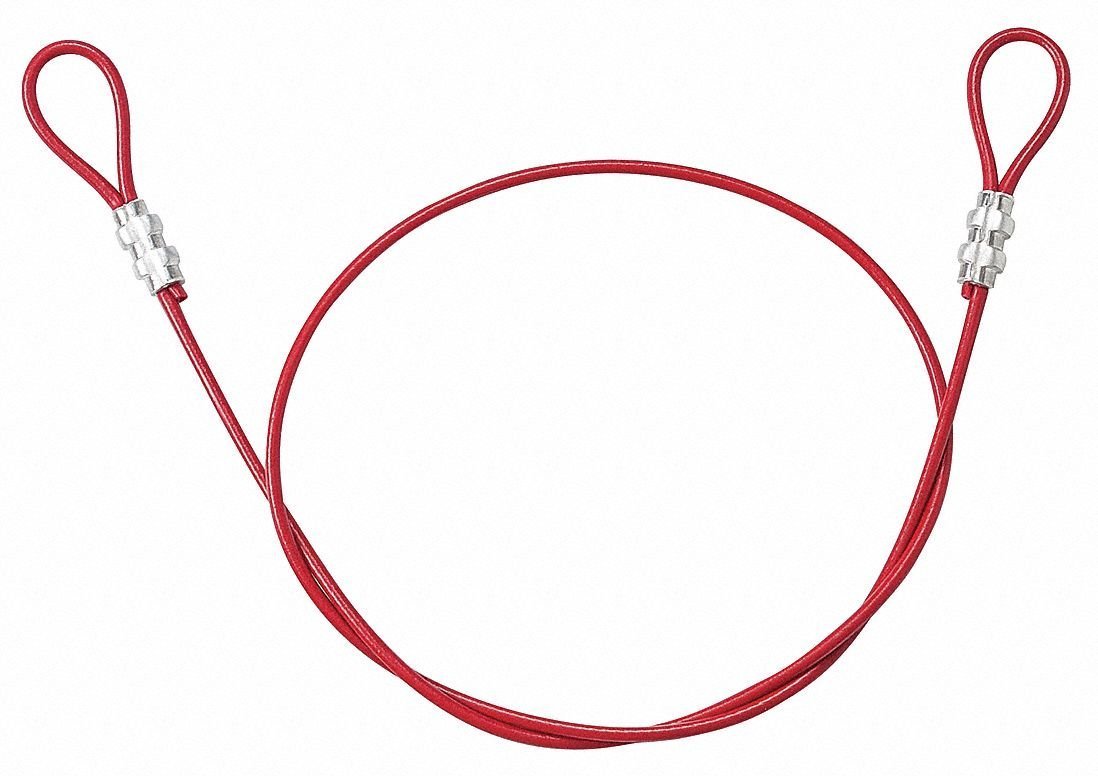
This is what the cable looked like, although the cable shown below is red in color, the cable used at this facility was just silver coated cable as shown in example photo #2 below it.

This is similar to what the contractor came across when he questioned the cable, but the lock shown in the picture was NOWHERE NEAR the valve the contractor needed to operate to do their work. See how the cable just loops through the valve with the orange handle? This is how all the isolation points looked on this compressor. The cable used for these compressors is 60′ long – it is an ergonomic hazard due to its weight!!!!! Nonetheless, I trained them on this practice, and they did exactly what they were trained on.

Now, I do not believe the red-colored device where the lock(s) are hung is adequate, as personnel would have to follow 60′ of cable to find the single lock locking the two (2) ends of the cable together.
I still believe in and will continue to teach these methods, just now that orange valve will have a clam-shell cover over it and the cable will pass through the openings of the clam-shell AND a LOTO tag will be attached and the cable loop. So the clam-shell is CLOSED, the cable runs through where a lock would go, and then the cable is looped and a tag hung on the loop so it is somewhat attached to the isolation device used. So, we are still using a single lock, but each isolation device will be clearly identified with an isolation device and a TAG that has the name of the LOTO owner, the date, and the purpose of the LOTO. I have even suggested that we use a COLORED CABLE that matches the LOTO Lock Color(s) chosen; in other words, if the LOTO locks are RED, then a red cable would be used, if the LOTO locks are yellow then a yellow cable would be used.
