
I have seen a cost savings trend that is increasing risks in a big way. It may seem minor to those who do not understand risk, but using a pressure cylinder without it being inspected and tested at its prescribed frequency is a serious safety miss. Usually, these risks are controlled somewhat when the facility has its cylinders filled by a competent 3rd party; notice I said “usually”, as we just learned of the tragic explosion in OH that claimed three lives was caused by a worker overfilling a cylinder that was decades past due for its requalification. But businesses that burn through a lot of cylinders each week have learned it’s much cheaper if they fill their own cylinders.
There is an entirely separate risk profile of having a bulk tank on site and filling cylinders than having the cylinders delivered. And of course, PPE, SOP, and training needs that go with these risks, which are almost always overlooked. So you end up with workers OVERFILLING PAST DUE cylinders such as the one below I found this week!
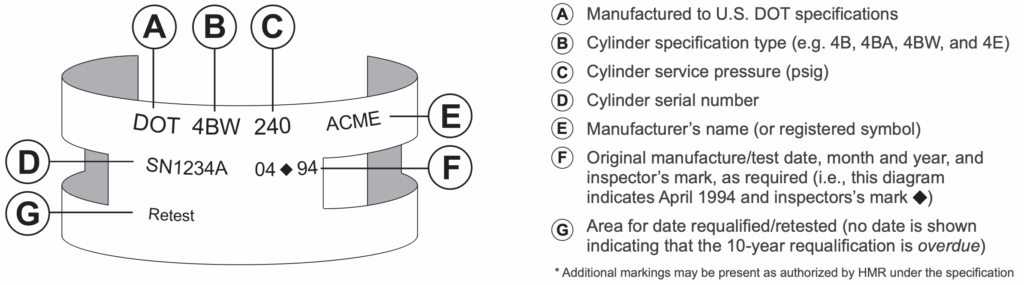
I caught some flak from the usual audience about how this is not a major problem because they had not experienced either of these failures before. I promise you, spend some time looking at the requal dates stamped into your cylinders, and you will begin to understand the depth and breadth of this problem. The same cylinder I found over-filled had this Requal Date stamped in it… (The cylinder was removed from service).
The cylinder below was manufactured in 11/98 and has never been requalified since. The frequency for this, for this type of cylinder, is at least every 10 years.

§ 180.209 Requirements for requalification of specification cylinders.
....
(e) Cylinders in non-corrosive gas service. A cylinder made in conformance with DOT Specifications 4B, 4BA, 4BW, or 4E protected externally by a suitable corrosion-resistant coating and used exclusively for non-corrosive gas that is commercially free from corroding components may be requalified by volumetric expansion testing every 12 years instead of every 5 years. As an alternative, the cylinder may be subjected to a proof pressure test at least two times the marked service pressure, but this latter type of test must be repeated every 10 years after expiration of the initial 12-year period. When subjected to a proof pressure test, as prescribed in CGA C-1 (IBR, see § 171.7 of this subchapter), the cylinder must be carefully examined under test pressure and removed from service if a leak or defect is found.
Source: https://www.phmsa.dot.gov/sites/phmsa.dot.gov/files/docs/propane_en_v3.pdf
