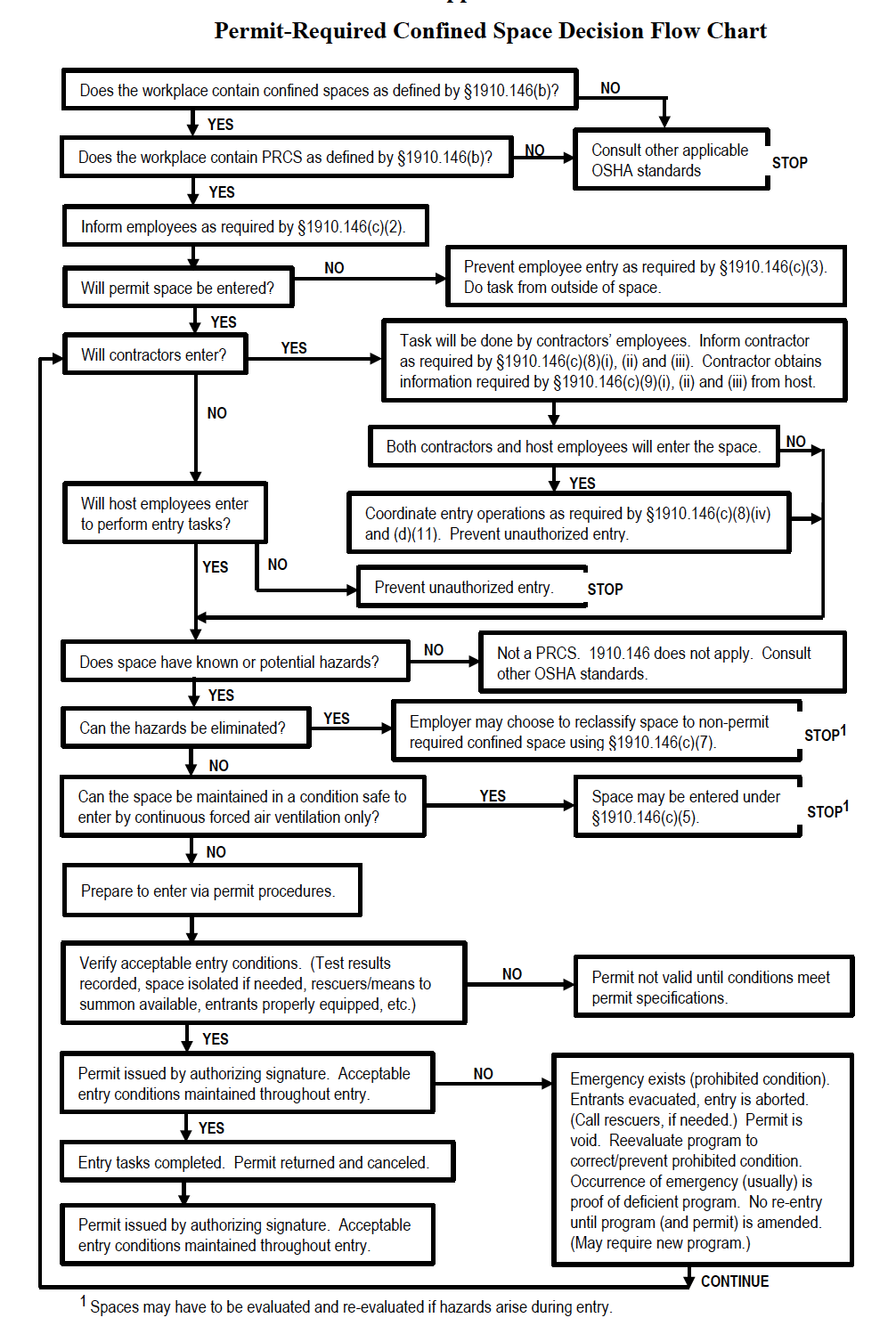
One of the most frequently asked about standards is OSHA’s Permit-Required Confined Space (PRCS) standard. The standard can be challenging to decipher, so this post attempts to break down an employer’s entry options. We should view the standard as offering three (3) entry options. Each option has its own set of rules and pros and cons.
Once a facility has completed its Confined Space/Permit-Required Confined Space evaluations, the employer must label those spaces deemed Permit-Required Confined Spaces (PRCS) AND decide if employees will enter these PRCS(s). If the employer decides their employees may enter one of these PRCS(s), they have three (3) entry options available to them. However, two (2) of these entry options have some significant limitations and apply ONLY to PRCS that meet strict criteria.
Option #1 is NOT ONE YOU SHOULD EVEN CONSIDER (in our opinion), but it is a legal option.
This option is for a PRCS that has ONLY ONE (1) CONFINED SPACE HAZARD, and that SINGLE PRCS hazard is a HAZARDOUS (even a POTENTIAL) ATMOSPHERE. If the employer can demonstrate that the HAZARDOUS ATMOSPHERE can be CONTROLLED using FORCED AIR VENTILATION to a SAFE LEVEL, this space would fall under 1910.146(c)(5). The employer MUST demonstrate that the ventilation taking place can maintain a safe atmosphere, as defined and quantified in the standard. We believe this means the employer has PREVIOUSLY used forced-air ventilation and atmospheric monitoring to document this capability BEFORE an actual human entry occurs. The pros to this, WHEN DONE 100% CORRECTLY, is that OSHA only requires that section (g) Training be completed; all other sections (d)-(k) are not required, which means no rescue provisions need to be in place.
PLEASE KNOW that (c)(5) was a carry-over from another OSHA standard, 1910.268 Telecommunications, and in my professional opinion, it has no place in 1910.146. But the powers to be at the time felt it was good enough for telecommunications workers to enter manholes and unvented vaults. But for those of us in typical workplaces with PRCS(s) that have pipes/tubing/hoses conveying hazardous materials to the PRCS AND/OR have agitators and/or augers within the PRCS would NOT qualify for using (c)(5) entry option. Please see my article Using 1910.146(c)(5) as your entry method into a Permit-Required Confined Space, which covers the PRCS standard preamble explanation for this limitation of (c)(5) entry option.
Option #2 is gaining popularity in many industries during shutdowns/turnarounds. It involves a space that has NO KNOWN or even a POTENTIAL HAZARDOUS ATMOSPHERE, AND ALL OTHER CONFINED SPACE HAZARDS have been ELIMINATED from the space.
If the space meets these criteria, the employer can use 1910.146(c)(7) to RECLASSIFY the PRCS to a NON-Permit Required Confined space. The pros to this, WHEN DONE 100% CORRECTLY, is that OSHA only requires that section (g) Training be completed; all other sections (d)-(k) are not required, which means no rescue provisions need to be in place.
A Couple of KEY POINTS regarding (c)(5) and (c)(7) options:
- The keywords in these options are CONTROLLED and ELIMINATED, which are drastically different.
- In (c)(5), we are ONLY CONTROLLING the hazardous atmosphere with the forced air ventilation, and in (c)(7), we are ELIMINATING all the non-atmospheric hazards.
- Depending on the level of risks (e.g., the type of hazardous atm), we feel that one layer of protection is INADEQUATE to protect entrants from the #1 cause of death in these spaces. Too many things could go wrong, and I discuss these failures in a separate article.
- In (c)(7), the employer is REQUIRED to document the steps taken to ELIMINATE the hazards that made the space a PRCS, who took these steps, and who verified their effectiveness. The documentation must have the name of the space, the date, how the hazards were eliminated, and who authorized the reclassification.
The 3rd and last option is for spaces with BOTH PHYSICAL HAZARDS and KNOWN OR POTENTIAL ATMOSPHERIC HAZARDS.
Entry into this type of space is a FULL PERMITTED ENTRY using all of the sections 1910.146 (d)-(k).