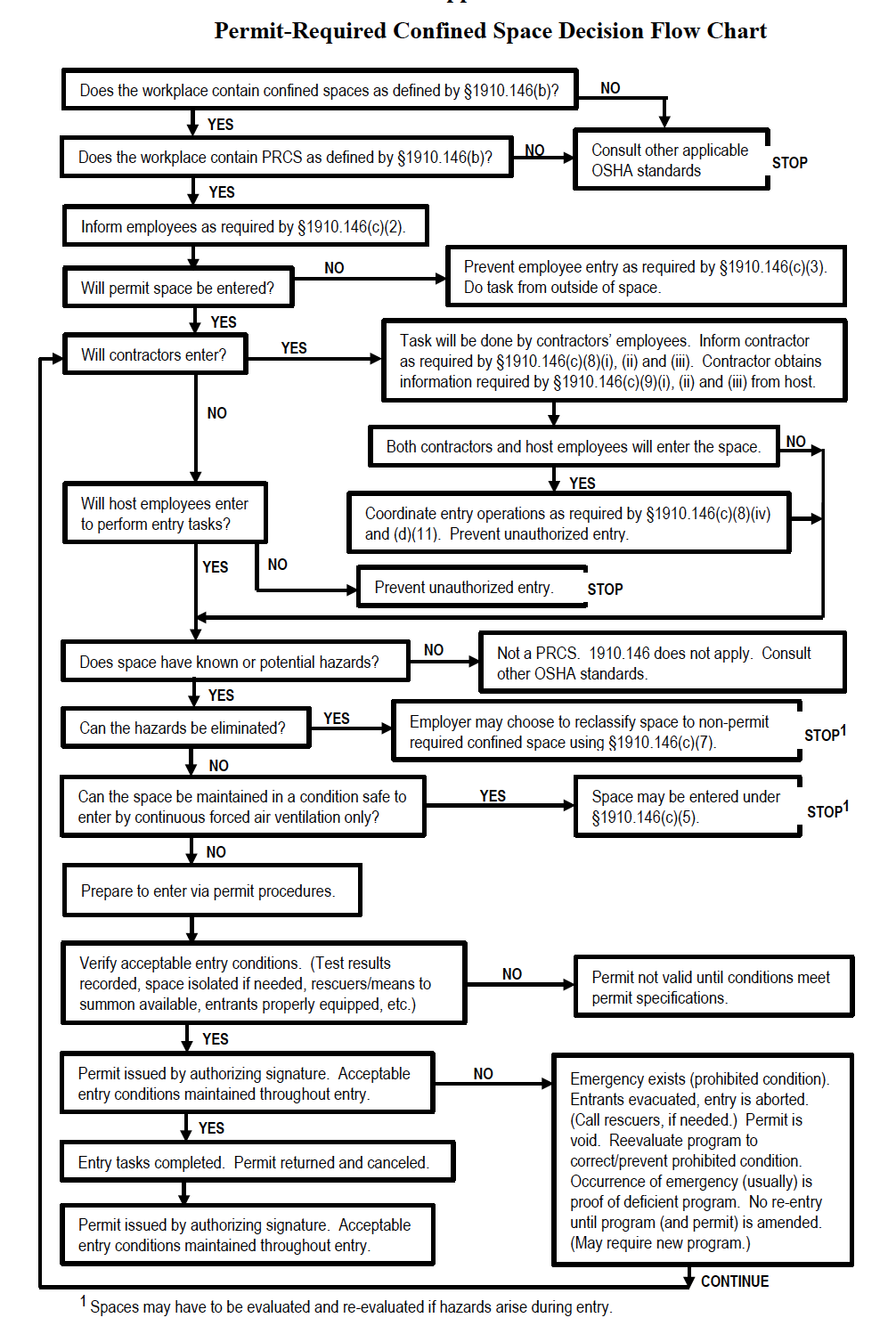
One of my favorite things about state plans… they often provide more insight into OSHA standards. Take for instance the state of WA OSHA’s, called Washington State Dept. of Labor & Industries, Safety Standards for Confined Spaces document. The state’s Construction standard on Confined Spaces closely mimics Federal OSHA’s requirements, but it is HOW the state’s standard is written that makes it a jewel. Following the State’s Governor executive order in 2005, the agency issued a new policy on “Plain Talk.” This meant the state’s OSHA standards are written in “plain talk,” and this is a MAJOR AID in helping understand the standard. So helpful, I often will read the state’s OSHA standard to get a better understanding of the Federal OSHA requirements; even when the state requirements may be more “comprehensive” than the federal standard(s). For example, here is part of the state’s Construction PRCS standard that came out in February 2018, explaining how to do the CS site evaluation…
Identification of Permit-Required Confined Space(s) involves a two-step process.
Step 1: Identify confined spaces.
Confined space. A space that is all of the following:
- Large enough and arranged so an employee could fully enter the area and work.
- Has limited or restricted entry or exit.
- Examples of spaces with limited or restricted entry are tanks, vessels, silos, storage bins, hoppers, vaults, excavations, and pits.
- Not primarily designed for continuous human occupancy.
See Appendix A Frequently Asked Questions and Examples of Confined Spaces by visiting the labor and industries web site at
http://www.lni.wa.gov/safety/rules/chapter/809/.
Step 2: Evaluate the actual and potential hazards of each confined space to identify the permit-required confined space(s).
Permit-required confined space or permit space. A confined space that has one or more of the following characteristics capable of causing death or serious physical harm
-
- Contains or has a potential to hold a hazardous atmosphere.
- Contains a material with the potential for engulfing someone who enters.
- Has an internal configuration that could allow someone who is entering to be trapped or asphyxiated by inwardly converging walls or by a floor, which slopes downward and tapers to a smaller cross-section.
- Contains any physical hazard. This includes any recognized health or safety hazards including engulfment in solid or liquid material, electrical shock, or moving parts.
- Contains any other recognized serious safety or health hazard that could either:
-
- Impair the ability to self-rescue; or
- Result in a situation that presents an immediate danger to life or health.
See Appendix B Examples of Permit-Required Confined Space Hazards by visiting the labor and industries website at http://www.lni.wa.gov/safety/rules/chapter/809/..
Here is WA-OSHA’s Safety Standards for Confined Spaces (pdf) document written in “plain talk.”