
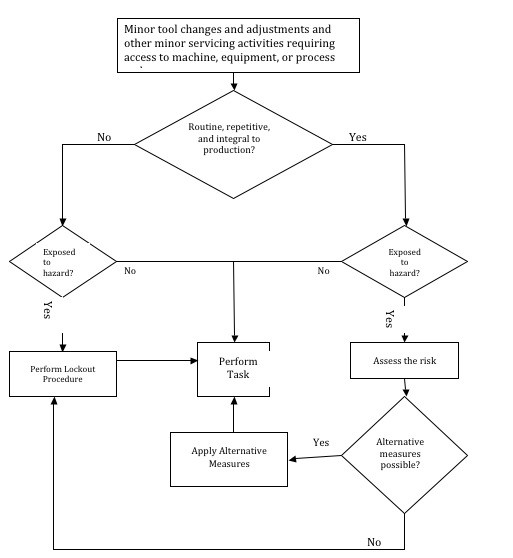
Control of Hazardous Energy Sources covers the servicing and maintenance of machines and equipment in which the unexpected energization or start-up of the machines or equipment or release of stored energy could cause injury to employees. (See Appendix A)
The Rule, 1910.1470(a)(2)(ii) reads:
“Normal production operations are not covered by the standard. Servicing and/or maintenance which take place during normal production operations are covered by this standard only when: An employee is required to remove or bypass a guard or other safety device; or An employee is required to place any part of his or her body into an area on a machine or piece of equipment where work is actually performed upon the material being proceeded (point of operation) or where an associated danger zone exists during a machine cycle.”
The exception to this paragraph reads:
“Note: Exception to paragraph (a)(2)(ii): Minor tool changes and adjustments, and other minor servicing activities, which take place during normal production operations, are not covered by this standard if they are routine, repetitive, and integral to the use of the equipment for production, provided that the work is performed using alternative measures which provide effective protection.”
We must apply a three-part test to see if the exception is applicable…
- Is the task a minor tool change or adjustment or minor servicing activity and,
- Is the task routine, repetitive, and integral to the use of the equipment, and
- Routine: The activity must be a regular course of procedure and be in accordance with established practices.
- Repetitive: The activity must be repeated as part of the production process or cycle.
- Integral: The activity must be inherent to the production process.
- Is the task performed using effective, alternative, protective measures?
NOTE: The exemption is intended to sustain the machine within the acceptable performance range and output quality. It is part and product oriented rather than repair orientated.
If the answers to ALL three of the questions above are YES, then the exception applies and the Lockout/Tagout standard does not.
The following questions will help determine if the task meets the first two parts of the test.
- How long does the task take?
- Is the task relatively minor in nature?
- Does the task involve no, or only minor, disassembly?
- Does the task frequently occur during the day, shift, or week?
- Does the task exist even when things are operating normally?
- Does the task occur on a regular, predictable basis?
- Does the operator normally perform the task?
- Is the task conducted using parts or tools readily available to the operator?
- Does the operator require specific training for this task?
- Does the task minimally interrupt the production process?
- What happens if the task is not performed?
If the answers to the questions above indicate that this task is a minor tool change, adjustment, or servicing activity and that it is routine, repetitive, and integral to using the equipment, you must decide if the task is performed using effective, alternative protective measures.
To do so, you must determine what measures are being taken. The following questions may be helpful in that regard.
- Are there established procedures for this task?
- Are the operator and other employees trained on this task?
- Are there other established energy control procedures for more involved tasks on this machine?
- Is the operator trained to know the difference?
- What control state is the machine put into?
- Is any other control input required? (Cycle Stop/Emergency Stop)
- What energy state does this leave the machine in?
- How does the operator verify this?
- How can the operator monitor the energy controls?
- What guards must be opened/removed?
- Are the guards interlocked?
- If interlocked, how are the interlocks integrated into the control system?
- Are any other energy control measures instituted? (Use of blocks, pins, or other devices)
- Is partial activation possible or necessary during the task?
- What steps must be followed to return the machine to operation?
Once you determine what procedures are followed, you must decide whether the procedures provide effective protection. The first step of this process is to ask the employer what risk assessment process was used in developing this procedure.
Employers must select the highest level of feasible controls(s) from the list below, with one being the highest level of protection. In many cases, the application of any SINGLE control measure is NOT adequate to provide effective protection for personnel. In these cases, it will be necessary to use a COMBINATION of measures.
- Eliminate the hazard through design.
- Lockout.
- Use of engineered safeguards techniques such as area scanners, guards, light curtains, pressure mats, presence sensing devices, or stop devices under the exclusive control of the operator.
- Use warning and alerting devices, including audible, visual devices, or barricades.
- Use of administrative controls such as safe work procedures, practices, and training.
- Use of personal protective equipment as appropriate to hazard.
Appendix A (Guideline)
Sample Risk Evaluation Process
1. Identify all tasks
Review all tasks and activities to determine those that may be considered minor tool changes, adjustments, and minor servicing activities.
2. Identify Hazards
Hazards, such as mechanical, electrical, thermal, pneumatic, hydraulic, radiation, residual or stored energy, motion, fuels, and human factors associated with each task shall be considered. Associated hazards for a particular task not related to hazardous energy release may also need to be reviewed. Hazard identification considered the potential for human error, management system deficiencies, and foreseeable improper use of equipment.
3. Assess the potential consequences
When assessing the severity of injuries to all persons that the hazards could harm, the most severe injury that can be expected to result from the exposure will be used to determine the protective requirements.
4. Assess the potential exposure to the hazards
Assess the potential exposure of all persons to the identified hazards. This assessment shall consider the nature, duration, and frequency of exposure to the hazards.
5. Assess the probability of occurrence
When determining the probability of occurrence of the hazardous event, include the following:
- Safeguards, safety devices, and safety systems either in use or to be used;
- Reliability, history, and potential for failure;
- Operational or maintenance demands of the task;
- Likelihood or defeat of safeguards;
- Accident history relating to the particular task, activity, machine, equipment, or process;
- The training, proficiency, and competence of all persons performing the task;
- The working environment.
6. Evaluate the risk
The information in 1 through 5 shall be evaluated for each identified hazard and task to determine the level of risk.
(See Figure/flowchart)

Source: www.dleg.state.mi.us/wsh/docs/inst/gishd_com_07_3.doc
