
Way back in 2015, I shared a practice I have used for most of my career, after working a major turnaround back in the 1990’s. And anyone who has worked a turnaround at a processing plant will certainly understand what I am trying to address with this practice. Bottom line, we should NEVER put the PRCS DANGER sign directly on the entry portal cover! This sets us up for having many OPEN and UNLABELED PRCSs. The revised drawing below is what I provide clients to include in their PRCS programs so they can avoid making this very common error. The drawing shows a tank with a manway attached to a davit arm, which can be swung out of the way, creating another potential blind spot for our DANGER sign.
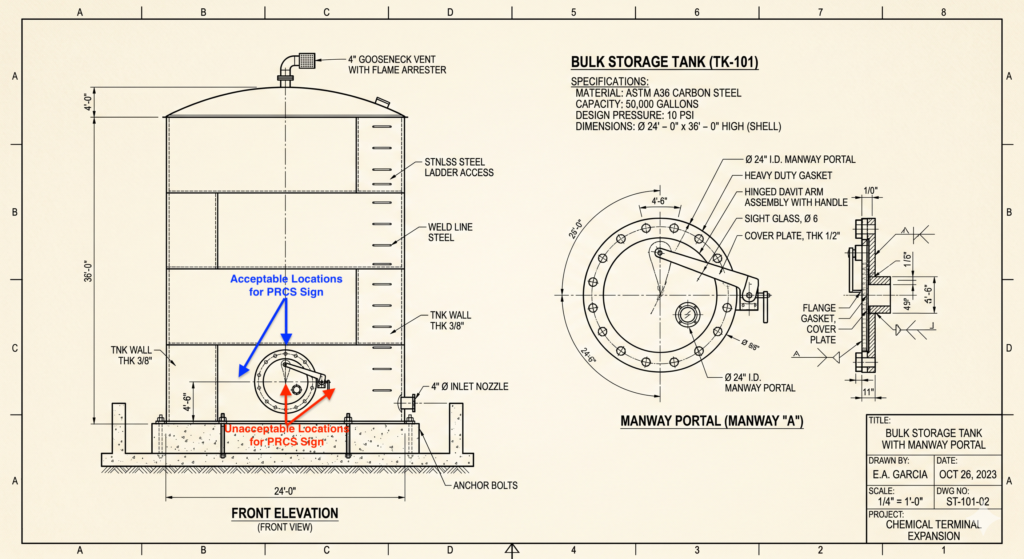
As shown above, we can apply our DANGER sign above the manway cover or to the left of it. But we should NOT apply the DANGER sign to the manway cover itself or to the right side of the manway, as that is where the davit will swing the manway cover.
I will say this, if your PRCS culture is MATURE and doing entries is a weekly activity at your facility and auditing results proove the facility achieves a high level of PRCS knowledge and practical skills, AND the davit arrangement allows for the manway cover to roate 360-degrees, placing the DANGER sign on the manway AND ensuring that the maway cover is postioned with the DANGER sign facing OUT and legible, then I would say we could apply the DANGER sign to the manway.
But 99% of the time, my program PROHIBITS the application of the DANGER sign in the “Unacceptable Locations” shown above.
Remember, when the space is OPEN, the DANGER sign MUST be visible as it is our primary means of preventing unauthorized entry. Some safety professionals subscribe to OSHA’s position that a PRCS need not be labeled at all if other means/methods are deployed to prevent unauthorized entry. I just do not subscribe to that method, as every facility I have audited in my career has failed miserably in trying to demonstrate that their other means/methods are “effective.” The simple test many fail is that a CLOSED process vessel, most will declare it a PRCS. But when we ask them about the “open skirt” under that vessel, most will NOT identify it as a CS, and many were actually PRCSs because the N2 feed passed through the skirt space.
So lesson learned… label ALL PRCS’s and how/where we label them MATTERS.