
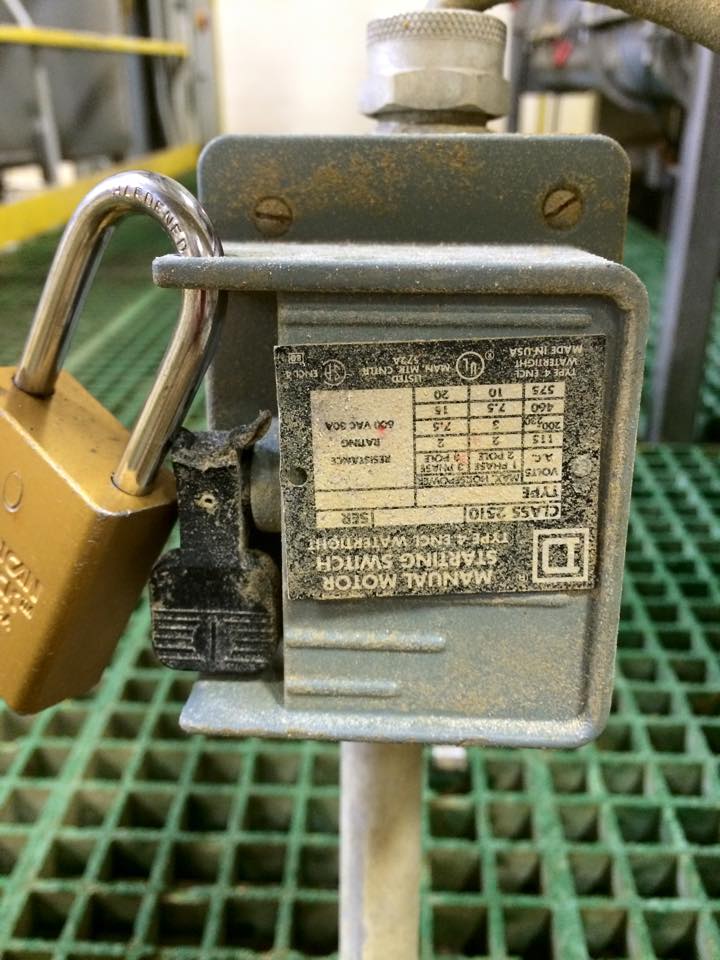
 If you spend enough time working on Lockout/Tagout (LOTO), you are bound to come across some crazy situations. Luckily I have some world-class clients who allow me to share my “interesting finds” and encourage me to share with all of you. This most recent find was at an OSHA VPP STAR site. We have been hired to do program-specific audits each quarter, with an emphasis on energy control. This means even though I may be auditing flammable liquids this quarter, I am ALWAYS auditing LOTO and conducting “periodic inspections” (and yes, I am an “authorized employee” within their LOTO program – I wrote it, wrote 99% of the machine-specific control plans, and still do all the LOTO training at the facility). For the most part, this facility KNOWS LOTO and LIVES IT DAILY; but we all have flaws – no one or no facility is perfect. Hence why we need LAYERS of PROTECTION in all our safety efforts. So today, I was making my rounds talking with everyone and came across one of the safety committee members who was cleaning a piece of equipment. He knew I was there to do an audit, as he had previously participated in many audits with me. He was PROUD and CONFIDENT of his ability to meet all LOTO requirements. But, the good will end there. Here is the image of his electrical isolation – do you see anything wrong?
The first isolation device was this broken electrical switch as we walked down his isolation. Now at first glance, some would say, “Switch off and lock applied,” and just move on. But look very closely and tell me with 100% certainty that this switch is LOCKED OUT. Remember, the definition of “Locked Out” is:
The placement of a lockout device on an energy isolating device, in accordance with an established procedure, ensuring that the energy isolating device and the equipment being controlled cannot be operated until the lockout device is removed.
Now take another look at this switch. Yes, it is OFF, and a lock has been applied, but there is ONLY half a switch present! The missing half makes the lockout lock virtually useless in preventing the switch from staying in the OFF position.
Now would OSHA cite this? I am not sure, but I can tell you this… this is IN NO WAY CLOSE to being acceptable in my LOTO program. I am also pleased to say that both the Safety Manager and Plant Manager (one of my former Plant Mangers) were both shocked that the workers missed this. As it turns out, the switch has been broken for months, meaning that all four shifts have been using this switch at least four times a day for that many months, and no one, even those supervisors who had done the three “audits” on this machine, identified.
The facility is currently doing a Nearmiss investigating and trying to understand how a facility that is so advanced in their LOTO and so fanatical about LOTO could allow this to happen for months with no one raising any level of concern. After all, as the PM walked away shaking his head, he summed it up well “Switch still works -the ON part is working just fine!”. His implication was that if the switch had gotten broken and the equipment could not be turned ON, it would have been reported by the end of the shift. He is probably right.
We all can grow and improve our safety culture. This is a good example of how “sweating the small stuff” can take your safety mindset to an entirely new level of safety expectations. By the time I left the facility today, every one of the safety committee members had heard about it and came by to see the setup and ask questions, as well as all the safety stewards and most of the supervisors from both shifts. I know most went back to their areas and began asking the right questions because my phone has not stopped ringing and the dozens of texts I have received from management and union officials thanking me and asking me a lot of questions – none of which have anything to do with “OSHA compliance” and ALL to do with worker safety regarding LOTO.
No one is being disciplined from this; this is a 100% LOTO learning opportunity. I commend the facility and the company, as the safety manager had already reported this as a “serious near-miss” to the corporate folks working on a “Lessons Learned” that will go out tomorrow.
Would your “authorized employee” have caught this as a LOTO failure? How about a “periodic inspection” – are you confident that your auditors would have recognized this?