
Have you ever seen a setup on a machine, typically those manufactured outside of the USA, with two (2) electrical disconnects?
Most of the time, these disconnects are COLOR-CODED to clearly identify their different uses, although we have seen some that were NOT color-coded, nor were they properly labeled! Here is an example of what this may look like; I have highlighted both switches with blue and red boxes…
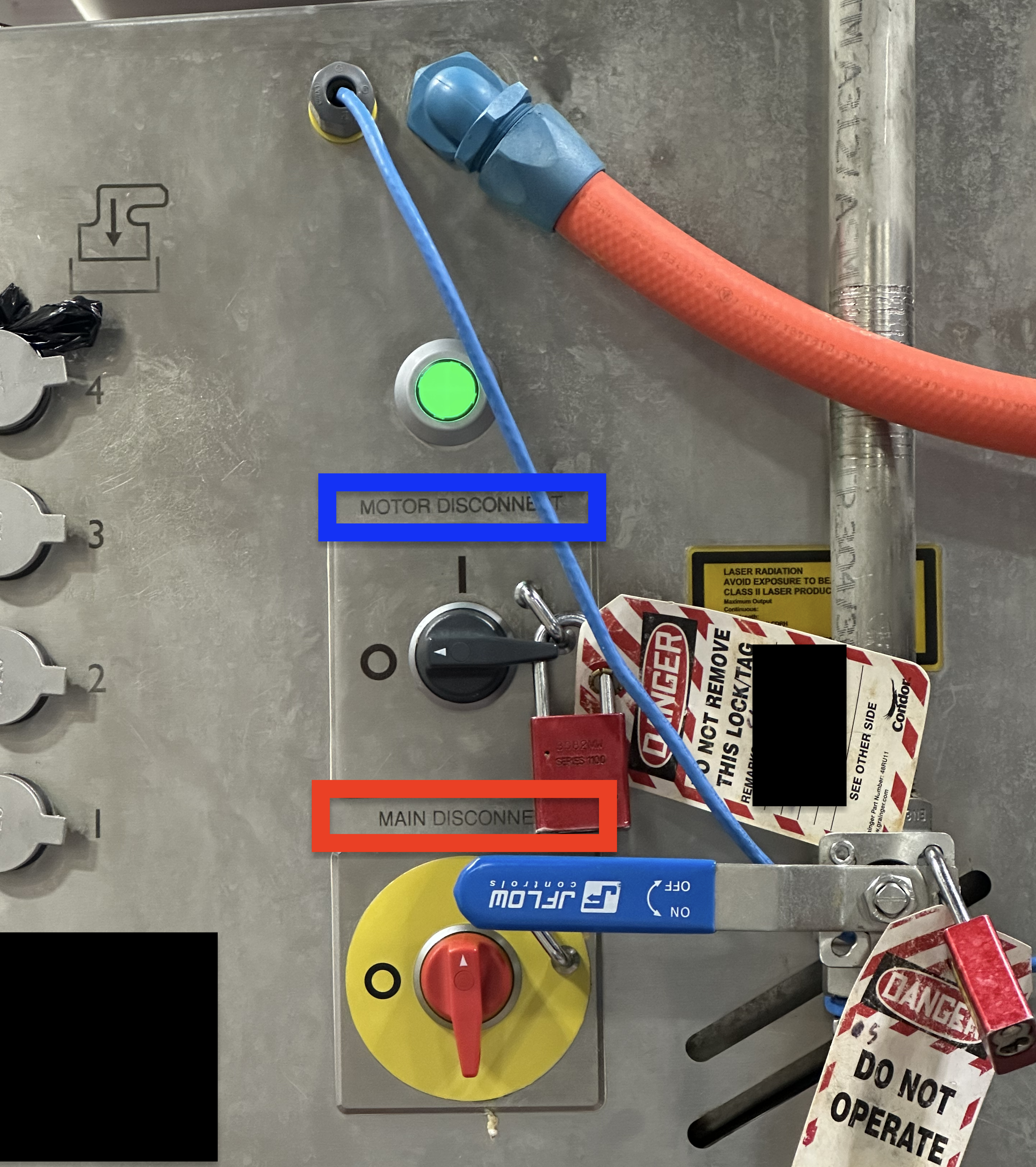
You may notice that they used the motor disconnect device in this example, and you can also notice that the green “power on” light above it is still illuminated.
As I spoke about in an earlier article this morning, the use of this device may be acceptable based on the SCOPE OF WORK being performed under this LO. But it is CRITICAL that the facility FULLY understand the use of this “motor disconnect” and the difference from using the “Main Disconnect,” as well as which SCOPES OF WORK can be performed under each disconnecting means.
We will not find much help from OSHA on this type of setup, so I turn to one of my favorite RAGAGEPs, NFPA 79: Electrical Standard for Industrial Machinery, specifically Chapter 5 – Incoming Supply Circuit Conductor Terminations and Devices for Disconnecting and Removing Power.
(emphasis by me)
|
NFPA 79
5.3 Supply Circuit Disconnecting (Isolating) Means. 5.3.1 General. The following general requirements apply to 5.3.2 through 5.3.5. 5.3.1.1 A supply circuit disconnecting means shall be provided for the following: (1) Each incoming supply circuit to a machine (2) The supply circuit to a feeder system using collector wires, collector bars, slipring assemblies, or flexible cable systems (reeled, festooned) to a machine or a number of machines (3) Each onboard power source (e.g., generator) 5.3.1.1.1* Each disconnecting means required by 5.3.1.1 shall be legibly marked to indicate the equipment it disconnects. 5.3.1.1.2 Where a machine is supplied by more than one supply circuit, a marking shall be installed at each supply circuit disconnect location denoting the location of all other supply circuit disconnects. 5.3.1.2 The supply circuit disconnecting means shall disconnect (isolate) the electrical equipment of the machine, including all control circuits, from the supply circuit when required (e.g., for work on the machine, including the electrical equipment). Circuits that are not required to be disconnected by the supply circuit disconnecting means shall comply with 5.3.5. 5.3.1.3 The supply circuit disconnecting means other than attachment plugs and receptacles shall be mounted within the control enclosure or immediately adjacent thereto. Exception: 5.3.1.4 Each supply circuit disconnecting means mounted within or adjacent to the control enclosure shall be interlocked with the control enclosure in accordance with 6.2.3. Where the supply circuit disconnecting means is not adjacent to the control enclosure, or where the supply disconnecting means is an attachment plug and receptacle, the control enclosure shall comply with 6.2.4 and a safety sign shall be provided in accordance with Section 16.2. 5.3.1.5 Where two or more disconnecting means are provided within the control enclosure for multiple supply circuits, they shall be grouped in one location where practicable. Protective interlocks for their correct operation shall be provided where a hazardous condition or damage to the machine or to the work in progress can occur. 5.3.2 Type. The supply circuit disconnecting device shall be one of the following types: (1) A listed motor circuit switch (switch disconnector) rated in horsepower (2) A listed, branch circuit rated, molded case circuit breaker (3) A listed molded case switch (4) An instantaneous trip circuit breaker that is part of a listed combination motor controller (5) A listed self-protected combination controller limited to single motor applications (6) An attachment plug and receptacle (plug/socket combination) for cord connection 5.3.3 Requirements. 5.3.3.1* Where the supply circuit disconnecting device is one of the types in 5.3.2(1) through 5.3.2(5), the device shall fulfill ALL of the following requirements: (1) Isolate the electrical equipment from the supply circuit and have one off (open) and one on (closed) position only. Circuit breakers, moldedcase switches, and self-protected combination motor controllers are permitted to have a reset (tripped) position between off (open) and on (closed). (2) Have an external operating means (e.g., handle) that complies with 5.3.4. Exception: (3) Be provided with a permanent means permitting it to be locked in the off (open) position only (e.g., by padlocks) independent of the door position. When so locked, remote as well as local closing shall be prevented. (4) Simultaneously disconnect all ungrounded conductors of the power supply circuit. (5) Be operable, by qualified persons, independent of the door position without the use of accessory tools or devices. (6) Be rated for the application as follows: (a) The ampere rating shall be at least 115 percent of the sum of the fullload currents required for all equipment that may be in operation at the same time under normal conditions of use. (b) Where rated in horsepower, the horsepower rating shall be at least equal to that which is defined by Table 430.151(B) of NFPA 70, National Electrical Code, for a locked rotor current equal to the largest sum resulting from the locked rotor currents of any combination of motors that can be started simultaneously and the fullload currents of the remaining motor and nonmotor loads that can be operated at that time. (c) The voltage rating shall be at least equal to the nominal supply circuit voltage. (7) The disconnecting means shall plainly indicate whether it is in the open (off) or closed position. 5.3.3.2* When the supply circuit disconnecting device is an attachment plug and receptacle (plug/socket combination), it shall fulfill all of the following requirements: (1) Have a loadbreak rating or be interlocked with a switching device that is loadbreak rated, and complies with 5.3.3.1(6). Attachment plug and receptacle (plug/socket combination) rated greater than 20 A or 2 hp shall be listed as a switchrated plug and receptacle (plug/socket combination). (2) Be of such a type and be so installed as to prevent unintended contact with live parts at any time even during insertion or removal of the connectors (3) Have a first make, last break grounding (earthing) contact (4) Have a retaining means to prevent unintended or accidental disconnection where rated at more than 20 amperes (5) Be located within sight from the operator station and be readily accessible 5.3.3.2.1 In addition to the requirements in 5.3.3.2, an additional switching device on the machine shall be provided for routine power switching operations of the machine on and off. 5.3.4 Operating Handle. 5.3.4.1 The center of the grip of the operating handle of the disconnecting means, when in its highest position, shall be not more than 2.0 m (6 ft 7 in.) above the servicing level. A permanent operating platform, readily accessible by means of a permanent stair or ladder, shall be considered the servicing level for the purpose of this requirement. 5.3.4.2 An operating handle of the disconnecting means required by 5.3.3.1 shall meet the following criteria: (1) Be readily accessible with doors in the open or closed position (2) Maintain the environmental rating of the enclosure to the degree necessary for the application when installed through the control enclosure (3) Not be restricted by the enclosure door when the door is in the open position 5.3.5 Excepted Circuits. 5.3.5.1 The following circuits shall not be required to be disconnected by the main supply circuit disconnecting means: (1) Lighting circuits for lighting needed during maintenance or repair (2) Attachment plugs and receptacles (plug and socket outlets) for the exclusive connection of repair or maintenance tools and equipment (e.g., hand drills, test equipment) (3) Under voltage protection circuits that are only used for automatic tripping in the event of supply circuit failure (4) Circuits supplying equipment that are required to remain energized for satisfactory operation [e.g., temperature controlled measuring devices, product (work in progress) heaters, program storage devices] 5.3.5.2 The supply circuits for excepted circuits shall be provided with all of the following: (1) A disconnecting means, isolating transformer, and overcurrent protection mounted in an enclosure adjacent to the main control enclosure or within the control enclosure, adjacent to the main supply circuit disconnecting means. (2) Line side (of the supply circuit disconnect) supply circuit conductors, when internal to the control enclosure, that are separate from and do not share a raceway with other conductors and that are encased in rigid or flexible conduit if longer than 460mm (18 in.) 5.3.5.3 The control interlocking circuits shall be capable of being disconnected at the control panel from which they are sourced. 5.3.5.4 Where circuits are not disconnected by the supply circuit disconnecting means, all of the following requirements shall be met: (1) Permanent safety sign(s) shall be placed adjacent to the supply circuit disconnecting operating handle(s) indicating that it does not deenergize all exposed live parts when it is in the open (off) (isolated) position as in 16.2.4. (2) A statement containing the information from 16.2.4 shall be included in the machine documentation. (3) A permanent safety sign shall be placed on a nonremovable part inside the control enclosure in proximity to each excepted circuit, or shall be identified by color as defined in 13.2.4. … 5.5 Devices for Disconnecting (Isolating) Electrical Equipment. 5.5.1 Devices shall be provided for disconnecting (isolating) electrical equipment to enable work to be performed when it is deenergized and isolated. 5.5.2 The supply circuit disconnecting device (see Section 5.3) shall be permitted to fulfill this requirement where there is no need for disconnecting individual portions of the electrical circuit. 5.5.3 Where it is expected that it will be necessary to work on separately operable parts of a machine, a disconnecting means shall be permitted for the electrical equipment of each such part of the machine requiring separate disconnection. 5.5.4 The following devices shall be permitted to fulfill the isolating function of 5.5.3: (1) Devices described in 5.3.2 (2) A manual motor controller marked “suitable as motor disconnect” and compliance with UL 508 where located on the load side of the last shortcircuit protective device (in the branch) (3) System isolation equipment that incorporates control lockout stations and is listed for disconnection purposes where located on the load side of the main supply circuit disconnecting means and overcurrent protection 5.5.5 Each operating means of the isolation devices in 5.5.4 shall be as follows: (1) Readily accessible and comply with 5.3.4 Exception: Switches and circuit breakers installed adjacent to motors, appliances, or other equipment that they supply shall be permitted to be accessible by portable means. (2) Within sight of the part of the machine requiring disconnection (3) Readily identifiable as an isolating means and marked to identify the equipment that is disconnected (4) For other than attachment plugs, provided with permanent means for locking in the off position only |