
In the 2027 edition of NFPA 30, the standard now provides a NEW schematic illustrating the spatial layout of hazardous (classified) locations for indoor areas with process equipment containing ignitible (flammable or combustible) liquids at pressures of 100 psig or less. I am not sure why they included this in NFPA 30 (Chapter 7) or why the new schematic differs from that in NFPA 497, but I will discuss this new schematic and other changes to NFPA 30 as they relate to HAZLOCs. It may be easier for some to understand the new view, but I wonder if NFPA 497 will be revised to reflect this new schematic.
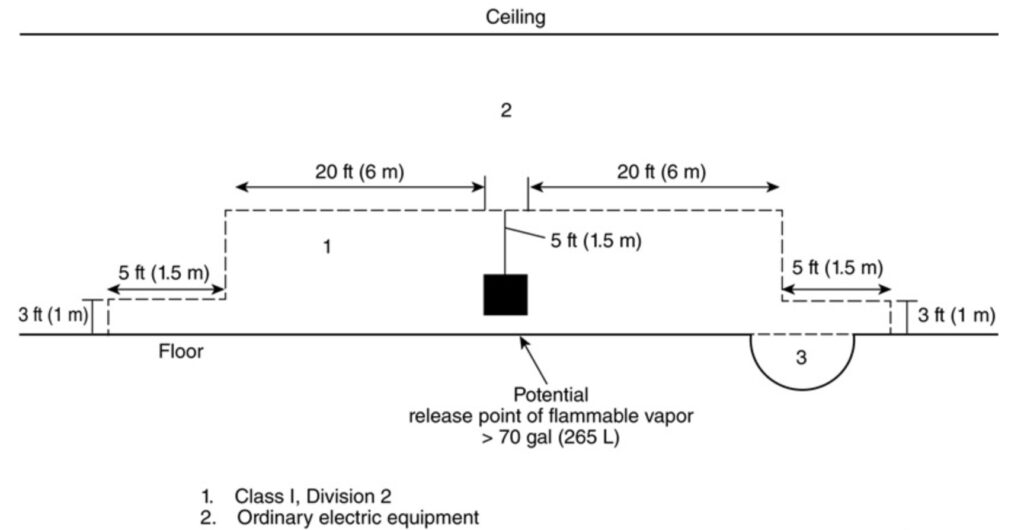
7.3.3.2 Figure 7.3.3.2(a) or Figure 7.3.3.2(b) shall be used to define the minimum spatial layout of hazardous (classified) locations for indoor areas with process equipment containing ignitible (flammable or combustible) liquids at pressures less than or equal to 100 psig (689 kPa).
| NFPA 30, Chapter 7 Electrical Ratings for Areas with Closed Equipment | NFPA 30, Chapter 7 Electrical Rates for Areas with Open Equipment |
 | 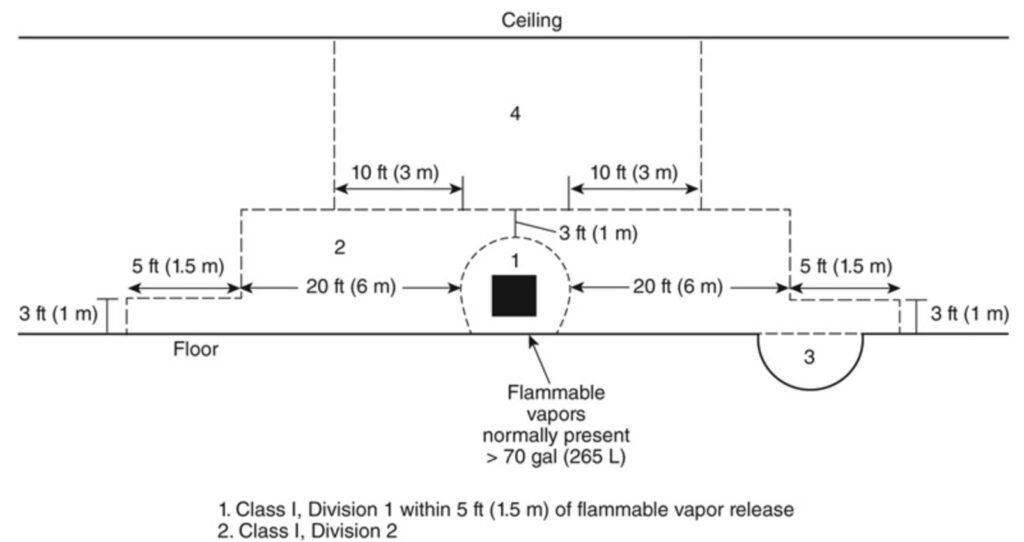 |
| NFPA 497 Figure 5.10.1(c) Leakage Located Indoors, at Floor Level. Adequate ventilation is provided. The material being handled is a flammable liquid | |
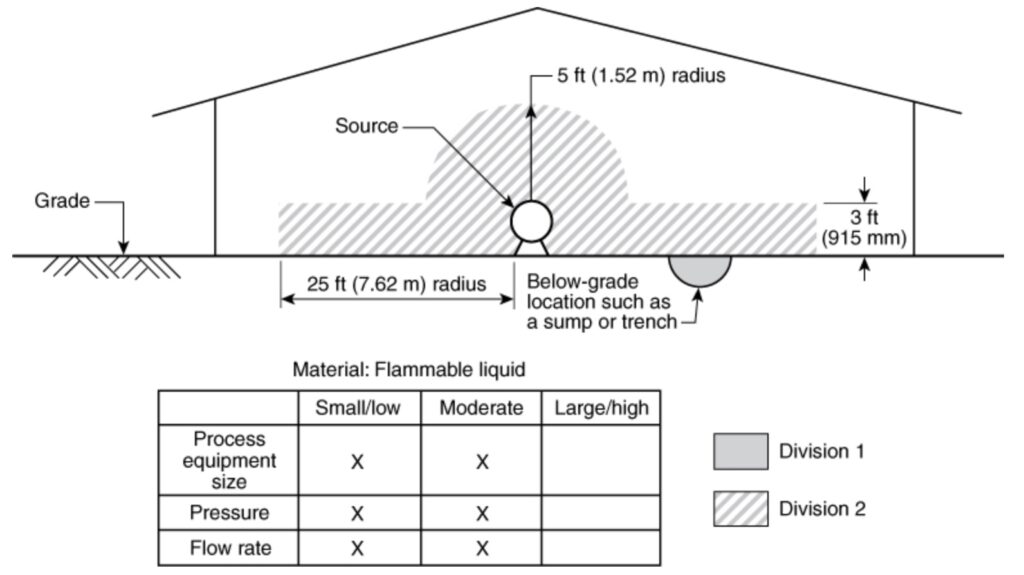 |
We can see that “below grade areas” are still Div 1 areas. But when we look at the 497 schematic, we see the 5′ bubble around the leak point, then the HAZLOC drops to 3′ height and extends another 20′, for a total distance of 25′.
But in the NFPA 30 schematic, this seems to be flipped on its head. Meaning the NFPA 30 schematic has the 5′ bubble (no longer shown as a “bubble”) extending out to the 20′, then it drops to the 3′ height for the last 5′.
NFPA 30, Chapter 7, does NOT differentiate between an area that has “Adequate Ventilation” (e.g., 1 cfm per square foot of floor area (0.3 m3/min/m2) and one that is not adequately ventilated, as we find in NFPA 497.
NFPA 30, Chapter 7, states the following areas shall be considered unclassified locations:
(1) Areas around all-welded piping systems with NO flanged, threaded, or mechanical joint connections.
(2) Dedicated storage rooms or warehouses with NO OPEN containers or ignitible (flammable or combustible) liquid handling operations where explosion hazards are not present as determined by the evaluation in 6.4.1.2.3.
(3) Areas extending beyond a floor, wall, roof, or other solid partition that has no openings within the classified area.
This is the verbiage from NFPA 497 for those areas where electrical classification is not normally needed:
5.5.1 Experience has shown that the release of ignitible mixtures from some operations and apparatus is so infrequent that area classification is not necessary. For example, it is not usually necessary to classify the following locations where combustible materials are processed, stored, or handled:
(1) Locations that have adequate ventilation, where combustible materials are contained within suitable, well-maintained, closed piping systems
(2) Locations that lack adequate ventilation, but where piping systems are without valves, fittings, flanges, and similar accessories that may be prone to leaks
(3) Locations where combustible materials are stored in suitable containers
(4) Locations where the use of combustible liquids, or flammable liquids or gases, will not produce gas or vapor sufficient to reach 25 percent of the lower flammable limit (LFL) of that combustible material
Notice that NFPA 30 specifies that the piping must be ALL welded, with no flanged, threaded, or mechanical joints, rather than NFPA 497’s reference to “well-maintained, closed piping systems“.
The 2027 edition of NFPA 497, 5.7.4 does mention flanges and screwed connections … These in turn present sources of leaks such as flanged and screwed connections, fittings, valves, meters, and so forth. Thus, considerable judgment will be required to establish the boundaries of Division 1 and Division 2 or Zone 0, Zone 1, and Zone 2 locations
NFPA 30, Chapter 7, permits “pressurized enclosures” for electrical equipment, but makes no mention of NFPA 496, Standard for Purged and Pressurized Enclosures for Electrical Equipment
7.3.4* Where the provisions of 7.3.1 through 7.3.3.4 require the installation of electrical equipment suitable for Class I, Division 1 or 2; or Zone 1; or Zone 2 locations, ordinary electrical equipment, including switchgear, shall be permitted to be used if it is installed in a room or enclosure that is maintained under positive pressure with respect to the classified area.