
Fire Codes mean something… at least in our world of occupational safety and health. As I was entering a restaurant for dinner, I am checking out my environment and what do I see but two (2) dewars of Nitrogen in some kind of “float spa”. This was in a “strip mall” type setting so of course, my curiosity got the best of me. Nitrogen is one of those chemicals many of us have become all too familiar with due to its vast uses in industrial settings and thus in most industrial applications, this cryogenic asphyxiant is respected and managed properly. But a spa in a strip mall… well let’s just say that between the three (3) of us we had a long list of concerns based merely on what you see here…
These two dewars are sitting right at the front door and as most strip mall units, there are two (2) exits: one at the entrance and one at the rear of the unit. How many concerns/questions would you have as the AHJ doing an inspection?
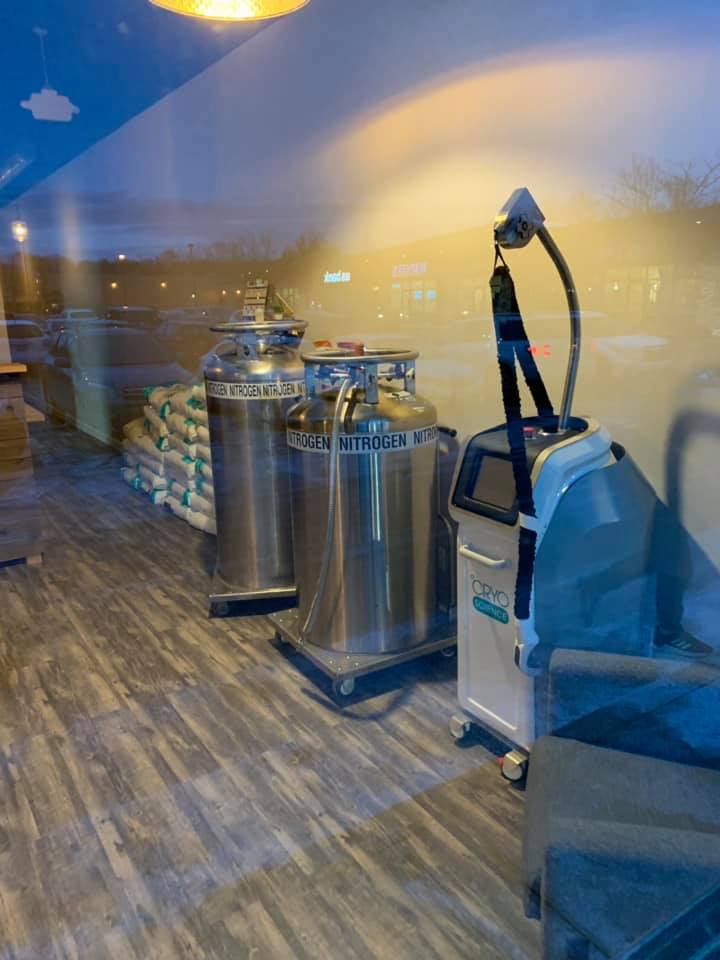
Using the OH Fire Code here are the basics that we would have inquired about:
5503.3 Pressure relief vent piping. Pressure relief vent-piping systems shall be constructed and arranged so as to remain functional and direct the flow of gas to a safe location in accordance with paragraphs (C)(3)(a)(5503.3.1) and (C)(3)(b)(5503.3.2) of this rule.
5503.3.2 Arrangement. Pressure relief device vent piping and drains in vent lines shall be arranged so that escaping gas will discharge unobstructed to the open air and not impinge on personnel, containers, equipment and adjacent structures or enter enclosed spaces. Pressure relief device vent lines shall be installed in such a manner to exclude or remove moisture and condensation and prevent malfunction of the pressure relief device because of freezing or ice accumulation.
Notice that the RV’s would discharge into the workspace of the spa.
5503.4.1 Identification signs. Visible hazard identification signs in accordance with NFPA 704 as listed in rule 1301:7-7-80 of the Administrative Code shall be provided at entrances to buildings or areas in which cryogenic fluids are stored, handled or used.
There were no NFPA 704 Diamonds on either the front door or the rear door to this unit.
5503.5.1 Security of areas. Containers and systems shall be secured against unauthorized entry and safeguarded in an approved manner.
5503.5.2 Securing of containers. … Portable containers subject to shifting or upset shall be secured. Nesting shall be an acceptable means of securing containers.
Note the lack of securing these dewars (on wheels mind you!) nor is “tampering” prevented with this method of storage.
5504.2 Indoor storage. Indoor storage of containers shall be in accordance with paragraphs (D)(2)(a)(5504.2.1) to (D)(2)(b)(iii)(5504.2.2.3) of this rule.
5504.2.1 Stationary containers. NOT APPLICABLE
(i) 5504.2.1.1 Containers. NOT APPLICABLE
5504.2.2 Portable containers. Indoor storage of portable containers shall comply with the provisions applicable to the type of fluid stored and paragraphs (5504.2.2.1) to (5504.2.2.3) of this rule.
5504.2.2.1 Containers. Portable containers shall comply with paragraph (5503.1) of this rule.
5504.2.2.2 Construction of indoor areas. Cryogenic fluids in portable containers stored indoors shall be stored in buildings, rooms or areas constructed in accordance with the building code as listed in rule 1301:7-7-80 of the Administrative Code.
5504.2.2.3 Ventilation. Storage areas shall be ventilated in accordance with the mechanical code as listed in rule 1301:7-7-80 of the Administrative Code.
The unit may indeed have the proper ventilation; however, nothing of the sort is visible in the area where these dewars sit at the time of the photo.
5505.4.1.1 Ventilation. Indoor areas where cryogenic fluids are dispensed shall be ventilated in accordance with the requirements of the mechanical code as listed in rule 1301:7-7-80 of the Administrative Code in a manner that captures any vapor at the point of generation.
And for those who ask the obvious question… “What if the containers are empty?” As I have said many times, NEVER assume compressed gas cylinders are empty until we have verified they are 100% empty. Note the last sentence of the “scope” of this section of the code…
5501.1 Scope. Storage, use and handling of cryogenic fluids shall comply with this rule and NFPA 55 as listed in rule 1301:7-7-80 of the Administrative Code. Cryogenic fluids classified as hazardous materials shall also comply with the general requirements of rule 1301:7-7-50 of the Administrative Code. Partially full containers containing residual cryogenic fluids shall be considered as full for the purposes of the controls required.