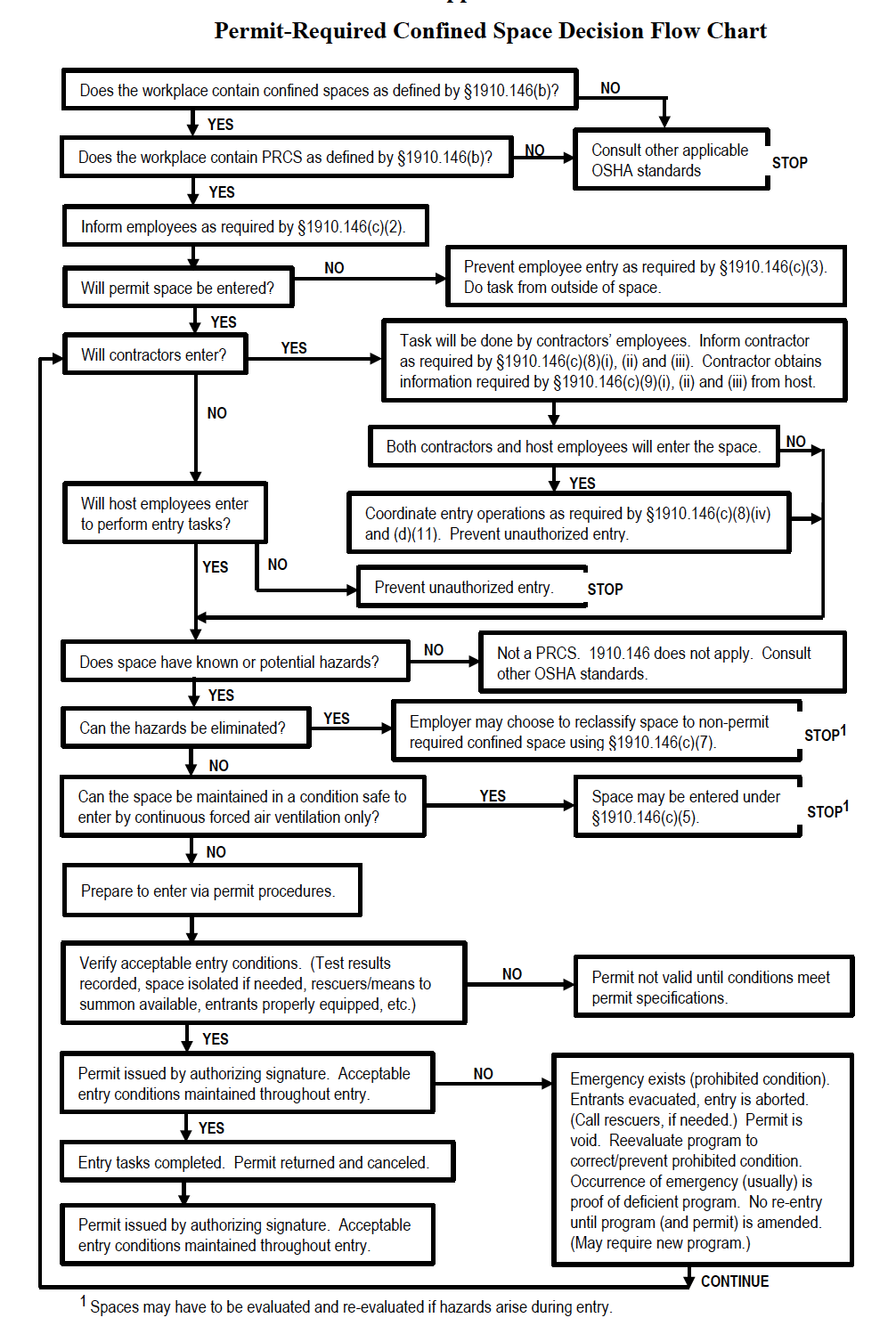
Most of the permit-required confined space standard requirements are in place to ensure that employees can safely enter and work inside permit spaces.
- The hazards within the space MUST be eliminated or controlled BEFORE entry is allowed.
- Testing and monitoring MUST be performed in order to ensure that entry conditions are acceptable before entry and that they remain so during the entire entry operation.
- Authorized entrants, attendants, entry supervisors, and others with duties performed under section 1910.146 MUST be trained to perform those duties safely and to recognize permit space hazards if they arise.
- Attendants MUST be stationed outside the space to keep unauthorized persons out of the space and to monitor the status of entrants to ensure (among other things) that hazards do not arise and that employees are evacuated quickly if they do.
Unfortunately, despite all these precautions, hazards may arise so quickly or unexpectedly that authorized entrants cannot escape from the permit space without assistance. 1910.146(k) addresses the rescue and emergency services needed in such an event.
Paragraph (k) of the final rule sets requirements for the rescue and emergency services provided to comply with paragraph (d)(9).
(d)(9) Develop and implement procedures for summoning rescue and emergency services, for rescuing entrants from permit spaces, for providing necessary emergency services to rescued employees, and for preventing unauthorized personnel from attempting a rescue;
Compliance with these provisions will enable an employer to extricate authorized entrants from permit spaces where uncontrolled hazards have arisen and will maximize the likelihood that any extricated personnel are not killed or permanently injured by exposure to permit space hazards. OSHA recognizes that an employer whose permit space program complies with this section may never need to have authorized entrants rescued. However, permit space hazards could arise in permit spaces during entry operations against which the other elements of the permit space program do not provide sufficient protection. This could occur in several ways – because of extraordinary circumstances that appear suddenly without warning or because of some deficiency in the permit space program. Accordingly, OSHA has determined that employers MUST include the means to rescue authorized entrants in their permit program.
In an emergency, rescue personnel would either
- enter a permit space to remove authorized entrants or
- would remain outside the permit space and pull out authorized entrants with retrieval lines attached to chest or full body harnesses worn by the entrants.
OSHA simply requires that, whatever means are chosen, the employer arrange the necessary rescue and emergency services. OSHA anticipated that employers will choose between entry and non-entry rescue as part of compliance with paragraph (d)(9) of the final rule.
The introductory text of paragraph (k) REQUIRES employers to arrange for rescue and emergency services. Some employers may prefer to establish an on-site rescue service. The on-site service normally provides the fastest response in an emergency. Other employers may prefer to rely on off-site rescue services, perhaps because they believe that they do not have the resources to train employees to perform rescue or because the ready availability of an adequate off-site rescue service makes an on-site capability unnecessary. The final rule allows employers to make arrangements for either on-site or off-site services.
The term “rescue team” is a misnomer because there could be cases, such as when non-entry rescue systems are used, in which one person will be responsible for rescuing authorized entrants. OSHA treats all rescue services alike, whether they are provided by the employer whose permit space is being entered or by another employer and whether they are stationed on-site or off-site.
In response to many comments during the rule-making, OSHA solicited testimony and comments regarding the use of outside rescue teams in Issue 12 of the hearing notice. In the hearing notice (54 FR 41463), OSHA noted that atmospheric hazards which deprive authorized entrants of a safe air supply generally pose life-threatening situations after about five minutes, though some hazards incapacitate or kill even faster. Some hearing participants recognized the problems faced by small employers in training and maintaining on-site rescue teams (Ex. 69, 106; Washington Tr. 286, 480-481; Chicago Tr. 318-319, 536). They argued that it was not always practical for such employers to train employees at the worksite in rescue techniques.
OSHA believes that the need to respond as quickly as possible to an emergency within a permit spaces indicates a preference for on-site rescue teams wherever it is practical for the employer to provide a rescue capability. The response times of on-site rescuers will usually be much shorter than those for typical off-site rescue and emergency services. Unfortunately, the response of on-site teams is not always sufficient to ensure to rescue of entrants within the 4 minutes acknowledged as the goal for the successful rescue of entrants overcome by oxygen deficiency(33). Additionally, the Agency realizes that some employers (small business employers in particular) will not be able to provide the type of in-house rescue expertise required by the final standard. Furthermore, because they are dedicated to responding to all types of medical emergencies, off-site rescue services are typically better equipped to treat injured employees.
__________
Footnote(33) OSHA realizes that oxygen deficiency is not the only hazard faced by authorized entrants, through, as noted earlier, it is the leading cause of death of permit space entrants. Some hazards will require a quicker response in order to save the entrant, other hazards need not be responded to as quickly. OSHA does believe that a 4-minute time limit on removing an incapacitated entrant from a permit space should be the goal of every rescue plan.
In light of the fact that even the best rescue methods can barely respond to an emergency or retrieve an incapacitated employee from a permit space within 4 minutes and that many cannot respond that quickly, OSHA believes that it is simply not reasonable for the Agency to require employers to develop capability to provide rescue within 4 minutes of an emergency alert, regardless of cost or practicality. More importantly, OSHA is concerned that requiring employers to provide any set response time would encourage the attempted rescue of entrants before all precautions necessary to ensure the safety of rescue personnel were taken. The Agency believes that emergency conditions may induce rescuers (especially those who are not full time rescuers) to rush into the permit space, in spite of the training required under the final rule. Considering that the incident data in the record document that most of those killed in permit space entries are would-be rescuers, the Agency believes that the final rule should stress non-entry rescue methods and provisions for the safety of rescue personnel rather than the time for such personnel enter a permit space and to remove an entrant.
For these reasons, OSHA has taken several actions.
- The Agency has carried forward the proposal’s acceptance of both on-site and off-site rescue services. The employer whose employees enter permit spaces must arrange for rescue and emergency services to be provided.
- The final rule incorporates a provision for employers providing rescue services to equip and train the rescue personnel properly. This provision applies equally to employers who provide rescue services for their own entrants and to employers who provide rescue services for other employers’ authorized entrants.
- OSHA has incorporated a provision requiring employers to provide retrieval systems or methods whenever an authorized entrant enters a permit space, unless the employer can demonstrate that the retrieval equipment would increase the overall risks of entry or that it would not contribute to the rescue of the entrant.
OSHA believes that these actions will help to ensure the safe and effective rescue of injured employees and will also provide flexibility for employers to choose the type of rescue service that best meets the demands of the workplace. OSHA acknowledges that the rescue provisions will not ensure that all incapacitated entrants will be successfully rescued from permit spaces. However, OSHA believes that prevention of emergencies in permit spaces is the most effective approach to this problem. The basic thrust is to require the employer to plan for entries into permit spaces and to provide for acceptable entry conditions, in order to minimize the chances that emergency conditions will arise during entry. OSHA further believes that when rescue is necessary, the rescue provisions of the final rule ensure the safety of employees performing rescue duties. This is particularly important in light of the accident data in Exhibit 13-16, which indicate that more would-be rescuers have been killed than entrants.
Paragraph (k)(1) of the final rule sets requirements for rescue services. These provisions apply to any employer who has employees enter permit spaces to perform rescue duties. OSHA believes that it is important to protect employees who enter permit spaces to perform rescue duties regardless of who their employer is. OSHA applies the provisions to all employers providing rescue services. The Agency has determined that this action is necessary to provide protection for employees of outside rescue services as well as those of in-plant rescue teams.
Paragraph (k)(1)(i) requires the employer to ensure that personnel assigned as rescuers are equipped with, and trained to use, all personal protective equipment and rescue equipment necessary to enable them to enter and perform rescue operations in the employer’s permit required confined spaces.
Paragraph (k)(1)(ii) requires the members of the rescue service to be trained to perform their assigned rescue duties. They are also required to receive the training required of authorized entrants under paragraph (g).
Paragraph (k)(1)(iii) of the final rule requires rescuers to practice making permit space rescues at least once every 12 months, by means of simulated rescue operations in which they remove dummies, manikins or actual persons from the actual permit spaces or from representative permit spaces. Representative permit spaces must, with respect to opening size, configuration, and accessibility, simulate the types of permit spaces from which rescue is to be performed.
The Agency agrees that the language of the proposal did not account for the wide diversity of types of rescue services covered by the final rule. While some rescue services have ready access to the actual permit spaces or to exact replicas of the permit spaces for practice, others do not. OSHA does not believe that it is always appropriate for employers to make the actual permit spaces safe for entry simply to allow the rescue service to practice. (Of course, if the space must be made safe for entry for other reasons, practice could be scheduled as part of the entry operation.) On the other hand, OSHA has determined that rescue service personnel must develop and maintain familiarity with the types of permit spaces from which rescue may be required.
For these reasons, the final rule recognizes practice in actual permit spaces or in representative spaces that simulate (rather than “closely approximate”) the permit spaces to be entered. In this way, the rule would not require multiple practice sessions for different permit spaces with similarly sized and configured openings. The rule anticipates that there will be variations between similar permit space openings. Additionally, the rule allows outside rescue services to practice in representative spaces that simulate the permit spaces they might have to enter. Thus, these services would not be required to visit every permit space every year, as long as practice rescue are conducted in representative spaces sometime during the year. It is important that the practice openings resemble those of the actual spaces, especially in means of access and egress. Otherwise, as noted earlier, the rescue service members may find that they have trouble getting into the space wearing personal protective equipment and carrying rescue equipment. In applying this rule, the Agency expects employers to conduct practice sessions using representations of the types of permit spaces the rescue service is expected to enter if the actual spaces are not available for entry. The final rule facilitates practice by outside rescue services by requiring the “host” employer to provide access to the permit spaces for planning and practice purposes.
OSHA disagrees with a commenter who stated that it was sufficient to require simply that employers train rescue teams to meet their goals. The Agency believes that the training requirements in paragraphs (k)(1)(i) and (k)(1)(ii) of the final rule do not, on their own, adequately ensure that the personnel assigned to perform rescues can function properly. OSHA believes that a periodic demonstration of the on-site rescue service’s ability to extract authorized entrants from permit spaces will provide the necessary feedback regarding the adequacy of the rescue equipment, the rescue procedures and the training provided for performance of rescue from permit spaces.
The language incorporated in paragraph (k)(1)(iii) allows the satisfactory performance of one or more actual rescues during the 12-month period to substitute for a practice rescue from a given space. (Practices in other types of spaces would still be required.) OSHA has previously recognized in other standards (such as section 1910.120, Hazardous waste operations and emergency response) that actual experience at a particular task is at least as valuable as a practice session or other type of training. It should be noted that the unsatisfactory performance of a rescue indicates the need for further training and does not substitute for a practice rescue. The intent of this exception is that if the rescuers performed their assigned tasks in a satisfactory manner, they need not perform a practice rescue for that 12-month period, regardless of the outcome of the rescue attempt. OSHA also notes that a rescue can be performed in a satisfactory manner and the entrants, through factors beyond the rescuers’ control, still not survive.
Paragraph (k)(1)(iv) requires all members of a rescue service to be trained in basic first-aid and in cardiopulmonary resuscitation (CPR). In addition, at least one of the members on site during rescue operations must hold current certification in first-aid and in CPR. OSHA believes that rescue personnel need instruction in first aid and CPR. It is recognized (Ex. 14-45; Washington Tr. 226; Houston Tr. 953) that yearly recertification is needed to maintain one’s proficiency. Therefore, the Agency has carried forward the requirement for at least one member to be certified in CPR. OSHA has not, however, extended the provision to require medical training more advanced than that proposed. Although other forms of medical training (such as for an emergency care attendant or an emergency responder) may be beneficial, such training is not necessary because the medical capabilities resulting from this training is very likely to be available from other emergency responders who will be treating the entrant after he or she is removed from the permit space. In fact, paragraph (d)(9) requires the employer to ensure the availability of necessary emergency services (such as paramedic services).
In light of the evidence on this issue, the Agency has concluded that a requirement for a lone person certified in first aid and CPR is not sufficient protection for injured permit space entrants. If that one rescuer were to depart after entry has begun or were to become incapacitated during rescue, there would be no one to render this all important first treatment in an emergency. For this reason, OSHA has incorporated into the final rule a requirement for all rescue team members to be trained in first aid and CPR (section 1910.146(k)(1)(iv)). Only one member of the rescue service needs to have a current CPR and first aid certification, however.
Paragraph (k)(2) of the final rule sets requirements for employers who retain outside rescue services to enter permit spaces for rescue of entrants.
OSHA notes that the final rule, through paragraphs (d)(9) and (k)(2), require the employer to take measures to enable the rescue of injured entrants.
Paragraph (k)(2)(ii) of the final rule requires an employer who retains off-site rescue services to provide the designated rescuers with access to permit spaces as necessary for those rescuers to develop an appropriate rescue plan and as necessary for the designated rescuers to practice rescue procedures in permit spaces whose features approximate those of the permit spaces from which rescue may be necessary.
A rescue service needs to know the location, configuration and other circumstances of a permit space in order to develop and practice effective rescue procedures. OSHA has determined that the off-site rescuer’s need for information on the permit spaces and for opportunities to perform practice rescues can be satisfied only through access to permit spaces whose size, configuration, and accessibility approximate those of the permit spaces from which rescue may be required. OSHA believes that compliance with this requirement, while minimally disrupting an employer’s operations, will greatly increase the effectiveness of off-site rescue services. It should be noted that this provision does not require the outside rescue service to actually use the permit spaces for practice; paragraph (k)(2)(ii) simply requires that the host employer provide access to the space. In performing practice rescues, the outside service may use any representative permit spaces that replicate those from which rescue may be performed, in accordance with paragraph (k)(1)(iii) of the final rule.
Paragraph (k)(3) sets requirements for non-entry rescue systems. OSHA has incorporated this provision into the final rule so that employers will have guidance regarding the proper use of harnesses and retrieval lines in non-entry rescue.
OSHA believes that retrieval lines can be very effective in assisting in the rescue of an unconscious employee from a confined space. Their other major advantage in rescue is that it is not necessary for a rescuer to be placed at risk in entering the permit space to help remove an injured entrant. The effectiveness of retrieval lines in rescue is amply demonstrated by the experience of employers currently using this equipment for confined space entries. On the other hand, OSHA realized that many spaces do not readily or safely accommodate the use of retrieval lines. As the rulemaking participants noted, obstructions can snag the retrieval line or the entrant, and air lines and electric cords within the space can pose entanglement hazards. In order to provide the greatest degree of safety while recognizing these problems, the final rule requires the use of retrieval systems or methods whenever an authorized entrant enters a permit space, except in situations which the retrieval equipment would increase the overall risk of entry or would not contribute to the rescue. This is the approach taken in ANSI Z117.1. OSHA believes that adopting the ANSI requirement will provide the most effective protection for employees, with due regard for situations in which retrieval systems should not be used.
In enforcing this provision, OSHA will inspect the permit space to determine whether or not a retrieval system would contribute to a rescue without increasing the overall risk of entry. The Agency will use the following guidelines to make this determination:
- A permit space with obstructions or turns that prevent pull on the retrieval line from being transmitted to the entrant does not require the use of a retrieval system.
- A permit space from which an employee being rescued with the retrieval system would be injured because of forceful contact with projections in the space does not require the use of a retrieval system.
- A permit space that was entered by an entrant using an air supplied respirator does not require the use of a retrieval system if the retrieval line could not be controlled so as to prevent entanglement hazards with the air line.
Paragraphs (k)(3)(i) and (k)(3)(ii) set forth requirements for the proper use of retrieval systems. Paragraph (k)(3)(i) requires the authorized entrants to wear a chest or full body harness with retrieval line attached. The point of attachment of the retrieval line must be at the center of the entrant’s back, near shoulder level, or above the entrant’s head so that the entrant will present the smallest possible profile during removal, in case a rescue becomes necessary. The use of wristlets in place of the full body harness is recognized, if their use is appropriate (that is, if a full body harness cannot be used because of the configuration of the space).
Paragraph (k)(3)(ii) requires the outside end of the retrieval line to be attached to a fixed point or a lifting (or other retrieval) device in such a manner that rescue can begin as soon as the rescuer (in most cases the attendant) becomes aware that rescue is necessary. (the attendant is only allowed to participate actively in non-entry rescue.) A mechanical device is required for vertical permit spaces more than 5 feet deep.
OSHA believes that there are circumstances where the attachment of a retrieval line to a fixed point would enable the attendant or other rescue personnel to safely extract an entrant without the need to enter the space. OSHA further recognizes that a mechanical device will usually be necessary to enable rescuers outside the space to lift entrants out of vertical permit spaces. Therefore, the OSHA has adopted the ANSI approach requiring a mechanical device to be available, if a retrieval system is used, during entry operations involving vertical type permit spaces more than 5 feet deep. (Any permit space whose opening is above the entrant is considered to be a “vertical-type permit space”.) The mechanical device used should be appropriate for rescue service. The employer should not use any mechanical device, such as a fork lift, that could injure the entrant during rescue.
The Agency believes that the identification of, and the means to notify a responsible person during rescue operations is a necessary part of rescue planning. Compliance with paragraph (d)(9) of the final rule, which requires employers to implement proper procedures for rescuing employees from a permit space, will necessarily involve provision for proper notification of the appropriate management personnel.
A proper analysis of the hazards in a permit space under paragraph (d)(2) of the final rule will provide a list of possible chemical exposures, which will be included on the permit. Therefore, employers should be able to determine whether an MSDS is available for any substance to which an employee is likely to be exposed.
OSHA believes that it is important to ensure that medical treatment facilities are provided with any available information concerning the substances to which entrants have been exposed. While OSHA recognizes that while such information may already be available to medical facilities from other sources (such as state emergency planning commissions), and that MSDS’s or similar written information may not be available at all in some instances, the Agency believes, based upon the comment and testimony received in response to issue 15 of the hearing notice, that it would be reasonable and prudent to require an employer to provide MSDS’s or other written information to a treating medical facility when such MSDS’s or other similar written information is already required to be kept at the worksite. The employer would only have to provide the information under the following conditions:
- If the MSDS or other written information is already required to be kept at the worksite by other applicable Federal (such as section 1910.1200, Hazard communication) or state regulation, and
- If there exists an MSDS or other written information for the specific substance or substances to which the entrant has been exposed.
Accordingly, OSHA has included paragraph (k)(4) in the final rule to requires that, if an injured entrant is exposed to a substance for which an MSDS or other similar written information is already required to be kept at the worksite, the MSDS or other written information be provided to the treating medical facility. Employers can comply with this provision by having that information accompany the employee to the medical facility or by providing it to the facility as soon as practicable after the employee’s arrival there.
Adapted from the PRCS pre-amble…