
OSHA issued a memorandum to its Regional Administrators and State Designees on 12/242014. The memorandum provides Area Offices with guidance on when an on-site inspection is warranted. OSHA has divided injury and illness reports into three categories. OSHA will inspect facilities that report an injury or illness that falls into one of the first two categories and will issue a RRI letter (commonly referred to as a phone/fax letter) to employers who report an injury or illness that falls into the third. Here is the memo…
 MEMORANDUM FOR: REGIONAL ADMINISTRATORS
State Designees
THROUGH: Dorothy Dougherty
Deputy Assistant Secretary
FROM: THOMAS GALASSI
Director, Directorate of Enforcement Programs
SUBJECT: Interim Enforcement Procedures for New
Requirements under 29 C.F.R. 1904.39
Overview
On September 18, 2014, OSHA issued a final rule revising its occupational injury and illness recordkeeping and reporting regulation at 29 C.F.R. 1904. [79 Federal Register 56130]. The new requirements will become effective on January 1, 2015. This memorandum sets forth interim agency procedures for implementation of the new injury and illness reporting requirements in 29 C.F.R. 1904.39. Specifically, the recordkeeping regulation has been revised to require employers to report all work-related in-patient hospitalizations, as well as amputations and losses of an eye to OSHA within 24 hours of the event.1 Please note that the existing requirement in Section 1904.39 requiring employers to report work-related fatalities to OSHA within eight hours has not changed. The new reporting requirements will have a significant impact on OSHA enforcement activities. We anticipate a large increase in the number of workplace incident reports to OSHA.
The National Office has established this interim enforcement plan to ensure that OSHA field offices are prepared for the influx of new reports. However, these are only interim procedures that will be evaluated and adjusted once the rule takes effect. This memorandum also includes information concerning the process for implementation, including; intake of reports; the input of reports into OIS and a new, temporary database; the triaging and sorting of the data to determine which reports will be inspected and investigated as a “Rapid Response Investigation” (RRI); and the action to be taken (whether an inspection or an RRI).2 Included within this process will be input into a new, temporary database that Area Offices will input information into alongside OIS. The details of this process and data input are explained in further detail below.
1 29 C.F.R. 1904.39 defines an in-patient hospitalization as a formal admission to the in-patient service of a hospital or clinic for care or treatment.
2 A “Rapid Response Investigation (RRI)” solely refers to investigations that are initiated due to these employer reports. It is based on phone/fax inquiry procedures, along with other procedures and protocols which are explained in further detail in this memorandum.
Enforcement Process
Given the scope of the new requirements, below is a flow chart that provides a general outline for how enforcement intake and respond to the anticipated influx of new reports. Each step is then described in further detail.
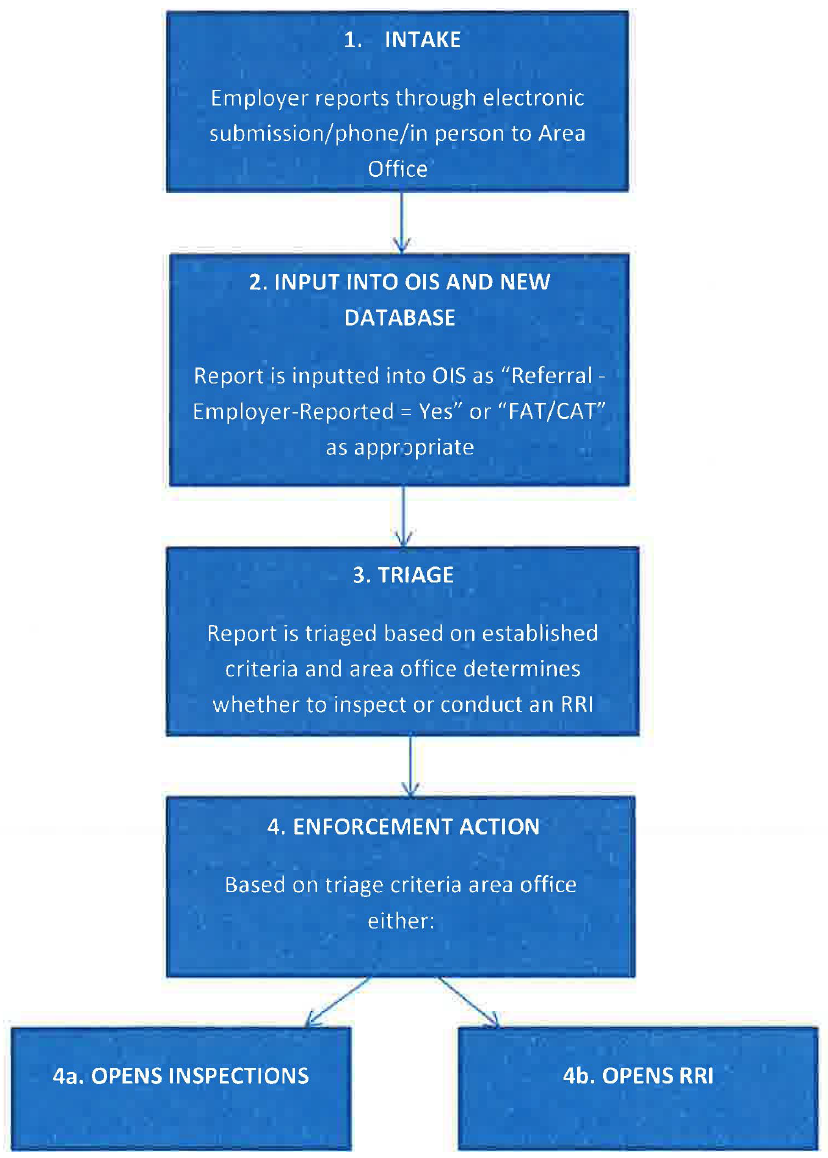
1. INTAKE (also see Intake flowchart)
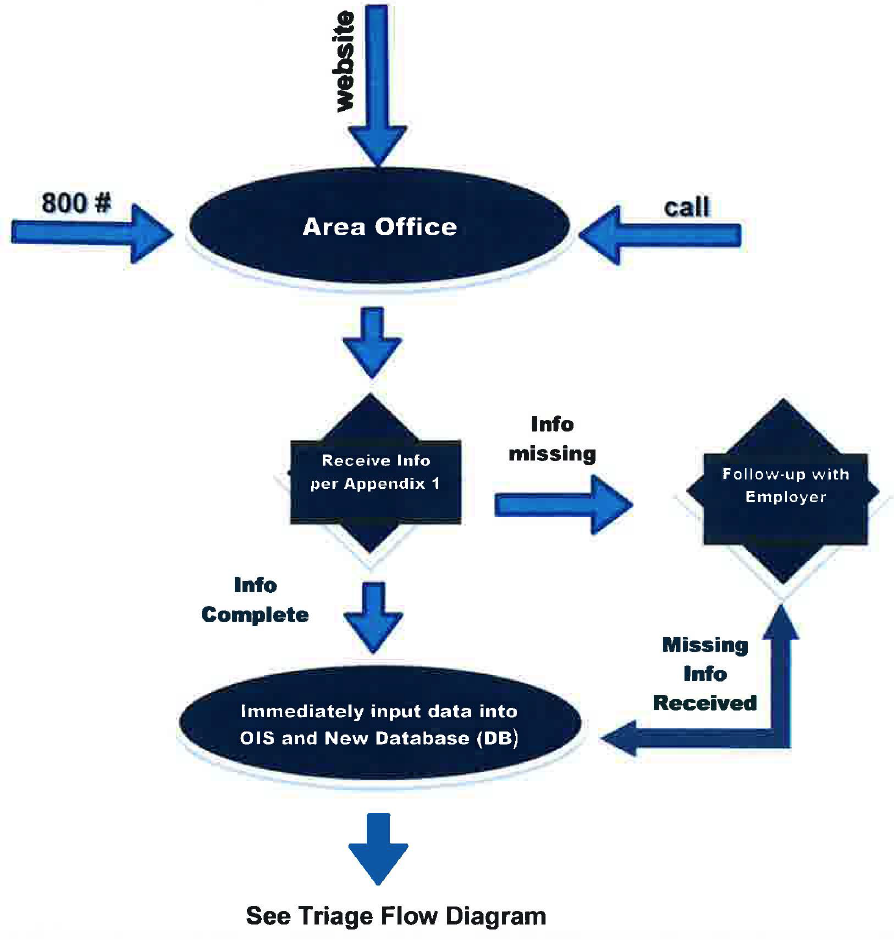
The new rule at Section 1904.39 provides that employers can report by telephone or in-person to the nearest Area Office; through the OSHA toll-free central telephone number, 1-800-321-6742; or by electronic submission on OSHA’s public website. The following information is required to be reported:
- The establishment name;
- The location of the work-related incident;
- The time of the work-related incident;
- The type ofreportable event (i.e., fatality, in-patient hospitalization, amputation, or loss of an eye);
- The number of employees who suffered a fatality, in-patient hospitalization, amputation, or loss of an eye;
- The names of the employees who suffered a fatality, in-patient hospitalization, amputation, or loss of an eye;
- Contact person and his or her phone number; and
- A brief description of the work-related incident.
Ideally, there should be an initial interaction between the Area Office and the reporting employer, in order to get as much information as possible regarding the cause of the incident and the employers’ preliminary plans to prevent any recurrence. To facilitate future communications between the employer and the Area Office, the employer’s contact information (phone number, email, etc.) should be obtained at the time of the initial intake.
Area Offices will need to determine the personnel who will be assigned to receive reports and check the Area Office’s email inbox for communications from the employer. Attached is a questionnaire/script to aid the Area Office personnel with collecting information through phone calls or in-person. See Appendix 1. This questionnaire will be electronically accessible on a new database website that is being developed. The Area Office will access the questionnaire on the new database and fill in the responses to the questions electronically for immediate data input. Further details of the new database are described in the following section. This questionnaire will be shared with the staff of the OSHA toll-free central telephone number. For electronic submission reporting on OSHA’s website, a web form has been developed to allow employers to report electronically and will soon be accessible on the OSHA public webpage. Electronic submissions will be forwarded to the appropriate Area Office based on the location of the incident.
For OSHA Hotline reports and electronic submissions, the Area Office should review the information provided to them and determine if a follow-up call is needed to obtain all the necessary information to comply with the reporting requirements and to determine how the report should be triaged.
NOTE: When an employer reports an incident, the Area Office must evaluate whether it is work-related. Employers are not required to report, and OSHA does not have authority over an injury or illness that is not work-related.
REPORTING INTAKE CHART
2. DATA COLLECTION: INPUT INTO OIS AND NEW DATABASE
OIS INPUT: Once the Area Office has received the report, it must manually input the information into OIS. All reports, whether collected electronically, by phone, or in person, must be put into OIS by the Area Office. The electronic questionnaire (Appendix 1) described in the Intake section of this memorandum may serve as a guide for inputting the data into OIS. A report will be inputted as an unprogrammed activity (UPA). The input of these new employer reports of in-patient hospitalizations, amputations, and loss of eye will be recorded as “Referral- Employer Reported= Yes.” However, reports of work-related fatalities and catastrophes will be inputted in the manner they always have been – inputted as “FAT /CAT.” Catastrophes, which are defined as three or more hospitalizations, will remain within the “FAT /CAT” category, but employer reported hospitalizations of 2 or less will be recorded as “Referral – Employer Reported= Yes.” The steps for inputting a report into OIS as a “Referral – Employer Reported = Yes” are described below. See Appendix 4 for screen shots of the guidance described below.
In the drop down screen for “Activity Type,” OSHA personnel should select “Referral.” A new box will then appear labeled “Employer Reported?” The users will then have to choose “Yes” or “No.” For these reports, the users should choose “Yes.” When they choose “Yes,” a new section will become active where a user can enter new data fields such as the number of amputations and in-patient hospitalizations. The users will then process the report in OIS as they would a normal referral. The only significant difference between these reports and other referrals is that these will be tagged as being reported by the employer and will include new data fields for information.
Additionally, a new Source Type field will be added to the Referrals section called “Employer/Employer Representative.” The user will select this as the source if the incident is reported by the employer or its representative.
If an inspection is initiated from an employer-reported referral, there will be a new inspection type for the user to choose. The user should choose “Referral – Employer Reported” in the inspection type drop-down box. If a user selects this type of inspection, the system will reguire the user to link the inspection to a referral UPA.
A letter must be sent to the employer when an employer-reported referral is selected for an RRI. This letter will be available on OIS. A sample of this letter is attached as an appendix (Appendix 3) to this memorandum.
The overall objective of the new reporting requirements is for the reports to trigger activities that lead to hazard abatement. Data collection is a major component of enforcement activities.
Data points that should be covered in the OIS input are:
- Establishment Information
- Source Information
- Receipt/Activity Information (receipt by, receipt time)
- Hazard description and location
- Number of in-patient hospitalizations
- Number of amputations
- Number of eye losses
- Event date and time
- Safety or Health hazard
- Whether Imminent Danger/Serious/Other/None
- Type of Event
- Number of employees
- Injured employee(s) activities before incident
- Narrative of what happened
- Type of injury/illness
- Injured employee(s) information: Name, gender, age, cause, nature of energy, next of kin
NEW DATABASE INPUT: The new, temporary database will also be used for data collection and the Area Office will have to input data into both OIS and the new database. This is only a temporary procedure and ultimately all data will be collected in OIS. For each report in the database. the OIS UPA Number will be entered to allow linkage between the two systems. The questionnaire website described above in the intake section is the first part of the new database. For every report, the Area Office will have to open the new database to use the questionnaire and input the data. If the Area Office chooses to conduct an RRI, then the database will also be used to summarize the findings/response of the employer from the RRI. Appendix 4 provides a sample screenshot of the RRI summary form in the new database.
3. TRIAGE REPORT TO DETERMINE INSPECTION OR RAPID RESPONSE INVESTIGATION
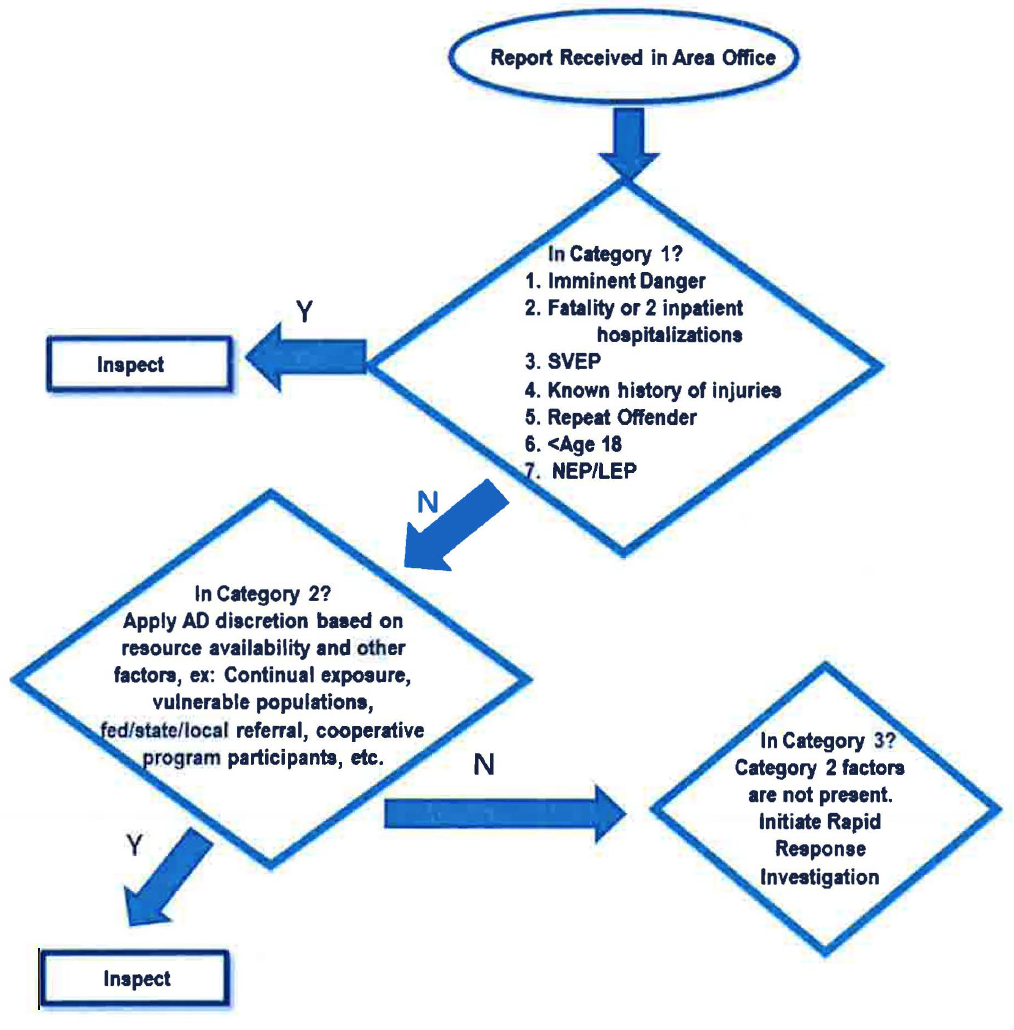
After a report has been taken by OSHA personnel and the necessary information has been collected, the Area Director or his/her designee must determine whether to conduct an inspection or an RRI. A report may be sorted into one of three categories: Category 1 includes reports that require an inspection. Category 2 includes reports where, based on the presence of certain criteria, the Area Director is authorized to conduct an inspection. Category 3 includes reports where, based on the same criteria, an inspection may not be warranted but an RRI will be initiated. However, ifthe incident is not work related, no inspection or RRI will be conducted. Below are the criteria and explanation for each of these categories:
(1) Category 1 are reports that must be inspected:
(a) All fatalities and reports of 2 or more in-patient hospitalizations
(b) Any injury involving a worker under 18
(c) Known history of multiple injuries (same or similar events in previous 12 months)
(d) Repeat offenders (history of egregious, willful, failure-to-abate, or repeated citations)
(e) SVEP/NEP/LEP
(f) Any imminent danger
(2) Response to Category 2 reports will be determined by the Area Director based on the criteria below and his/her knowledge of the circumstances of the event. For reports that do not fit into Category 1, the Area Director should review the questions below. If multiple questions can be answered with “yes,” the Area Office is encouraged to conduct an inspection. However, this list is not exhaustive and there may be other criteria particular to the incident that could be considered by the Area Director:
(a) Are employees still being exposed to the factors underlying the hazards that resulted in the injury or illness?
(b) Was the incident the result of a safety program failure such as PRCS, LOTO, PSM, etc.?
( c) Was the employee exposed to a serious hazard (i.e. explosive materials, combustible dust, falls and heat)?
(d) Were temporary workers or other vulnerable populations injured or made ill?
(e) Has another government agency (federal, state, or local) made a referral?
(f) Does the employer have prior OSHA inspection history?
(g) Is there a Whistleblower complaint/inspection pending?
(h) Is the employer a Cooperative Program Participant, e.g., VPP, OSHA Strategic partnerships, SHARP or an active Alliance member?
(i) Did the incident involve health issues such as chemical exposures, heat stress, etc.?
(3) Category 3 reports are based on responses to the Category 2 criteria; generally, if the answers to the questions above are “no,” then an inspection may not be warranted. The Area Office may initiate an RRI.
NOTE: If the Area Director believes that there is no reasonable basis that a violation or hazard exists; no inspection or RRI will be conducted.
“TRIAGE”
ADDITIONAL GUIDANCE CHART FOR ORGANIZING REPORTS AND
DETERMINING INSPECTIONS AND RRIs
4. OPEN INSPECTION OR RRI
For reports that have been designated for inspection by the Area Office, the Area Office should generally follow the inspection procedures according to the Field Operations Manual (FOM). If an inspection is warranted, it will be initiated as soon as resources permit and will normally be initiated within five working days of the report. For reports that have been designated for an RRI the Area Office should generally follow the procedures for a Phone/Fax inquiry in Chapter 9, Section I of the FOM. Additionally, the Area Office should ensure that the steps described in the following paragraphs are taken.
Once a report has come in and been designated for an RRI, the Area Office must initiate an RRI to identify hazards, provide abatement assistance, and confirm abatement. At all stages of the investigation, the Area Office should serve as a resource for compliance assistance to prevent further injuries and illnesses.
The Area Office should call the employer to initiate the RRI within one day of receipt of report. Appendix 2 provides a script for guidance for this initial call. The call should cover the following items:
- Review the incident with employer and collect any additional information missing from the initial report (i.e., what happened; why it happened; what systems are in place to prevent this type of incident)
- Explain the protocols the employer must complete to satisfy the RRI
- Provide consultation and compliance assistance regarding safety and health issues and abatement; explain sending the RRI letter with the incident investigation tool as guidance (Attachment)
- Explain employee rights
Protocols Employer Must Satisfy: The employer must respond within five working days to confirm abatement/steps that have been taken for abatement. (The employer may ask for an extension for complicated events). The employer must provide results of its investigation into the incident in a written letter to OSHA. The Area Office should give specific guidance on the type of results to provide (photos, sample results, programs, training records, receipts for equipment, etc.). Additionally, the employer must provide a written letter to OSHA, documenting abatement. The documentation can be in an initial response letter due in five days or, if necessary, can be in a 2nd letter due when abatement is completed.
Compliance Assistance: The Area Office should provide technical and compliance assistance regarding abatement/corrections/best practices. When applicable, the Area Office should provide information on the hierarchy of controls, OSHA web page for information (guidance, eTools, etc.), and other assistance as appropriate (sample programs, local consultants, etc.). In addition, with the RRI letter, the Area Office should include a brochure on OSHA’ s consultation services. The Area Office will also explain to the employer that materials to assist them in conducting an incident investigation will be included in the letter that will be sent to them summarizing the phone call. This letter and incident investigation tool are attached to this memorandum as Appendix 2. In the near future, OSHA will identify other web tools that are available to guide the employer in their incident investigation efforts.
Explain Employee Rights: The Area Office should explain that a copy of the letter from OSHA should be posted where the incident occurred and return the Certificate of Posting to OSHA. And, if applicable, the employer must provide a copy of the letter to the Union and Safety Committee. Whistleblower rights under Section 11 C should also be explained.
Consequences: In closing the call, the Area Office should remind the employer of the consequences of failure to provide an adequate response. If there is no response or if it is an inadequate response, OSHA may conduct an inspection.
Closing an RRI: If the response is adequate, the Area Office will summarize the findings/response from the employer and enter that information within the new database. See Appendix 4 for a sample screenshot of the new database for entering this summary. Then, at the Area Director’s discretion, a call or email, may be made to the employer to inform it that the response has been received and the case will be closed. If the response is not adequate, the Area Office may call the employer to follow-up and obtain additional information until the Area Office is satisfied that the RRI may be closed.
Citing for Failure to Report
The new reporting requirements in Section 1904.39 provide that an employer is required to report to OSHA, within 24 hours, all in-patient hospitalizations, amputations, and loss of an eye occurring within 24 hours of a work-related incident. The requirement for reporting workrelated fatalities remains the same. Employers must report, within 8 hours, the death of an employee from a work-related incident. An employer will be cited for failure to report any of these occurrences within the specified time frame. Please see OSHA Instruction CPL 02-00-135, Recordkeeping Procedures and Policy Manual, for guidance on failure to report. The existing penalties described in CPL 02-00-13 5 will remain the same for failure to report a fatality or a catastrophe of three or more inpatient hospitalizations. As described below, for other work-related events the employer fails to report, the penalty amounts have been modified.
An Other-Than-Serious citation will normally be issued for failure to report one or two inpatient hospitalizations, amputation or loss of an eye. The unadjusted penalty will be $1,000.
If the Area Director determines that it is appropriate to achieve the necessary deterrent effect, the unadjusted penalty may be $5,000 or up to $7,000.
If the Area Director becomes aware of an incident required to be reported under § 1904.39 through some means other than an employer report (e.g., inspection or referral from fire or police department) prior to the elapse of the reporting period, and an inspection of the incident is made, a citation for Failure to Report will normally not be issued.
Outreach
To ensure that the public is informed of the new requirements under 29 C.F.R. 1904.39, OSHA is engaging in outreach to industry and interested parties. Area Offices are encouraged to conduct their own outreach initiatives. For further information and resources, please see the OSHA website at www.osha.gov/recordkeeping2014.
If you have any questions regarding these new requirements and the enforcement plan, please contact the Directorate of Enforcement Programs, Office of General Industry and Agricultural Enforcement at 202-693-2100.
APPENDIX 1
Amputation, Loss of Eye and Hospitalizations Employer Report Questionnaire
Obtain information from the caller by asking the following questions, where relevant.
- Are you calling to report a fatality, in-patient hospitalization, amputation, or loss of an eye?
- What is your name, title, and address, email address and best phone numbers to reach you?
- Now I’m going to ask you some questions about the injured employee(s).
- How many injured employees were there?
- What is the name/What are the names of the injured employee(s)?
- How old is/are the injured employee(s)?
- What parts of the injured employee’s body were affected?
- Was the injured employee hospitalized? Had an amputation? Lose an eye?
- Are there any other workers who were injured or became ill in the same incident?
- What are their names and ages?
- Now I’m going to ask you about each injured employee’s workplace.
- Who is the injured employee’s employer?
- What is the employer’s address?
- What is the employer’s telephone number/person of contact?
- What industry is the employer in – for example, construction, manufacturing, transportation…?
- Was the injured employee working as a contract or temporary worker?
- How many people work at the injured employee’s workplace?
- Is there an employee representative or a union at the workplace? If so, what is their name, address, and telephone number?
- Now I’m going to ask you some questions about the incident that led to the[hospitalization/amputation/loss of an eye]?
- When did it happen – date and time?
- Where did it happen? What is the address of that location?
- What is the business name of the location, if there is one?
- What happened?
- What is the injured employee’s job/job title?
- What does the injured employee do at the jobsite?
- What was the injured employee doing just before s/he got injured/became ill? What tools, equipment, or materials was s/he using?
- What directly caused the harm to the injured employee?
- Is the hazard that directly caused the harm to the injured employee still in the workplace?
- Could it potentially harm other people in the workplace? How many people?
- What steps have been taken to remove the hazard?
- Has something like this happened before in this workplace, or almost happened?
NOTE: The above are the questions to help guide the Area Office in the employer’s call when the employer calls to report the incident. These are also the fields that will be in the new
database. When closing the call, the Area Office should close the intake call with the following:
Thank you. In the next few days we may be calling you, either to help walk you through the next steps, or if we need more information about the incident.
In the meantime, I encourage you to visit OSHA ‘s webpage to find our resources for employers. We have a wide variety of educational materials and tools that businesses can use to understand, identify, and fix workplace hazards. You can find the webpage at www.osha.gov.
If you have any questions, you can reach us by phone at [AREA OFFICE PHONE NUMBER], email at {AREA OFFICE EMAIL ADDRESS] or fax at {AREA OFFICE FAX NUMBER].
APPENDIX2
Model for Area Director’s Initiating Call for Rapid Response Investigation
Hello, my name is [AREA DIRECTOR’S NAME] and I am calling from the Occupational Safety and Health Administration to follow up on the incident report you made on [DATE] that [NAME
OF INJURED EMPLOYEE] was injured at your worksite at [ESTABLISHMENT NAME AND ADDRESS].
How is [NAME OF INJURED EMPLOYEE] doing? (Appropriate response here, depending on the answer)
These kinds of serious injuries often indicate the presence of hazards that could put other workers at risk too, so we want to make sure you investigate the root causes of the incident. You should find out what led to the incident and what safety modifications can you make now to prevent future injuries to other workers.
It is important to ask not just what the worker was doing at the time of the injury, but also what the task required him I her [as appropriate] to do. I encourage you to involve your other employees in your investigation; since they work most closely with the equipment and processes and can help you answer these kinds of questions.
We will want to know the results of your investigation. If we don’t hear from you, we may need to conduct our own inspection. Please send the results of your investigation to us in writing by [DATE]. You should include supporting documents like photographs, videos, or test results that you have gathered in the course of your investigation, as well as a description of what you’ve being doing since to correct the hazard(s).
I will also be sending you a letter describing what we’ve just talked about as well as some resources to guide you through the process of conducting your incident investigation. In addition, there are many resources on our webpage at www.osha.gov for employers like you who want to improve safety and health at their workplaces.
Do you have any questions for me?
Again, my name is [AREA DIRECTOR’S NAME]. If you have any additional questions, you can reach me by phone at [PHONE NUMBER], email at [AREA OFFICE EMAIL ADDRESS] or fax
at [AREA OFFICE FAX NUMBER].
APPENDIX3
Sample Letter to Employer for an RRI
[ESTABLISHMENT NAME AND ADDRESS]
Attn: [EMPLOYER NAME]
Dear [EMPLOYER NAME]:
This letter is to follow up the conversation we had on [DATE] in reference to the employee injury that occurred on [DA TE 2] at your worksite. I wanted to remind you that there are some important steps you should now be taking to ensure the safety of your workers and avoid the need for an OSHA inspection.
In most cases, a serious injury indicates the presence of workplace hazards that threaten the health and safety of other workers. OSHA is very concerned that additional employees at your worksite are at risk of being injured. While this letter is not a citation, and we do not intend to conduct an inspection at this time, we ask that you immediately conduct your own investigation into the incident and make any necessary changes to avoid further incidents.
Please complete each of the following by [DATE]:
- Conduct an incident investigation (see Attachment A) [ ]
- Document findings and send corrective actions to [AO FAX NUMBER] or [AO EMAIL] [ ]
- Post a copy of this letter where employees can readily review it [ ]
- Fax or email a copy of the signed Certificate of Posting (Attachment B) to [AO FAX
NUMBER] or [AO EMAIL] [ ]
If we do not receive a response from you by [DATE] indicating the actions you have taken, your worksite may be considered for an immediate on-site inspection.
The goal of your incident investigation will be to identify both the immediate and the underlying causes of the incident. To assist you in conducting an effective investigation, I have attached a guide you can use in identifying the root causes of the incident and taking the necessary steps to ensure your employees are protected from future injuries. Additional resources are available at www.osha.gov.
Please note that it is against the law for employers to retaliate or discriminate in any way against an employee for raising safety and health issues or for exercising their rights under the OSHA law. This includes the right to report a work-related injury or illness to their employer, or to contact OSHA.
After correcting any immediate hazards, small and medium-sized businesses may be interested in requesting free, confidential assistance from the On-Site Consultation Program. Consultants from a state agency or university will work with you to identify workplace hazards, provide advice on compliance with OSHA standards, and assist you in establishing a safety and health management program. These services are separate from enforcement and do not result in penalties or citations. See the attached pamphlet for more information or call [STATE CONTACT] to reach your local On-Site Consultation office. The pamphlet is also available at www.osha.gov/Publications/3357consultation-sm.pdf.
If you have any questions, please call me at [AO PHONE NUMBER] or email me at [AO EMAIL]. Your support and interest in the safety and health of your employees is appreciated.
Sincerely,
[AREA DIRECTOR’S NAME]
Area Director
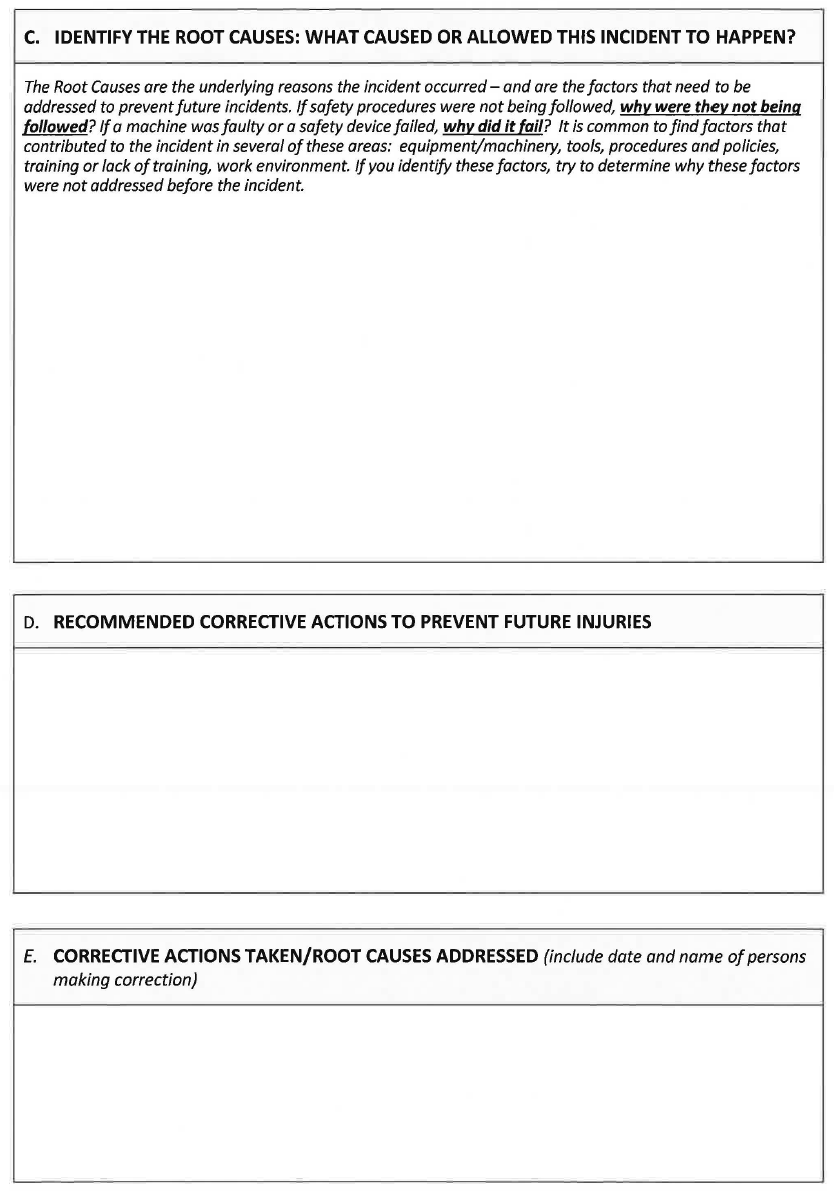
“Attachment A”
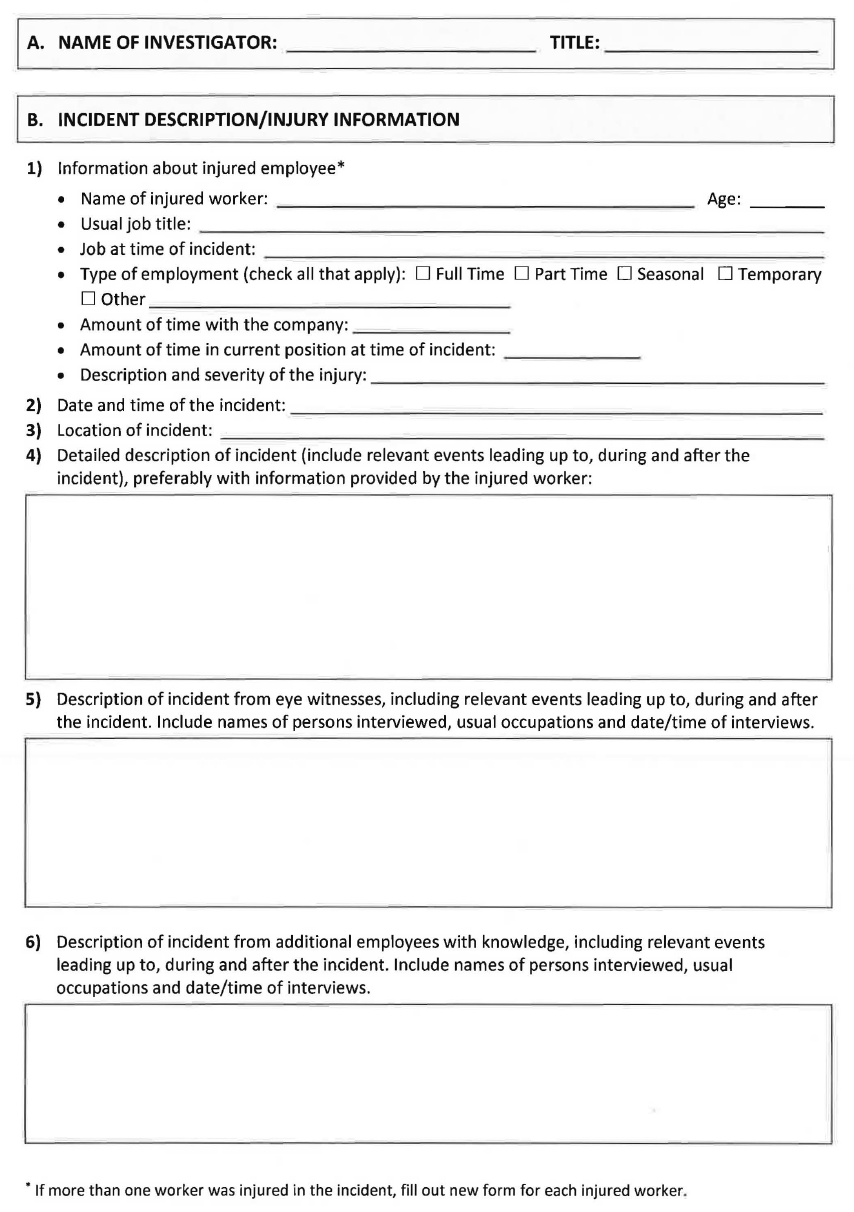
NON-MANDATORY INVESTIGATIVE TOOL
NOTE:
- This investigation tool is provided to assist employers in finding the cause of incidents and to prevent similar incidents in the future. It contains criteria that may be used to evaluate the capabilities of current safety practice(s). This is a non-mandatory tool.
- Additional resources are available at:
- OSHA’s website: www.osha.gov
- Free On-site Consultation Program: https://www.osha.gov/dcsp/smallbusiness/consult directory text.html
“Attachment B”
CERTIFICATION
OF POSTING OSHA NOTIFICATION
OF EMPLOYER REPORTED INCIDENT
See Attached original for images
APPENDIX 4
Sample OIS and RRI Screenshots
Sample OIS Screenshots/Forms/Guidance for Inputting Reports into OIS
See Attached original for images
Sample RRI Screenshot/Form for Inputting Summary of Employer Actions
See Attached original for images
CLICK HERE for the original memo (pdf)