
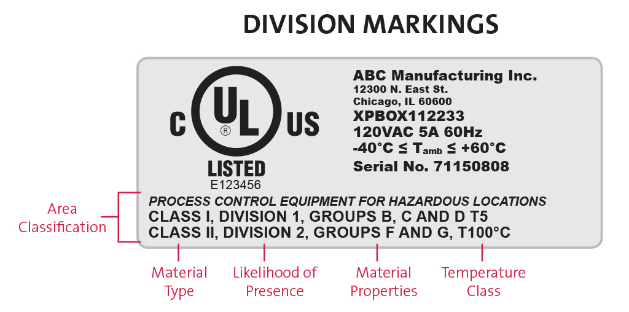
Recently, OSHA cited a global manufacturer for HAZLOC violations using its 1910.307 – Hazardous (classified) locations standard. We do not see this standard often cited, as in most PSM/RMP citations related to Hazardous Locations (HAZLOC), OSHA and EPA will reference the RAGAGEP NFPA 70. It is one of our common findings in our PSM/RMP audits at flammable processes; however, our findings usually involve “mobile/portable” equipment, where this citation involved FIXED equipment that was installed inside a HAZLOC.
I share these specific citations as a learning opportunity for those who may not know what to look for…
Citation 1 Item 6
Type of Violation: Serious; $10,938
29 CFR 1910.307(c)(2)(i): Equipment in hazardous (classified) location(s) was not approved for the ignitable or combustible properties of the specific gas, vapor, dust, or fiber that was or could be present:
a) On or about May 4, 2023, within the H-Space building number 3 in the Synthesis 1 Hood/Manifold, the employer exposed employees to fire and explosion hazards in that the employer required employees to use improperly rated equipment such as, but not limited to vacuum pumps within a Class I Division II Group B manifold/hood while synthesizing a flammable chemical.
b) On or about May 4, 2023, within the H-Space building number 3 in the Synthesis 2 Hood/Manifold, the employer exposed employees to fire and explosion hazards in that the employer required employees to use improperly rated equipment such as, but not limited to vacuum pumps within a Class I Division II Group B manifold/hood while synthesizing a flammable chemical.
c) On or about May 4, 2023, within the H-Space building number 3 in the Mixing 1 Hood/Manifold, the employer exposed employees to fire and explosion hazards in that the employer required employees to use improperly rated equipment such as, but not limited to vacuum pumps within a Class I Division II Group B manifold/hood while
mixing/transfilling a flammable chemical.
d) On or about May 4, 2023, within the H-Space building number 3 in the Mixing 2 Hood/Manifold, the employer exposed employees to fire and explosion hazards in that the employer required employees to use improperly rated equipment such as, but not limited to vacuum pumps within a Class I Division II Group B manifold/hood while
mixing/transfilling a flammable chemical.
e) On or about May 4, 2023, within the H-Space building number 3 in the Mixing 3 Hood/Manifold, the employer exposed employees to fire and explosion hazards in that the employer required employees to use improperly rated equipment such as, but not limited to vacuum pumps within a Class I Division II Group B manifold/hood while
mixing/transfilling a flammable chemical.
f) On or about May 4, 2023, within the H-Space building number 3 in the Purification Hood/Manifold, the employer exposed employees to fire and explosion hazards in that the employer required employees to use improperly rated equipment such as, but not limited to vacuum pumps within a Class I Division II Group B
manifold/hood while purifying/distilling a flammable chemical.
g) On or about May 4, 2023, within the H-Space building number 3 in the Cryotrap Hood/Manifold, the employer exposed employees to fire and explosion hazards in that the employer required employees to use improperly rated equipment such as, but not limited to vacuum pumps within a Class I Division II Group B manifold/hood while
cryotrapping a flammable chemical.
h) On or about May 4, 2023, within the H-Space building number 3 in the Quality Control Hood/Manifold, the employer exposed employees to fire and explosion hazards in that the employer required employees to use improperly rated equipment such as, but not limited to vacuum pumps within a Class I Division II Group B manifold/hood while checking quality of the products of a flammable chemical.
Citation 1 Item 7a
Type of Violation: Serious; $10,938
29 CFR 1910.307(g)(2)(ii): Each room, section, or area was not considered individually in determining its classification.
a) On or about May 4, 2023, the employer exposed employees to fire, explosion, respiratory and contact hazards, in that the H-Space or Building 3 was not electrically classified properly as a Class I Division II environment where diborane would become hazardous in case of an accident or some unusual operating condition.
Citation 2 Item 1
Type of Violation: Willful – Serious; $125,007
29 CFR 1910.307(c): Equipment, wiring methods, and installations of equipment in hazardous (classified) locations were not intrinsically safe, approved for the hazardous (classified) location, or safe for the hazardous (classified) location:
a) On or about May 4, 2023, within the H-Space building number 3 in the Synthesis 1 Hood/Manifold, the employer exposed employees to fire and explosion hazards in that the employer required employees to use equipment such as, but not limited to, heat guns that were not intrinsically safe or designed to be used within a Class I Division II Group B manifold/hood where flammable chemicals and vapors are present while synthesizing Diborane.
b) On or about May 4, 2023, within the H-Space building number 3 in the Synthesis 2 Hood/Manifold, the employer exposed employees to fire and explosion hazards in that the employer required employees to use equipment such as, but not limited to, heat guns that were not intrinsically safe or designed to be used within a Class I Division II Group B manifold/hood where flammable chemicals and vapors are present while synthesizing Diborane.
c) On or about May 4, 2023, within the H-Space building number 3 in the Mixing 1 Hood/Manifold, the employer exposed employees to fire and explosion hazards in that the employer required employees to use equipment such as, but not limited to, heat guns that were not intrinsically safe or designed to be used within a Class I Division II Group B manifold/hood where flammable chemicals and vapors are present while mixing/transfilling Diborane and its mixtures.
d) On or about May 4, 2023, within the H-Space building number 3 in the Mixing 2 Hood/Manifold, the employer exposed employees to fire and explosion hazards in that the employer required employees to use equipment such as, but not limited to, heat guns that were not intrinsically safe or designed to be used within a Class I Division II Group B manifold/hood where flammable chemicals and vapors are present while mixing/transfilling Diborane and its mixtures.
e) On or about May 4, 2023, within the H-Space building number 3 in the Mixing 3 Hood/Manifold, the employer exposed employees to fire and explosion hazards in that the employer required employees to use equipment such as, but not limited to, heat guns that were not intrinsically safe or designed to be used within a Class I Division II Group B manifold/hood where flammable chemicals and vapors are present while mixing/transfilling Diborane and its mixtures.
f) On or about May 4, 2023, within the H-Space building number 3 in the Purification Hood/Manifold, the employer exposed employees to fire and explosion hazards in that the employer required employees to use equipment such as, but not limited to, heat guns that were not intrinsically safe or designed to be used within a
Class I Division II Group B manifold/hood where flammable chemicals and vapors are present while purifying/distilling Diborane.
g) On or about May 4, 2023, within the H-Space building number 3 in the Cryotrap Hood/Manifold, the employer exposed employees to fire and explosion hazards in that the employer required employees to use equipment such as, but not limited to, heat guns that were not intrinsically safe or designed to be used within a Class I Division II Group B manifold/hood where flammable chemicals and vapors are present while cryotrapping flammable chemicals.
h) On or about May 4, 2023, within the H-Space building number 3 in the Quality Control Hood/Manifold, the employer exposed employees to fire and explosion hazards in that the employer required employees to use equipment such as, but not limited to, heat guns that were not intrinsically safe or designed to be used within a Class I Division II Group B manifold/hood where flammable chemicals and vapors are present while checking quality of flammable chemicals.
Every device or piece of equipment installed in the defined HAZLOC that poses an ignition hazard MUST be labeled to identify it as ACCEPTABLE for that SPECIFIC HAZLOC. SAFTENG members can read dozens of my articles regarding how to use NFPA 497 and 499 when establishing a HAZLOC and then how to ensure that the DESIGN incorporates HAZLOCs. This is a CRITICAL PROTECTION layer and is considered to be an Engineering Control (as well as administrative control) in our layers of protection. If the portable/mobile devices and fixed equipments within the boundaries of the HAZLOC are NOT identified for use in the specific HAZLOC, then we have a serious problem.

