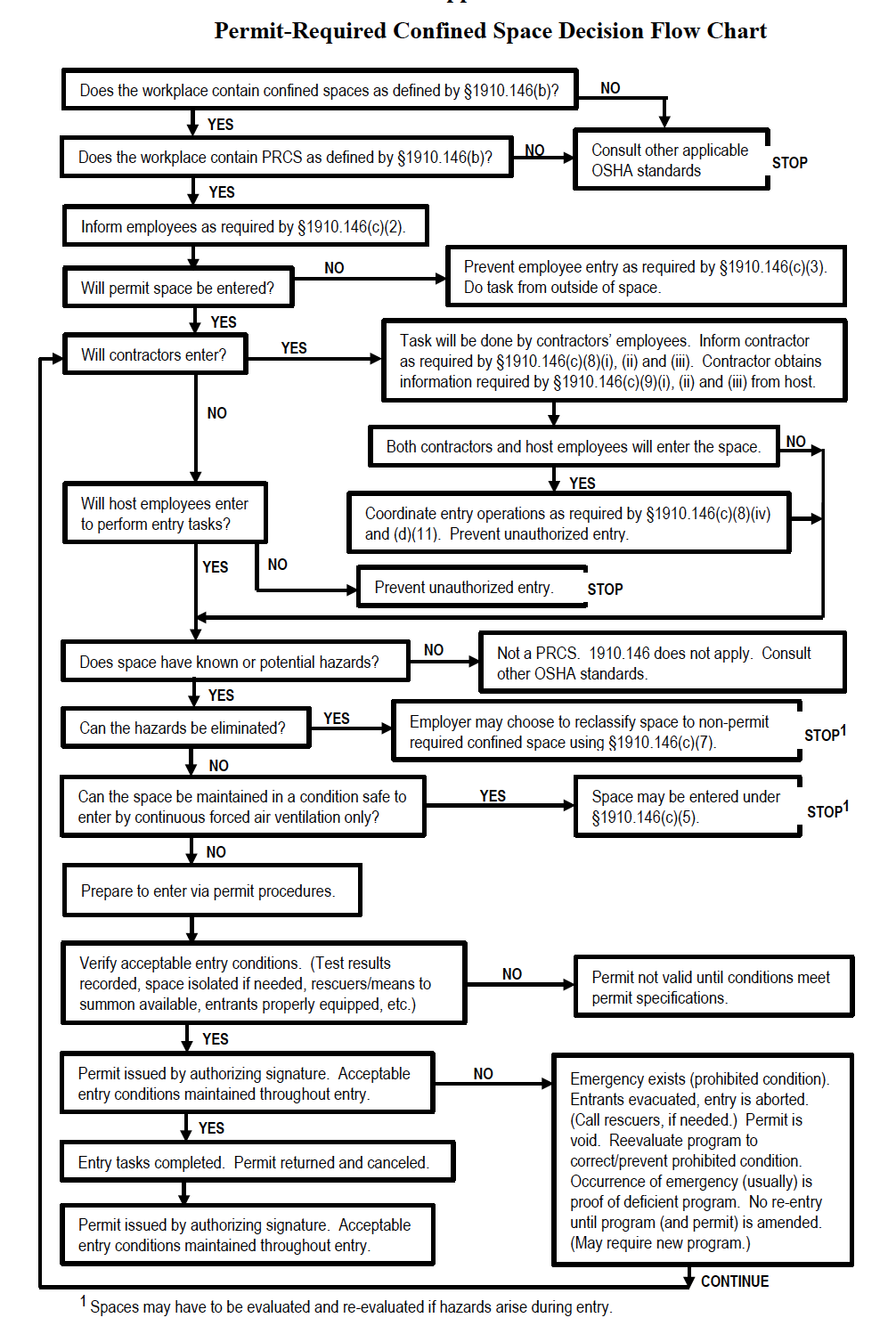
One of the topics we have debated about 1910.146 is whether (c)(5) and (c)(7) entry methods could be used simultaneously on the same space. I was a resounding “No” but since we could never get an official answer from OSHA, there were many in our profession who felt it was acceptable to use (c)(5) and (c)(7) entry methods simultaneously on the same space. Then in 2015, OSHA published their 1926 Subpart AA Confined Spaces in Construction in which they made it appear that they were allowing both entry methods could be used simultaneously on the same space. Then in 2016, they issued an LOI which lends more evidence that they intended this to be the case:
(emphasis by me & I made bullet statements for extra emphasis)
Q# 1: If an employer has workers performing construction work inside a water tank that has limited egress and at least one physical hazard, such as trip hazards, poor illumination, slippery floors, inclined surfaces, ladders, suspended scaffolds, and/or atmospheric hazards or potential atmospheric hazards, must that employer establish a permit program and have employees enter the space under a confined space permit, as required by Subpart AA of 29 CFR Part 1926, Confined Spaces in Construction?
Answer
Yes, assuming the water tank is large enough for an employee to bodily enter it, is not designed for regular occupancy, and there is some impediment to egress, the water tank meets the definition of a confined space under 29 CFR 1926.1202. Furthermore, permit-required confined spaces include confined spaces that have a physical hazard, atmospheric hazard, potential atmospheric hazard, or any other recognized serious safety or health hazard. To the extent that the physical and atmospheric hazards you describe could prevent a worker from exiting the space under his or her own power (self-rescue), those hazards could trigger “permit required confined spaces” requirements per 29 CFR 1926.1204.
However, if
- the physical hazards can be eliminated or isolated through engineering controls, AND
- any atmospheric hazards can be controlled through forced-air ventilation AND continuous atmospheric monitoring,
the space may be entered using the alternate procedures set forth in 29 CFR 1926.1203(e), instead of full permit space entry procedures.
So with this LOI and the way the 1926 standard was written, I would agree that OSHA is allowing both “reclassification” and “alternative” entry methods to be used simultaneously on the same space.