
Earlier this year I wrote an article about the International Fire Code (IFC) and its practice of limiting flammable liquids outside of proper storage means, such as cabinets and rooms. In that article I posted the OSHA requirements but did not explain how the OSHA requirements applied to workplaces, rather I chose to use the IFC as it is much more relevant and up-to-date than OSHA’s 1910.106 which is 46 years old today and was based on a 1960’s version of NFPA 30. But I have received a lot of questions and comments as to how this Maximum Allowable Quantity (MAQ) practice would apply in OSHA’s eyes. So here is my take on OSHA’s MAQ requirements:
First, I am basing this article on the fact that the majority of those asking questions are working within an “Industrial Plant” as defined by OSHA. This means the flammable liquids used within the facility are:
1) incidental to the principal business, and
2) handled or used only in unit physical operations such as mixing, drying, evaporating, filtering, distillation, and similar operations which do not involve chemical reactions
The information in this posting does NOT apply to CHEMICAL PLANTS, REFINERIES OR DISTILLERIES. These types of businesses have more rigorous requirements (see .106(h)) and will most likely be PSM covered processes necessitating the need for adopting NFPA 30 (the TOP standard for flammable liquids) as the facility’s Recognized and Generally Accepted Good Engineering Practice (RAGAGEP).
So what does OSHA say when taking flammables out of flammable storage cabinets and/or storage rooms to use in the manufacture of goods?
OSHA calls this practice “Incidental storage or use of flammable liquids” and we find these requirements in 1910.106(e)(2)(i) and they shall be applicable to those portions of an industrial plant where the use and handling of flammable liquids is ONLY incidental to the principal business, such as automobile assembly, construction of electronic equipment, furniture manufacturing, tool manufacturer cleaning parts with flammable degreasing chemicals, or other similar activities.
OSHA also requires that when a container of flammable liquid(s) is NOT being used it MUST BE CLOSED so as to contain the vapors.
OSHA also reminds us that ALL storage shall comply with paragraph (d)(3) or (4) of this section:
(d)(3) is “Design, construction, and capacity of storage cabinets”, and
(d)(4) is “Design and construction of inside storage rooms”
The quantity of flammable liquid(s) that may be located OUTSIDE of an inside storage room or storage cabinet in a building OR in any one (1) fire area of a building shall not exceed:
- 25 gallons of Category 1 flammable liquids in containers
- 120 gallons of Category 2, 3, or 4 flammable liquids in containers
- 660 gallons of Category 2, 3, or 4 flammable liquids in a single portable tank
NOTE:
Category 1 shall include liquids with FP<73.4°F and BP<95°F
Category 2 shall include liquids having FP<73.4°F and BP>95°F
Category 3 shall include liquids having FP>73.4°F and <140°F
Category 4 shall include liquids having FP>140°F and <199.4°F
But here is one small problem with the .106 language. It defines a “fire area” as:
an area of a building separated from the remainder of the building by construction having a fire resistance of at least 1 hour and having all communicating openings properly protected by an assembly having a fire-resistance rating of at least 1 hour.
There is NO guidance as to how many “fire areas” are allowed per floor and how about those manufacturing areas that are thousands of square ft and wide-open (e.g. no firewalls)?
So when we look at a space like the one shown below:
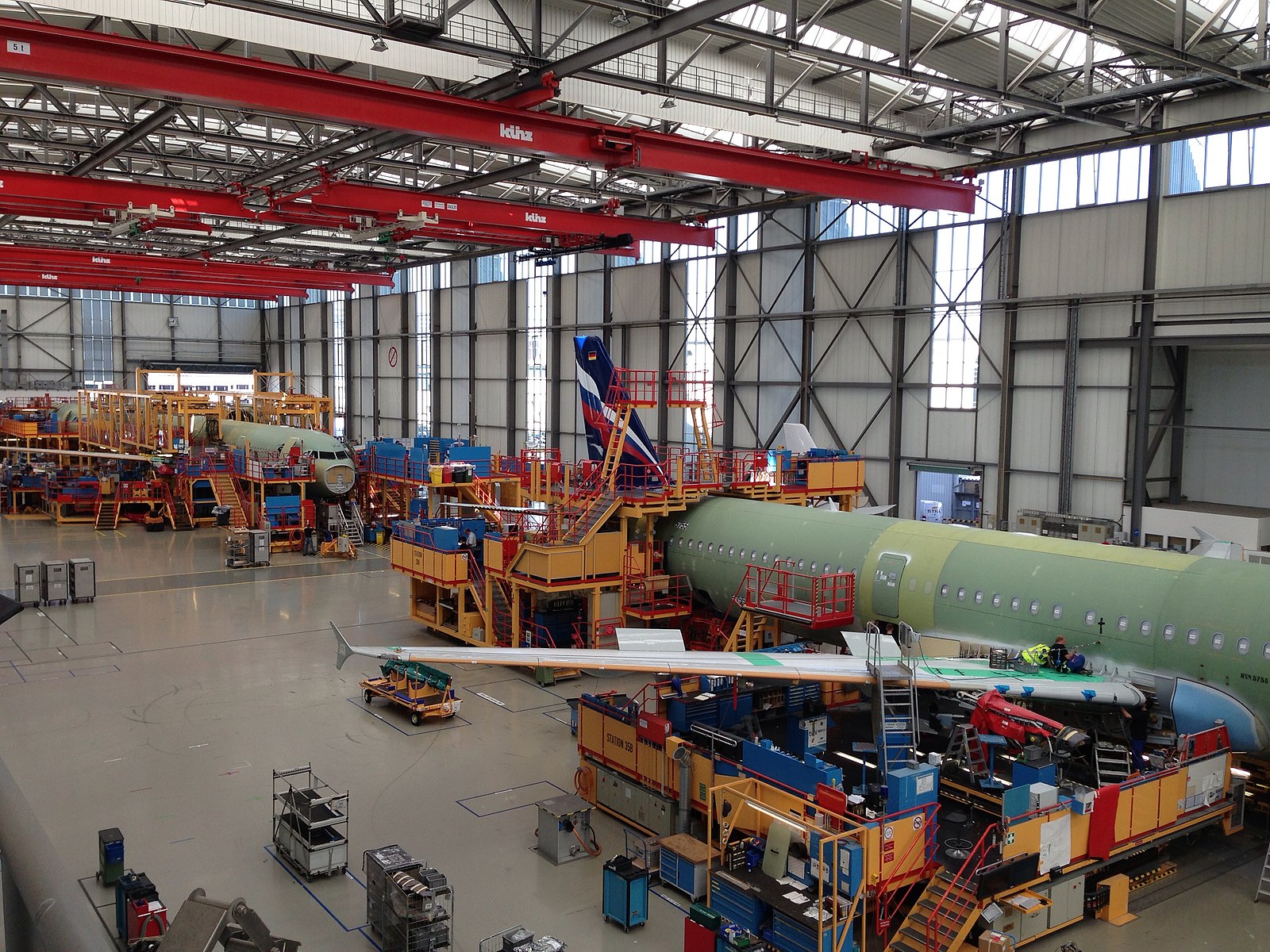
A321 final assembly (9351765668), CC BY 2.0
.jpg)
This workplace is massive and it is wide OPEN so if we follow the OSHA restrictions the area shown above would be allowed to have:
25 gallons of Ether in CLOSED containers
120 gallons of Acetone, Toluene, most Alcohols, etc. in CLOSED containers
660 gallons of Xylene in a CLOSED containers
Some have interpreted these requirements to allow the choice of one (1) of the three (3) options. In other words, some have interpreted this to mean that if 25 gallons of a Category 1 flammable liquid was stored in containers outside of an inside storage room or storage cabinet in a building, NO ADDITIONAL quantity of CAT 2, CAT 3, or CAT 4 flammable liquids would be allowed. This is INCORRECT to the intended meaning, as clarified in STD 01-05-015.
The source document (i.e. NFPA No. 30-1969 Flammable and Combustible Liquids Code), requires the following: (emphasis by me)
- The quantity of liquid that may be located outside of an inside storage room or storage cabinet in a building shall NOT exceed that given in (a), (b) AND (c).
- This means that ANY COMBINATION of the permitted quantities of various CATEGORIES of flammable liquids is allowed so long as the maximum permitted quantity for any one of the three categories is NOT exceeded.
Even with these allowed quantities, in a wide-open workspace this can be VERY LIMITING. The idea is SEGREGATION of the fuel source for a fire that will allow sprinklers to work and to slow the spread of the fire. In 2017 we designed eight inside flammable storage rooms for a large scale manufacturer whose workspace was nearly 1 million sq ft with ZERO firewalls. We built these inside-storage rooms in strategic locations as preferred by the facility so they could easily and readily access their flammable liquids (used in cleaning, quality, and manufacturing). The bulk of the flammables were stored outside in a newly designed OUTSIDE flammable storage area. But due to thru-put demands, the facility needed to have more flammables closer to the manufacturing and lab areas but was “hindered” by these requirements. So the solution was INDOOR HAZMAT Lockers and constructed INSIDE STORAGE rooms meeting/exceeding 1910.106(d)(4). We used the HAZMAT lockers where we had a BLANK WALL available to run our ventilation out and we used concrete construction for the rooms built in the center of the facility. We then instituted sort of a 5S for flammable liquids based on the work stations so that employees knew CLEARLY how much of their flammable liquids they could have in their defined fire area(s). Remember, 805 gallons of flammable liquids is the MAX with ANY COMBINATION of the permitted quantities of various CATEGORIES of flammable liquids is allowed so long as the maximum permitted quantity for ANY ONE of the three categories is NOT exceeded.
OSHA also does NOT limit the number of “fire areas” like the IFC does. As long as you have 1-hr fire separation, OSHA does not limit the number of fire areas within a building; whereas the IFC limits the fire areas per floor based on the level/story of the building. Please note, the IFC uses the term “control area” rather than “fire area”.
| TABLE 5003.8.3.2 DESIGN AND NUMBER OF CONTROL AREAS | |||
|
Floor Level |
# of Control Areas Per Floor |
Percentage of the Maximum Allowable Quantity Per Control Area (%) |
Fire Resistance Rating for Fire Barriers (hours) |
|
9 and up |
1 |
5 |
2 |
|
8 |
2 |
5 |
2 |
|
7 |
2 |
5 |
2 |
|
6 |
2 |
12.5 |
2 |
|
5 |
2 |
12.5 |
2 |
|
4 |
2 |
12.5 |
2 |
|
3 |
2 |
50 |
1 |
|
2 |
3 |
75 |
1 |
|
1 |
4 |
100 |
1 |
|
Basement 1 |
3 |
75 |
1 |
|
Basement 2 |
2 |
50 |
1 |
|
NO STORAGE BELOW B-2 |
|||
|
a. Percentages shall be of the maximum allowable quantity per control area shown in Tables 5003.1.1(1) and 5003.1.1(2), with all increases allowed in the footnotes to those tables. b. Separation shall include fire barriers and horizontal assemblies as necessary to provide separation from other portions of the building. |
|||
But OSHA also does not have the “exceptions” that the IFC has. For example, OSHA does not give credit to sprinkler systems whereas the IFC does in that a sprinkled area is allowed to DOUBLE the list quantities. Also, the IFC allows us to DOUBLE the quantities AGAIN if we use “listed safety cans” as our “container”. This means the IFC would allow 480 gallons of a Category 2 flammable liquids in a “fire area” that was BOTH sprinkled AND the flammables were in “listed safety cans”. Again, OSHA does NOT allow for these exceptions!!!!
The ONLY thing OSHA recognizes is SEGREGATION by 1-hr firewalls. So we have two choices:
- Separate our 1-million square ft manufacturing area with 1-hr rated firewalls, or
- Build/Install inside flammable liquid storage rooms
What about the use of Flammable Liquid Storage Cabinets?
Rather than building a room for my flammables, why can’t I just buy 25 flammable liquid storage cabinets and put them all in the same area for my indoor storage?
You can do this. We are only limited by 1910.106(d)(3)(i) which limits EACH cabinet to
- not more than 60 gallons of Category 1, 2, or 3 flammable liquids,
- nor more than 120 gallons of Category 4 flammable liquids
Years ago, NFPA 30 had restrictions on how many flammable cabinets could be located in a certain distance of each other, but that requirement has been removed in recent years. But now NFPA 30, 9.5.2 (2018) states: (emphasis by me)
The total aggregate volume of Class I, Class II, and Class IIIA liquids in a GROUP OF STORAGE CABINETS shall not exceed the maximum allowable quantity of flammable and combustible liquids per control area based on the OCCUPANCY where the cabinets are located.
And one day I will get around to walking us thru “control areas” as they are defined and managed within NFPA 30.
So if we follow RECOGNIZED AND GENERALLY ACCEPTED GOOD ENGINEERING PRACTICES the solution is NOT a bunch of flammable storage cabinets cobbled together! But again, this is NOT from OSHA’s 1910.106 – hence why I stopped using .106 around the year 1994, as it SUCKS as a safety engineering standard. But it is WITHOUT a doubt the absolute minimum requirements for those who are looking to make OSHA happy. If you’re looking to protect your building and employees then look to NFPA 30 or another favorite of mine IGNITABLE LIQUID STORAGE IN PORTABLE CONTAINERS (Global FM, Property Loss Prevention Data Sheet 7-29), which states:
2.2.3 Use FM Approved ignitable liquid storage cabinets to hold limited quantities of ignitable liquids. Arrange the cabinets as follows:
-
- Restrict ignitable liquid quantities as necessary so that the cabinet will contain the largest expected liquid release (e.g., largest metal container and contents of all plastic and glass containers).
- Limit the amount of liquid storage to the Approval limit.
- Cutoff is not needed from storage or non-storage occupancies.
- Provide a minimum of 20 ft (6 m) separation between cabinets and non-liquid warehouse areas.’
- Do not put cabinets within non-liquid rack storage arrangements. Protect the surrounding occupancy in accordance with FM Global data sheets.
- Do not dispense ignitable liquids from containers located in storage cabinets unless the area the cabinet is located in meets the recommendations in Data Sheet 7-32, Ignitable Liquid Operations.