
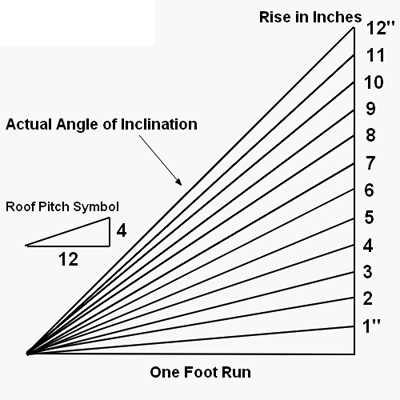
 OSHA’s new Fall Protection standard for General Industry has a lot of MAJOR changes (for the better!) that we will be dealing with over the next several years (up to 20 years for some). One that caught my eye was the new requirements for our maintenance personnel who may be doing work on low-sloped roofs (defined as a roof having a slope less than or equal to 4 in 12 (vertical to horizontal). Final paragraph (b)(13) is a new provision that establishes fall protection requirements when employees perform work on low-slope roofs. OSHA is adding this provision to make the general industry standard more consistent with the construction fall protection standard, which includes a provision addressing roofing work performed on low-slope roofs (§1926.501(b)(10)). Under paragraph (b)(13), the type of fall protection measures employers MUST use on low-slope roofs depends upon the distance they work from the roof edge. The final rule divides work on low-slope roofs into three (3) zones:
- Work performed LESS THAN 6 feet from the roof edge;
- Work performed 6 feet to less than 15 feet from the roof edge; and
- Work performed 15 feet or MORE from the roof edge
1. Work performed less than 6 feet from the roof edge
Final paragraph (b)(13)(i), like the construction standard (§§1926.501(b)(10) and 1926.502(f)) requires that employers use conventional fall protection systems (i.e., guardrail systems, safety net systems, personal fall protection systems) when they work LESS THAN 6 feet from the edge of a low-slope roof. OSHA believes that using a conventional fall protection system is necessary to protect workers from falling when they work that close to the roof edge, including the edge of low-slope roofs. Without conventional fall protection, an inadvertent slip or trip this close to the edge could propel the worker off the roof.
2. Work performed 6 feet to less than 15 feet from the roof edge
Final paragraph (b)(13)(ii), which applies when employees work AT LEAST 6 feet but LES THAN 15 feet from the roof edge, requires that employers protect workers from falling by using:
- A conventional fall protection system; OR
- A designated area, but ONLY when the employer is performing work “that is BOTH infrequent and temporary.”
The final rule defines “designated area” as “a distinct portion of a walking-working surface delineated by a warning line in which employees may perform work without additional fall protection” (final §1910.21(b)). The definition of “designated area” is similar to the construction standard’s “warning line system,” defined as a barrier erected on a roof to warn employees that they are approaching an unprotected roof side or edge, and which designates an area in which roofing work may take place without the use of guardrail, body belt, or safety net systems to protect employees in that area (§1926.500(b)).
“Temporary” means that the duration of the task the worker performs is brief or short. Temporary and brief or short tasks generally include those that a worker is able to perform in less time than it takes to install or set up conventional fall protection. Temporary tasks also include those that workers are able to complete at one time rather than repeatedly climbing up or returning to the roof or requiring more than one workshift to complete.
The term “infrequent,” for purposes of the final rule, means that the task or job is performed ONLY
- on occasion, when needed (e.g., equipment breakdown),
- on an occasional basis, or
- at sporadic or irregular intervals.
Infrequent tasks include work activities such as annual maintenance or servicing of equipment, monthly or quarterly replacement of batteries or HVAC filters, and responding to equipment outage or breakdown. In these instances, the frequency of exposure to fall hazards is very limited. By contrast, tasks performed or repeated on a daily, routine or regular basis are NOT infrequent activities within the meaning of the final rule. Infrequent jobs also do NOT include those that workers perform as a primary or routine part of their job or repeatedly at various locations during a workshift. A task may be considered infrequent when it is performed:
- ONCE a month,
- ONCE a year, OR
- when needed
3. Work performed 15 feet or MORE from the roof edge
Final paragraph (b)(13)(iii), which applies to work performed 15 feet or more from the edge of a low-slope roof, requires that employers protect workers from falling by:
- Using a conventional fall protection system or a “designated area”. If, however, the work is BOTH infrequent AND temporary, employers do NOT have to provide ANY fall protection (final paragraph (b)(13)(iii)(A)); AND
- Implementing and enforcing a work rule PROHIBITING employees from going within 15 feet of the roof edge without using fall protection in accordance with final paragraphs (b)(13)(i) and (ii) (final paragraph (b)(13)(iii)(B)).
So there we have it, OSHA has finally incorporated “safe distances” (my term – not OSHA’s) into the fall protection schemes allowed in our general industry!