
This new Respiratory Protection Directive updates OSHA’s inspection procedures and enforcement policies since the previous update, September 25, 1998. This Instruction provides guidance to the national, regional, and area offices for performing compliance inspections involving OSHA’s Respiratory Protection Standard, 29 CFR 1910.134. This Instruction also serves to inform industry, employer and worker groups, state programs, and other federal agencies concerning OSHA’s policy and procedures for implementing intervention and inspection programs to reduce or eliminate workplace exposures related to hazardous airborne substances. This is a MUST READ for all respirator program administrators, as there are a few surprises in this CPL!!! For one… if anyone other than the PLCHP is maintaining your Questionnaires you may have some issues regarding “confidentiality”!
Significant Changes
- This Directive supersedes OSHA’s prior Respiratory Protection Directive, CPL 02-00-120, dated September 25, 1998, and includes the following significant changes:
- This revision updates the definition’s section of the directive to include changes to the Respiratory Protection Standard (71 FR 50122, November 2006) that provide definitions for assigned protection factors and maximum use concentrations.
- This update provides greater clarification on voluntary respirator use, and better explains the components of compliant respirator programs and provides additional acceptable methods to assess respiratory hazards.
- This revision also updates the directive with information related to the revised Hazard Communication standard, 29 CFR 1910.1200, which was published in March 2012. This revised Hazard Communication standard (HCS 2012) aligned OSHA’s standard with the Globally Harmonized System of Classification and Labeling of Chemicals (GHS), Revision 3.
- This revision also provides guidance on evaluating the need for respiratory protection for chemicals used in workplaces by referring to employers’ Hazard Communication Programs, 29 CFR 1910.1200, wherein chemical manufacturers may have communicated on safety data sheets that use of their products may be hazardous if inhaled and have recommended that users wear respiratory protection.
Here are some KEY points I have written about in years past that, in my opinion were clear from the regulatory language, and now OSHA has made crystal clear in this new CPL: (emphasis added by me)
Permissible Practice
- engineering controls must be the primary means used to reduce employee exposure to toxic chemicals, and that respirators may only be used if engineering controls are infeasible or while they are being implemented
- Feasible engineering, work practice, or administrative controls must be instituted even though they may not be sufficient to reduce exposure to or below the OSHA permissible exposure limit (PEL)
- Respirators must be used in conjunction with feasible controls whenever exposures cannot be controlled at or below permissible limits
- Feasible engineering, work practice, or administrative controls must be instituted even though they may not be sufficient to reduce exposure to or below the OSHA permissible exposure limit (PEL)
Respiratory Protection Program
- a written respiratory protection program is REQUIRED when
- necessary to protect the health of the employee from workplace air contaminants, or
- when the employer requires the use of respirators
- a limited written program is also required when respirators (other than filtering facepieces) are being voluntarily worn by employees
- program must include workplace-specific procedures and contain all applicable program elements
- where respirators are required, respirators (and their associated requirements such as fit testing and maintenance), training and medical evaluations must be provided at no cost to the employee
- it is the intent of the standard that the employer would not be required to incur any costs associated with voluntary use of filtering facepieces other than providing a copy of Appendix D of the standard to each user
- If employers allow the voluntary use of respirators other than filtering facepieces, the costs associated with ensuring the respirator itself does not create a hazard, such as medical evaluations and maintenance, must be provided at no cost to the employee
- program must be tailored to cover the specific work operations and practices in the workplace
- provisions listed in paragraph (c)(1)(i) thru (ix) of the standard must be included in the written program unless it is determined they are not applicable
- These provisions are to be considered when evaluating a written program:
-
- procedures for selecting respirators,
- medical evaluations for users,
- fit-testing procedures for tight-fitting respirators,
- procedures for proper use during routine and emergency situations,
- procedures for cleaning, storing, disinfecting, etc.,
- procedures to ensure adequate air quality and flow for atmosphere-supplying respirators,
- training on respiratory hazards,
- training on proper use, donning and removing the respirator, etc.,
- procedures for regularly evaluating the effectiveness of the program.
- Voluntary use is when an employee chooses to wear a respirator (e.g., for comfort), even though the use of a respirator is not required either by the employer or by an OSHA standard
- requirements for voluntary use of respirators can be divided into two (2) categories:
-
- Requirements for filtering facepieces , i.e., dust masks; and,
- Requirements for all other respirators, such as elastomeric (e.g., rubber, silicone, neoprene, plastic) facepieces and powered air purifying respirators, typically with removable cartridges or filters.
Voluntary Use of Filtering Facepiece Respirators
- majority of voluntary use situations involve the use of filtering facepieces (i.e., disposable dust masks, including those for nuisance levels of organic vapors), which are provided for the employee’s comfort.
- NIOSH-approved filtering facepieces are strongly recommended but are NOT required
- voluntary use of filtering facepieces alone does not require the employer to have a written program
- in exceptional circumstances, however, a citation may be warranted if an adverse health condition due to the respirator itself could be supported and documented (e.g., respirator is dirty, contaminated, or its use interferes with the employees ability to work safely)
- Some manufacturers market unapproved respirators as “face masks” or by using other terminology
- these are still considered respirators and the information in Appendix D of the standard must be given to users of these unapproved respirators
- merely posting Appendix D is NOT considered adequate
- if unapproved respirators are required to be used by the employer, then by definition they cannot be considered voluntary use and a citation of 1910.134(d)(1)(ii) shall be cited as serious
Voluntary Use of Elastomeric or Atmosphere-Supplying Respirators
- in cases where an employee is voluntarily using a respirator other than a filtering facepiece (dust mask) respirator, the employer must provide employees with information in Appendix D of the standard
- use of elastomeric or supplied-air respirators, even when voluntary on the part of the employee, will require the employer to include all applicable elements in a written program to ensure that use of these respirators does not create a hazard
- the written respiratory protection program will vary by the type of respirator used but must include at least the medical evaluation, cleaning, maintenance, and storage components
Selection of Respirators
- employer is required to select and provide an appropriate respirator (NIOSH certified) based on the respiratory hazard(s) present in the workplace
- employer must identify hazardous airborne contaminants that employees may inhale and make a reasonable estimate of employee exposures in determining the appropriate respirator for employees to use.
- employer must evaluate the respiratory hazards in the workplace where there is a potential for an employee overexposure
- Oxygen deficient atmospheres and those atmospheres that are not or cannot be estimated must be treated as immediately dangerous to life and health (IDLH) environments
Workplace Hazard Assessment
- employers must make a reasonable estimate of employee exposures as a continuing practice, employers are required to identify hazards as a result of changes in the workplace such as a change in equipment, process, products, or control measures that could result in new exposures
- although the most reliable and accurate method to determine exposure is to conduct personal air sampling, this is not explicitly required by OSHA’s Respiratory Protection standard, other means can be used to estimate workplace exposures
- acceptable means include using one or more of the following:
- Personal sampling
- use validated methods, such as the OSHA Sampling and Analytical Methods or those in the NIOSH Manual of Analytical Methods protocols, and sample results should be compared to exposure limits such as the OSHA PELs
- if personal breathing zone sampling is used, it must reflect the exposures of employees on EACH work shift, in EACH job classification, in EACH work area where employees could reasonably be expected to be exposed to a respiratory hazard
- number of samples necessary to accurately assess potential employee exposure depends on the complexity, variability, andcontrols of the work processes, and how well the employer has characterized those variables
- Environmental screening
- involves estimating employee exposures based on the concentrations of hazardous substances picked up by monitors in the work environment
- environmental screening is generally considered less accurate in characterizing employee exposures than personal sampling
- may use direct read instrumentation, such as photoionization detectors (PID), flame ionization detectors (FID), infrared detectors (IR), scattered light dust detectors, or detector tubes to conduct environmental screening
- screening data should be obtained at times and locations appropriate for evaluating employee exposures
- determine the worst-case exposure scenario when conducting the workplace hazard assessment
- to be accurate, the screening equipment used must be properly calibrated in accordance with the manufacturer’s instructions and also be able to detect and analyze the suspected airborne hazard(s)
- interferences to the instrumentation should also be considered when using environmental screening data to conduct the workplace hazard assessment
- Historical data
- exposure data previously obtained during work operations conducted under conditions closely resembling the processes, types of material, control methods, work practices, and environmental conditions in the employer’s current work operations
- historical data must represent the highest exposures likely to occur under reasonably foreseeable conditions of storage, processing, use, or handling
- must document the use of historical data as part of its written program
- for historical data to accurately characterize exposures in the employer’s workplace, it is critical that the employer’s processes, controls, and facility configuration are sufficiently similar to those of the source data utilized
- Objective data
- exposure data obtained from industry studies, trade associations, or from tests conducted by chemicalmanufacturers which may be used to closely estimate airborne concentrations in the workplace
- objective data must represent the highest exposures likely to occur under reasonably foreseeable conditions of storage, processing, use, or handling
- must document the use of objective data as part of its written program
- for objective data to accurately characterize exposures in the employer’s workplace, it is critical that the employer’s processes, controls, and facility configuration are sufficiently similar to those of the source data utilized
- Mathematical approaches
- preamble to the 1998 final rule (63 FR 1199) states that employers may use data on the physical and chemical properties of air contaminants, combined with information on room dimensions, air exchange rates, contaminant release rates, and other pertinent data (including exposure patterns and work practices) to estimate the maximum exposure that could be anticipated in the workplace
- Personal sampling
- acceptable means include using one or more of the following:
Safety Data Sheets
- HAZCOM standard requires employers to inventory the hazardous chemicals in their workplace and to maintain copies of safety data sheets (SDS) for each hazardous chemical
- Respiratory Protection standard requires employers to examine the workplace and determine if the quantity, circumstances, and use of the hazardous chemicals require further evaluation for respiratory hazards
- SDSs for hazardous chemicals are required to contain information such as the substance’s hazard classification, physical and chemical characteristics, toxicological information, and generally applicable control measures.
- HCS 2012 requires manufacturers to classify hazardous chemicals to identify their intrinsic hazardous properties (1910.1200, Appendix A, section 0.1.1)
- several chemical hazard classes and categories require respiratory protection precautionary statements
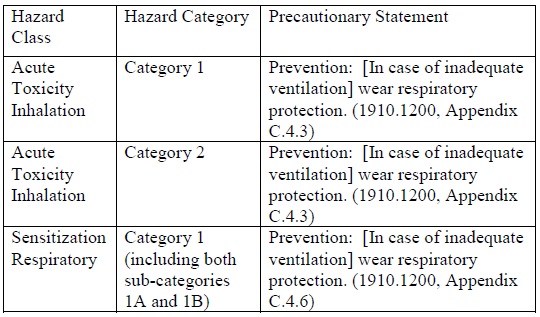
- chemicals that are acutely toxic by inhalation and respiratory sensitizers require the precautionary statements indicated in Table 1 below
- employers using chemicals classified as acutely toxic by inhalation and respiratory sensitizers must have completed exposure assessments as required by 1910.134(d)(1) if there is a reasonable possibility of employee overexposure.
Table 1. Hazard Classification and Respirator Precautionary Statement in 29 CFR 1910.1200
- after a workplace hazard assessment identifies respiratory hazards, the employer must select the respirator/filter appropriate for the workplace environment based on the airborne hazard(s) present and workplace and user factors that affect respiratory performance and reliability.
- selection process must include:
- For particulates, the determination of the filtration efficiency, i.e., whether the filter media is 95%, 99%, or 99.97% efficient;
- For chemical vapors, whether the sorbent bed characteristics are specific to the hazard;
- an evaluation of the selected respirator/filter’s assigned protection factor (APF) and the protection provided to the employee [(d)(3)(i)(A)]; and,
- the maximum use concentration (MUC) for which the respirator may be used [(d)(3)(i)(B)].
- All respirators required to be used in the workplace must be NIOSH-approved and appropriate for the hazard
- this includes specialized-use respirators such as for Chemical, Biological, Radiological, Nuclear, and Explosive (CBRNE) use.
- employers must
- select a respirator/filter that maintains the exposure at or below the MUC, as measured outside the respirator,
- not apply MUCs to IDLH conditions,
- set the maximum MUC at the lower limit when the calculated MUC exceeds the IDLH or the performance limits of the cartridge
- must follow the respirator/filter manufacturer’s recommendations
Program Administrator
- “respiratory protection program administrator” is required to oversee and evaluate the respirator program
- individual must be suitably trained and have the appropriate accountability and responsibility to manage the full respiratory protection program
- companies with multiple work sites may have a program administrator at each work site, as long as this person is qualified and retains the accountability and responsibility for the day-to-day operation of the specific program for that site
- alternatively, a company may opt to have one program administrator for several sites and/or one program for several similar sites as long as the program contains the necessary elements and addresses the hazards at those sites
- extent of training or experience required for the program administrator will vary based on the complexity of the respiratory hazards in the workplace
ESLI or CHANGE OUT SCHEDULES
- cartridge/canister air purifying respirator for the protection against gases and vapors does not have an end-of-service-life indicator (ESLI), then the employer must implement a cartridge/canister change schedule based on objective information that will ensure the cartridges/canisters are changed before the end of their service life
- purpose of a change schedule is to establish the time period for replacing respirator cartridges and canisters; this is critical to preventing contaminants from respirator breakthrough, and thereby over-exposing workers.
- Data and information relied upon to establish the schedule must be included in the respirator program.
Several of OSHA’s substance-specific standards contain provisions addressing this issue:
- Acrylonitrile 1910.1045(h)(2)(ii)(A): end-of-service life or end of shift (whichever occurs first).
- Benzene 1910.1028(g)(2)(ii): end-of-service life or beginning of shift (whichever occurs first).
- 1,3-Butadiene 1910.1051(h)(2)(ii): every 1 – 4 hours depending on the concentration according to Table 1 and at beginning of each shift.
- Vinyl chloride 1910.1017(g)(3)(ii): end-of-service life or end of shift in which they are first used (whichever occurs first).
- Methylene chloride 1910.1052(g)(2)(ii): canisters may only be used for emergency escape and must be replaced after use.
- change schedule for a mixture should be based on reasonable assumptions that include a margin of safety for the worker wearing the respirator
- Where the individual compounds in the mixture have similar breakthrough times (i.e., within one order of magnitude), service life of the cartridge should be established assuming the mixture stream behaves as a pure system of the most rapidly migrating component or compound with the shortest breakthrough time (i.e., sum up the concentration of the components).
- Where the individual compounds in the mixture vary by two orders of magnitude or greater, the service life may be based on the contaminant with the shortest breakthrough time. OSHA believes that an approach such as this may reflect good health and safety practice where neither objective nor experimental data are available for the mixture.
MEDICAL EVALUATIONS
- evaluation must be provided before the initial fit-testing and before the respirator is used for the first time.
- evaluations consist of the administration of a medical questionnaire, which is found in the mandatory Appendix C of the standard, or provision of a physical examination that elicits the same information as the questionnaire for the employee.
- An employer who opts to provide physical examinations to his or her employees need not also administer the medical questionnaire.
- evaluations are required for all respirator users except for employees who voluntarily use dusts masks and for those whose only respirator would be the use of escape-only respirators.
- SCBA is NOT considered an escape-only respirator.
- Employees who refuse to be medically evaluated CANNOT be assigned to work in areas where they are required to wear a respirator
- where employers use a transient workforce (e.g., temporary or construction workers), the employer may accept the written medical recommendation of the employee’s ability to use a respirator as determined by the employee’s previous employer’s physician or other licensed health care professional (PLHCP) only if the work conditions and type and weight of the respirator remains the same and appropriate for use at the employee’s new work site. In this situation, the employer must obtain from the previous employer a copy of the PLHCP’s written recommendation
- employer may NOT change the wording of questions in Part A, if the form is being used as the sole means to evaluate employees
- PLHCP may add questions to the questionnaire that could assist in determining whether the employee can perform the work while wearing respiratory protection
WOW!!!!!!…. In order to maintain strict confidentiality of the information obtained in the questionnaire, the employer’s role is limited to distributing the blank questionnaire to the employee for him or her to fill out, or providing it to the PLHCP, who will administer the questionnaire to the employee. If the employer provides the questionnaire to the employee, an addressed and postage-paid envelope should also be provided for the employee to mail it to the PLHCP. The questionnaire and findings may also be maintained by the employer’s medical office, if the health office is administratively separate from the employer’s central administration offices.
- employer must ensure that the questionnaire is administered in such a manner that employees can understand the content, and the confidentiality of the record is maintained
- PLHCP may be a physician, a registered nurse, a nurse practitioner, a physician assistant, or other licensed health care professional acting within the scope of his or her state license, registration, or certification
- PLHCP must be legally permitted by his or her professional license to conduct the type of medical evaluation required by the Respiratory Protection standard
FIT TESTING
- required for all employees using negative or positive pressure tight-fitting respirators, where such respirators are required by OSHA or where the employer requires the use of such a respirator.
- fit test is not required for voluntary users or for escape-only respirators
- fit test must be performed before the respirator is used in the workplace
- must be repeated at least annually and
- whenever a different respirator facepiece is used or
- a change in the employee’s physical condition could affect respirator fit
- if the respirator subsequently becomes unacceptable to the employee (i.e., causes irritation or pain to the employee), the employee must be given the opportunity to select a different respirator facepiece and be retested.
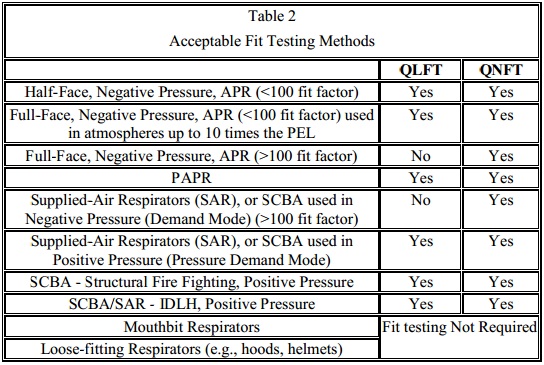
- Qualitative Fit Testing (QLFT) may be used to fit test negative pressure air-purifying respirators if they will ONLY be used in atmospheres less than ten times the PEL, since existing evidence only validates the QLFT protocols listed in Appendix A of the standard to identify respirators that achieve a fit factor of 100.
- For greater concentrations, Quantitative Fit Testing (QNFT) MUST be used.
- when quantitative fit testing is used, all full-facepiece respirators must meet or exceed a fit factor of 500,
- quarter- and half-mask respirators must meet or exceed 100
- when quantitative fit testing is used, all full-facepiece respirators must meet or exceed a fit factor of 500,
- positive pressure, atmosphere-supplying respirators, either qualitative or quantitative fit testing may be used
Use of Respirators
- must establish and implement procedures for the proper use of respirators
- procedures include:
- prohibiting conditions that may result in facepiece leakage
- preventing employees from removing respirators in hazardous environments
- ensuring continued respirator operation throughout the shift
- establishing procedures for the use of respirators in IDLH atmospheres
- procedures include:
- CSHO should be alert for the presence of facial hair (more than one day’s growth) that comes between the sealing surface of the respirator and the face as well as other conditions that could result in facepiece seal leakage or interfere with valve function of tight-fitting respirators, such as the presence of facial scars, the wearing of jewelry, or the use of headgear that projects under the facepiece seal.
- Corrective glasses or goggles or other personal protective equipment (such as faceshields, protective clothing, and helmets) must not interfere with the seal of the facepiece to the face of the user.
- if employees wear other safety equipment with their respirators, the employees must pass an appropriate fit test while wearing the equipment to determine if it interferes with the seal.
Continuing Respirator Effectiveness
- required, by paragraph (g)(2)(i), to maintain appropriate surveillance of workplace conditions and degree of employee exposure (such as to air contaminants) or stress
- paragraph (c)(1)(ix) requires employers to address in its written program the type of regular surveillance of the workplace necessary to evaluate the effectiveness of the respirator program
- surveillance procedures may include continuous or periodic monitoring, on-site observations, and notation of problems
- intensity of the surveillance should be tailored to the hazards present in the workplace
- Highly hazardous substances that pose acute respiratory hazards merit a higher degree of surveillance
IDLH Atmospheres
- employer must be prepared for emergency rescue or respirator failure whenever employee(s) are working inside of an IDLH atmosphere
- at least one (1) person must be on standby outside the IDLH atmosphere and maintain communication with the person inside at all times
- standby person(s) must be trained and equipped to provide an effective emergency rescue
- Except in emergency situations, environments containing IDLH atmospheres are frequently well enough characterized and controlled that a single standby person can monitor the status of multiple entrants.
- the need for multiple standbys should be evaluated in conjunction with the ability of the standby personnel to meet all their standby duties, including their ability to monitor the worker(s) in the area and their ability to initiate effective rescue procedures.
- procedures must address how the employer will be notified when standby person(s) outside of the IDLH atmosphere enter the IDLH atmosphere to provide emergency rescue and what actions will be taken or assistance provided by the employer
- emergency procedures must be developed and included in the employer’s written respiratory protection program
- employee(s) located outside must maintain a visual, voice, or signal line of communication with the employee(s) in the IDLH atmosphere
Paragraph (g)(3) does not apply to IDLH atmospheres in a permit-required confined space (PRCS) or to environments in which there is an uncontrolled release of a hazardous substance. IDLH atmospheres in a PRCS are specifically addressed in the PRCS standard, 1910.146, and its accompanying directive, CPL 02-00-100. Environments in which there is an emergency release of a hazardous substance are addressed in paragraph (q) of OSHA’s Hazardous Waste Operations and Emergency Response (HAZWOPER) standard, 1910.120 or 1926.65, and its accompanying directive, CPL 02-02-073. In facilities where an uncontrolled release of a hazardous substance could create an emergency IDLH atmosphere, employers must follow the requirements of HAZWOPER paragraph (q). These situations must be addressed in the employer’s emergency response plan and the response procedures must be consistent with that standard.
Procedures for Interior Structural Firefighting
- applies to private sector workers engaged in firefighting, including those working in industrial fire brigades and private incorporated fire companies, and to Federal employees under Section 19 of the Act.
- these or equivalent provisions apply to State and local government firefighters only in the 27 States that operate OSHA-approved State plans, which are required to adopt an identical or “at least as effective” standard and extend its coverage to public employees.
- coverage of volunteer firefighters in these States varies by State and depends on State law
- provision is limited to workers performing an interior attack on an interior structural fire
- OSHA has defined “interior structural fire fighting” to mean: “the physical activity of fire suppression, rescue or both, inside of buildings or enclosed structures which are beyond the incipient stage.”
- This is firefighting to control or extinguish a fire in an advanced stage of burning, producing large amounts of smoke, heat and toxic products of combustion.
- it is the incident commander’s responsibility, based on training and experience, to judge whether a fire is an interior structural fire, and how it will be attacked
- must always be at least two firefighters stationed outside during interior structural firefighting,
- they must be trained, equipped and prepared to enter if necessary to rescue the (at least two) firefighters inside.
- incident commander has the responsibility and flexibility to determine when more than two outside firefighters are necessary given the circumstances of the fire
- two-in/two-out rule does NOT require an arithmetic progression for every firefighter inside, i.e., the rule should NOT be interpreted as 4-in-4-out, 8-in-8-out, etc.
- there is an explicit exemption in the standard that if life is in jeopardy, firefighters have the discretion to perform the rescue, and the “two-in/two-out” requirement is waived
- there is no violation of the standard under such life-saving rescue circumstances
- two-in/two-out provision is not intended as a staffing requirement
- it does NOT require fire departments to hire additional firefighters
- it does NOT require four-person fire companies
- it does NOT require four persons on a fire truck
- the “two-in/two-out” rule is a worker safety practice requirement, NOT a staffing requirement
- standard allows one of the standby firefighters to have other duties such as serving as the incident commander, safety officer, or operator of fire apparatus
- one (1) of the outside firefighters must actively monitor the status of the inside firefighters and may NOT be assigned additional duties
- second outside firefighter may be involved in a wide variety of activities
- BOTH of the outside personnel must be able to provide support and assistance to the two interior firefighters; any assignment of additional duties for one of the outside firefighters must be weighed against the potential for interference with this requirement
- one (1) of the outside firefighters must actively monitor the status of the inside firefighters and may NOT be assigned additional duties
- two firefighters (buddies) entering an IDLH atmosphere to perform interior structural firefighting must maintain visual or voice communication at all times
- electronic methods of communication such as the use of radios shall not be substituted for direct visual contact between the team members in the danger area
- reliable electronic communication devices are not prohibited and certainly have value in augmenting communication and may be used to communicate between inside team members and outside standby personnel
- electronic methods of communication such as the use of radios shall not be substituted for direct visual contact between the team members in the danger area
Maintenance and Care of Respirators
- respirators must be
- cleaned and disinfected as often as necessary to keep them in a sanitary condition
- properly stored to prevent damage and contamination
- inspected regularly and repaired as necessary
- employer can have respirators cleaned and repaired in a centralized operation where respirators are passed out to employees, or require the respirator user to perform all cleaning and respirator maintenance functions
- respirators issued to more than one employee must be cleaned and disinfected before being worn by another user
- use of individually-wrapped cleaning towelettes may be appropriate as an interim method in the cleaning schedule for individually assigned respirators, but they must not be the only method in place
- during fit testing, towelettes may also be used between employees being tested, however these respirators must be thoroughly cleaned at the end of each day, using the procedures in Appendix B-2
- must ensure that respirators are inspected before each use and during cleaning
- a minimally acceptable inspection procedure for ALL respirators includes
- a check of respirator function,
- tightness of connections and
- the condition of the various parts, including but not limited to
- the facepiece,
- head straps,
- valves,
- connecting tube,
- cartridges, canisters, or filters, and
- a check of the respirator’s elastomer parts for pliability and signs of deterioration.
- SCBAs also require an inspection of the air and oxygen cylinders to assure that the cylinder pressure is maintained at 90% of the manufacturer’s recommended pressure level and that the regulator and low pressure warning devices function properly.
- to assure that both the regulator and low pressure warning devices function properly, the warning device must be activated and heard by the person performing the inspection
- respirators must be properly stored to protect them against physical damage, contamination, excessive moisture, extreme temperatures, sunlight, and damaging chemicals
- emergency use respirators must be stored in compartments or in covers, both of which must be clearly marked as containing the emergency respirators
Respirators That Are Available for Emergency Use
- inspection must be conducted monthly for all emergency use respirators
- must certify in writing that an inspection was performed
- certification must include:
- the name (or signature) of the person who made the inspection,
- the findings of the inspection,
- any remedial action, and
- a serial number or other means of identifying the inspected respirator.
- respirator must also be checked before and after each use
- emergency escape-only respirators carried by employees must be inspected before being taken into the workplace for potential use
Repairs
- defective respirators must be removed from service
- respirator is defective if one or more of its components is missing, damaged, or visibly deteriorated
- employer must develop some means to ensure defective respirators are not used in the workplace
- can comply by placing an “out of service” tag on the respirator to help ensure that the defective respirator is not inadvertently used or by removing the respirator from the work area
- appropriately trained person must be responsible for performing repairs or adjustments to respirators
- appropriately trained person is an individual who has received training from the manufacturer or otherwise has demonstrated that he or she has the skills to return the respirator to its original state of effectiveness
- training is performance-oriented, so it is acceptable for the employee to have acquired the skills through practice rather than by attending a formal training course
- repairs to reducing and admission valves, regulators, and alarms must be done by a technician trained by the manufacturer
- Only the respirator manufacturer’s NIOSH-approved parts that are designed for the particular respirator being repaired can be used to repair a respirator.
Breathing Air Quality and Use
- compressed breathing air must meet at least the requirements for Grade D breathing air
- if compressors are used to supply breathing air, the CSHO should note the location of the compressor intake and ensure it is located in an area uncontaminated by either combustion exhaust gases produced by vehicles or the compressor itself (if applicable), or by other exhaust gases ventilated from plant processes
- a tag containing the signature of the person authorized by the employer to change the in-line sorbent beds and filters and the date of the latest change must be maintained at the compressor
- air compressors that are NOT oil lubricated, a CO alarm is NOT required
- employer is required to ensure that carbon monoxide levels in the breathing air do not exceed 10 ppm
- practical methods for ensuring that the carbon monoxide level does not exceed 10 ppm include:
- placing the air intake for the compressor in an area that the employer knows is free from contaminants,
- frequent or continuous monitoring of the breathing air supply,
- the use of carbon monoxide filters, or
- the use of a high temperature alarm or shut off devices
- practical methods for ensuring that the carbon monoxide level does not exceed 10 ppm include:
- employer is required to ensure that carbon monoxide levels in the breathing air do not exceed 10 ppm
- an oil-lubricated air compressor MUST have either
- a carbon monoxide alarm,
- high temperature alarm,
- or both
- if ONLY a high temperature alarm is used, then the breathing air must be tested for the presence of carbon monoxide at intervals sufficient to ensure that carbon monoxide levels do not exceed 10 ppm
- the alarm must be able to alert the users or another employee who knows to alert any respirator users
- if ONLY a high temperature alarm is used, then the breathing air must be tested for the presence of carbon monoxide at intervals sufficient to ensure that carbon monoxide levels do not exceed 10 ppm
- if cylinders are used they must be marked with a NIOSH-approval label
- Cylinders of purchased breathing air must have a certificate of analysis from the supplier that the breathing air meets the required Grade D air and moisture content
- ALL breathing air couplings must be incompatible with those of non-respirable air or other gases used at the site to prevent inadvertent servicing of airline respirators with non-respirable gases or oxygen
Identification of Filters, Cartridges, and Canisters
- must ensure that all canisters and filters are properly labeled and color coded with the NIOSH-approval label and that the label is not removed, obscured, or defaced while in service
- date and time labels applied to the filters/cartridges should not be considered violations unless they are expired, obscure the label to disallow ready identification, or cause the labeled filter/canister to become illegible
Training and Information
- must be provided prior to an employee’s use of a respirator in the workplace and must be comprehensive and understandable
- must recur annually and more often if retraining appears necessary to ensure safe use
- must ensure that each employee can demonstrate a knowledge of all items in (k)(1)(i) thru (vii)
- Pre-testing may be used as a training aid to determine the extent of retraining required.
- employees who voluntarily wear respirators must, at least, be given the information in Appendix D of the standard
Program Evaluation
- must conduct evaluations of the workplace to ensure the written respiratory protection program is properly implemente
- employer must observe and consult employees to determine if they have any problems with the program and ensure that the respirators are used properly
- if the program administrator keeps a written assessment, implemented changes may be considered as efforts toward improvement
- recent changes in the workplace such as new processes should have been evaluated for necessary respiratory protection program changes
Recordkeeping
- For every employee required to wear a respirator, the employer must establish and retain records of medical evaluations and fit testing
- medical evaluation records must be made available to the employee and to OSHA in accordance with 1910.1020
- must also make an employee’s fit testing records available to that employee and to OSHA
- standard does not intend for the employer to make an employee’s medical or fit testing records available to any other individual unless that individual is the employee’s “designated representative,” as defined in 1910.1020(c)(3)
- employer must retain a record of the medical evaluation which includes the PLHCP’s written recommendation
- Fit test records must be kept until the next fit test is administered
- each fit test record must contain:
- the employee identification,
- type of fit test,
- date last tested,
- the results of the test, and
- the make, model and size of the respirator tested
- each fit test record must contain:
CLICK HERE for the entire CPL