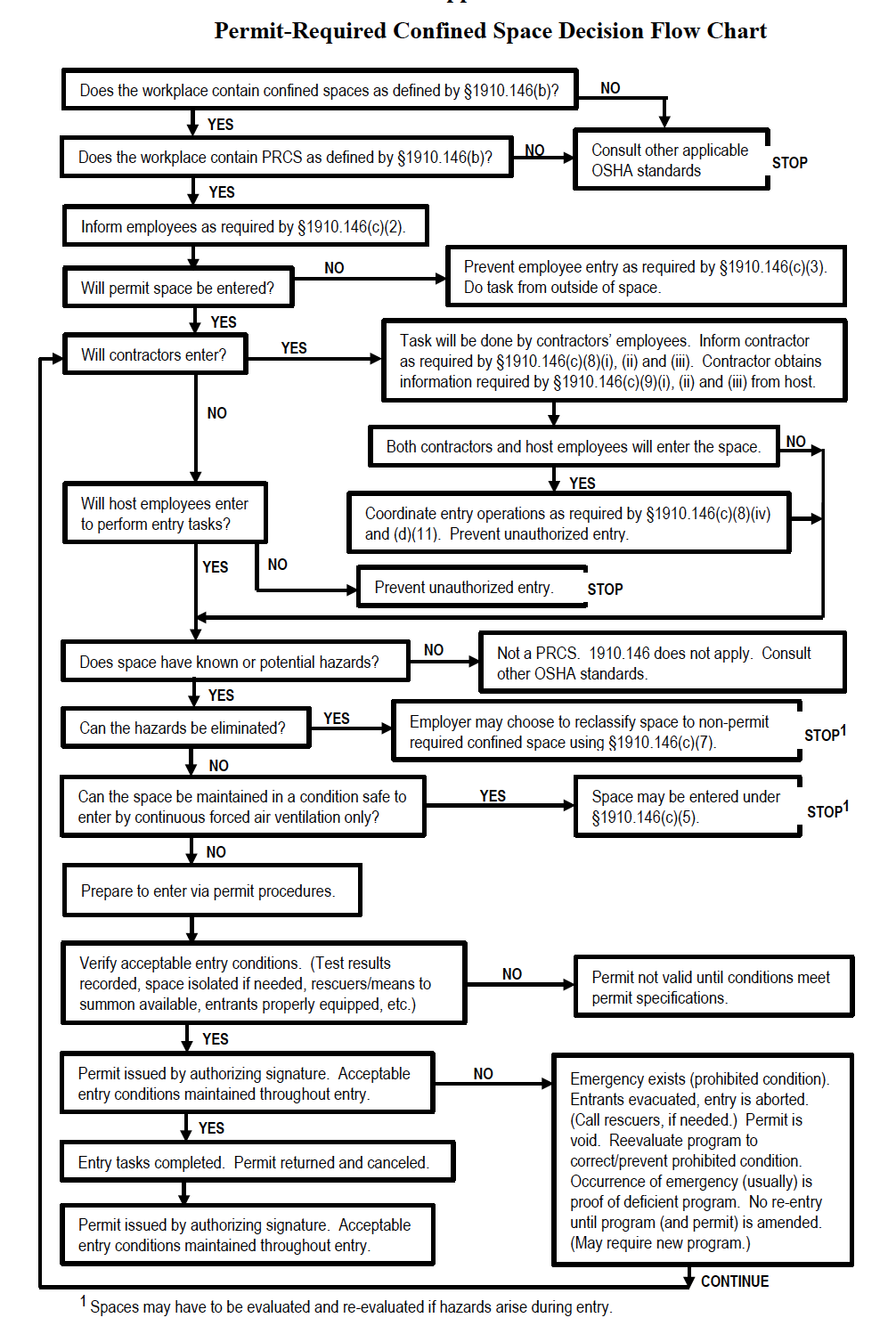
This OSHRC decision reverses an ALJ decision which I posted in August 2013, but this case has some very interesting aspects that EVERYONE who manages a PRCS Entry program needs to read. Most notably, this case involves:
- gas meter maintenance,
- program revision/employees not protected,
- “Conditions” Required for Alternate Entry,
- program revision/annual permit review,
- enforcement,
- specify acceptable entry conditions.
I have highlighted some key aspects, but this one the OSHRC got it right!
A company operates several industrial truck tank-washing facilities. OSHA inspected the facility following an accident involving an employee who required emergency medical assistance after he was found unconscious in a tank at the facility. OSHA issued two citations alleging several serious and willful violations. Most of the items alleged violations of various sections of the permit-required confined spaces (PRCSs) standard, 29 C.F.R. § 1910.146. The Secretary proposed a total penalty of $314,000. The parties settled several citation items prior to the hearing, leaving five serious items and four willful items with a total proposed penalty of $238,000 at issue before Administrative Law Judge Sharon D. Calhoun. The judge affirmed two citation items as serious (Serious Citation 1, Item 13 and Willful Citation 2, Item 1a) and two citation items as willful (Willful Citation 2, Items 2 and 3). She vacated the remaining five items (Serious Citation 1, Items 10, 11a, 11b, and 12, and Willful Citation 2, Item 1b). The judge assessed a total penalty of $150,000.
Both parties petitioned for review of the judge’s decision. At issue before the Commission are three of the items affirmed by the judge, including the willful characterization of two of those items—Serious Citation 1, Item 13 (non-entry rescue system), and Willful Citation 2, Items 2 (testing of conditions in permit space) and 3 (entry permit preparation). Also at issue are four of the items vacated by the judge based on her finding that the facility complied with the alternate entry procedures specified in § 1910.146(c)(5)
Serious Citation 1, Items 10 (gas meter maintenance), 11a (program revision/employees not protected), and 11b (program revision/annual permit review), and Willful Citation 2, Item 1b (specify acceptable entry conditions).
For the reasons that follow, we:
- vacate Serious Citation 1, Item 10;
- affirm Serious Citation 1, Items 11a, 11b, and 13 as serious;
- affirm Willful Citation 2, Item 1b as serious.
For the affirmed violations, we assess a total penalty of $110,500.
BACKGROUND
At the facility, employees wash trailer tanks that have been used to transport various liquids, including hazardous materials. When a customer drives an empty tank into the facility for cleaning, the tank is brought to one of four bays, where a employee first drains any residual product through a valve in the bottom of the tank. The employee then commences the cleaning process, which involves administering cleaning agents through a mechanical device called a “spinner.” While standing on a catwalk that provides access to an opening in the top of the tank, the employee inserts the spinner into the opening, and the spinner sprays the cleaning agent onto the tank’s interior surfaces. The cleaning process can involve hot or cold water, a hot detergent wash, a hot caustic wash, a wash using a solvent, or a combination of these substances, depending on the contents of the tank before cleaning. After this wash, the employee uses the spinner again to spray rinse water into the tank, then uses steam and blow dryers to sanitize and dry the tank. On occasion, this process does not completely clean the tank. In such instances, an employee must enter the tank to remove the remaining residue. The facility has a written “Permit Required Confined Space Entry Program,” which includes a provision stating that tank entry is allowed only if a supervisor completes and issues a permit authorizing entry. Before issuing a permit, a supervisor must test the tank’s atmosphere for oxygen content and for flammable and toxic vapors. If the supervisor issues a permit, the employee entering the tank must wear a harness attached to a retrieval device to enable non-entry rescue in the event of an emergency. A standby employee or “attendant” must be present outside the tank to monitor the entering employee at all times, and the facility uses blowers to continuously blow outside air into the tank during an entry.
Towards the end of the overnight shift on January 28, 2009, the employee supervising that shift’s tank washing crew (Supervisor A) began cleaning a tank that contained a pasty residue. He observed that the residue was not draining properly out of the bottom of the tank, so he decided to enter the tank to clear any obstruction. It is undisputed that Supervisor A did NOT conduct any atmospheric testing, complete a permit before entering the tank, or use his harness and the non-entry rescue system. Once inside the tank, Supervisor A lost consciousness and had to be rescued by the Summit Fire Department. Emergency personnel took Supervisor A to the hospital where doctors diagnosed him with “Syncope and Collapse, Toxic Effect of Unspecified Gas, Fume, or Vapor.” The Facility Manager formally disciplined Supervisor A in writing on the day of the accident.
DISCUSSION
The seven alleged violations before us on review fall into two categories:
(1) those based on Supervisor A’s entry into the tank, and
(2) those for which the facility claims that it complied with the PRCS standard’s alternate entry procedures specified in § 1910.146(c)(5).
I. Alleged Violations Based on Supervisor A’s Tank Entry
The Secretary alleges three violations based on Supervisor A’s conduct before and during his entry into the tank on the day of the accident:
- Serious Citation 1, Item 13, based on Supervisor A’s failure to attach himself to a non-entry rescue system before entering the tank, in violation of § 1910.146(k)(3);
- Willful Citation 2, Item 2, based on Supervisor A’s entry into the tank without first testing the conditions inside to ensure that it was safe for entry, in violation of § 1910.146(d)(5)(i); and
- Willful Citation 2, Item 3, based on Supervisor A’s failure to complete an entry permit documenting the measures taken to ensure safe entry, in violation of § 1910.146(e)(1).
At issue on review is the judge’s finding that the facility had knowledge of the conditions alleged under all three items, as well as her characterization of the two items as willful.
A. Knowledge
Under Commission precedent, to establish knowledge, the Secretary must prove that the employer knew or, with the exercise of reasonable diligence, should have known of the conditions constituting the violation. The judge concluded that the facility had actual knowledge of the violative conditions by imputing Supervisor A’s knowledge of his own violative conduct to the company, citing Dover Elevator for the proposition that “when a supervisory employee has actual or constructive knowledge of the violative conditions, that knowledge is imputed to the employer, and the Secretary satisfies his burden of proof without having to demonstrate any inadequacy or defect in the employer’s safety program.”
Here, there is no dispute that Supervisor A had actual knowledge of his own misconduct. Thus, under Commission precedent, Supervisor A’s knowledge is imputable to the company. However, the Third Circuit, one of three circuits to which this case could be appealed, differs from the Commission, as it requires that in order to impute knowledge from a supervisor who participates in the violative conduct, the Secretary must prove that the supervisor’s participation was foreseeable by showing that the employer’s safety program was inadequate. Although neither the Seventh nor D.C. Circuit has indicated whether it would adopt the Third Circuit’s view, even under the Third Circuit’s foreseeability test we would reach the same conclusion because, as discussed below, we find the record shows that Supervisor A’s misconduct was foreseeable. While the judge did not analyze the facility’s safety program in the context of her knowledge analysis, she considered its adequacy in her analysis of the facility’s affirmative defense of unpreventable employee misconduct (UEM). She rejected the defense, finding that the company failed to take reasonable steps to discover violations of its work rules and failed to enforce those rules. We agree with the judge that the facility’s safety program was inadequate because the facility did not effectively enforce its work rules designed to protect employees from PRCS hazards when violations were discovered.
As the judge found, the record shows that the facility had work rules designed to prevent the violations and had communicated those rules to its employees. The facility’s program bars entry into “dirty” tanks, i.e., those that have not been washed. The program does allow entry into “clean” tanks, i.e., those that have gone through a mechanical wash, but employees must treat washed tanks as PRCSs. This includes requiring employees to wear a harness and attach it to a retrieval line to enable non-entry rescue, to test the atmospheric conditions within the tank, and to complete an entry permit before entering a PRCS. These rules were included in the PRCS training program used to train employees and were communicated to employees, including Supervisor A.
The record also shows that the facility had a reasonable method to discover violations of its rules. First, as the judge points out, the facility could readily discover such violations by reviewing the tank entry permits, which the Facility Manager acknowledged he did. Second, as described in the table below, each of the 28 entry permits produced to the Secretary had an error or omission, and 11 of those deficient permits—nearly 40%—were completed by Supervisor A.
| Tank Entry Permit Deficiencies | ||||||||||
|
Permit Number |
Supervisor A Involved? |
Lack of Post-Entry Air Monitoring |
Duration of Authorization Not Specified |
Duration of Authorization Exceeded |
Entry and/or Exit Times Missing |
No or Missing MSDS Review |
Entrant Not Listed |
Attendant Not Listed |
No supervisor approval and/or permit cancellation |
No Toxicity or LEL Levels Recorded |
| 649 | No | x | x | |||||||
| 650 | No | x | x | |||||||
| 651 | No | x | x | |||||||
| 652 | No | x | x | |||||||
| 653 | No | x | x | |||||||
| 654 | Yes | x | x | x | x | x | ||||
| 655 | No | x | x | |||||||
| 656 | No | x | x | |||||||
| 657 | No | x | x | |||||||
| 658 | No | x | x | |||||||
| 659 | No | x | x | x | ||||||
| 660 | Yes | x | x | x | x | |||||
| 661 | Yes | x | x | x | ||||||
| 662 | Yes | x | x | x | ||||||
| 663 | Yes | x | x | |||||||
| 664 | Yes | x | x | x | x | |||||
| 665 | Yes | x | ||||||||
| 666 | No | x | x | x | ||||||
| 667 | No | x | x | |||||||
| 668 | Yes | x | x | x | x | x | ||||
| 669 | No | x | x | x | ||||||
| 670 | Yes | x | x | x | x | x | ||||
| 671 | No | x | ||||||||
| 672 | Yes | x | x | |||||||
| 673 | Yes | x | x | x | ||||||
| 674 | No | x | x | |||||||
| 675 | No | x | x | x | ||||||
| 676 | No | x | x |
|
||||||
While none of these deficiencies show the specific violations at issue here with regard to Supervisor A’s entry, evidence relating to an employer’s entire safety program, not just those aspects specific to the citations at issue, is relevant to assessing the program’s adequacy for foreseeability purposes.
The deficiencies evident in all 28 tank entry permits show that employees were violating safety rules. For instance, the facility’s PRCS program requires employees to conduct air monitoring subsequent to entry and record the monitoring results on the permits, yet no such results appear on any of the 28 permits in evidence. Both the company’s PRCS program and PRCS training program also state that permits must specify the duration for which they are valid, yet seven of the permits show entries exceeding the 20 minutes that the permits specify as the maximum duration—including one showing a 1-hour, 40-minute entry; one showing a 1-hour, 30-minute entry; and one showing a 2-hour entry. In addition, the facility’s PRCS training program requires employees to review material safety data sheets (MSDSs), but 12 permits either have no indication of whether MSDSs were reviewed or affirmatively indicate that they were not reviewed at all. Moreover, both the PRCS program and the PRCS training program require the entrant and the attendant to be listed on the permits before entry. Nonetheless, six permits — all completed by Supervisor A — do not name an entry attendant, and two additional permits, also completed by Supervisor A, name the attendant but not the entrant. Finally, one permit indicates that an employee entered a dirty tank which, if true, would have been a clear violation of the facility’s work rule prohibiting such an entry.
Even if the permits are only facially deficient and the required actions were in fact taken, the permits plainly show that employees were violating the work rules the facility had for completing them and, at least in some cases, indicate that employees were failing to comply with other entry work rules as well. The Facility Manager testified that he reviewed these completed permits, and while that demonstrates the facility had a reasonable method of discovering deficiencies, we find that the Facility Manager’s failure to follow up on the permit deficiencies he observed demonstrates a failure to enforce the company’s program.
Moreover, Supervisor A admitted that he violated the work rules at issue here because he “was tired, it was cold, and [he] wanted to try to just finish that trailer.” Supervisor A’s own permits, on their face, show numerous violations of work rules, and his conduct on the day of the accident is consistent with those previous violations, all of which support the conclusion that he did not fear disciplinary action for violating the facility’s safety rules. This misconduct, combined with the company’s apparent acceptance of deficient entry permits without repercussions, establishes that the facility failed to enforce its safety program.
Accordingly, we conclude that Supervisor A’s misconduct was foreseeable, and thus his knowledge of his own misconduct would be properly imputable to the facility even under Third Circuit precedent. As no other elements of the violations are at issue, we affirm Serious Citation 1, Item 13, and Willful Citation 2, Items 2 and 3.
B. Characterization of Willful Citation 2, Items 2 and 3
On review, the facility challenges the judge’s willful characterization of Items 2 and 3, which allege violations pertaining to Supervisor A’s entry into the tank without testing the atmosphere and without completing a tank entry permit. “Willful violations are ‘characterized by an intentional or knowing disregard for the requirements of the Act or a “plain indifference” to employee safety, in which the employer manifests a “heightened awareness” that its conduct violates the Act or that the conditions at its workplace present a hazard.’ This state of mind is evident where “the employer was actually aware, at the time of the violative act, that the act was unlawful, or that it possessed a state of mind such that if it were informed of the standard, it would not care.” The judge affirmed Items 2 and 3 as willful based on Supervisor A’s admission that he knew it was wrong to enter the tank without testing it or completing a tank entry permit. We agree with the judge that Supervisor A’s conduct was willful. Supervisor A knew he was violating the facility’s safety rules and OSHA’s PRCS standard when he entered the tank without first testing the atmospheric conditions or completing an entry permit. As noted above, he admitted that he disregarded these rules because it was the end of his shift, he was tired, it was cold, and he “just wanted to finish that trailer.” We find that Supervisor A’s conduct shows a conscious disregard for known requirements of the standard, and his willful state of mind is imputed to the company.
We also REJECT the facility’s contention that it made a good faith effort to comply sufficient to overcome a finding of willfulness. Although the company had work rules that it communicated to its employees and submitted evidence of three instances of disciplinary action, the fact remains that the facility’s Manager, despite admitting that he reviewed all the permits, never disciplined an employee for improperly completing entry permits or for the violations that were readily apparent on the face of the permits. While the facility’s conduct does not amount to an “ ‘absence of any evidence that [the employer] enforced [its] safety rules,’ ”, a good faith effort to comply requires some action when violations of safety rules are plain, as they certainly were here. Therefore, we affirm BOTH items as WILLFUL.
II. Applicability of Alternate Entry Procedures and Other Alleged PRCS Violations
A. Did the facility Meet the “Conditions” Required for Alternate Entry?
The facility asserts that it was not required to comply with the cited provisions of the PRCS standard because, it contends, it was entitled to rely on the alternate entry procedures specified in § 1910.146(c)(5)(ii). See § 1910.146(c)(5). Reliance on the alternate entry procedures, however, is only available when certain prerequisites, denoted “conditions” in the standard, are met.
1910.146(c)(5)(i) provides: “An employer whose employees enter a permit space need not comply with paragraph[] (d) . . . provided that: [alternate entry conditions (A) through (F) are satisfied].” Use of the alternate entry procedures is limited to PRCSs in which the only hazards posed are atmospheric hazards that can be controlled by ventilation. § 1910.146(c)(5)(i)(A). To be exempt from the full permit procedures in paragraph (d), all of the conditions detailed in § 1910.146(c)(5)(i)(A)-(F) must be met.
The judge found that the facility complied with all of the specified alternate entry conditions under § 1910.146(c)(5)(i), and therefore she vacated all four citation items that the Secretary alleged under paragraph (d) of the PRCS standard. For the following reasons, we find that the facility failed to meet the conditions set forth under paragraphs (B) and (C), and therefore conclude that it did not qualify for use of the alternate entry procedures.
Paragraph (B) requires an employer to “demonstrate that continuous forced air ventilation alone is sufficient to maintain that permit space safe for entry[.]” § 1910.146(c)(5)(i)(B). Paragraph (C) has an associated condition—an employer must “develop[] monitoring and inspection data that supports the demonstrations required by paragraph[] . . . [(B)] . . . .” § 1910.146(c)(5)(i)(C). The judge found that the facility met the requirement in paragraph (B) because the facility’s tank entry procedure requires testing for hazards before entry and the facility “established [that] it uses continuous forced air ventilation during entry.” The judge also found that the facility’s tank entry permits document the monitoring and inspection data requirements of paragraph (C).
Although paragraph (B) itself does not specify what sort of demonstration would be sufficient to show that continuous forced air ventilation alone is sufficient to maintain the permit space safe for entry, the preamble to the PRCS standard reflects OSHA’s concern that the demonstration realistically account for the critical role played by the ventilation system where the alternative procedures have displaced other protective measures:
In order for the space to be considered safe, the atmosphere within the space after ventilation may not be expected to approach a hazardous atmosphere. This is necessary so that, if the ventilation shuts down for any reason (such as loss of power), the employees will have enough time to recognize the hazard and either exit the space or restore the ventilation. A guideline of 50 percent of the level of flammable or toxic substances that would constitute a “hazardous atmosphere” may be used by employers in making the determination required under (c)(5)(i)(B). Permit-Required Confined Spaces, 58 Fed. Reg. 4,464, 4,488 (Jan. 14, 1993).
We agree with the Secretary that to satisfy paragraph (B) in the circumstances here, the facility had to have monitoring and inspection data, specified under paragraph (C), proving that ventilation would “maintain” the atmosphere inside its tanks safe for entry. While the facility contends that paragraph (B) has been met because its wash process renders tanks free from any potential hazardous atmosphere such that its use of continuous ventilation during entry is an additional, but unnecessary, precaution, the record does NOT support this claim. The facility’s expert and an engineer who consults with transportation clients on confined space entry compliance, testified that the company’s wash process removes any potential hazardous atmosphere from the tanks, which he based on his “first hand evaluation of the procedures used to clean those tank trailers and dry [them] and . . . testing data that I’ve seen and . . . produced.” He did not identify the “data” to which he was referring and his only supporting reference appears to be a report he finalized in July 2009, in which he concluded that “[b]ased on a review of previous atmospheric testing results at the other company facilities and the pre-tank entry test results at the Summit terminal, the tank trailer washing procedures are found to be adequate to remove any potential atmospheric or dermal hazards inside the tank trailers.”
We find that this report is of limited value. It does not specify what past “testing results” the expert relied on to reach this conclusion, and, in fact, the report contains no testing data at all. Furthermore, the report was dated July 2009, over six months after the January 2009 inspection, so we find it of limited value, if any, in assessing the facility’s demonstration, which paragraph (B) requires be made before any tank entries occur.
The facility relies on two reports prepared for Suttles Truck Leasing, whose tank-washing facilities the company bought in 1999, to support its claim that the wash process used at the Summit facility reduces atmospheric hazards to the extent that ventilation alone is sufficient to keep its employees safe during entry. In relying on these reports, the facility points to the experts testimony that the wash process at Summit is not materially different from the wash process used by Suttles. Both of the reports — one from 1996 and the other from 1999 — contain testing data regarding the atmospheric hazards inside tanks both before and after Suttles’ wash process. The 1996 report suggests that Suttles’ wash process was successful at keeping toxic hazards below the permissible exposure limit (PEL) in tanks that employees may enter. The Commission previously considered this report in Suttles Truck Leasing, Inc., 20 BNA OSHC 1953, 1966 (No. 97-0545, 2004) (consolidated), and found, based on the report, that Suttles’ wash process purged any “toxic atmospheres” in the tanks at issue in that case. The facility contends that this report establishes that the facility’s wash process eliminated all hazards in the instant case, but we do not agree. As the Secretary’s expert pointed out at the hearing, Suttles washed the 20 tanks tested for the 1996 report using only water, while this facility often uses solvents that can, on their own, create atmospheric hazards. Furthermore, the facility’s wash process has a great deal of variability and leaves much to the discretion of its employees; for example, the facility relies on employees to decide to wash the tanks with water or a solvent and how long to wash and dry them. Thus, we find that the 1996 report fails to support the facility’s claim.
The 1999 Suttles report is equally lacking. For this report, washed tanks were tested with newly acquired photoionization detectors (PIDs), which are more sensitive in detecting volatile organic compounds than the facility’s four-gas meter. The test results from the PIDs showed that two out of Suttles’ 20 post-wash tanks had concentrations of hazardous organic vapors above the PEL. Additionally, 11 of the 51 total tests showed some level of difference between readings taken in the front, middle, and rear of the tanks, and two of the 51 showed oxygen levels below OSHA’s acceptable range. Thus, while the 1999 report concluded that “[t]here is minimal exposure to a hazardous atmosphere within a tank washed at a Suttles Truck Leasing, Inc. terminal,” it does not state if and how ventilation might affect this atmosphere during entry. Under these circumstances, we find that the 1999 and 1996 reports do not demonstrate that the facility’s tank wash process removes any potential for a hazardous atmosphere — and in fact suggests that it may not. Accordingly, neither report satisfies paragraph (B), nor contains monitoring and inspection data that satisfy the requirements of paragraph (C).
In addition, we find that the facility’s reliance on pre-entry testing does not mitigate the limitations of the facility’s tank wash process or its variability among employees who control it. Because the four-gas meter used at the Summit facility is incapable of testing for all potential atmospheric hazards, the facility’s pre-entry testing cannot serve as a check to ensure the wash process sufficiently eliminates atmospheric hazards by use of ventilation alone. As OSHA’s expert explained, this type of meter does not measure potential volatile organic compounds individually with a reading based on parts per million (ppm) — it measures these compounds all together as a lower explosive limit (LEL) percentage. As a result, OSHA’s expert stated that it is possible to have “readings of significant numbers at that parts per million level and still show zero percent LEL.” Thus, the facility’s meter might not alert employees performing pre-entry testing to volatile organic compounds above the PEL — a real possibility according to the 1999 Suttles report. Indeed, the meter’s inability to accurately report volatile organic compound levels — i.e., for purposes of toxicity (rather than explosive levels)—is relevant to the extent the facility must prove that no atmospheric contaminant can be expected to approach a hazardous level during entry. Accordingly, we find the pre-entry data recorded on the permits does not satisfy the requirements in paragraphs (B) or (C).
Finally, we note that the facility offered no data at all analyzing the effectiveness of its ventilation — no results were recorded of testing conducted after employees were in a tank for longer than an hour, which the Facility Manager identified as an entry requirement. The only evidence of monitoring results during an entry is another report from Suttles, which documents a 20-minute-long tank entry test in 1997. That tank had been washed using hot water only and was tested multiple times for temperature, relative humidity, oxygen, and LEL from eight different locations throughout the 20-minute entry. The test results showed 0.0 LEL throughout the entire entry and oxygen levels that dropped from 20.7% to 20.4%. The report, however, does not state whether there was ventilation during the entry. Accordingly, we do not find that this report, or any other evidence in the record, supports the facility’s argument that its use of continuous ventilation eliminated the possibility of a hazard developing during entry. Indeed, none of this evidence addresses or rebuts the testimony of the Secretary’s expert that the act of scraping off residue remaining after the wash process “has the potential to disturb the material in such a way that it’s going to give off . . . potentially hazardous vapors.”
In sum, we find that the facility did not satisfy the conditions specified in § 1910.146(c)(5)(i)(B) and (C) and, therefore, its contention that it could rely on the alternate entry procedures under § 1910.146(c)(5)(ii) is rejected. Accordingly, we reverse the judge’s decision to the contrary. We turn next to the four citation items alleging violations of the standard’s PRCS program requirements under § 1910.146(d).
B. Serious Citation 1, Item 10
The Secretary alleges that the facility violated § 1910.146(d)(4)(i) by failing to provide and maintain testing and monitoring equipment required to comply with paragraph (d)(5) — in other words, the facility did not have equipment to properly test and monitor the tank’s atmosphere before and during entry for acceptable levels of oxygen, combustible gases, and toxic gases. It is undisputed that at the time of the inspection, the facility’s four-gas meter (the only one at the facility) would not “zero out” or read the correct oxygen concentration of the normal atmosphere. According to the Secretary, simply turning on the meter would have alerted the facility to this problem, so the meter’s inoperability was easily determinable with the exercise of reasonable diligence. He further asserts that the facility’s own maintenance policy required calibrating the machine every 30 days and replacing the sensors every 60 days or sooner, but that the facility’s calibration log sheet shows, as of the inspection on January 28, 2009, the meter had not been calibrated since November 20, 2008 — thus, for 69 days.
There is no evidence in the record to establish when the meter became inoperable, nor has the Secretary shown that reasonable diligence required the facility to assess its operability any sooner than it did — that is, when it was next turned on. The meter’s user manual does not specify how frequently it should be calibrated, stating only to “[p]lease check frequently for proper operation and treat the instrument with the respect due a device that can save your life.” (Emphasis added.) The Secretary has not shown what the manual means by “frequently,” what the facility considers “frequent,” or what the industry considers “frequent.” Although he points to the facility’s expert July 2009 report — prepared after the OSHA inspection — as proof that the facility’s policy at that time was to calibrate the meter every 30 days and replace the sensors every 60 days, there is no evidence establishing what the facility’s policy was at the time of the inspection. The facility’s records show that it usually calibrated the meter every one to two months, but we have no basis on which to conclude that this schedule or even 69 days was deficient. Furthermore, the record shows that tank entries at the Summit facility were infrequent and that the meter was not used on a daily basis. Under these circumstances, we find that the Secretary has not established a violation of § 1910.146(d)(4)(i) and vacate Serious Citation 1, Item 10.
C. Serious Citation 1, Items 11a and 11b
Under Item 11a, the Secretary alleges that the facility violated § 1910.146(d)(13) by failing to revise its PRCS program to correct deficiencies documented on tank entry permits reviewed by the Facility Manager, including the lack of entrant and attendant names and signatures. Under Item 11b, the Secretary alleges that the facility violated § 1910.146(d)(14) by failing to revise its PRCS program once entry permits showed employees had failed to follow PRCS requirements when entering tanks. It is undisputed that these provisions apply to the cited conditions, so the only remaining issues are noncompliance and knowledge. For the following reasons, we affirm both items.
Noncompliance
According to the Secretary, the deficiencies on the entry permits—particularly the failures to record periodic testing when staying in the tanks for over an hour and failing to specify an attendant—gave the Facility Manager who reviewed them “reason to believe” that “measures taken under the facility’s PRCS program may not protect employees.” As the Secretary also notes, under the plain language of the standard, this requires the employer to take corrective action. The company responds that none of the permit deficiencies trigger the requirement to revise the program because they do not indicate defects in the written program itself—rather, they show failures to follow that program.
We disagree. Although the Secretary has not identified any deficiency in the facility’s written PRCS program that correlates with the errors on the entry permits, the distinction the facility suggests — that implementation failures are not covered by the cited provisions— lacks merit. Sections 1910.146(d)(13) and (14) both require the employer to review and revise “the program” to ensure employees are adequately protected from PRCS hazards. The standard defines a PRCS program broadly as “the employer’s overall program for controlling, and, where appropriate, for protecting employees from, permit space hazards and for regulating employee entry into permit spaces.” § 1910.146(b). Indeed, under § 1910.146(d), which is titled “Permit-required confined space program (permit space program),” the first provision requires the employer to “[i]mplement the measures necessary to prevent unauthorized entry.” § 1910.146(d)(1) (emphasis added).
In addition, in the “Note” following § 1910.146(d)(13), one of the listed “[e]xamples of circumstances requiring the review of the permit space program” is of an implementation problem — “any unauthorized entry of a permit space” — as such entries by definition do not comply with the terms of a compliant program. See § 1910.146(d)(13), note; § 1910.146(b) (defining “authorized entrant” as “an employee who is authorized by the employer to enter a permit space”); § 1910.146(d)(1) (PRCS program must restrict entry to authorized entrants); see also 58 Fed. Reg. at 4,503 (explaining that the note accompanying paragraph (d)(13) contains information intended to assist employers in complying with the requirement). Finally, the very purpose of the cited provisions is to ensure that employees are protected from permit space hazards—they are not protected if they do not follow the requirements of the standard and the employer’s PRCS program. See §§ 1910.146(d)(13) and (14). Therefore, we find that compliance with paragraphs (d)(13) and (14) required the facility to revise its PRCS program, either immediately under (d)(13) once it had reason to believe the program may not be protecting employees, or after an annual review of the permits under (d)(14). The facility did neither.
We also reject the facility’s argument that the Facility Manager reviewed the program periodically and made changes as needed, as reflected in memoranda he issued in 1997, 2003, and 2008. Although these memoranda discuss new work rules for entering confined spaces —i.e., prohibiting entry into dirty tanks, prohibiting entry into tanks with nitrogen blankets, and prohibiting entry into tanks containing less than 20.9% oxygen — none of them address the other issues raised by the deficient permits; namely, staying in tanks for over an hour without periodic testing and entering tanks without an attendant. Thus, these memoranda were not program revisions that complied with the requirements of paragraphs (d)(13) and (14). Accordingly, we find the Secretary has shown that the facility failed to comply with the requirements of the cited standards.
Knowledge
The Facility Manager acknowledged that he reviewed the entry permits, and deficiencies were evident on the face of these permits; yet, he did not point out errors to employees or discipline employees for permit violations. We find in these circumstances that not only must the Facility Manager have known of the permit deficiencies, he also must have known of the failure to revise the facility’s PRCS program in response to these deficiencies. On the record before us, we conclude that there is a sufficient basis for imputing to the Facility Manager’s knowledge of the failure to revise its PRCS program to correct deficiencies documented on tank entry permits.
As previously noted, this case can be appealed to three different circuit courts of appeals—the Third, Seventh, and D.C. Circuits. Of these three circuits, only the Third Circuit analyzes the Secretary’s burden of proving knowledge differently when it is based on supervisory misconduct. Under Commission precedent, the Facility Manager’s knowledge of the deficiencies and his failure to revise the PRCS program in response to those deficiencies is imputable to the company. We also note that this case presents an issue not raised in any of the circuit court foreseeability cases, all of which appear to involve misconduct at a lower supervisory level. Here, the Facility Manager, who has worked in this position since 1997, ran the day-to-day operations of the entire Summit plant, directed employees’ work (with authority to hire, fire, and discipline employees), and had managerial responsibility for all supervisors at the plant. Thus, in light of the Facility Manager’s level of authority, a foreseeability analysis may not be necessary. However, it appears likely that even under the Third Circuit’s foreseeability precedent, the Facility Manager’s knowledge would have been imputable. We are not seeking to impute knowledge here based on an isolated incident of rogue or idiosyncratic supervisory misconduct; but rather, based on the Facility Manager’s high level of oversight and involvement in the management and policy decisions at the plant—including those involving written safety documents and safety training — as well as the pervasive degree of deficiencies on tank entry permits and the attendant failure to revise the PRCS program to correct the deficiencies before subsequent entries were authorized. Therefore, we find that the company had actual knowledge of the violative conditions.
Accordingly, we affirm grouped Serious Citation 1, Items 11a and 11b as serious.
D. Willful Citation 2, Item 1b
In Willful Citation 2, Item 1b, the Secretary alleges that the facility violated § 1910.146(d)(3)(i) by failing to develop and implement measures necessary for safe permit entry, including “specifying acceptable entry conditions.” Specifically, the Secretary claims that the facility’s written PRCS program erroneously stated that oxygen levels as low as 16.5% and LELs as high as 14% were acceptable for entry. Although the judge concluded that the facility did not have to comply with this provision because she found the facility complied with the alternate entry procedures, she found that the facility’s program “does not specify acceptable entry conditions.” The company does not dispute that the numbers referred to in its program are incorrect, but argues that it provided employees with a subsequent memorandum correcting the oxygen levels and trained employees on the correct oxygen levels and LELs, which, it contends, satisfies compliance with the standard.
We find that the facility’s efforts to correct the errors in its main PRCS program document through subsequent training and a memorandum are insufficient under the PRCS standard because the company never corrected the errors in the written PRCS program itself. Section 1910.146(c)(4) requires a “written program,” but does not specify that it must be contained within one document. Therefore, we find that the Facility Manager’s memorandum correcting the oxygen levels is part of the facility’s overall program. However, we agree with the Secretary that because the uncorrected main document remained available to employees, they “could have used and relied upon [its] erroneous specification of unacceptable entry conditions if they failed to remember their prior training” or consult the subsequent memorandum. Although the standard does not prohibit memorializing program procedures in multiple documents, we find it requires that there be no confusion about which information is correct. See § 1910.146(d)(3)(i) (requiring the employer to develop a program that specifies acceptable entry conditions). Here, there was incorrect, and inconsistent, written entry condition information available to employees, and there was no clarification regarding where the correct information was located.
We also find that the facility’s oral training on the correct entry conditions did not negate the written program’s erroneous information. The cited provision requires that the acceptable entry conditions be specified “[u]nder the permit space program required by paragraph (c)(4).” § 1910.146(d) (introductory paragraph). Because paragraph (c)(4) requires the employer to have a “written permit space program,” the facility had to specify the acceptable entry conditions in writing in order to comply with § 1910.146(d)(3)(i)—communicating the correct entry conditions orally does not satisfy the cited requirement. § 1910.146(c)(4) (emphasis added). Under these circumstances, we find the Secretary has established noncompliance.
We also find the Secretary has established knowledge. The record shows that the facility drafted the PRCS program and the Facility Manager admitted he knew of the deficiencies in the program. The Facility Manager’s knowledge is based on his actual knowledge of the contents of the program and its deficiencies, not on any act or omission on his part, so his knowledge does not present a foreseeability issue and is imputable to the company.
Accordingly, we affirm Willful Citation 2, Item 1b as serious. See supra note 3.
III. Penalties
In assessing a penalty, the Commission gives due consideration to the employer’s size, the gravity of the violation, the good faith of the employer, and any history of violations. Under Commission precedent, gravity is typically the most important factor. When determining gravity, the Commission considers the number of exposed employees, the duration of their exposure, whether precautions could have been taken against injury, and the likelihood of injury. For the items she affirmed, the judge assessed the proposed maximum penalties of $7,000 for Serious Citation 1, Item 13 and $70,000 each for Willful Citation 2, Items 2 and 3, based on the compliance officer’s testimony that the violations were of high gravity because the incident involving Supervisor A showed there was a greater likelihood of death or serious incapacitation. For the items vacated by the judge that we affirm on review, the Secretary proposed the maximum $7,000 penalty for Serious Citation 1, Items 11a and 11b and a $3,500 penalty for Willful Citation 2, Item 1b for the same reasons.
With regard to gravity, the facility’s entry permits show that tank entry was an infrequent occurrence at the Summit facility and only a few employees entered the tanks. The record also establishes that the facility developed and implemented a written PRCS program with specific procedures governing any tank entry, including requirements that employees use a non-entry rescue system when entering a tank, test the conditions inside the tank to ensure that it is safe for entry, and complete an entry permit documenting the measures taken to ensure safe entry. As for the three violations based on Supervisor A’s entry into a dirty tank, the facility’s program specifically prohibited its employees from entering dirty tanks, and the fact that the tank was dirty increased Supervisor A’s risk of exposure. In addition, all three of the violations based on Supervisor A’s entry into the tank involve the actions of a single employee. Finally, with respect to Serious Citation 1, Items 11a and 11b, we find that the cited requirements relating to PRCS program revisions overlap considerably. For these reasons, we find that these violations were not of such high gravity to merit the statutory maximum penalty amounts.
Accordingly, we find
- $3,500 an appropriate penalty for Serious Citation 1, Item 13;
- $50,000 each an appropriate penalty for Willful Citation 2, Items 2 and 3;
- $5,000 an appropriate penalty for grouped Serious Citation 1, Items 11a and 11b; and
- $2,000 an appropriate penalty for Willful Citation 2, Item 1b.
ORDER
We vacate Serious Citation 1, Item 10.
We affirm Serious Citation 1, Items 11a, 11b, and 13 as serious; Willful Citation 2, Item 1b as serious; Willful Citation 2, Items 2 and 3 as willful; and assess a total penalty of $110,500.
SO ORDERED.
CLICK HERE for this case.
CLICK HERE for the ALJ Case.