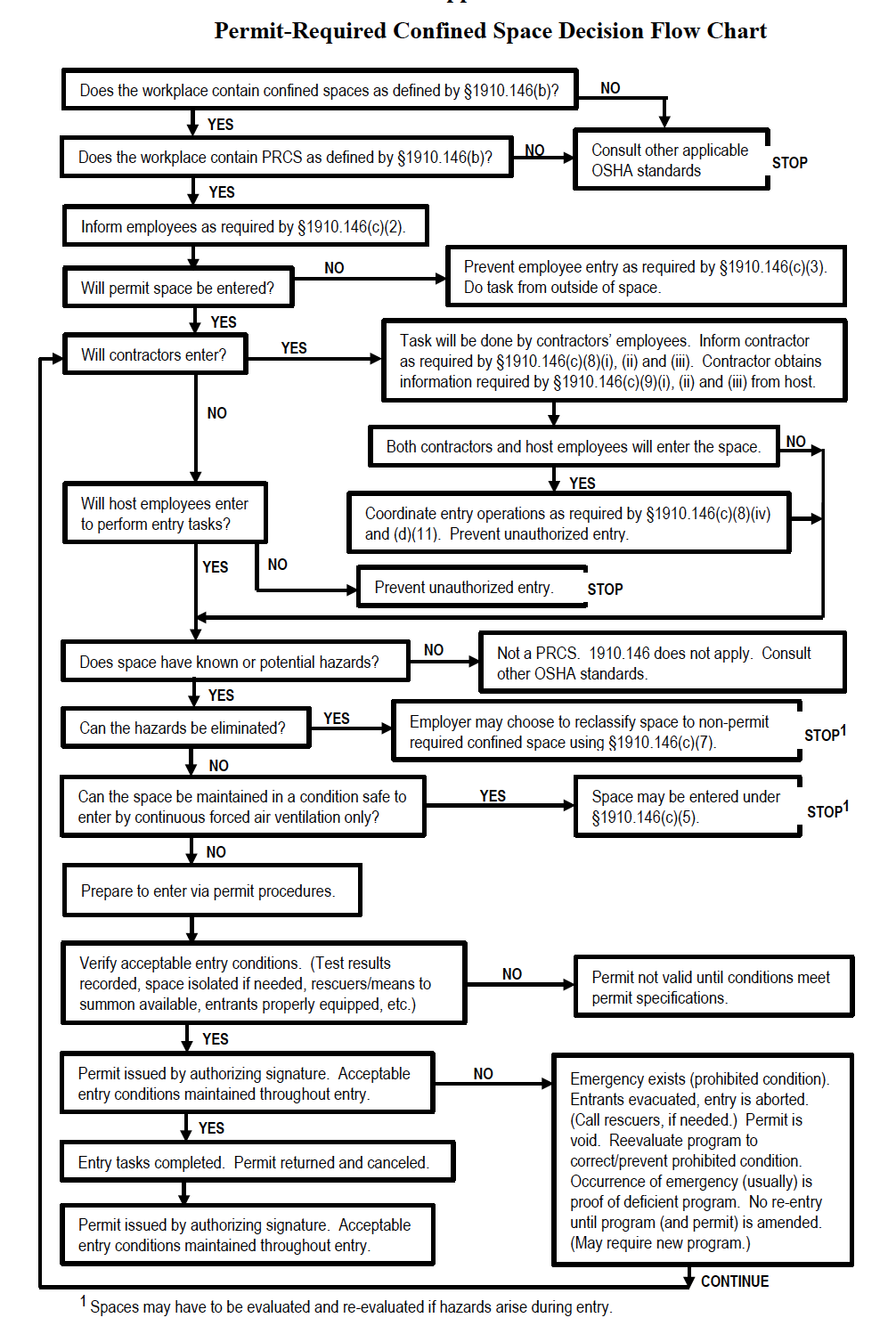
This case is one for the record books! Reading this decision is like reading a mystery novel like “Clue.” The ALJ literally eats up some of the witnesses and calls them liars. The official case files have names redacted because of the back-and-forth between the company and ex-employees. BOTTOM LINE… a company can not claim they comply with BOTH 1910.146(c)(5) and (c)(7) at the same time, and tanker trailers can be PRCSs that fall under OSHA jurisdiction.
And when a supervisor breaks the rules, “employee misconduct” is extremely difficult to prove. The one thing I took from this case file…
BE PROFESSIONAL in all your work, DOCUMENT your work, and ALWAYS DO THE RIGHT THING!
NOTE: Due to the length of this case report, I have highlighted the key areas regarding the OSHRC’s view on confined space safety, reclassification (c)(7), and alternative entry (c)(5).
The company operates several tank wash facilities throughout the United States. OSHA inspected the Company’s facility in Illinois, on January 28, 2009, following local media reports that an employee required emergency medical assistance after being found unconscious in one of the tanks at the facility. Based upon that inspection, OSHA issued two citations to The Company on July 24, 2009, alleging serious and willful violations of the Occupational Safety and Health Act of 1970 (Act). Most of the items alleged violations of various sections of the permit-required confined spaces (PRCS) standard at 29 C.F.R, §1910.146. The Company timely contested the citations. The Secretary and The Company settled several items prior to the hearing. Remaining are the following items alleging serious and willful violations of nine subsections of the PRCS standard:
Item 10 of Citation No. 1 alleges a serious violation of 29 C. F. R. § 1910.146(d)(4)(i), for failing to ensure that testing and monitoring equipment was maintained properly.
Item 11a of Citation No. 1 alleges a serious violation of 29 C. F. R. § 1910.146(d)(13), for failing to review entry operations when the employer had reason to believe that the measures taken under the PRCS program would not protect employees and for failing to revise the program to correct deficiencies.
Item 11b of Citation No. 1 alleges a serious violation of 29 C. F. R. § 1910.146(d)(14), for failing to review and revise the PRCS program to ensure employees participating in entry operations were protected.
Item 12 of Citation No. 1 alleges a serious violation of 29 C. F. R. § 1910.146(g)(3), for failing to establish employee proficiency in the duties required by the PRCS standard.
Item 13 of Citation No. 1 alleges a serious violation of 29 C. F. R. § 1910.146(k)(3), for failing to use a retrieval system for a non-entry rescue.
The Secretary proposed a penalty of $7,000.00 each for Items 10, 12, and 13.
The Secretary proposed a penalty of $7,000.00 for grouped Items 11a and 11b.
Item 1a of Citation No. 2 alleges a willful violation of 29 C. F. R. § 1910.146(c)(4), for failing to develop and implement a written permit space entry program.
Item 1b of Citation No. 2 alleges a willful violation of 29 C. F. R. § 1910.146(d)(3)(i), for failure to specify acceptable entry conditions under its PRCS program.
Item 2 of Citation No. 2 alleges a willful violation of 29 C. F. R. § 1910.146(d)(5)(i), for failing to evaluate the PRCS conditions before authorizing entry.
Item 3 of Citation No. 2 alleges a willful violation of 29 C. F. R. § 1910.146(e)(1), for failing to document the completion of measures taken to ensure safe PRCS entry.
The Secretary proposed a penalty of $70,000.00 each for Items 2 and 3. The Secretary proposed a penalty of $70,000.00 for grouped Items 1a and 1b.
The Company argues the PRCS standard does not apply to the tanks in its facility. The company also asserts the affirmative defense of unpreventable employee misconduct on the part of the employee who entered the tank.
For the reasons discussed below,
Items 10, 11a, 11b, and 12 of Citation No. 1 are vacated.
Item 13 of Citation No. 1 is affirmed, and a penalty of $7,000.00 is assessed.
Item 1b of Citation No. 2 is vacated.
Item 1a of Citation No. 2 is affirmed as serious, and a penalty of $3,500.00 is assessed.
Items 2 and 3 of Citation No. 2 are affirmed as willful, and a penalty of $70,000.00 for each item is assessed.
This hearing was particularly contentious. Witnesses and counsel for The Company accused each other of various unethical or illegal activities that are not within the purview of this court. For this reason, most of the employee and ex-employee witnesses will not be referred to by name. Many of the allegations of illicit conduct are extraneous to the issues in this case. At times, some allegations must be discussed as part of the credibility determination for certain witnesses. The following two paragraphs represent the few facts upon which the parties agree:
The Company cleans the interiors of stainless steel industrial tanks (also referred to as “wagons” and “tankers”) used to transport various commercial non-food liquid substances throughout the United States. The Company operates a facility in Illinois, which has been managed by [redacted] since 1997. Including [redacted], The Company employs fourteen employees at the facility. The Company operates three different shifts daily. After one of The Company’s customers delivers a load to its destination, the driver brings the tank to the facility. The facility contains five tank wash bays. Each bay has a catwalk structure from which employees can open the hatch at the top of the tank and visually inspect the interior of the tank. The hatch also serves as the entryway for an employee required to enter the tank. The Company’s tank washers drain the tank of any residual product (referred to as “heel”). The tank washers then insert a mechanical device known as a “spinner” into the tank, which moves from one end of the tank to the other for an initial rinsing and scrubbing with soap. Sometimes tank washers use solvents, including toluene, to clean the tank’s interior. After a final rinse, the company considers the tank to be “industry clean,” which means the tank is clean enough to haul a new load without contaminating the new product. The tank washers use blow dryers to completely dry the tank. Occasionally an employee must enter a cleaned tank to scrape off residue left in the tank.
At the time of the hearing, Supervisor #1 had worked for The Company for six years, and had been a supervisor for the previous three years. He was the supervisor for the third shift, which operates from 11:00 p.m. to 7:30 a.m. At the time in question, Supervisor #1 supervised two other employees on his shift, Employee #5 and Ex-Tank Washer. On January 28, 2009, at approximately 6:00 a.m., Supervisor #1 was in the process of washing a tank. Supervisor #1 claims the valve of the tank was blocked, preventing the tank from draining properly. The Company’s normal procedure in such a situation is to back flush the valve, which usually removes the blockage. Supervisor #1 testified he deviated from this procedure on January 28, 2009:
Well, I was hosing [the tank] down, and it sort of clogged up, and I know I made a mistake I really shouldn’t have went into [the tank], but I just went in there trying to clear it out for a minute, and I turned and I slipped, and I must have hit my head or something, and that was the last thing I remember.
Another employee discovered Supervisor #1 in the tank and called 911. Emergency personnel from the local Fire Department responded to the call. A news crew from a local television station also arrived at the site. The television station carried the story live on its morning news show, which is how an OSHA compliance officer happened to see it as she prepared to go to work that morning. The OSHA compliance officer testified:
Well, I was headed to my office anyway. It was a regular work day. I don’t recall—I thought it was a Monday, but I don’t recall right now. And, I made reference to the appropriate people at my office location that I had heard about this incident. And you know, there was some discussion about who would respond to this. I volunteered. I’m not sure if I volunteered was the only reason I ended up going, but, you know, it was decided that I would head to the facility.
The OSHA compliance officer arrived at The Company’s facility at approximately 9:00 a.m. By the time she arrived, paramedics had transported Supervisor #1 by ambulance to a hospital. The OSHA compliance officer met with [redacted], The Company’s plant manager, and held an opening conference. Approximately twenty minutes into the conference, [redacted] handed the CSHO a document purported to be a transcript of a statement made to [redacted] by Supervisor #1 before he was taken away by the paramedics. The typed, unsigned document reads:
JANUARY 28, 2009
INCIDENT STATEMENT OF [SUPERVISOR #1]
I WAS SETTING UP TO CLEAN A TRAILER. THE VALVE HAD A RESTRICTION CAUSING THE CLEANING SOLUTION NOT TO CIRCULATE. I PUT THE FRESH AIR BLOWER IN THE TANK AND MY RESPIRATOR ON AND WENT IN THE TANK TO REMOVE THE OBSTACLE. I SLIPPED ON SOMETHING AND APPARENTLY HIT MY HEAD. (Exh. C-14).
[redacted] also provided the CSHO with a second document, which was a written notice of discipline from [redacted] to Supervisor #1, which stated:
JANUARY 28, 2009
FROM: [redacted]
TO: [SUPERVISOR #1]
SUBJECT: VIOLATION OF SAFETY RULES
ON JANUARY 28, 2009, AT APPROXIMATELY 6:00 AM YOU ENTERED A TANK THAT YOU KNEW DID NOT MEET SAFETY REQUIREMENTS. ALTHOUGH YOU PUT THE FRESH AIR LINES INTO THE TRAILER AND WORE YOUR RESPIRATOR, YOU APPARENTLY SLIPPED AND FELL, MAKING IT HARD TO BRING YOU OUT OF THE TRAILER. AS A SUPERVISOR, YOU OF ALL PEOPLE KNOW BETTER. YOU HAD NO BUSINESS ENTERING THE TRAILER AT ALL. YOU ARE GIVEN 3 DAYS OFF WITHOUT PAY, STRIPPED OF YOUR SUPERVISOR TITLE AND REQUIRED TO REDO ALL OF YOUR SAFETY TRAINING. (Exh. C-15).
At the hearing, Supervisor #1 denied he spoke with [redacted] after he was removed from the tank. Supervisor #1 did not see [redacted] until the next work day. When he was shown a copy of the above-quoted statement, Supervisor #1 testified, “I don’t remember saying that,” and said he was not aware [redacted] had given a copy of the statement to the CSHO and represented to her that it was Supervisor #1’s statement. This is one of many discrepancies that appear in the record, which is replete with instances of contradictory and conflicting statements. The testimony of some witnesses differed from their deposition testimony, or from their testimony on direct examination to cross examination, or sometimes from their immediately previous sentences. It was not uncommon for two witnesses present at the same event to recount the event in dramatically divergent narratives. Other witnesses suffered significant lapses in memory, repeatedly responding, “I don’t recall” or “I don’t remember” to routine questions relating to the issues. At times, some witnesses’ testimony seemed scripted, as they repeated certain phrases, regardless of the questions they were asked. This case requires a number of credibility determinations, some of which will be resolved not by determining who is a more credible witness, but by deciding who is the least incredible.
The pattern of conflicting testimony and faulty memory was set by the first two witnesses who appeared on the first day of the seven-day hearing. Firefighter 1 and Firefighter 2 both worked for the Fire Department at the time of the hearing, and both responded to the 911 call on January 28, 2009. Unlike the majority of the witnesses at the hearing, they are disinterested individuals with no personal stake in the outcome of this case. They had no motive to shade their testimony, either to protect their jobs or to undermine an ex-employer. They responded to the call as trained professionals, presumably less affected by emotions produced by the stressful situation. Yet, their testimony differs on a number of key points.
Firefighter 1 was the assistant chief of operations for the Fire Department at the time of the hearing. On January 28, 2009, he had just started working his shift at 6:00 a. m., when the call came in requesting assistance at the facility. The Fire Department’s ambulance was dispatched to the facility, and he arrived shortly afterward. The tank at issue was parked in a bay, next to a catwalk structure. He climbed the stairs to the catwalk and looked down into the hatch of the tank. He observed Supervisor #1 lying at the bottom of the tank. He testified:
He was laying somewhat flat on his side. Because of the way the dimensions are on the tank, it was like a circular cylinder type. He was lying on his side, looked to be moving very slowly, wasn’t talking or anything. I noticed that he did have a respirator around his neck area. He stated that Supervisor #1 was conscious: “I saw his eyes were open. He was doing slow movements of both his hands and legs”. When asked about Supervisor #1’s breathing, he stated, “I would say it was labored breathing. I mean, he was breathing, there was movement, eyes were open”. He saw some residual product in the tank, which he described as gray and pasty. He recalled that Supervisor #1 was wearing a long sleeve shirt and work pants and boots. The Fire Department requires its employees to file a report for all emergency calls. In the report he filed the day of the incident, his assessment of Supervisor #1 differed somewhat from his hearing testimony:
Subject was unconscious and not responding to verbal commands. Upon arrival [XXXXXX] and SQ-954 crews met up with [the ambulance crew] who related that the man inside tanker was cleaning tanker and only had on an air purification respirator, regular work clothes and no safety harness or safety line. Subject was not responsive but slowly moving. . . Two crew members entered the tank to retrieve unconscious subject.(Exh. C-7).
After the crew members removed Supervisor #1 from the tank, they took him to an adjacent building to be “deconned,” or decontaminated. He stated that decon is “where they take the individual and take him to a shower unit, strip him of his clothing, what he was wearing, and just flood him with copious amounts of water to take away any residue or any product that he may still have on himself”. He saw Supervisor #1 five to eight minutes after he had been removed from the tank. He described Supervisor #1’s condition: “As he was being assisted as he was coming out of the building, he seemed to be in a happy-go-lucky state, more like he was just confused, but indicating to all that he was fine and didn’t need any further attention of any sort”. Supervisor #1 did not report he hit his head and was not treated for head injuries.
At the time of the hearing, Firefighter 2 was a firefighter-paramedic with the Fire Department. He was the first paramedic to arrive at the facility on January 28. He and his partner donned “turn-out gear,” (protective clothing, gloves, a face mask, and a self-contained breathing apparatus) because they smelled “polar solvents, alcohol-based solvents, a real strong odor of an alcohol solvent”. He climbed up to the catwalk and looked down through the hatch of the tank. He saw”[a] man face down in the product that was in there”. He testified, “[I]t was most of his face in the product. He had a respirator on. The respirator was not covering his nose and mouth completely. It appeared to be jarred loose from whenever he fell in the product”. He described the man as “African-American wearing blue overalls, coveralls”. Supervisor #1 was not wearing a harness. He and his partner, Firefighter 3, entered the tank. He stated the gray product at the bottom of the tank was a foot to a foot and a half deep. He testified he flipped Supervisor #1 over so that he was on his back. Supervisor #1 was unconscious when he flipped him over. He attempted to revive Supervisor #1 by giving him “painful stimuli to try to see if he could come to[,] . . . what we call a sternum rub where you take your knuckles, and you rub on their sternum pretty hard. That’s a painful area, and when somebody is incoherent like that or unconscious, sometimes you can get a response out of them to bring them back to consciousness”. Supervisor #1 did not respond to the sternum rub. He examined Supervisor #1’s head and saw no signs of trauma. Firefighter 2 and Firefighter 3 looped webbing around Supervisor #1’s body and the firefighters above lifted him out. Supervisor #1 was still unconscious as he was lifted out. After Firefighter 2 and Firefighter 3 exited the tank, Firefighter 2 saw Supervisor #1 walking down the catwalk stairs with assistance. Firefighter 2 stated that Supervisor #1 was “in a state of malaise, very lethargic, confused, muttering”.
Supervisor #1 was taken to Loyola University Medical Center. Exhibit C-16 is a copy of Supervisor #1’s certified medical records detailing his stay at Loyola. Under “Chief Complaint,” his Chart Report states: “Chemical Exposure” and “cleaning tank exposure to toluene.” The Chart Report states the diagnosis is “Syncope and Collapse, Toxic Effect of Unspecified Gas, Fume, or Vapor” (Exh. C-16, 22nd page). No mention of Supervisor #1 hitting his head, or of head trauma appears in the report. Dr. XXXXXXX wrote the following “History of Present Illness”:
51 year old male, cleans inside of tanker trucks as occupation, states this morning he was in tanker and shoveling out a thicker substance that he was under the impression was printing ink residue. He often uses toluene in his work, he states this a.m. it had not been open. He wears a respirator covering his nose and mouth. As he worked further into the tanker, his partner turned around and found him passed out. He next remembers people trying to awaken him. He did not have any pre-syncopal symptoms and feels fine now. No prior such incidents. HAZMAT at scene and as per emt paperwork the FD recorded the fumes inside the tank to be >800ppm of toluene. Per their note he was “unconscious for about 15 min prior to getting patient out of hazard.” The chemical identification sheets list toluene and also ethyl alcohol and ethyl silicate. Patient feels fine, no HEENT complaints, no skin complaints, no shortness of breath, no chest pain, no n/v/d, no focal neuro complaints. No cardiac hx, no sudden deaths in family, no HL. (Exh. C-16, 24th page).
With respect to Supervisor #1’s physical condition in the tank, Firefighter 2’s testimony that Supervisor #1 was unconscious is credited over Firefighter 1’s testimony that Supervisor #1 was awake. Firefighter 1 stated he responds to emergency calls “to assist in the command structure”. He observed Supervisor #1 in the tank from the vantage point of the catwalk. He did not physically assist Supervisor #1 or examine him. In addition, the report Firefighter 1 wrote up the day of the incident twice states Supervisor #1 was unconscious.
Firefighter 2 responded to the emergency call in his capacity as a paramedic. He entered the tank and physically assisted Supervisor #1. He turned him over, performed a sternum rub, and examined his head. With the assistance of Firefighter 3, he looped webbing around Supervisor #1 so that he could be retrieved from the tank. Firefighter 2 was in a better position to determine that Supervisor #1 was unconscious.
The undersigned also finds that Supervisor #1’s purported statement to [redacted] (Exh. C-14) prior to being taken to the hospital is not credible. Supervisor #1 does not recall talking to [redacted] or making the statement. Neither Firefighter recalled seeing Supervisor #1 talk to [redacted] prior to being taken by ambulance to the hospital. Supervisor #1 testified regarding his memory of events following his return to consciousness:
The rescue people taking me out of there, down the ramp, and they started to cut my clothing off me, and I said, “Wait one minute,” I said, “I can take this off,” because I was kind of scared they was going to cut me with that thing he was cutting it with. And, he said, “You got to calm down, and you got to take a shower, and we’re going to the hospital.” And, I said, “Okay.” I went in to take a shower, and the ambulance person said, “Come on, you got to go,” and they took me out of there butt naked.
It is not credible that, during this sequence of events, [redacted] was able to step in and take the purported statement from Supervisor #1. Supervisor #1 was surrounded by numerous emergency personnel focused on getting him into an ambulance and then to a hospital as quickly as possible. Exhibit C-14 is given no weight.
ELEMENTS OF A VIOLATION
The Secretary has the burden of establishing the employer violated the cited standards. To prove a violation of an OSHA standard, the Secretary must show by a preponderance of the evidence that
(1) the cited standard applies;
(2) the employer failed to comply with the terms of the cited standard;
(3) employees had access to the violative condition; and
(4) the cited employer either knew or could have known with the exercise of reasonable diligence of the violative condition.
Applicability of the Cited Standard
1910.146(a) provides that the PRCS standard “contains requirements for practices and procedures to protect employees in general industry from the hazards of entry into permit-required confined spaces.” As a threshold issue, The Company contends the PRCS standard does not apply to the cited conditions, and thus all of the remaining items must be vacated.
In 1910.146(b), the following definitions of “confined space” and “permit-required confined space” are found:
Confined space means a space that:
(1) Is large enough and so configured that an employee can bodily enter and perform assigned work; and
(2) Has limited or restricted means for entry or exit (for example, tanks, vessels, silos, storage bins, hoppers, vaults, and pits are spaces that may have limited means of entry); and
(3) Is not designed for continuous employee occupancy.
Permit-required confined space (permit space) means a confined space that has one or more of the following characteristics:
(1)Contains or has a potential to contain a hazardous atmosphere;
(2)Contains a material that has the potential for engulfing the entrant;
(3)Has an internal configuration such that an entrant could be trapped or asphyxiated by inwardly converging walls or by a floor which slopes downward and tapers to a smaller cross-section; or
(4)Contains any other recognized serious safety or health hazard.
The Company argues that dirty tanks are not considered confined spaces because company policy prohibits employees from entering dirty tanks. The company argues that clean tanks are not considered permit-required confined spaces because tanks that have been washed no longer contain a potential for a hazardous atmosphere. The Company further contends that, even if clean tanks are considered permit confined spaces, the company has met the requirements for reclassifying the tanks under § 1910.146(c)(7), as well as the requirements for alternate entry under § 1910.146(c)(5).
Item 13 of Citation No. 1 and Items 2 and 3 of Citation No. 2 deal specifically with Supervisor #1’s entry into the dirty tank on January 28, 2009. The remaining items apply more generally to The Company’s tank entry procedure. There is no dispute that Supervisor #1 entered a dirty tank, but The Company contends it was an isolated incident that does not reflect the company’s usual working conditions. It must first be determined if The Company allowed its employees routinely to enter dirty tanks.
Dirty Tanks
The Company asserts it has a long-standing rule prohibiting its employees from entering dirty tanks. Exhibit R-3 is purportedly a copy of a memo from [redacted] to “ALL TANK WASH EMPLOYEES,” dated November 8, 1997. The memo (with its odd second sentence) states:
UNDER NO CIRCUMSTANCES ARE YOU TO ENTER AN UNCLEANED TANK EVEN IF THE MONITOR INDICATES IT IS SAFE.
THIS IS THE FIRST SAFETY MEETING UNDER MY DIRECTION AS FACILITY MANAGER AT XXXXXXX, ILLINOIS AND THIS IS THE POLICY FROM NOW ON AT XXXXX.
(Exh. R-3).
The Commission has determined that whether or not an employee is required to enter a space has no bearing on its classification as a confined space. In Cagle’s Inc., 22 BNA OSHC 1185, 1186 (No. 98-0485, 2008), the Review Commission held that a “space with restricted egress and unintended for employee entry under specified circumstances constituted a confined space where, under those circumstances, an employee nonetheless entered the space.” Here, regardless of whether or not The Company prohibited employees from entering dirty tanks, Supervisor #1 did, in fact, enter one. The Company concedes Supervisor #1 entered a dirty tank on January 28, 2009. Therefore, under Cagle’s, the tank Supervisor #1 entered was a confined space[3]. This entry, The Company contends, was perpetrated by an employee committing an unprecedented act of unpreventable employee misconduct. The Company presented a parade of employee witnesses ([redacted], XXXXXXXX, Employee #1, Employee #2, Employee #3, Employee #4, Employee #5, and Employee #6) who stated unequivocally they had never entered a dirty tank in all their years with The Company, and that they had never seen other employees enter dirty tanks.
Supervisor #1 admitted he entered a dirty tank on January 28, 2009, but claimed that was the only time he had done so. The Secretary countered with two former The Company employees, Ex-Tank Washer and Ex-Supervisor #2, who stated that employees routinely entered dirty tanks under the direction of The Company’s supervisors.
Ex-Tank Washer
Ex-Tank Washer did not testify at the hearing. He was working the same shift as Supervisor #1 the day Supervisor #1 entered the dirty tank. The CSHO did not speak with Ex-Tank Washer during her initial inspection of The Company’s facility. After the Secretary issued the instant citations on July 24, 2009, Ex-Tank Washer called OSHA and asked to speak to the CSHO. [redacted] had fired Ex-Tank Washer, and Ex-Tank Washer called the CSHO to inform her of ongoing hazardous working conditions at the facility. The CSHO typed up a statement using information she learned from Ex-Tank Washer during the telephone call. The CSHO left blanks in the statement when she was unsure of the facts. Later, Ex-Tank Washer came to the OSHA office, where he filled in the blanks left in the statement, and then signed the statement.
Ex-Tank Washer worked for The Company from October 2007 until August 14, 2009. On August 14, [redacted] asked Ex-Tank Washer to take a drug test because, [redacted] stated, “[A]s I walked past [Ex-Tank Washer] in the tank wash, I detected a very strong odor of marijuana” (Tr. 1895). Ex-Tank Washer declined to go to the clinic The Company uses for drug tests, and [redacted] fired him. What happened next is disputed.
[redacted] testified:
[Ex-Tank Washer] was very, very angry by this time, and he was shouting obscenities, making accusations. He was in a very high state of anger, his demeanor was very frightening, his eyes were fire engine red, his veins were bulging out on his neck, and he was spitting and screaming and cursing. And, he said, “If I lose my F’ing job over this, I’m going to F- you up, I’m going to F- [Supervisor #1] up, I’m going to F- the company up. Well, the shouting and hollering continued, and I continued to edge him toward the door. I had to get him out of the building, and finally did get him out the door, and two other employees came at that time and seen there was a commotion going on, and they escorted him to his vehicle at which time he left the premises.
[redacted] testified he himself did not get angry, he did not use obscenities, and he did not push Ex-Tank Washer. [redacted] went to his office and called the Police Department to report Ex-Tank Washer’s conduct. The officer he spoke with informed [redacted] that Ex-Tank Washer had already stopped by the police station (located one block from The Company’s facility) and had filed an assault complaint against [redacted]. A few minutes later, a police officer arrived at The Company’s facility and took [redacted] statement.
The reporting officer (R/O) filed an “Offense/Incident Report,” which states:
R/O spoke with victim who related that when he was getting off work at 0730 hours, his boss (offender) asked him to take a drug test. When victim asked why, offender for no reason became angry. Offender then grabbed victim by the throat choking him, then pushed him outside the door. Victim openly admitted that he smokes marijuana but he doesn’t do it at work. Victim also stated that other company employees smoke marijuana on the job which is why he questioned offender.
R/O was contacted by offender who related that he asked victim to take a drug test because he felt that victim was under the influence of drugs. It is company policy if someone refuses, he is automatically terminated. Victim became immediately upset, becoming belligerent towards offender. Victim started making threats towards offender and witnesses as well as his immediate supervisor [Supervisor #1] who was not present and had nothing to do with this occurrence. Victim was asked to leave which he refused. At this time offender pushed victim out of the office area through a doorway towards the outside. Offender states that he pushed victim in the chest and never choked him.
Offender was advised by R/O that when victim refused to leave, he should have called Police. Victim advised on the procedure of signing complaints.
When confronted with his own statement to the police that he “pushed victim in the chest,” [redacted] initially said he did not push him. Upon further questioning, [redacted] allowed he may have “urged or guided” Ex-Tank Washer by gently placing his hand on his arm, a gesture he reenacted with counsel for The Company (Tr. 1918). [redacted] could not explain why he informed the police officer, immediately after the incident, that he had pushed Ex-Tank Washer in the chest. [redacted] testified he was not arrested and was not charged with assault.
Shortly after this altercation, Ex-Tank Washer contacted the CSHO. On September 24, 2009, Ex-Tank Washer met with the CSHO and signed the statement she had prepared, based on her telephone conversation with him[4]:
I, [Ex-Tank Washer], worked at The Company Container from approximately October 5th 2007 until August 14, 2009. On the most recent event, [Supervisor #1] directed me to enter the dirty tank wagon on the week before 1-28-09. I was to enter the tank wagon to perform the following task: dig out old product. I, [Ex-Tank Washer], was instructed to enter tank wagons, which had not been cleaned of the residual product on numerous occasions by [Supervisor #1], my supervisor. I, [Ex-Tank Washer], witnessed my supervisor, [Supervisor #1], enter dirty tank wagons on numerous occasions (approximately) 3-4 times a week without following the necessary safety precautions including, but not limited to, the completion of an entry permit, performance of air monitoring and a lack of use of retrieval device(s) for rescue if needed. [Supervisor #1] was my direct supervisor and [redacted] was the Plant Manager and supervised myself and [Supervisor #1]. On January 28, 2009, I entered a dirty tank wagon with [Supervisor #1]. On January 28, 2009, I was directed to enter the dirty tank wagon by [Supervisor#1], after it airs out. Employee #1 witnessed [Supervisor #1] instructing me to enter the tank wagon without completion of a permit and air monitoring on January 28, 2009. On January 28, 2009, [Supervisor #1], instructed me to enter the dirty tank wagon to perform the assigned duties of digging out product. I, [Ex-Tank Washer], was removed from this tank wagon by [Employee #5 and Employee #3] because I was unable to remove myself from the tank wagon. Mr. [redacted] witnessed me being rescued from the tank wagon. I believe that I could not remove myself from the tank wagon because I was adversely affected from the chemicals present in the tank wagon I had entered. I was told by [redacted] and the Attorney to tell any OSHA representative the following about the incident that occurred on January 28, 2009: I do not go inside tanks. Keep replies to yes or no. Do not volunteer any information. In order to keep my position of Tank Washer at The Company , I was required by [Supervisor #1] to enter tank wagons without completing any safety precautions. The supervision at the facility did not follow OSHA regulations when entering tank wagons because: Ignorant to the facts
I complained to [Supervisor #1] on numerous occasions that I was concerned about my safety when entering the dirty tank wagons without following safety procedures.
Employee #7 – Employee #2 heard me voice safety concerns about entering tank wagons on different occasions. I voiced my concerns for my health and safety to [redacted] on numerous occasions including the following: 8-14-09. When I voiced my concerns about not performing air monitoring or completion of permits prior to entering the tank wagons, [redacted] responded by: Shut my freaking mouth or go home. [redacted] told me to do what [Supervisor #1] says and if it’s not right he will re[c]tify it. When I voiced my safety concerns about not performing air monitoring and/or permits prior to entering dirty tank wagons to [Supervisor #1, Supervisor #1] instructed the following to me: Go in the tank and hurry up out. [redacted] was aware that [Supervisor #1] did not complete permits prior to entering dirty tank wagons. I know he was aware of this practice because: Never had any work permits.
I know [redacted] was aware that employees entered dirty tank wagons because: Anytime you write [“]hand labor[“] he, [redacted], knew that we went inside tanks. [redacted] witnessed employees enter dirty tank wagons without following the necessary safety precautions such as, wearing safety harnesses attached to retrieval devices, performing air monitoring and completion of permits.
[Supervisor #1] never required that I complete a permit prior to entry into a tank wagon 1 time. The most recent time he required me to complete a permit was 8-14-09. I witnessed [Employee #5] enter wagons approximately 2 times a week. I, [Ex-Tank Washer], was threatened with my job if I did not act what I believed to be unsafe, as [Supervisor #1] instructed me. The unsafe behavior I was required to perform at The Company included entering dirty tank wagons without performing air monitoring, without the use of rescue equipment and without completion of permit entry. [redacted] involvement with entering permit spaces included the following[:] Showing us how to fill out phony paperwork. [redacted] was in the facility at least 5 times per day and often viewed employees entering tank wagons, both clean and dirty. [redacted] was involved with day to day operations which involved which tank wagons would be entered. [redacted] often instructed employees to enter tank wagons. Employees were allowed to enter dirty tank wagons without the completion of any permits or air monitoring by redacted]. On average, during the night shift, employee(s) entered tank wagons approximately 1—2 time per night and 3—4 times per week. I told [redacted] on various occasions that I was concerned about my safety when entering tank wagons without following any safety procedures. The last time I voiced my safety concerns to [redacted], I was fired on August 14, 2009.
(Exh. C-40).
Ex-Tank Washer filed an 11(c) action with OSHA, alleging [redacted] fired him after “voicing safety concerns” (Exh. C-41). The OSHA investigator for the 11(c) action was XXXXXXXX. After gathering information and interviewing witnesses, XXXXX recommended dismissal of the 11(c) complaint (Exh. R-42).
The Secretary subpoenaed Ex-Tank Washer to appear as a witness at the hearing. Ex-Tank Washer failed to appear at the hearing, and could not be located subsequently.
Counsel for The Company chose to pursue a slash and burn strategy in order to discredit Ex-Tank Washer. No stone was left unthrown as a litany of Ex-Tank Washer’s supposed character flaws were recited for the record. [redacted] made a number of unsubstantiated charges against Ex-Tank Washer. [redacted] stated Ex-Tank Washer had a record of numerous felony convictions for offenses including stealing copper wire, possession of drugs, armed robbery, aggravated robbery, aggravated battery of a police officer, vehicular invasion, and possession of burglary tools. Other than [redacted] testimony, The Company adduced no evidence of these convictions. The Company also adduced no evidence explaining why the company was not troubled by Ex-Tank Washer’s purported criminal record during the almost two years he worked for The Company. It was only after Ex-Tank Washer went to OSHA that The Company developed concern about Ex-Tank Washer’s purported moral failings. In fact, when asked how he knew Ex-Tank Washer had a reputation for violence, [redacted] replied, “I know that because I held his job for him two different times, 30 days each time, for violent crimes against females”.
The Company enlisted employee Employee #6 to pile on the trashing of Ex-Tank Washer’s name. Employee #6 testified he lived in the same building as Ex-Tank Washer. Employee #6 accused Ex-Tank Washer of tapping into his cable lines for free TV service, ripping his screen doors, and jimmying his locks. People came to Employee #6’s door at all hours looking for Ex-Tank Washer. Plus, “[Ex-Tank Washer’s] traffic was always blocking me from getting out of my parking space. There were just so many things with this guy. I mean, my mail was opened”. When asked how he knew Ex-Tank Washer was the person responsible for the instances of cable tapping, screen ripping, lock jimmying, and mail opening, Employee #6 responded, “Well, he was the only one home in the building in the daytime. Everyone else in that building was working the day shift”. Employee #6 also stated Ex-Tank Washer borrowed money from him and failed to pay it back. Employee #6 was aware Ex-Tank Washer on occasion bought “juice” (brand name “Possible Flush”) to “clean his system up. When it’s time to take a drug test, that would substitute to clean his system out”.
Ex-Supervisor #2
[redacted] hired Ex-Supervisor #2 as the second shift (3:00 p.m. to 11:30 p.m.) supervisor at the facility in March 2009 (approximately two months after Supervisor #1 entered the dirty tank at issue). Ex-Supervisor #2 left The Company on August 16, 2010 (approximately one year after [redacted] fired Ex-Tank Washer). At the hearing, Ex-Supervisor #2 testified he observed employees enter dirty tanks “pretty much daily”. He did not allow employees he supervised to enter dirty tanks, but he saw employees from the shift before his and the shift after enter the dirty tanks. Ex-Supervisor #2 said [redacted] was aware employees were entering the dirty tanks: “He directed [Employee #2] to dig out a trailer that contained tar”.
Ex-Supervisor #2 experienced ongoing problems with tardiness and absenteeism due to his daughter’s serious illness. In August 2010, Ex-Supervisor #2 was in the process of negotiating with an auto dealership for the purchase of a new car. On August 15, 2010, Ex-Supervisor #2 called into The Company to inform the company he would be late. Ex-Supervisor #2 testified regarding the ensuing events:
[W]hat happened was I ended up receiving three days [of suspension] to go get a car to make sure I had transportation for my daughter because the transmission had blown up. I called [The Company] and let them know that I was going to be about two hours late. At 5:00 when I walked out of the dealership, my phone was ringing, and it was [Employee #1] saying, “[redacted] says why don’t you take three days off.” So, I went in the next day to speak to [redacted] about it and he got irate. Well, what happened was, I went in and tried to talk to him about it. He said, “You must think I’m F-ing stupid.” I said, “Sometimes I think you let guys around here blow smoke up your butt.” With that, he got irate and jumped up and started swinging at me and pushing me, and shoving me all the way down the hallway and telling me to get the f___ out of here—excuse my language—get the f___ out of here and, you know, pushing me and shoving me, and the only thing I could think to say to him to get him to stop was, “[redacted], if you hit me, I’ll sue you. That is assault. Stop.” And, he shoved me out the door, and I twisted my ankle a little bit, but, you know, as I was back-pedaling, I’m trying to grab my belongings out of the facility, and he just kept on pushing and pushing. And that was the last day I was employed there. I wasn’t terminated. I just decided to resign.
In [redacted] version of the events, [redacted] did not get angry, did not use obscenities, and did not physically touch Ex-Supervisor #2. Otherwise, [redacted] agrees that Ex-Supervisor #2 quit following notification that he had received a three-day suspension for attendance issues. [redacted] stated that Ex-Supervisor #2 called him at his home the following Sunday night and apologized for his behavior, and asked for his job back. [redacted] testified he told Ex-Supervisor #2, “There is no common ground for you and I to talk about this any further”. Approximately two weeks later, [redacted] learned that “an unnamed disgruntled former employee had gone to OSHA”. This accords with Ex-Supervisor #2’s testimony that he called [redacted] and asked to return to The Company, and [redacted] told him his “bridge was burned” and refused to take him back. Ex-Supervisor #2 stated he contacted OSHA approximately two weeks later.
Ex-Supervisor #2’s testimony was riddled with contradictions. He rarely stuck to his original answer to any given question. Ex-Supervisor #2 continuously elaborated, or refined, or backtracked from his initial responses to questions. He appeared to be attempting the difficult task of making damaging statements about his ex-employer while simultaneously currying favor with [redacted]. (According to [redacted], Ex-Supervisor #2 told him he considered [redacted] a “father figure”).
As just one example, Ex-Supervisor #2 was questioned about a tank wash he performed in front of The Company’s expert witness, XXXXXXX, so XXXXXXXXX could observe The Company’s entry procedure. The questioning regarding this innocuous incident, which had no bearing on Ex-Supervisor #2’s accusations of unsafe work practices against The Company, became an opportunity for Ex-Supervisor #2 to obfuscate the facts:
Q. There’s a gentleman in the back of the room. Do you see him in the very back, back?
Ex-Supervisor #2: Yes, sir.
Q. Do you know who he is?
Ex-Supervisor #2: I have no idea, sir.
Q. Do you recall seeing him out at the Terminal before? He’s an expert engineer, named XXXXXXXXXX?
Ex-Supervisor #2: No, I don’t recall seeing him, sir.
Q. Do you recall performing a tank wash while he was there so he could observe an entry?
Ex-Supervisor #2: No, sir, I do not. He asked me what my procedure was. I didn’t perform one because he was leaving.
Q. That wasn’t my question, but a second ago you said you don’t recall him. Now you do?
Ex-Supervisor #2: Now that you’re mentioning about performing a tank wash, I do.
Q. Now you remember him?
Ex-Supervisor #2: I didn’t perform a tank wash for the gentleman. He had asked me what my procedure was to clean a tank or I forget if there was a product that he might have even given me as a question to like, how would you clean such and such, and I told him, you know, we’re just going to enter, and he had to leave I think or he was on his way out as I was getting to work.
Q. Did you finish your answer?
Ex-Supervisor #2: Yes.
Q. So, now you remember all that?
Ex-Supervisor #2: Yes.
Q. But, two minutes ago, you looked at him and said you didn’t recognize him; you’d never seen him before?
Ex-Supervisor #2: I don’t recognize him but if that’s the gentleman you say was out there, I remember having a conversation with –he could have put on ten pounds sir. You’re talking over a year. You know, he could have put on twenty pounds. I don’t recall his face, sir.
Q. Do you recall performing a tank entry while Mr. XXXXX was present at the The Company Terminal?
Ex-Supervisor #2: I don’t remember it being Mr. XXXXXXX, sir. I believe it was XXXXXXX. We did a demonstration as a group. We volunteered to do a demonstration for XXXXXXX because they needed to show that we knew how to do it, and I told [redacted] we had been practicing and we had been training.
In fact, Ex-Supervisor #2 performed the tank entry at XXXXXX’s request, and XXXXXX took two photographs of Ex-Supervisor #2 as he did so (Exh. R-35; Tr. 1484-1485). Ex-Supervisor #2’s testimony regarding this tank entry is not pivotal in terms of evidence (the fact Ex-Supervisor #2 performed the tank entry demonstration is not controversial and was not disputed by anyone but Ex-Supervisor #2), but it is illustrative of Ex-Supervisor #2’s tendency to gild his responses. His testimony as a whole alternated between evasive and overly-detailed.
Ex-Supervisor #2’s reliability as a witness was further undermined the second day of his testimony. Ex-Supervisor #2 first testified on October 27, 2010. At the end of the day, XXXXXXXXXXXXX, one of the two attorneys representing The Company, was cross-examining Ex-Supervisor #2. The next morning, on October 28, 2010, XXXXXXXX resumed his cross-examination. He started by asking Ex-Supervisor #2 about a text message Ex-Supervisor #2 had sent from his cell phone to XXXXXXX’s cell phone the day before. The text read, “20 an hour, a hand shake from [redacted]. If I tell the truth up there, it will hurt him”.
Ex-Supervisor #2 testified regarding the circumstances that resulted in his text to XXXXXX:
Yesterday, when I arrived, Mr. XXXXXXXX chased me down the hallway, and we had quite a lengthy conversation at the elevator about how The Company needs me, “We’re all friends. That’s what friends are for. I understand your daughter is sick. What does she have?” I explained to him my daughter has neurofibromatosis. He said, “Oh yes, one of my colleagues at the office has that, his wife has that, and she’s constantly getting tumors removed from her head,” which he advised me that, no bridge is burned with coming back to work for The Company. [redacted] and you are good guys, you’re all good people.” [Y]esterday, I think for lunch,[XXXXXXX] has been asking me to go to lunch with them every day to talk, and I just said, “No, no, no,” and then I started thinking, well, if my bridge isn’t burned, I can go back to work and provide for my family, and also in a way to kind of make sure those guys aren’t going to get hurt. I think I could do more there than I could here.
But, it was him saying that my bridge wasn’t burned, so I’m looking to see exactly where they would go in order to do what they need to cover this situation up.
It was presented to me as one hand washes the other. My understanding was that basically he wanted me to not show up. That’s what it was. I forgot exactly what he said. To the best of what I remember was [XXXXXXXX] had told me one hand washes the other and he said, “You don’t even need to show up.” You know, before I had started testifying, he said, “You don’t even need to show up.” And, I asked him, I said, “Well, I’m under subpoena. Wouldn’t I be arrested?” And, he says, “In my twenty years of practicing law, I’ve never heard that; anyone being arrested for that. . . . I was leaving at that point and he said, “Well think about it,” and I said, “Okay.” We were bouncing back and forth. Initially, it was I could have my job back, and then I was obviously hoping for more. [What I was trying to convey in the text was] that I get $20 an hour and a hand shake from [redacted], you know, like no hard feelings in order to go back to work and not testify here today.
. . . [If The Company had agreed to the text], [m]y wife would have come up with a case of postpartum depression. She had just had a child two weeks ago, so I would have had an emergency and go home.
Credibility Determination Regarding the Statement of Ex-Tank Washer and the Testimony of Ex-Supervisor #2
The Secretary contends The Company’s employees routinely enter dirty tanks. This contention is based primarily on Ex-Tank Washer’s statement and Ex-Supervisor #2’s testimony. The Company has raised questions regarding their trustworthiness as witnesses. The undersigned must determine whether these ex-employees of The Company’s are credible. With respect to Ex-Tank Washer, only his signed statement made at OSHA’s office is in evidence. Ex-Tank Washer failed to appear in response to a subpoena, and The Company was unable to cross-examine him. This alone would cast doubt on the reliability of his statement. The statement is further undermined when read in conjunction with the police report that was filed when Ex-Tank Washer lodged an assault charge against [redacted]. In his statement made to OSHA more than a month after he was fired, Ex-Tank Washer stated, “I voiced my concerns for my health and safety to Mr. [redacted] on numerous occasions, including the following: 8-14-08. . . .The last time I voiced my safety concerns to [redacted], I was fired on August 14, 2009” (Exh. C-40). In his statement to the police, made within minutes of his firing, Ex-Tank Washer made no mention of his safety concerns. Instead, Ex-Tank Washer informed the police he was fired for failing to take a drug test. [redacted] corroborated that Ex-Tank Washer’s refusal to take a drug test was the grounds for Ex-Tank Washer’s termination. It would appear that Ex-Tank Washer’s statement to OSHA that he was fired for raising safety concerns was a post hoc rationale designed to ennoble Ex-Tank Washer and damage The Company. Based on Ex-Tank Washer’s evasion of the subpoena and the contradiction between his statement to OSHA and his statement to the Police Department, the undersigned finds Ex-Tank Washer’s statement to be unreliable. No weight will be given to Exhibit C-40.
Ex-Supervisor #2’s testimony as a whole lacked credibility. Ex-Supervisor #2 found it difficult not to amend or tweak his answers as the questioning progressed. He appeared to be embellishing his responses, repeatedly adding details or rephrasing his answers. It is, however, the introduction of the text message to XXXXXX that puts Ex-Supervisor #2’s testimony beyond the pale. The text is evidence Ex-Supervisor #2 was willing to lie and to evade a subpoena as he negotiated to be rehired. Ex-Supervisor #2 essentially admitted on the record he could be bought. In doing so, Ex-Supervisor #2 demonstrated he was unreliable and untrustworthy. His testimony will not be considered when analyzing the alleged violations.
Without Ex-Tank Washer’s statement to OSHA and Ex-Supervisor #2’s testimony, the only evidence the Secretary has that a The Company employee entered a dirty tank is Supervisor #1’s entry on January 28, 2009. The other eight The Company employees stated they themselves had never entered a dirty tank, and they had never seen any other employees do so. Much of this testimony appeared coached, but the Secretary was not able to elicit contrary evidence. Based upon the record, it is determined that The Company’s employees did not routinely enter dirty tanks.
Permit-Required Confined Spaces
OSHA requires employers to have a permit-required confined space program when its workplace has a confined space that has or has a potential to have a hazardous atmosphere. Section 1910.146(b) provides:
Hazardous atmosphere means an atmosphere that may expose employees to the risk of death, incapacitation, impairment of ability to self-rescue (that is, escape unaided from a permit space), injury, or acute illness from one or more of the following causes:
(1) Flammable gas, vapor, or mist in excess of 10 percent of its lower flammable limit (LEL);
(2) Airborne combustible dust at a concentration that meets or exceeds its LEL;
(3) Atmospheric oxygen concentrations below 19.5 percent or above 23.5 percent;
(4) Atmospheric concentration of any substance for which a dose or a permissible exposure limit is published in Subpart G, Occupational Health and Environmental Control, or in Subpart Z, Toxic and Hazardous Substances, of this part and which could result in employee exposure in excess of its dose or permissible exposure limit;
(5) Any other atmospheric condition that is immediately dangerous to life or health.
The Company contends that because its employees enter only washed tanks at its facility, the tanks do not have or have a potential to have a hazardous atmosphere. Therefore, The Company contends, the PRCS standard does not apply. The Company is incorrect on this point. The question of whether washed tanks are PRCSs was addressed by the Commission in Suttles Truck Leasing, Inc., 20 BNA OSHC 1953 (Nos. 97-0545 & 97-0546, 2004). In that case, the employer operated tank washing facilities in Creola, Alabama, and Columbus, Ohio. The employer (represented by the same attorneys who represent The Company in the instant case) argued that the PRCS standard did not apply to post-wash tanks because they were not PRCSs. The Commission disagreed, holding “that the tanks—both pre-wash and post-wash—were PRCSs.” The Company’s contention is rejected. The company’s washed tanks are PRCSs, and subject to the PRCS standard.
Reclassification of PRCSs
The Company contends it met the requirements for reclassification under § 1910.146(c)(7), which provides:
A space classified by the employer as a permit-requested confined space may be reclassified as a non-permit confined space under the following procedures:
(i) If the permit space poses no actual or potential atmospheric hazards and if all hazards within the space are eliminated without entry into the space, the permit space may be reclassified as a non-permit confined space for as long as the non-atmospheric hazards remain eliminated.
NOTE: Control of atmospheric hazards through forced air ventilation does not constitute elimination of the hazards. Paragraph (c)(5) covers permit space entry where the employer can demonstrate that forced air ventilation alone will control all hazards in the space.
(iii) The employer shall document the basis for determining that all hazards in a permit space have been eliminated, through a certification that contains the date, the location of the space, and the signature of the person making the determination. The certification shall be made available to each employee entering the space or to that employee’s authorized representative.
The Company hired XXXXXXXXX, who prepared a report entitled “Tank Trailer Washing and Confined Space Entry Evaluation Report” (Exh. R-36). XXXXXXXXX is a professional engineer with extensive experience in the industrial tank wash industry. He is trained in the chemistry and physics relating to the evaluation of external and internal environments (Exh. R-31; Tr. 1438-1442). He was qualified at the hearing as an expert in chemistry, physics, and engineering relating to the evaluation of industrial tanks (Tr. 1445, 1463-1464). XXXXXXX conducted testing on one tank at The Company’s facility in July 2009, and observed The Company’s wash and tank entry procedures there. XXXXXXX had previously observed, tested, and evaluated other tank wash facilities he said were operated by The Company in other locations. XXXXXXX found the facility’s procedures were equivalent to the other facilities he had visited. Based upon his visit to The Company’s facility, XXXXXXXX concluded the following in his report:
[T]he tank trailer testing protocols and results for the other The Company facilities are applicable and appropriate for use at the XXXXXX terminal. Based on a review of previous atmospheric testing results at the other The Company facilities and the pre-tank entry results at the XXXXXXXX terminal, the tank trailer washing procedures are found to be adequate to remove any potential atmospheric or dermal hazards inside the tank trailers. Since the tank trailers are empty during all entries, they contain no material that would have the potential to engulf an entrant. Additionally, the tank trailers do not have inwardly converging walls or a floor that slopes downward to a smaller cross-section that could trap or cause asphyxiation. (Exh. C-36, p. 6-1).
Based on XXXXX’s report, The Company contends it has satisfied the requirement of § 1910.146(c)(7)(i), by establishing the permit space poses no actual or potential atmospheric hazards. The testing, however, of the other “The Company” facilities upon which XXXXXXX relies were not actually The Company facilities at the time of the testing. XXXXXXX is referring to tests done at facilities in Demopolis and Creola, Alabama, and Columbus, Ohio, in 1996 and 1997, when the tank wash facilities were owned by Suttles. At the time of the hearing, John Clarence Bean worked in The Company’s facility in Demopolis, Alabama. He explained the relationship between Suttles and The Company:
In 1998 with Suttles, the family owned a trucking company, leasing company, tank wash services and driver leasing. The family decided at that time they wanted to sell the company. Two of his sons were full grown and wanted to move out and do something else with their lives. He put it out that he wanted to sell the company, and within probably six months, we were approached by XXXXXXXXXX.
We went through the process of going through the company and finding out what we actually owned and getting titles together and counting some of the equipment and counting some of the buildings, and we sold out to XXXXXXXXX. . . . I was asked to move with the new company.
Craig Schroll is a self-employed consultant who testified for the Secretary. He is a board certified safety professional, who helped develop the PRCS standard. He is on the adjunct faculty for the OSHA Training Institute (Exh. C-52; Tr. 1748, 1751-1752). He was qualified as an expert on hazard assessments and permit-required confined spaces. Schroll disagreed with XXXXXXX’s opinion that tanks are no longer PRCSs after they go through the mechanical wash process. He believes XXXXXXX overstates the facts when he says all contaminants are removed in the wash process. The way it’s written in the reports, there is a lot of potential in the process as described for there to be variability based on the particular tank washer, and their interpretation. It’s more of a description than a procedure outlined in the reports, and they identify that maybe you can clean with solvent, maybe not. There is not any real clear identification about which leads to which wash. Just with water, there is cold water washing, there’s warm washing, there’s solvent washes, there’s caustic washes. There’s really not a lot of detail provided in terms of which thing is used of what process for previous material. The testing to which XXXXXX refers in his report is the testing that was at issue in Suttles, where the Commission found that the evaluation done at Suttles’s Columbus, Ohio, facility “confirmed that any toxic atmosphere in the tanks was purged during the cleaning process. . . Suttles was warranted in dispensing with the testing for toxic atmospheres so long as the tanks were washed, dried and ventilated in accordance with the operating procedures developed in consultation with Dr. XXXX” Id. at 1966 (emphasis in the original). The Company is attempting to piggy-back onto this testing conducted twelve years prior to the instant inspection, for a different company. As Schroll noted, the Suttles testing represents “a limited sampling from long ago”.
The Company attempts to conflate the two companies, treating them as interchangeable with regard to previous evaluations and interactions with OSHA. The Company argues the Secretary is equitably estopped from pursuing this case on the grounds the Commission found the Columbus, Ohio, testing could be applied to the wash tank procedures in Creola, Alabama, in the Suttles decision. The Company contends it is entitled to use the twelve-year old Suttles data to avoid compliance with the PRCS standard at its Illinois facility.
The record shows, however, that there is no continuity between the former Suttles facilities in Ohio and Alabama and the current The Company facility in Illinois. The conditions of the Illinois facility and the old Suttles facilities are not the same. XXXXXXX admitted that the tanks tested in 1996 and 1997 were washed with water, rather than with solvents sometimes used at the Illinois facility. The Illinois facility uses one large spinner to clean a tank, while the other facilities use three smaller spinners. The Company washes baffled tanks, which contain interior divisions as a road safety feature. The baffles create barriers for ventilation air flow. The testing done in 1996 and 1997 did not include baffled tanks. Plant manager [redacted] was questioned about his relationship with Suttles:
Q. [W]hen you first started at [The Company] back in 1997, it had no relationship with Suttles Truck Leasing, isn’t that right?
[redacted]: To the best of my knowledge.
Q. Okay, now, prior to Ms. XXXXXX’s inspection, had you ever communicated with anybody at Suttles Truck Leasing regarding their cleaning procedures?
[redacted]: I don’t believe I had.
Q. You’ve never talked to anybody at Suttles Truck Leasing to find out if they’re cleaning the exact same things that you are, is that right?
[redacted]: I did not speak to anybody about that, that’s right.
Q. So, prior to Ms. XXXXXX doing her inspection, you didn’t have any knowledge as to whether or not Suttles Truck Leasing was cleaning the same types of chemicals that you clean at The Company, isn’t that right?
[redacted]: I believe that’s right.
Q. Now, prior to Ms. XXXXXX’s inspection, did you have any relationships with any of the other The Company facility managers?
[redacted]: Not a business or job relationship. I spoke with a few of them.
Q. Did you ever speak to them about cleaning procedures?
[redacted]: No.
Q. Since Ms. XXXXX’s inspection, have you talked to any of the other facility managers at The Company across the country about their cleaning procedures?
[redacted]: I haven’t talked directly to any of the other managers pertaining to cleaning methods, no.
In order to meet the reclassification requirements, The Company must also document the certification process in accordance with § 1910.146(c)(7)(iii). [redacted] attempted at the hearing to equate The Company’s entry permits with the reclassification certificate, and in so doing revealed the company’s claim of reclassification was a litigation strategy, and not a procedure of which he, as plant manager, was aware:
Q. So, you believe that you have met (iii) through the permits you’ve produced in this case, is that right?
[redacted]: I believe the (iii), yes.
Q. Have you ever given any training to your employees regarding certification of the reclassified space?
[redacted]: There has been some. I didn’t personally give the training, but our employees have had some training pertaining to that, yes.
Q. Okay, was that before or after Ms. XXXXX’s inspection?
[redacted]: I believe that was after.
Q. So, before Ms. XXXXXX’s inspection, did you ever teach your employees about how to properly certify that a space has been reclassified?
[redacted]: Our employees were doing all of this. They weren’t trained to call it reclassified. We’ve always been doing all of these things.
Q. Okay, you just decided to call it reclassified later, right?
[redacted]: I didn’t decide that.
Q. You didn’t decide that. Somebody else at The Company did, right?
[redacted]: No.
The undersigned agrees with Schroll that the 1996 and 1997 testing is too remote in time to apply to The Company’s Illinois facility. The Company has failed to establish the tanks had no actual or potential atmospheric hazards. The only evaluation done at The Company’s facility was performed on one tank in July 2009, after the incident that gave rise to this inspection occurred. The Company cannot predicate reclassification on data recorded a dozen years previously in a different location under different circumstances for a different company. Furthermore, The Company adduced no documentary evidence of reclassification certification, as required by § 1910.146(c)(7). The Company has failed to prove reclassification.
Alternate Entry
The Company contends it has met the requirements for alternate entry under § 1910.146(c)(5), which provides:
An employer may use the alternate procedures specified in paragraph (c)(5)(ii) of this section for entering a permit space under the conditions set forth in paragraph (c)(5)(i) of this section.
(i) An employer whose employees enter a permit space need not comply with paragraphs (d) through (f) and (h) through (k) of this section, provided that:
(A) The employer can demonstrate that the only hazard posed by the permit space is an actual or potential hazardous atmosphere;
(B) The employer can demonstrate that continuous forced air ventilation alone is sufficient to maintain that permit space safe for entry;
(C) The employer develops monitoring and inspection data that supports the demonstrations required by paragraphs (c)(5)(i)(A) and (c)(5)(i)(B) of this section;
(D) If an initial entry of the permit space is necessary to obtain the data required by paragraph (c)(5)(i)(C) of this section, the entry is performed in compliance with paragraphs (d) through (k) of this section;
(E) The determinations and supporting data required by paragraphs (c)(5)(i)(A), (c)(5)(i)(B), and (c)(5)(i)(C) of this section are documented by the employer and are made available to each employee who enters the permit space under the terms of paragraph (c)(5) of this section or to that employee’s authorized representative; and
(F) Entry into the permit space under the terms of paragraph (c)(5)(i) of this section is performed in accordance with the requirements of paragraph (c)(5)(ii) of this section.
The Company adduced undisputed testimony that it used continuous forced air ventilation during tank entries. The Secretary argues that an employer cannot simultaneously claim that it uses reclassification and alternate entry for permit spaces — the two are mutually exclusive. For reclassification, the employer must establish the permit space “poses no actual or potential atmospheric hazards.” Alternate entry requires the employer to establish “that the only hazard posed by the permit space is an actual or potential hazardous atmosphere.” Obviously the employer cannot demonstrate a space poses no actual or potential atmospheric hazards, while at the same time demonstrating that it poses only an actual or potential hazardous atmosphere. Here, however, the undersigned has concluded that The Company failed to establish its washed tanks pose no actual or potential atmospheric hazards under § 1910.146(c)(7). The Company is permitted to pursue an alternative legal theory.
The Secretary does not dispute The Company’s claim that it used continuous forced air ventilation. She questions the extent of the company’s documentation in general terms. Schroll testified that to implement alternate entry, “the standard requires that you evaluate your ventilation. You would have to figure the size and configuration of the confined space that you are attempting to ventilate. You would have to evaluate where you’re introducing ventilation flows, how much you’re flowing over what period of time” (Tr. 1781). He did not state The Company’s documentation was inadequate. The standard does not require data with the specificity required by Schroll. It requires the employer to develop “monitoring and inspection data that supports the demonstrations required” to show “that continuous forced air ventilation alone is sufficient to maintain that permit space safe for entry.”
XXXXXXX’s report details the ventilation process for washed tanks. Washed tanks are ventilated regardless of whether an employee is required to enter the tank after the washing process. Under “Tank Trailer Washing Procedure,” XXXXXX lists eight steps for cleaning a tank. After the final rinse (Step 5), the procedure states:
Step 6: Steam lines are placed into the tank trailer along with 2-4” air hoses. The introduction of steam and blown air into the tank trailer serves to sanitize and dry the interior surface. The steam is typically applied for 10 minutes after which the steam lines are removed. Blown air is continually applied for an additional 15 minutes after the steam lines are removed.
Step 7: On rare occasions, a tank trailer must be entered for inspection or to remove any small amounts of inert material that was not removed during the washing process. If a tank trailer is required to be entered, the facility personnel follow the Tank Trailer Entry Procedure as defined in Section 4 of this report. After tank trailer entry and exit, the tank trailer is rinsed with water for an additional 2 minutes.
(Exh. R-36).
The Tank Trailer Entry Procedure requires employees to fill out a tank entry permit, which includes monitoring for oxygen, lower explosive limit, and toxic levels of hydrogen sulfide and carbon monoxide. Required levels for entry are 20.9% for oxygen, 0% for lower explosive limit, and 0.00 ppm for toxicity.
Step 10 provides:
Tank entry person performs interior surface inspection or performs removal of any inert material remaining in tank trailer. During the entire time an individual is inside the tank trailer, verbal communication is maintained with the standby personnel and air is also continually blown inside the tank trailer via the 2-4” air hoses. (Exh. R-36).
[redacted] testified The Company runs forced air ventilation the entire duration of a confined entry. XXXXXXXX explained the air is not ventilated from inside the facility:
Q. Okay, then, let’s talk about continuous air—how does the air get into the tank?
XXXXXX: Well, you attach a hose that’s attached to a blower to the trailer, and it blows air into it.
Q. And, where is the air coming from?
XXXXXX: It’s outside air.
Q. Okay, and that outside air is coming from air in the facility, isn’t it?
XXXXXX: Outside air, outside the building. It’s pulling it through and going into the tank trailer.
Q. So, you’re pulling it from outside the building?
XXXXXX: It’s fresh air.
The Company has established it uses continuous forced air ventilation during entry. The only hazard posed by the tanks is an actual or potential hazardous atmosphere.[5] The Company’s tank entry permits document the monitoring and data requirements of § 1910.146(c)(5)(i)(C) and (E). It is determined that The Company has established it uses the alternate entry procedures of the PRCS standard.
Accordingly, The Company need not comply with paragraphs (d) through (f) and (h) through (k) of the PRCS standard for entries made into clean tanks. The undersigned does not find The Company met the requirements for alternate entry with respect to Supervisor #1’s entry into a dirty tank on January 28, 2009. Supervisor #1 did not perform air monitoring before entering the tank, and did not ventilate the tank while he was in it.[6] Alleged violations that occurred when Supervisor #1 entered the dirty tank will be analyzed under the conventional requirements of the PRCS.
For purposes of analysis, the remaining items will be considered in three groups. In the first group are items alleging noncompliance with subsections found in paragraphs (d) through (f) and (h) through (k), issued for periods when The Company was implementing alternate entry. The second group consists of items issued for periods when The Company was implementing alternate entry, but the cited subsections are not found in paragraphs (d) through (f) and (h) through (k). The third group includes those items alleging violations resulting from Supervisor #1’s entry into the dirty tank on January 28, 2009, when The Company’s alternate entry procedure was not being implemented.
Group 1: Alleged Violations of PRCS Subsections Found in Paragraphs (d) Through (f) and (h) Through (k), During Alternate Entry
Item 10 of Citation No. 1: Alleged Serious Violation of § 1910.146(d)(4)(i)
Item 10 of Citation No. 1 alleges:
On or about January 28, 2009, employees were required to enter permit required confined spaces. Testing and monitoring equipment needed to evaluate permit spaces, such as, but not limited to, a hazardous gas monitor, was not maintained in working condition and/or properly calibrated.
Section 1910.146(d)(4)(i) provides:
(d) Under the permit space program required by paragraph (c)(4) of this section, the employer shall:
. . .
(4) Provide the following equipment (specified in paragraphs (d)(4)(i) through(d)(4)(ix) of this section) at no cost to employees, maintain that equipment properly, and ensure that employees use that equipment properly:
(i) Testing and monitoring equipment needed to comply with paragraph (d)(5) of this section[.]
The Company requires its employees to use a 4-gas meter to test the atmosphere of its tanks. The CSHO asked to view the meter during her inspection. When she turned on the meter, she was “unable to obtain an oxygen level reading of the normal atmosphere” (Exh. C-53 through C-59; Tr. 214-215). [redacted] acknowledged the meter gave a faulty reading. Supervisor #1 did not use the meter to test the atmosphere of the dirty tank he entered on January 28, 2009. Thus, this item is analyzed under § 1910.146(c)(5)(i), which provides that an employer “need not comply with paragraph[ ] (d)”of the PRCS. Therefore, The Company was not required to comply with § 1910.146(d)(4)(i).
Item 10 is vacated.[7]
Items 11a and 11b of Citation No. 1:
Alleged Serious Violation of §§ 1910.146(d)(13) and (14)
Items 11a and 11b of Citation No. 1 allege:
On or about January 28, 2009, the employer reviewed entry operations which included permits that documented entry into permit spaces. The employer failed to revise the program to correct deficiencies documented on the permits including, but not limited to, lack of entrant and attendant names and/or signatures.
. . .
On or about January 28, 2009, the employer reviewed canceled permits which documented entry into permit required confined spaces. The employer failed to revise the permit space program when permits documented that employee(s) who had entered the spaces, failed to follow the requirements of a permit required confined space.
Sections 1910.146(d)(13) and (14) provide:
(d) Under the permit space program required by paragraph (c)(4) of this section, the employer shall:
. . .
(13) Review entry operations when the employer has reason to believe that the measures taken under the permit space program may not protect employees and revise the program to correct deficiencies found to exist before subsequent entries are authorized[.]
(14) Review the permit space program, using the canceled permits retained under paragraph (e)(6) of this section within 1 year after each entry and revise the program as necessary, to ensure that employees participating in entry operations are protected from permit space hazards.
The Secretary contends The Company violated the cited standards because [redacted] “failed to review entry operations and correct deficiencies in his program after being given shoddy permits from his own supervisors for over a year” (Secretary’s brief, p. 79). Deficiencies include permits failing to list an attendant during entry, permits omitting subsequent air monitoring data, permits showing a failure to review MSDSs prior to entry, permits exceeding the time limit listed, and permits with no time of entry (Exh. C-38).
Items 11a and 11b allege violations of paragraph (d) of the PRCS standard. Under The Company’s alternate entry procedure, The Company was not required to comply with §§ 1910.146(d)(13) and (14).
Items 11a and 11b are vacated.
Item 1b of Citation No. 2: Alleged Willful Violation of § 1910.146(d)(3)(i)
Item 1b of Citation No. 2 alleges:
On or about January 28, 2009, employees were required to enter permit required confined spaces. The employer failed to specify acceptable entry conditions necessary for safe permit space entry operations.
Section 1910.146(d)(3)(i) provides:
[The employer shall]:
(3) Develop and implement the means, procedures, and practices necessary for safe permit space entry operations including, but not limited to, the following:
(i) Specifying acceptable entry conditions.
The Secretary contends The Company’s confined space program does not mention how a space is to be evaluated to determine the existence of potential hazards. The program does not specify acceptable entry conditions (Exh. C-20).
Item 1b alleges a violation of paragraph (d) of the PRCS standard. Under The Company’s alternate entry procedure, The Company was not required to comply with § 1910.146(d)(3)(i).
Item 1b is vacated.
Group 2: Alleged Violations of PRCS Subsections Not Found in Paragraphs (d) Through (f) and (h) Through (k), During Alternate Entry
Item 12 of Citation No. 1: Alleged Serious Violation of § 1910.146(g)(3)
Item 12 of Citation No. 1 alleges:
On or about January 28, 2009, employees were required to enter permit required confined spaces. The employer failed to ensure the employees were proficient and that all employees understood, and had the knowledge and skills to perform safe entry operations.
Section 1910.146(g)(3) provides:
The training shall establish employee proficiency in the duties required by this section and shall introduce new or revised procedures, as necessary, for compliance with this section.
Employers using alternate entry are required to comply with paragraph (g) of the PRCS standard. Section 1910.146(g)(3) applies to The Company’s workplace.
The Secretary’s evidence in support of Item 12 is slight. She bases this allegation on statements employees made to the CSHO during the course of her investigation. When Supervisor #1 came to OSHA’s office for a deposition, he was unable to correctly answer certain questions, including what “LEL” stood for, and stated that tank entry was appropriate at levels of “20 and above” for LEL and toxicity (The Company’s rule is that LEL and toxicity must be 0.000). The CSHO also testified that Employee #5 and Employee #8 did not seem to understand the requirements of the PRCS standard with regard to entry and toxicity. At the hearing, Supervisor #1 testified he had worked the night shift at The Company immediately prior to going to OSHA’s office for his deposition. He stated he informed the CSHO that he was “tired and sleepy” during his deposition. The CSHO questioned Employee #5 and Employee #8 in English; both are Spanish speaking. She could not recall if a translator assisted with her questioning. The CSHO’s testimony on this issue was tentative (this is true of her testimony as a whole). She qualified most of her answers, spoke in general terms, and could not recall crucial details.
Supervisor #1 was able to answer questions competently at the hearing. Employee #5, who testified with the aid of an interpreter, did not demonstrate a lack of proficiency in his required duties. The employees’ improved performance may be due to coaching prior to their appearances. The undersigned cannot, however, dismiss the possibility the conditions under which the CSHO questioned the witnesses contributed to her perception they were not proficient. It is determined the Secretary has failed to establish a violation of § 1910.146(g)(3).
Item 12 is dismissed.
Item 1a of Citation No. 2: Alleged Willful Violation of § 1910.146(c)(4)
Item 1a of Citation No. 2 alleges:
On or about January 28, 2009, the employer failed to develop or implement a written permit space entry program which complied with 29 CFR 1910.146. The employer’s written permit deficiencies included but were not limited to, complete purging, flushing or ventilating procedures, testing and monitoring equipment available for adequate evaluation of permit space conditions, and inadequate procedures for rescuing and summoning for rescue and emergency services.
Section 1910.146(c)(4) provides:
If the employer decides that its employees will enter permit spaces, the employer shall develop and implement a written permit space program that complies with this section. The written program shall be available for inspection by employees and their authorized representatives.
Employers using alternate entry are required to comply with paragraph (c) of the PRCS standard. Section 1910.146(c)(4) applies to The Company’s workplace. [redacted] provided the CSHO with The Company’s written PRCS program. [redacted] stated that he does not hand out copies of the PRCS program to employees, but it is available for them to look at (Exh. C-20; Tr. 397, 1275-1276). The CSHO found a number of deficiencies in the written program. Perhaps the most egregious deficiency is paragraph 16 of the program, which provides:
If the test indicates that the atmospheric conditions are hazardous, the confined space shall be purged as required in 14 above. Atmospheric conditions shall be termed hazardous if test shows any of the following:
(a) The presence of oxygen below or above the breathing air range (16.5 to 21.9 % by volume.)
(b) Any atmosphere with less than 19.5 % oxygen should not be entered without an approved self-contained breathing apparatus (SCBA).
(c) The presence of a flammable vapor.
(Exh. C-20, p. 637) (emphasis added).
Section 1910.146(b) defines an oxygen deficient atmosphere as “an atmosphere containing less than 19.5 percent oxygen by volume.” The Company’s program lists the breathing range for oxygen as being three full percentage points below the actual acceptable range. [redacted] acknowledged the program was incorrect, and that someone who entered a tank with 16.5% oxygen could become incapacitated. [redacted] excused the inaccuracy by saying The Company trained its employees that 19.5 % oxygen is the correct figure. [redacted] testified he believed the PRCS program was acceptable because OSHA had inspected The Company’s Illinois facility in 2001 and had not cited the company under § 1910.146(c)(4). He admitted the compliance officer for the 2001 inspection never told him The Company’s program was “okay”. “[I]t is well-established by both the Commission and the courts that OSHA’s failure to cite an employer during a past inspection does not, standing alone, constitute a lack of fair notice.” The Secretary has established The Company was in noncompliance with the cited standard. Every employee who entered a PRCS had access to the violative condition; if an employee relied on the PRCS program (which employees should be able to do), he could have died or sustained serious injuries from the oxygen-deficient atmosphere. [redacted] was aware of the error in the written program, and had considered deleting it, but failed to change it.
The Secretary has established a violation of § 1910.146(c)(4).
Willful Classification of Item 1a of Citation No. 2
The Secretary classifies this violation as willful. A willful violation is one “committed with intentional, knowing or voluntary disregard for the requirements of the Act, or with plain indifference to employee safety.” A showing of evil or malicious intent is not necessary to establish willfulness. A willful violation is differentiated from a nonwillful violation by an employer’s heightened awareness of the illegality of the conduct or conditions and by a state of mind, i.e., conscious disregard or plain indifference for the safety and health of employees.
The Secretary contends The Company’s violation of § 1910.146(c)(4) is willful based on [redacted] acknowledgment that he knew of the PRCS program’s deficiencies, yet did not change it. Furthermore, the Secretary cited The Company for violating the same standard in 2006, following an inspection at The Company’s facility in XXXXXXX, New Jersey (Exh. C-6). It is determined the Secretary has not established willfulness with regard to this item. The 2006 citation occurred at a different facility under different management. In addition, the New Jersey facility had no written PRCS program. Although The Company’s PRCS program at issue here was deficient, employees were not left to rely solely on the program with no other guidance. During training they were informed of the correct percentage of oxygen for acceptable entry. [redacted] issued a memo in 2008 clarifying the acceptable oxygen percentage for entry (Exh. R-9).
Item 1a of Citation No. 2 is affirmed as serious.
Group 3: Alleged Violations Resulting from Supervisor #1’s Tank Entry on January 28, 2009
Item 13 of Citation No. 1: Alleged Serious Violation of § 1910.146(k)(3)
Item 13 of Citation No. 1 alleges:
On or about January 28, 2009, an employee entered a permit required confined space and was not attached to a non-entry rescue system. The employee had not worn a full body harness with a retrieval line attached to a mechanical device for use in assistance of a non entry-rescue.
Section 1910.146(k)(3) provides:
To facilitate non-entry rescue, retrieval systems or methods shall be used whenever an authorized entrant enters a permit space, unless the retrieval equipment would increase the overall risk of entry or would not contribute to the rescue of the entrant.
This item is based on Supervisor #1’s entry into the dirty tank on January 28, 2009. Section 1910.126(k)(3) applies to Supervisor #1’s entry. The Secretary alleges Supervisor #1 entered the tank without wearing a harness. Supervisor #1 claims he was wearing a harness, but both assistant fire chief and paramedic state that he was not. It is undisputed he was not attached to a retrieval line.
Firefighter 2 entered the tank to help retrieve Supervisor #1. Firefighter 2 turned Supervisor #1 over, administered a sternum rub to him and wrapped webbing around Supervisor #1’s body so he could be lifted from above. When asked if Supervisor #1 was wearing any retrieval device, Firefighter 2 responded, “Retrieval? No, it would be a harness. That’s why I used my webbing”. In his report, Firefighter 2 wrote, “a hoisting mechanism was above the tanker, when crew attempted to move the mechanism above the hatch, it would not reach. While in the process of moving the mechanism over, a harness was handed to crew by a worker. Crew again looked at the unconscious man who had no harness on” (Exh. 7a). Firefighter 2’s demeanor on the witness stand was professional and straightforward. He gave detailed, consistent testimony. His testimony is in accordance with the report he wrote following Supervisor #1’s retrieval. Firefighter 2 was a credible witness and his testimony that Supervisor #1 was not wearing a harness is accepted. The Secretary has established The Company failed to comply with the terms of the standard. Supervisor #1 was not wearing a harness, and the hoisting mechanism above the tank would not reach the hatch. Even if The Company could establish Supervisor #1 was wearing his harness and the hoisting mechanism did reach the hatch, a violation would still be established. It is undisputed that Supervisor #1 was not attached to the hoisting mechanism. The Company’s argument that it complied with the cited standard because the hoisting device was, in fact, 50 feet long and “could reach anyone in the bay” (The Company’s brief, p. 82) is nonsensical. The standard unambiguously requires that retrieval systems be used (not just available) whenever an employee enters a permit space, in order “[t]o facilitate non-entry rescue.” If the hoisting device is not actually attached to the employee’s harness, non-entry rescue is not possible. Rather, the rescuer must also enter the permit space (as Firefighter 2 did here), and physically attach the employee’s harness to the hoisting device.
The Secretary has established Supervisor #1’s exposure to the hazardous atmosphere in the tank. At the hospital, Supervisor #1 was diagnosed with toxic exposure to toluene (Exh. C-16). Had Supervisor #1 been attached to the hoisting device in compliance with § 1910.146(k)(3), his fellow employees could have retrieved him from the tank as soon as he was discovered. Instead, Supervisor #1 continued to lay unconscious in the tank while rescue personnel responded to the emergency call. Supervisor #1 had actual knowledge that he was entering the dirty tank while not wearing a harness or being attached to the hoisting device. At the time of the entry, Supervisor #1 was a supervisor for The Company. As such, his knowledge is imputed to The Company. (“[W]hen a supervisory employer has actual or constructive knowledge of the violative conditions, that knowledge is imputed to the employer, and the Secretary satisfies [her] burden of proof without having to demonstrate any inadequacy or defect in the employer’s safety program.”)
The Secretary has established The Company committed a violation of § 1910.146(k)(3). Under § 17(k) of the Act, a violation is serious “if there is a substantial probability that death or serious physical harm could result from” the violative condition. Here, The Company’s employees were unable to retrieve Supervisor #1 from the tank, and had to summon emergency personnel. Paramedics were required to enter the dirty tank, exposing themselves to the hazardous atmosphere. Supervisor #1 was hospitalized.
The violation is properly classified as serious.
Item 2 of Citation No. 2: Alleged Willful Violation of § 1910.146(d)(5)(i)
Item 2 of Citation No. 2 alleges:
On or about January 28, 2009, an employee entered a permit required confined space. The employee entered without testing the conditions inside the permit space to ensure the space was safe for entry.
Section 1910.146(d)(5)(i) provides:
[The employer shall] [t]est conditions in the permit space to determine if acceptable entry conditions exist before entry is authorized to begin, except that, if isolation of the space is infeasible because the space is large or is part of a continuous system (such as a sewer), pre-entry testing shall be performed to the extent feasible before entry is authorized, and, if entry is authorized, entry conditions shall be continuously monitored in the areas where authorized entrants are working[.]
This item is based on Supervisor #1’s entry into the dirty tank on January 28, 2009. Section 1910.126(k)(3) applies to Supervisor #1’s entry. It is undisputed Supervisor #1 did not test the atmosphere of the dirty tank before he entered it. Supervisor #1 was exposed to the hazardous atmosphere in the tank. As supervisor, Supervisor #1’s knowledge that he failed to test the atmosphere of the tank is imputed to The Company.
The Secretary has established a violation of § 1910.146(d)(5)(i).
Item 3 of Citation No. 2: Alleged Willful Violation of § 1910.146(e)(1)
Item 3 of Citation No. 2 alleges:
On or about January 28, 2009, a supervisor entered a permit required confined space. The supervisor failed to complete a permit which would have documented the measures taken to ensure safe permit space entry operations.
Section 1910.146(e)(1) provides:
Before entry is authorized, the employer shall document the completion of measures required by paragraph (d)(3) of this section by preparing an entry permit.
This item is based on Supervisor #1’s entry into the dirty tank on January 28, 2009. Section 1910.126(k)(3) applies to Supervisor #1’s entry. It is undisputed Supervisor #1 did not complete a permit documenting the measures he took to ensure safe permit space entry operations. Supervisor #1 was exposed to the hazardous atmosphere in the tank. As supervisor, Supervisor #1’s knowledge that he failed to complete the permit is imputed to The Company.
The Secretary has established a violation of § 1910.146(e)(1).
Employee Misconduct Defense
The Company contends that when Supervisor #1 entered the dirty tank on January 28, 2009, he was engaged in unpreventable employee misconduct for which The Company is not liable. To establish the unpreventable employee misconduct defense, an employer must show that:
- it established a work rule to prevent the violation;
- adequately communicated the rule to its employees, including supervisors;
- took reasonable steps to discover violations of the rule; and
- effectively enforced the rule.
In addition, the employer has the burden of showing “that the violative conduct of the employee was idiosyncratic and unforeseeable.”. Where, as here, the purported employee misconduct includes the actions of a supervisory employee, the employer faces a higher standard of proof. “[W]here a supervisory employee is involved, the proof of unpreventable employee misconduct is more rigorous and the defense is more difficult to establish since it is the supervisor’s duty to protect the safety of employees under his supervision . . . . A supervisor’s involvement in the misconduct is strong evidence that the employer’s safety program was lax.” Archer-Western Contractors Ltd., 15 BNA OSHC 1013, 1016-1017 (No. 87-1067, 1991).
The Company established it had work rules designed to prevent the violations committed by Supervisor #1 when he entered the dirty tank. The Company uses a confined spaces training program developed by J. J. Keller. The program includes rules requiring employees to wear harnesses and retrieval lines when entering a PRCS, to test the conditions before entering a PRCS, and to complete an entry permit before entering a PRCS (Exh. R-8, pp. 10, 14-15, 21). These rules were communicated to The Company’s employees, including Supervisor #1, through training (Exh. R-7). The Company has failed to establish, however, that it took reasonable steps to discover violations of its rules. One of the best tools The Company had for discovering violations was the tank entry permits the company required its employees to complete before entering the washed tanks. The permits are each one page in length, and require minimal information to be supplied or checked off. Of the twenty-eight permits The Company produced to the Secretary, every one contained an error or omission (Exh. C-38). Eleven of the defective twenty-eight permits were filled out by Supervisor #1. None of the permits indicates that subsequent air monitoring was conducted. Permits indicated that work was being done for as long as three hours without subsequent air monitoring. Some permits noted “permit is only good for 20 minutes,” yet employees exceeded twenty minutes on seventeen of the permits. Supervisor #1 failed to review MSDSs prior to tank entry. His permits failed to identify an attendant. Some permits listed Supervisor #1 as attendant, but did not list a cleaner (Exh. C-38). Review of the tank entry permits by [redacted] would have alerted him that The Company’s employees, including supervisor Supervisor #1, were failing to complete the permits properly, and were violating The Company’s safety rules. The Company also failed to enforce its rules. [redacted] not only admitted he failed to enforce The Company’s safety program, he sought to excuse it:
Well, for myself personally, the reason why there is so little discipline—and I apologize if I’m out of line—but we have seen a classic example over the last two days of why I run a lax discipline, documented discipline, because it opens the door for every employee who gets angry to pick up the phone and call OSHA.
One of The Company’s supervisors violated OSHA’s PRCS standard, as well as The Company’s own safety program. The plant manager admitted he was lax with his discipline for safety violations. Under these circumstances, The Company cannot establish that Supervisor #1’s conduct was either idiosyncratic or unforeseeable. To the contrary, it was predictable that an employee would bypass the safety rules when obviously deficient tank entry permits were continually accepted without repercussions.
The Company has failed to establish its defense of employee misconduct.
Willful Classification of Items 2 and 3 of Citation No. 2
The Secretary classifies The Company’s violations of §§ 1910.146(d)(5)(i) (testing of PRCS conditions) and (e)(1) (preparing entry permit) as willful. “The hallmark of a willful violation is the employer’s state of mind at the time of the violation–an ‘intentional, knowing, or voluntary disregard for the requirements of the Act or . . . plain indifference to employee safety.” Supervisor #1 testified that he knew he was wrong in entering the dirty tank without testing it or completing a tank entry permit, but stated that it was at the end of his shift and he just wanted to finish it quickly, so he disregarded the safety rules in which he was trained: “I was tired, it was cold, and I wanted to try to finish the trailer and I made a mistake” (Tr. 1597). It is determined that Supervisor #1’s violations of the cited standards are willful. Supervisor #1’s entry into the dirty tank was the result of a deliberate decision he made, and it put his life at risk.[8] He admitted knowing it was wrong to enter the dirty tank, and he compounded the wrongdoing by failing to test the tank or fill out the required permit. Supervisor #1 then neglected to wear a harness, thus ensuring his predictable rescue was made much more difficult for emergency personnel. All of these violations were committed with premeditation by Supervisor #1. “The employer is responsible for the willful nature of its supervisors’ actions to the same extent that the employer is responsible for their knowledge of violative conditions.” Supervisor #1, as a supervisor for The Company, knowingly disregarded the requirements of §§1910.146(d)(5)(i) and (e)(1). He sacrificed safety for expedience. Supervisor #1’s actions present a clear-cut case of willfulness, which is imputed to The Company.
Items 2 and 3 of Citation No. 2 are affirmed as willful.
Incidental Issues
The Company raises various incidental issues, which fall generally under the umbrella of what The Company refers to as “government misconduct.” The conspiracies and intrigue conjured up by The Company’s attorneys include the CSHO’s “improper agenda,” her purported manipulation of evidence, and her supposed coercion of witnesses. The Company’s post-hearing brief is brimming with indignant footnotes, fulminating against everything from the compliance officer’s laughter during the hearing to the Secretary’s counsel inadvertently omitting a page from an exhibit. No incident is too small for The Company’s counsel to pounce on and claim as evidence of misconduct or nefarious motives. None of these assertions has any basis in reality and The Company’s contention is summarily dismissed.
The Company also asks the undersigned to reconsider her ruling that Schroll could testify as a rebuttal expert for the Secretary, and her admission into evidence of Ex-Tank Washer’s statement. The undersigned declines to do so.
Penalty Determination
The Commission is the final arbiter of penalties in all contested cases. “In assessing penalties, section 17(j) of the OSH Act, 29 U. S. C. § 666(j), requires the Commission to give due consideration to the gravity of the violation and the employer’s size, history of violation, and good faith.” “Gravity is a principal factor in a penalty determination and is based on the number of employees exposed, duration of exposure, likelihood of injury, and precautions taken against injury.” The Company employed fourteen employees at its XXXXX, Illinois, facility. The company has several other facilities throughout the United States, but its total number of employees was not adduced at the hearing. In 2006, OSHA cited The Company for violations at its XXXXXXX, New Jersey, facility (Exh. C-6).
The Company is given no credit for good faith. The record indicates The Company attempted to manipulate OSHA’s inspection from the time the CSHO entered its facility. [redacted] handed the CSHO a bogus statement, purportedly taken from Supervisor #1 somewhere between the time he was hoisted unconscious out of the dirty tank and when he was taken away by ambulance to a hospital.
Item 13 of Citation No. 1-§ 1910.146(k)(3): The gravity of this violation is high. Supervisor #1 was not wearing a harness and was not attached to a retrieval device. This violation prolonged his exposure to the hazardous atmosphere, and caused rescue personnel to be exposed as well. A penalty of $7,000.00 is assessed.
Item 1a of Citation No. 2–§ 1910.146(c)(4): The gravity of this violation is moderately high. The Company had a written PRCS, but it was deficient. It stated that 16.5 % was the lower acceptable range for oxygen. This deficiency was mitigated somewhat by The Company’s training and memo issued by [redacted] correcting the percentage of oxygen. A penalty of $3,500.00 is assessed.
Item 2 of Citation No. 2–§ 1910.146(d)(5)(i): The gravity of this violation is high. Supervisor #1 entered the dirty tank without testing the atmospheric conditions. This violation exposed him to a hazardous atmosphere. A penalty of $70,000.00 is assessed.
Item 3 of Citation No. 2–§ 1910.146(e)(1): The gravity of this violation is high. The completion of the tank entry permit is designed to ensure employees take the proper precautions before entering the tank. A penalty of $70,000.00 is assessed.
Findings of Fact and Conclusions of Law
The foregoing decision constitutes the findings of fact and conclusions of law in accordance with Rule 52(a) of the Federal Rules of Civil Procedure.
ORDER
Based upon the foregoing decision, it is ORDERED that:
1. Item 10 of Citation No. 1, alleging a serious violation of § 1910.146(d)(4)(i), is vacated, and no penalty is assessed;
2. Item 11a of Citation No. 1, alleging a serious violation of § 1910.146(d)(13), is vacated, and no penalty is assessed;
3. Item 11b of Citation No. 1, alleging a serious violation of § 1910.146(d)(14), is vacated, and no penalty is assessed;
4. Item 12 of Citation No. 1, alleging a serious violation of § 1910.146(g)(3), is vacated, and no penalty is assessed;
5. Item 13 of Citation No. 1, alleging a serious violation of § 1910.146(k)(3), is affirmed, and a penalty of $7,000.00 is assessed;
6. Item 1a of Citation No. 2, alleging a willful violation of § 1910.146(c)(4), is affirmed as serious, and a penalty of $3,500.00 is assessed;
7. Item 1b of Citation No. 2, alleging a willful violation of § 1910.146(d)(3)(i), is vacated, and no penalty is assessed;
8. Item 2 of Citation No. 2, alleging a willful violation of § 1910.146(d)(5)(i), is affirmed as willful, and a penalty of $70,000.00 is assessed; and
9. Item 3 of Citation No. 2, alleging a willful violation of § 1910.146(e)(1), is affirmed as willful, and a penalty of $70,000.00 is assessed.
/s/ Sharon D. Calhoun
SHARON D. CALHOUN
Judge
[1] The Company filed a post-hearing motion to strike portions of the Secretary’s brief. The Secretary referred, in a footnote, to Exhibit C-20A, which was rejected at the hearing (Secretary’s brief, p. 14, footnote 11). The Company’s motion is granted. References to Exhibit C-20A will not be considered.
[2] There are significant gaps in the record concerning the circumstances of Supervisor #1’s entry into the tank, and the discovery of his unconscious body. Supervisor #1 was discovered at approximately 6:00 a.m. The compliance officer did not arrive until approximately 9:00 a.m. The Company, therefore, was in the best position to provide information regarding who discovered Supervisor #1, how the discovery came about, and what attempts were made to rescue him. None of this information was provided. At the hospital, Supervisor #1 told medical personnel he was cleaning inside the tank with another employee. This runs counter to the narrative The Company presented at the hearing. The undersigned regards The Company’s account of Supervisor #1’s entry into the tank as dubious.
[3] In order to meet the definition of a permit-required confined space, the confined space must have one or more of the hazardous characteristics listed in § 1910.146(b). In the present case, the Secretary contends the tanks contain or have the potential to contain a hazardous atmosphere. While The Company denies that its clean tanks contain hazardous atmospheres, it does not dispute that the dirty tanks contain or have the potential to contain hazardous atmospheres.
[4] The italicized portions of the statement reproduced here indicate Ex-Tank Washer’s handwritten additions to the statement Bachus had previously typed.
[5] Section 1910.146(b) lists other hazardous characteristics of a permit-required confined space as:
(1) contains or has a potential to contain a hazardous atmosphere;
(2) Contains a material that has the potential for engulfing entrant;
(3) Has an internal configuration such that an entrant could be trapped or asphyxiated by inwardly converging walls or by a floor which slopes downward and tapers to a smaller cross-section; or
(4) Contains any other recognized serious safety or health hazard.
A hazardous atmosphere is the only permit-required confined space hazard at issue in this proceeding.
[6] In its brief, The Company states Supervisor #1 “went to the top of the tank, inserted a blower and began blowing the tank, put on a negative pressure respirator and harness, and without hooking off (Tr. 1599) or testing the atmosphere (Tr. 607-608) or completing a permit (Tr. 607-608) as he was trained, entered the tank (Tr. 1595-1596).” (The Company’s brief, p. 13; emphasis added). Nowhere in any of the cited transcript pages does Supervisor #1 testify that he put a blower in the tank. Paramedic Maylath testified there was one air hose draped over the top of the tank (not two air hoses as required by The Company’s own procedure) when he arrived at The Company’s facility, but there is no evidence Supervisor #1 placed it there. It is likely Supervisor #1’s fellow employees placed it there when Supervisor #1 was discovered unconscious in the tank.
[7] Item 10 would be vacated even if The Company were required to comply with the cited standard. [redacted] testified that a person using the meter could not tell if it was functioning properly until the meter was turned on. If an employee did turn on the meter and discover it was not working, [redacted] would post a sign forbidding employees to enter tanks until the meter was repaired (Exh. R-5; Tr. 1046-1047). There is no evidence The Company knew the meter was faulty until Bachus turned it on during her inspection.
[8] It is also likely he was complicit in putting a subordinate employee’s life at risk, since he told medical personnel at the hospital that he was inside the tank with another employee, who was helping him clean it out (Exh. C-16).
CLICK HERE to see the entire case file.