













In April 2023, EPA published a report on the first survey conducted of the State Emergency Response Commissions. The purpose of the survey was to learn how the Emergency Planning and Community Right-to-Know Act is currently implemented at the state and local levels, as required by the 1986 legislation, as well as its amendments of certain provisions in 2018.
State Emergency Response Commissions are...
Read More
On Dec. 3, 2004, a 50,000-pound steel pressure vessel violently exploded at the southwest Houston Marcus Oil and Chemical facility.
The pressure vessel contained flammable hydrocarbons such as hexane.
The pressure vessel was a horizontal tank 12 feet in diameter, 50 feet long, and operated at a pressure of approximately 67 psi.
Marcus Oil did NOT use a qualified welder or proper welding procedure to...
Read More
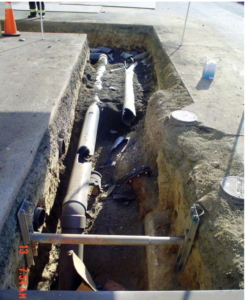
On September 13, 2007, a subcontractor was implementing a hot tap into a carbon steel pipe.
The explosion was caused by the heat from the acetylene torch kindling the residual vapor inside, attaching to the polyvinylchloride (PVC) piping.
Shrapnel pieces were blown up to 100 feet outwards due to the force of the explosion.
The two workers who were closest to the explosion were guarded by an alcove...
Read More
On January 15, 2008, a pressure vessel at a New Jersey foundry exploded, killing one 60-year-old worker instantly while injuring eight other workers with shrapnel.
The pressure vessel in question was used to pressurize/depressurize molten aluminum to prevent/eliminate porosity from the metal.
The incident occurred while two (2) workers, including the one who was killed, were testing a new O-ring gasket...
Read More
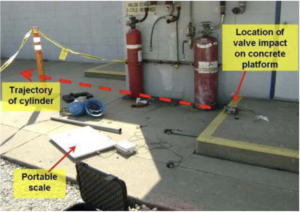
In June 2008, a cylinder was dropped, and its top valve hit a concrete platform.
The impact of the cylinder valve on the concrete caused the threads on the screw connection, which held the valve on the cylinder, to fail, resulting in complete separation of the valve from the cylinder.
The cylinder’s internal pressure was 600 psig.
The combination of pressure and size of the cylinder hole caused it...
Read More
At 11:30 p.m. on March 19, 2009, Solus Industrial Innovations LLC employees from the third shift had just come to work. Their employer is a manufacturer of plastic conveyor parts.
One employee (Employee #1) pointed out to the on-shift supervisor that there was a pool of water near an 80-gallon water heater that was being used to supply heating water to the production process.
Minutes after this exchange,...
Read More

In May 2009, a compressed air tank failed, blowing the bottom off of the tank and sending fragments flying into a concrete wall, puncturing the wall. The investigation following the incidentrevealed several serious problems with the condition of the tank, including severe corrosion and rust at the bottom of the tank, where it failed, and an improper weld repair which had been made to the tank at some...
Read More
On March 3, 2010, a Peoples Gas worker died, and another was seriously injured after they were struck by a pipe while pressure-testing an underground gas main.
…
HomeRead More »
Read More
Summary
On the days leading to January 6, 2014, unusual weather conditions with high-temperature variations caused a large pressure rise inside the three storage vessels at the Brookhaven National Laboratory (BNL) compressed natural gas (CNG) fueling facility. The pressure increase reached the point where the relief valve on each vessel opened automatically and released gas to the atmosphere. However,...
Read More
Worker Fatality During Attempted Removal of Blind Flange on Cell 14 Magnet Cooling Water System
Summary
On October 21, 2015, two National High Magnetic Field Laboratory (NHMFL) mechanical technicians were involved in an incident while attempting to remove a Victaulic blind flange from supply piping on a Magnet Cooling Water (MCW) System. The mechanical technicians assisted a welder in obtaining final...
Read More
As a part of the hazard assessment requirements in 40 CFR Part 68, Subpart B, I must analyze worst-case release scenarios and document certain analyses in my risk management plan (RMP).
How many worst-case release scenarios must be analyzed, and how many analyses must be specifically documented in the RMP?
…
HomeRead More »
Read More
How do the Clean Air Act (CAA) risk management program requirements differ from the hazardous chemical reporting requirements under the Emergency Planning and Community Right-to-Know Act (EPCRA)?
…
HomeRead More »
Read More