








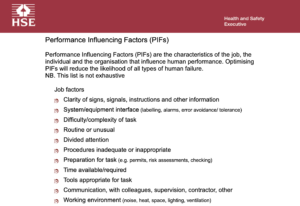
Performance Influencing Factors (PIFs) is another term, from across the pond, for error traps. You will see me use these terms interchangeably in my HF postings, as I was formally trained to use the term PIFs, but these days it seems we use the term trap.
But after spending a year working with an organization that performed many MANUAL HIGH-RISK tasks daily, I found the UK’s HSE infographic...
Read More

In light of the tragedy in Greece this week, I think it is time to share this video from Lund University’s College of Human Factors Engineering again. Be sure to check out all of Johan Bergström’s videos on YouTube.
A term in HFE seldom gets mentioned during accident investigations, as most will say it, “muddies the water” in the investigation. But the space between...
Read More
Flexible hoses are often used to temporarily transfer hydrocarbons and other process fluids to facilitate turnaround activities (clearing equipment, de-inventorying, purging, etc.) and transfer process fluids/products to rail cars and/or/or tanker trucks for shipment. Flexible hoses may also be installed within process piping systems to mitigate the effects of thermal expansion, vibration, or movement...
Read More
Facilities should have a written program to ensure flanges are properly made up. Proper makeup of every flange in a piping system is important for reliability. Proper makeup includes:
…
HomeRead More »
Read More
The ever-controversial “check valve” has now been defined as to when it should be formally included in the piping MI inspection process. As we have discussed many times, if we claim a check valve in our PHA and/or SOP as a “safeguard,” then by all means, this valve has been defacto identified as a “safety critical valve”. Here is the official definition...
Read More
The endpoint concentrations for regulated toxic substances under the risk management program rule (40 CFR Part 68 Appendix A) are listed in units of milligrams per liter (mg/L). Is this equivalent to parts per million (ppm)?
…
HomeRead More »
Read More
Passive mitigation is defined in § 68.3 as “equipment, devices, or technologies that function without human, mechanical, or other energy input.”
…
HomeRead More »
Read More
According to the definition of “process” in 40 CFR §68.3, any group of vessels that are interconnected is considered to be a single process.
If a stationary source has two interconnected vessels and one contains 6,000 pounds of BUTANE while the other contains 6,000 pounds of PROPANE, is this a covered process under 40 CFR Part 68?
…
HomeRead More »
Read More
What does EPA plan to do to verify the accuracy and completeness of submitted Risk Management Plans (RMPs)?
…
HomeRead More »
Read More
Would the risk management program regulations cover the loading and unloading of transportation containers?
…
HomeRead More »
Read More
Some landfills collect methane gas and either vent, flare, or store it for subsequent fuel use. Are methane processes at landfills subject to the requirements of the EPA Risk Management Program?
…
HomeRead More »
Read More
Oleum, which is a mixture of sulfuric acid and sulfur trioxide, is listed as a regulated toxic substance in 40 CFR §68.130.
Sulfur trioxide is also listed individually as a regulated toxic substance.
Suppose a single process consists of one vessel containing oleum and one vessel containing sulfur trioxide. Must the amount of sulfur trioxide in the oleum be aggregated with the amount of pure sulfur...
Read More