













The regulation governing the reporting of accidental releases can be found in title 40 Code of Federal Regulations (CFR) Part 1604, Reporting of Accidental Releases.
The regulation requires the owner or operator of a stationary source to report any accidental release resulting in a fatality, serious injury, or substantial property damages. The purpose of this part is to require prompt notification...
Read More
Massachusetts Fire Code hazardous material processing regulation (527 CMR 33) requires a hazard evaluation or limited process safety program for many companies that have never faced this requirement before, (though many companies have been essentially performing these tasks as good practice). Many companies covered by this regulation must now document that a hazard evaluation has been done,...
Read More
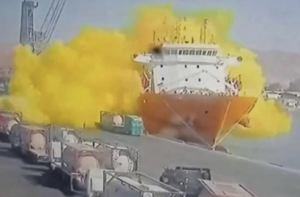
This past week we witnessed a tragic incident involving chlorine (Cl2), a 25-ton ISO container, and a crane/sling failure. The incident claimed 13 workers’ lives and sent another 250 to hospitals for emergency care. Many have claimed this to be the “worst-possible outcome”. Here in the USA, we call these “Worst Case Release Scenarios” (WCS). A lot...
Read More
The Respondent manufactures bread and bakery products. The Respondent’s bakery processes meet the definition of”process” and “covered process “, as defined by 40 C.F.R. § 68.3. The Respondent had one RMP program level 3 covered process (anhydrous ammonia refrigeration system) which stores or otherwise uses a regulated substance in an amount exceeding the applicable threshold....
Read More
Respondent has a commercial scale distillation process used for research purposes at the Facility, meeting the definition of “process “, as defined by 40 C.F.R. § 68.3. Isobutane is a “regulated substance ” pursuant to 40 C.F.R. § 68.3 with a threshold quantity of 10,000 pounds. Respondent has greater than a threshold quantity of isobutane, in a process at the Facility,...
Read More
World-class safety can be summed up in this manner…
The ability to recognize a serious hazard that can be controlled by an existing safe work practice that is in place for complying with a different OSHA standard.
If you’re a process safety engineer/practitioner you have dealt with “line break/process opening” for your Highly Hazardous Chemicals (HHC) and Extremely Hazardous...
Read More
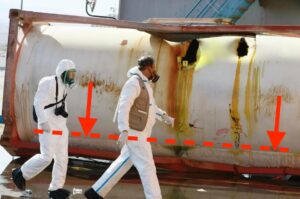
As we saw in Jordan last week, gases stored as liquids can “auto-refrigerate” in large-scale accelerated releases. In the aftermath pictures, we can see a clear frost line along the bottom of the ISO container, which is evidence of a refrigerated liquid level within the container. (See pic and explanation below)
…
HomeRead More »
Read More
Full Disclosure: This is a horrible decision, based on legal matters and not on safety and health. So use it wisely!
In this case, we must decide whether the Power Generation Plant violated OSHA’s Hazardous Waste Operations and Emergency Response standard when employees at one of its power plants responded to an ammonia release without donning certain protective gear. Because we conclude...
Read More
Pursuant to the risk management program regulations, facilities must perform an offsite consequence analysis for the worst-case release scenario.
Do the quantities of two separate vessels that are interconnected with a closed valve need to be aggregated for the worst-case release scenario analysis?
NO
…
HomeRead More »
Read More
Stationary sources subject to the Program 3 Prevention Program requirements in 40 CFR Part 68, Subpart D, must include in their Risk Management Plan (RMP) the date of the most recent review or revision of hot work permit procedures in Section 7.13.
What are hot work permit procedures and what date should the stationary source enter in Section 7.13?
…
HomeRead More »
Read More
A process covered under 40 CFR Part 68 is eligible for Program 1 requirements if it meets all of the criteria listed at 40 CFR §68.10(b). Those criteria include a requirement that the process cannot have had an accidental release of a regulated substance that led to offsite death, injury, or environmental response or restoration activities within five years prior to the risk management plan (RMP) submission.
If...
Read More
The risk management program regulations require the owner or operator of a covered stationary source to develop and implement an emergency response program as described in 40 CFR §68.95, which must include an emergency response plan, emergency response equipment procedures, employee training, and procedures to ensure the program is up-to-date. Do all facilities subject to the risk management program...
Read More