












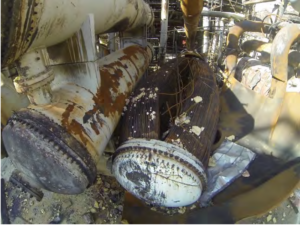
The purpose of this Enforcement Alert is to highlight the importance of accident prevention efforts during startup periods and other times of non-routine operations. Chemical accidents can occur at any time, but there are times when facilities are more prone to accidents. The startup is a particularly vulnerable time. The Chemical Safety Board (CSB) noted in its Safety Digest, “CSB Investigations of...
Read More

During a recent audit of a facility’s emergency response programs, we came across an interesting “manufacturer requirement” regarding the use of their Emergency Escape Breathing apparatus/device (EEBA or EEBD). This client is one who wants every single layer of mitigation efforts reviewed and validated, so we reviewed their efforts surrounding these EEBA’s, especially...
Read More
Three (3) Elk Grove Village Fire Department investigators, along with one from the Bureau of Alcohol, Tobacco, Firearms, and Explosives (ATF), established that a faulty 1/4″ drain valve on a vessel level controller system caused the liquid ammonia leak at the food processing plant in Elk Grove Village, IL. The leak led to an explosion at the plant on July 7, 2017, causing nearly $30M in damages...
Read More
Under 2019’s ESHB 1817, owners of petroleum refining or petrochemical manufacturing must ensure their contractors and subcontractors use a skilled and trained workforce to perform all on-site construction, alteration, demolition, installation, repair, or maintenance work. The new law is under Chapter 49.80 RCW.
A “skilled and trained workforce” means a workforce where all the workers are either
registered...
Read More
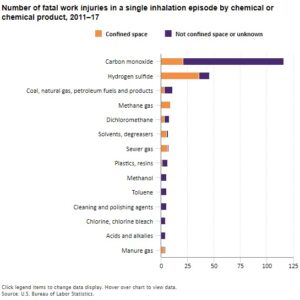
I use this graph in my PRCS training and it always seems to get a lot of discussions, so I thought I would share it here. SAFTENG members can download my training materials from the Member’s Area “Document Library. But this particular graph shows us the Number of fatalities from 2011-2017 from a single inhalation episode by chemical and if this event occurred inside a...
Read More
An account administrator at a securities firm was working overtime in a section of a vault. At 7:10 p.m., security personnel closed and locked the vault. The employee was working in a section of the vault accessible only with a swipe card. The security guard did not have a swipe card and did not access that area of the vault, but instead looked through a small window and apparently did not see the...
Read More
3/8/2021 UPDATE:
Of course, someone finds an LOI that says otherwise to my position and totally blows me away – not because the LOI says a PFT is not required, but that in the LOI OSHA states that personnel who are trained to the Operations Level are not HAZMAT responders and therefore do not need to have a PFT. I am sorry, but that is nonsense and I can not defend such rubbish – follow...
Read More
Firefighter #1, Firefighter #2, and Firefighter #3 were participating in a training drill. All three (3) Firefighters were assigned to the decontamination team, which is responsible for decontaminating hazardous materials response members. The team was suited in LEVEL B protective gear and was utilizing Self Contained Breathing Apparatus. The team was using a “buddy breather” system, which...
Read More
This happened in the USA in the Year 2010 and involved two (2) plumbers and two Volunteer (2) firefighters. We had the SINGLE entrant getting overcome by a bad atmosphere and his/her partner decides to enter to help and becomes a victim. To make matters worse, this incident involved a Volunteer FF (32-year veteran) who entered to attempt a rescue without an SCBA and attendant and was overcome...
Read More
Last week I asked my FaceBook Group a “trick question” regarding the end-of-service-time indicator (EOSTI) on our Supplied Air Respirators that we use for emergency response. I was so pleased to get so many texts/calls/emails and even a few phone calls checking to see if I was feeling OK. I did not tell the group it was a trick question, but a lot of them realized there was...
Read More
At 4:41 p.m. on July 24, 2020, Employees #1 and #2 set a 32-foot ladder into an eight-and-a-half-foot manhole that was connected to the main city sewer line station. Employee #1 entered the manhole and was immediately overcome by hydrogen sulfide gas, Employee #2 entered and was also overcome by the gas.
…
HomeRead More »
Read More
At 11:30 a.m. on July 9, 2020, Employees #1 and #2 and their foreman, employed by a waste management company, were installing a closed-circuit television (CCTV) into an 8-inch sewer line to enable inspections in the manhole. They did NOT test the atmosphere before attempting to enter the manhole, which met the definition of permit-required confined space, and ventilation equipment was NOT available....
Read More