CLICK HERE to Renew your Membership
CLICK HERE for a NEW Membership
CLICK HERE to see eligibility requirements for FREE Membership
If you have any questions, please contact me

I am proud to announce that SAFTENG and The Chlorine Institute have renewed our partnership for another year (through 2026). Members of The Chlorine Institute receive a FREE SAFTENG membership. If you qualify, please contact me
NOTE: Any trade group interested in becoming a partner with SAFTENG for your Member Companies, please reach out, and I can share the plan






A few months ago I wrote about this new refrigerant as having the catastrophic risk of a BLEVE event. Now I wish to offer some guidance on how a business utilizing this refrigerant can reduce the likelihood of this type of event. First, there are NO engineering standards that guide a manufacturer of an ASME pressure vessel in how to construct a pressure vessel so that it will not fail in a BLEVE...
Read More


This is what happens when we load heavy equipment like fools. Too many videos of “succesful” (although foolish) attempts at loading this type of equipment into the back of trucks UNSAFELY and now it seems everyone thinks they can do it. Here is a failure mode that one would think would cross the worker(s) minds before attempting…
Read More
Respondent has five RMProgram covered processes. The letdown area process, the urea process, and the high pressure solutions process store or otherwise use ammonia in an amount exceeding its applicable threshold of 10,000 pounds; the chlorine addition process stores or otherwise uses chlorine in an amount exceeding its applicable threshold of 2,500 pounds; and the sulfur dioxide addition process stores...
Read More
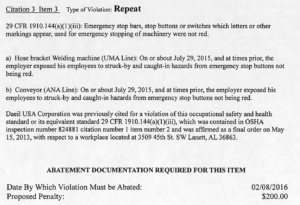
We dont see this citation very often, but it is a standard and it is one that we use often…
1910.144(a)(1)(iii) Stop. Emergency stop bars on hazardous machines such as rubber mills, wire blocks, flat work ironers, etc., shall be red. Stop buttons or electrical switches which letters or other markings appear, used for emergency stopping of machinery shall be red.
Here is an OSHA citation...
Read More
As we know, 1910.146 gives employers three (3) methods to enter Permit-Required Confined Spaces:
1) Full permitted entry following (d)-(k),
2) alternative entry methods prescribed in (c)(5), and
3) reclassification of the PRCS to a non-permit space by following (c)(7).
However, in the past year or so, we have come across another method… using BOTH (c)(5) AND (c)(7) in the same space at the same...
Read More
This incident is a PERFECT example of what can happen when STORED ENERGY is overlooked. For energy sources like hydraulics and pneumatic (e.g., gases), merely closing a valve and locking it closed or locking out a pump is NOT full energy control. Procedures MUST include the means to dissipate the stored energy to the Zero Energy State (ZES). Keeping in mind that sometimes the dissipation...
Read More
Respondent is a corporation authorized to do business in the State of Texas. Respondent owns and operates a chemical building, manufacturing, and packaging facility. Respondent receives bulk raw chemicals, including liquid sodium chlorite, delivered in tanker, railcar, and packaged containers. Respondent uses these raw ingredients to produce finished products. Liquid sodium chlorite is an extremely...
Read More
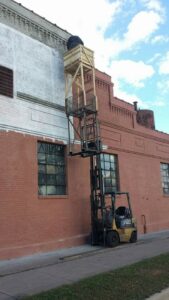
Anyone wondering who got him up there? Besides being driver-less, look closely for the other OSHA violation…
Read More
Respondent is a fertilizer distributor engaged in the business of selling anhydrous ammonia to farmers as fertilizer. Anhydrous ammonia is classified as a physical or health hazard, and a simple asphyxiant and therefore is an “extremely hazardous substance” according to Section 302(a)(2) of EPCRA. The Respondent stores more than 10,000 lbs. of anhydrous ammonia at the facility. On...
Read More
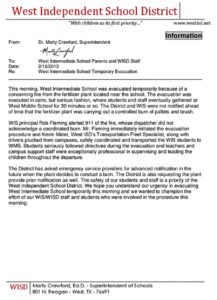
1/29/16 UPDATE – CSB Investigation Video and Investigation Report
…
HomeRead More »
Read More