













On December 24, 2008, natural gas leaking from a gas distribution pipeline resulted in an explosion and fire at 10708 Pauite Way, Rancho Cordova, California. One person died, and others were injured.
The National Transportation Safety Board (“NTSB”) immediately began to investigate the accident. The NTSB concluded its investigation on May 18, 2010, with the issuance of its Pipeline Accident Brief...
Read More
ASME B31.9 requires that utility piping be leak tested BEFORE initial operation. Hydrostatic testing shall be employed when possible. Pneumatic testing may be used instead of hydrostatic testing only under the limitations provided in para. 937.4.
…
HomeRead More »
Read More
ASME B31.9 covers “utility piping.” The Code DEFINES and QUANTIFIES the phrase “utility piping.” We use this code for utilities associated with our PSM/RMP-covered processes WHEN the utility either PREVENTS, PROTECTS, or MITIGATES an event. Specifically, the code applies to the following services, except as excluded in para. 900.1.3:
…
HomeRead More »
Read More
We have discussed all the requirements for transferring flammable liquids and gases (i.e., NFPA Flammable “4”); however, I have not mentioned the requirements for transferring TOXIC and HIGHLY TOXIC LIQUIDS that have an NFPA 704 Health Rating of 3 or 4. We see these issues in our Chlorine work where Cl2 is a “utility” to the business and is sort of “out of sight –...
Read More

Early Warning of Natural Gas Leaks Can Prevent Deaths and Injuries
The Problem
It is vital that occupants evacuate a building when a natural gas leak occurs or is suspected.
Although natural gas is generally a safe source of energy, when a pipeline or natural gas appliance leaks, the gas can migrate into a building and reach dangerous concentrations that can ignite and...
Read More
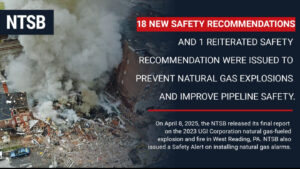
Today #NTSB released the final report of the March 24, 2023, natural gas-fueled explosion and fire at the R.M. Palmer candy factory in West Reading, Pennsylvania. The NTSB issued 18 new safety recommendations, 1 reiterated safety recommendation, and published a Safety Alert to the public about the importance of installing natural gas alarms in businesses and homes.
Read the final report here: https://www.ntsb.gov/…/AccidentReports/Reports/PIR2501.pdf
Read...
Read More
During my PHAs and Audits, I typically find businesses that are not focused on the UNLOADING risks associated with their hazardous materials. I tend to get a lot of pushback about how Unloading is a DOT function and somehow not related to process safety. The risks associated with unloading 7,000 gallons of an HHC/EHS through “temporary connections” and a “hose(s)” may be the...
Read More
In 2021, I wrote an article regarding OSHA’s Permit-Required Confined Space standard and reclassifying PRCSs to a Non-PRCS status. This article centered on the keyword “potential” when discussing a hazardous atmosphere. The intent of that article (Defining and Quantifying “potential hazardous atmosphere”) was to clarify when/how a POTENTIAL was present to create a Hazardous...
Read More
The question was asked…
If the underground piping is protected by a cathodic protection system, does this system need to be turned OFF and Locked Out before workers begin working on the pipe?
…
HomeRead More »
Read More
On May 3, 2006, Employee #1 was in a trench (approximately 37″ deep and 44 to 46″ wide), digging dirt from around a 10″ diameter PVC water pipeline to locate a water leak. The pipeline was pressurized to approximately 125-130 psi with compressed air.
…
HomeRead More »
Read More

One of the more common issues we come across in regards to Hot Work is the encroachment of combustible/flammable hazards within the REQUIRED 35′ Fire Safety Zone.
1910.252(a)(2)(vii) Relocation of combustibles. Where practicable, all combustibles shall be relocated at least 35 feet (10.7 m) from the work site. Where relocation is impracticable, combustibles shall be protected with flameproofed...
Read More
I normally do not share construction accidents, as I am not a construction safety professional. I would not even attempt to play one on TV! However, this case is an excellent example for the general industry and those who work with hazardous chemicals. One of the reasons why my HAZCOM training is 2+ hours is I teach workers how to read an SDS. Far too many have no idea what Vapor/Gas Density is...
Read More