
PAPR’s, APF’s and big assumptions = bad decisions!
PAPR APF 3M Versaflo

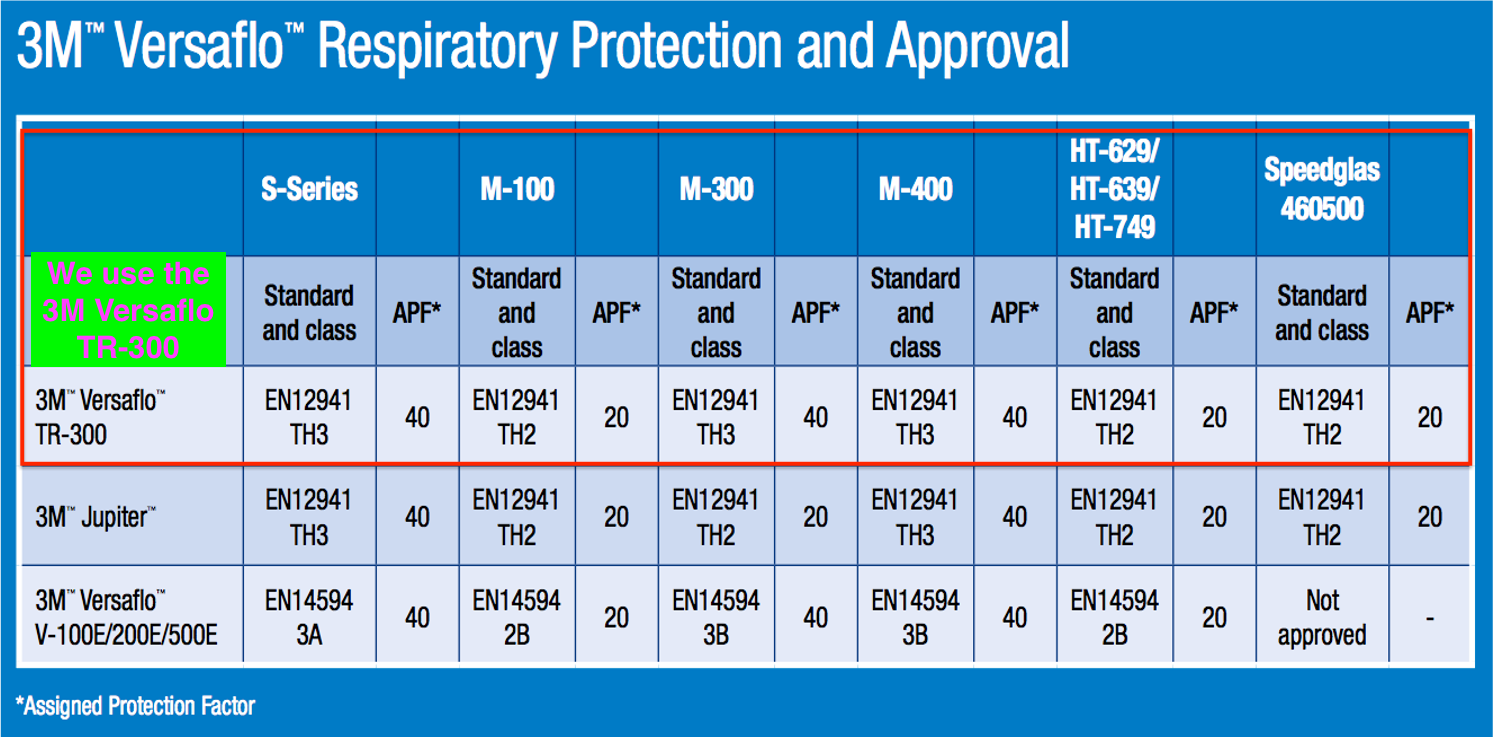
What is the Assigned Protection Factor (APF) for a Powered Air-Purifying Respirator (PAPR)?  Most people will claim 1,000 and with that, we are already off the rails!!!  SAFTENG members can refer back to my 2015 article (What is the ACTUAL assigned protection factor for Powered Air Purifying Respirators (PAPR) WITHOUT a tight-fitting facepiece?) where I explain how we can get to an APF of 1,000, but we should ALWAYS start at an APF of 25!  Yes, 25 – half the APF of a Full-FACE APR.  So as to set some boundaries, a loose-fitting PAPR will start with a LOWER APF than a non-powered Full-FACE tight-fitting APR.  Case in point, here is a manufacturer’s prescribed APF for their brand/model/style PAPR…

PAPR APF 3M Versaflo

We can see right off the bat, the manufacturer’s Assigned Protection Factor is between 20 and 40.  Remember a basic full-face APR has an APF of 50.  If we needed the level of protection provided by the full-face APR and we switch to a PAPR because of facial hair issues, we are LESSENING the degree of protection and in some cases, we have found employees were NOT ADEQUATELY PROTECTED.

We also came across another SERIOUS limitation of this brand/model/style PAPR.  It became so popular on the plant site that the safety group permitted its use to spread to other units/departments.  The safety team liked this because it eliminated hundreds of annual fit tests.  It seemed, all you had to do is ask and your department was given approval for this PAPR; until the day an employee got violently ill after using his/her PAPR for a routine task.  When safety responded and began to investigate they found that this PAPR had become the respirator of choice for nearly all the tasks in the unit/department – EVEN though this PAPR is for particulates ONLY.  The guys liked it because they could grow their facial hair back, the ladies liked them because they were cooler in the summer months so with very little oversight and a horrible attendance rate for the annual training this PAPR was found to have potentially caused over 1,000 exposure events, some borderline IDLH events in just 2020.  Some of this was due to COVID restrictions – but that is an unacceptable excuse when it comes to RP in a facility where RP plays a VITAL ROLE in worker protection.

3M Versaflo Limitations

NOTE: I love 3M and SCOTT and personally use ONLY these brands of respirators and recommend them to my clients – so I am not speaking ill of 3M; I am merely using their data as the event I was asked to review used these brands/model/style PAPR.


Folks if you are the acting Respiratory Protection Program Administrator, catching things like these issues should be a cake-walk!  Understanding the MANUFACTURER’S APF may be LESS THAN OSHA’s Table 1. – Assigned Protection Factors and that the respirator’s APF’s are CRITICAL to the proper SELECTION of respiratory protection and is a FUNDAMENTAL SKILL that the program admin MUST possess.  It should go without saying that this person MUST FULLY understand the LIMITATIONS of their RP being used on site.

Loose-Fitting PAPR’s do in fact eliminate the need for fit testing and can be used with SOME facial hair!  But let’s be clear, the men in ZZ-Top or Duck Dynasty would NOT be capable of using a Loose-Fitting PAPR as their level of facial hair would exceed the ability of the hood to contain their facial hair.  SO these RP devices STILL have some facial hair limitations.  But more importantly, these PAPRs typically will come with a LOWER APF and we must be able to recognize this limitation if we wish to use them properly!

Scroll to Top