
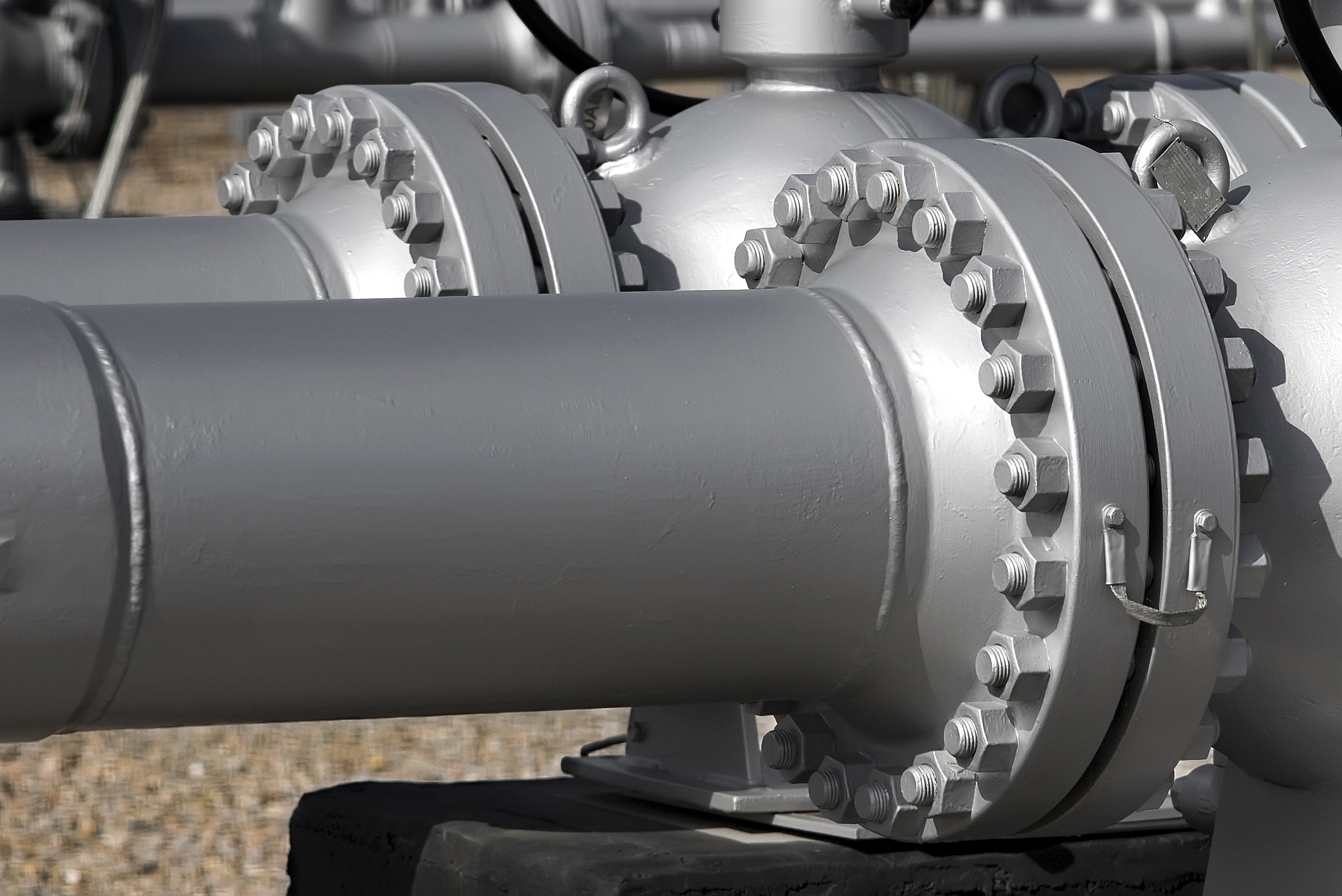
As a process safety professional, what do we see and what comes to mind when we see a pipe flange like the one shown here? In this small and simple picture, how many sections of OSHA’s PSM standard (or EPA’s RMP rule) impact this pipe flange; better yet, can we name all the RGAGEPS that would impact this pipe flange? Look closely as this is sort of a “special” flange! Can we tell what may be traveling via this pipe based on what we see in this picture?
In this article, I want to use this simple pipe flange to demonstrate how a flange in our piping has such a HUGE impact on process safety. I will point out some items and pose questions and over the next several weeks I will expand on these topics in the hopes that more process safety practitioners may be able to see process safety as a proverbial onion that we can peel back layer by layer.
First things first… for the purist pipe engineers – what I am calling a flange is technically a…
mechanical joint: a joint for the purpose of mechanical strength or leak resistance, or both, in which the mechanical strength is developed by threaded, grooved, rolled, flared, or flanged pipe ends; or by bolts, pins, toggles, or rings; and the leak resistance is developed by threads and compounds, gaskets, rolled ends, caulking, or machined and mated surfaces.
I use the lay-term “flange” as that is what most process safety practitioners will call them.
As we have discussed MANY MANY times, welded joints have their own set of QA/QC requirements and the same will go for our “flanged connections”. Even processes where the vast majority of field joinments are welded, almost all chemical processes will have some flanged connections. Much like welded connections, flanged connections are an “art” and come with their own RAGAGEPs, tools, skills, procedures, and training.
I view a pipe flange like an onion… there are several layers we have to peel back to make sure it is installed correctly. The joinment MUST have a written procedure, much like our Welding Procedure Specification (WPS), our flanges (all types) will need a written procedure to ensure they are installed per code (ASME B31). Sort of like changing a tire on a vehicle, the tightening pattern of the nuts and bolts matter AND how tight we get them matters a LOT. So our procedures will provide us a tightening pattern, similar to the one below.

Our procedure MUST also ensure that we tighten our flange properly! Too loose and we have a leak; too tight and we crush our gasket leading to a catastrophic leak potential. This means that we MUST have a “Torque Wrench” and be trained in its use. Of course, to ensure we can meet the torque requirements, we must ensure that we have the CORRECT length of bolts/studs to ensure the installer can meet BOTH torque requirements AND have “3-threads-showing”. And of course, torque wrenches come with their own set of procedures and calibration requirements. At least annually, and some manufacturers may require their tool to be calibrated more frequently, the torque wrench MUST be calibrated. This can be done in-house with proper procedures, tools, etc., or most facilities will send their wrenches out (typically back to the manufacturer) for calibration. NOTE: if your facility has its torque wrenches in the MI program and is doing the calibration you are probably in the top 1% of PSM/RMP facilities! Congratulations!
The gasket is an ABSOLUTE CRITICAL piece to a flange connection and I will write a separate article about these devices.
You may have noticed a special connection on the flange picture above? I have highlighted it below in the yellow box…
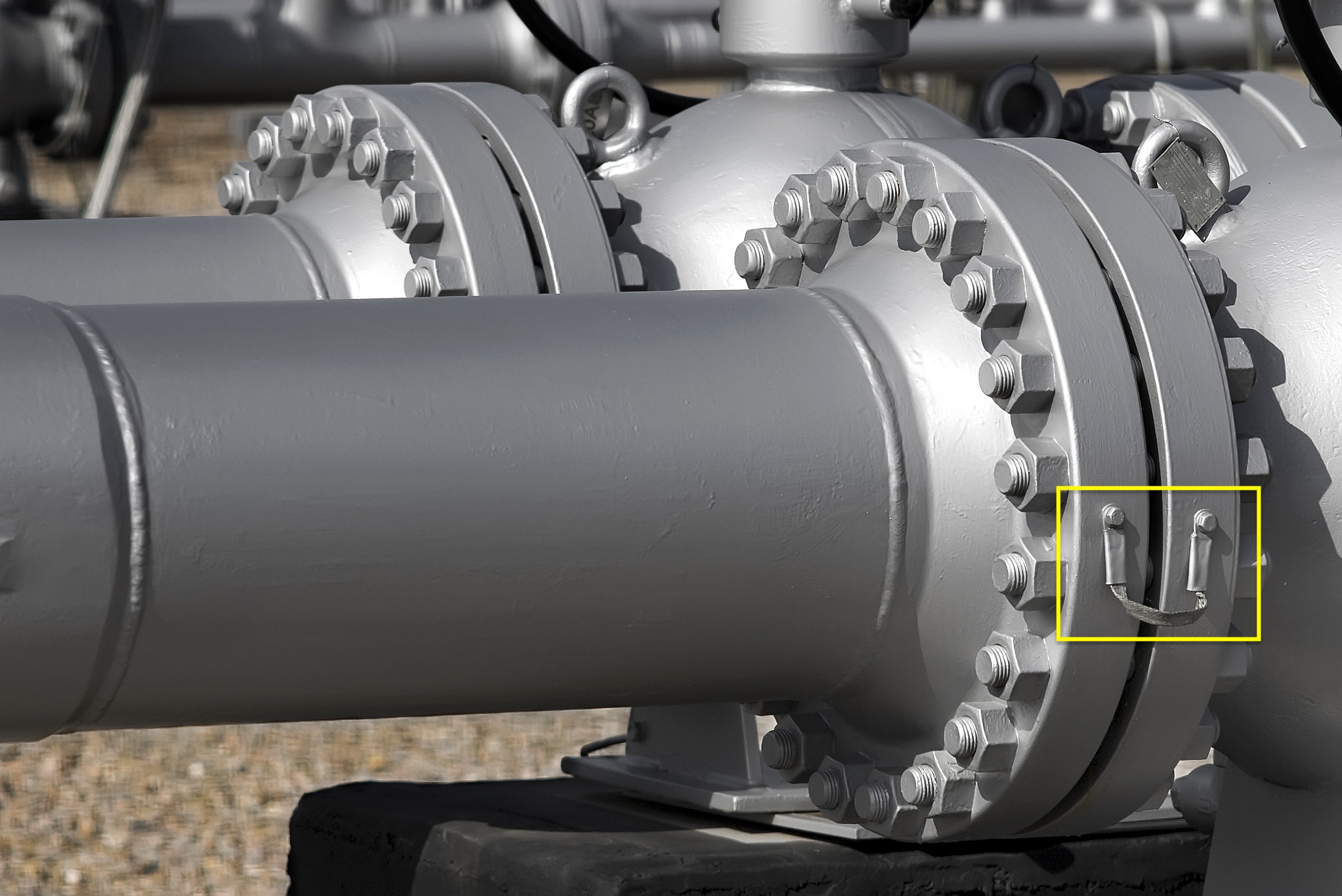
These are called “jumpers” and they are an indication that the material flow through the flange may be flammable liquids/gases/vapors. These are designed to ensure the continuity of a “ground path” across the flange faces. With a gasket between the two flange faces, the wrong kind of gasket can act as an insulator and block the path to ground so a lot of pipe designs will have these devices as the flanges. They work wonderfully, but they do add a layer of complexity to the pipe design, inspections, and maintenance of the piping circuit. And I will add, some pipe engineers will swear by these devices and emphatically require them; other pipe engineers hate them and think they do nothing but add work with little payoff. I will let them debate that in their circles, but for us if these devices are in the pipe spec’s they become a “safety system” which has to be designed properly, procedures to install and maintain them and of course training on those procedures.
And of course, just like our welded and threaded connections, we MUST pressure test and leak test our flange connections to ensure they are adequate BEFORE we introduce a hazardous material to the connection. If the engineering is right and the installation is right, then passing pressure and leak tests should be a cakewalk.
So here is a list of questions to ask your pipe engineer about your flanges:
1) Do we have a pipe spec for our flange connections?
2) Do we have specific bolt/stud requirements to ensure proper length/strength/materials of construction?
3) Do we have a gasket spec for each flange?
4) Do we have a procedure for the bolt tightening pattern?
5) Do we have a torque valve for our flanges in our pipe spec to ensure tightness but not crushing the gasket?
6) Do we have a basic rule of “3-threads-showing” on our bolts/studs?
7) Do we get our torque wrench(s) calibrated per the manufacturer’s frequency?
8) Do we train personnel on our flange procedure(s) that include using a torque wrench?
9) Do we have a procedure for pressure testing and then leak testing the connection?
10) If the flange(s) have “jumper(s)” do we have a procedure for testing the “continuity of ground” across each flange?
11) If the flange(s) have “jumper(s)” do we have a PM for their annual inspection/testing?
12) If the flange(s) have “jumper(s)” do we have a written procedure for their annual inspection/testing?
13) If the flange(s) have “jumper(s)” do we have this design in our PSI -Safety Systems?
and the $64,000 question…
Do we require all of this be managed properly when we change a gasket?
Yes, changing a gasket out, EVEN a replacement in kind, all of the above plays a CRITICAL role in ensuring the flanged connection is ready to see a HAZMAT pass through it!
This is when our risks increase with flanged connections vs. welded connections. Flanged connections require MORE MAINTENANCE and this leads to a higher risk of someone not following procedures, not using proper tools, etc. and this has oftentimes led to a serious LOPC event. The BIGGEST mistake that is usually made is on a “leaking flange”… workers go out and tighten the flange until the leak stops – all be damned about the tightening pattern, torquing values, etc. Doing this repeatedly, oftentimes with cheaters used, we end up with a crushed gasket and a serious LOPC event.
We also see the failure to pressure test/leak test a flange after a simple gasket replacement job. IT MUST BE an established requirement that any time a flange face is OPENED then it’s closure MUST BE DONE as if it is a new installation. This means ALL requirements are applied, including pressure and leak testing the connection(s).