 A tower mechanic was entering a fractionation vessel at a gas facility to prepare a final inspection of the vessel. The interior of the vessel was under a nitrogen purge, and the worker was using supplied air. Shortly after entering the vessel, the worker went into distress.
The on-site emergency response team extracted the worker and provided first aid. The incident resulted in a fatality.
Background information
An energy company gathered, produced, and processed natural gas and natural gas liquid. Additionally, it processed oil sands. The company operated facilities in Alberta and British Columbia. The company was founded in 2002 and was based in Calgary, Alberta, Canada.
At the time of the incident, the company contracted the work for the pressure vessel confined space entry to a leading employer in the fields of process technology and separation towers, as well as 2-component mixing and dispensing systems. The contractor was hired to clean and inspect the pressure tank.
The tower mechanic had been employed to perform confined space entries and to carry out maintenance in the vessel pre and post inspection. The tower mechanic had been employed on a casual/irregular basis since May 29, 2012. The tower mechanic was deemed a competent worker and was in possession of all required courses and certification. The tower mechanic had completed the required training to work at the fractionation facility.
The superintendent, at the time of the incident, had been employed for approximately 5 years and had a total of 22 years of relevant experience in this industry. The superintendent was supervising the confined space entry and had completed all of the pre-requisite job tasks such as the permits, pre-job meeting, bump tested air monitoring instruments and reviewed the equipment to be used for the job.
The spotter had been employed on a casual/irregular basis since April 2015, and this was their second such employment. The spotter had approximately 18 years’ experience as a tower mechanic. At the time of the incident, the spotter was feeding the airline to the tower mechanic and then followed and observed the tower mechanic into the pressure vessel.
The first emergency response team member (ERT 1) that responded to the incident had been employed for approximately 4 years and had a total of 12 to 15 years of related experience in this industry. At the time of the incident, ERT 1 was part of a 2 person emergency response team and was situated approximately 5 metres (m) from the entrance to the confined space. The second ERT member (ERT 2) that responded to the incident had been employed for approximately 4.5 years and had a total of 7 years of related experience in this industry.
At the time of the incident, ERT 2 was part of the 2 person emergency response team and was situated approximately 5 m from the entrance of the confined space.
Equipment and Materials
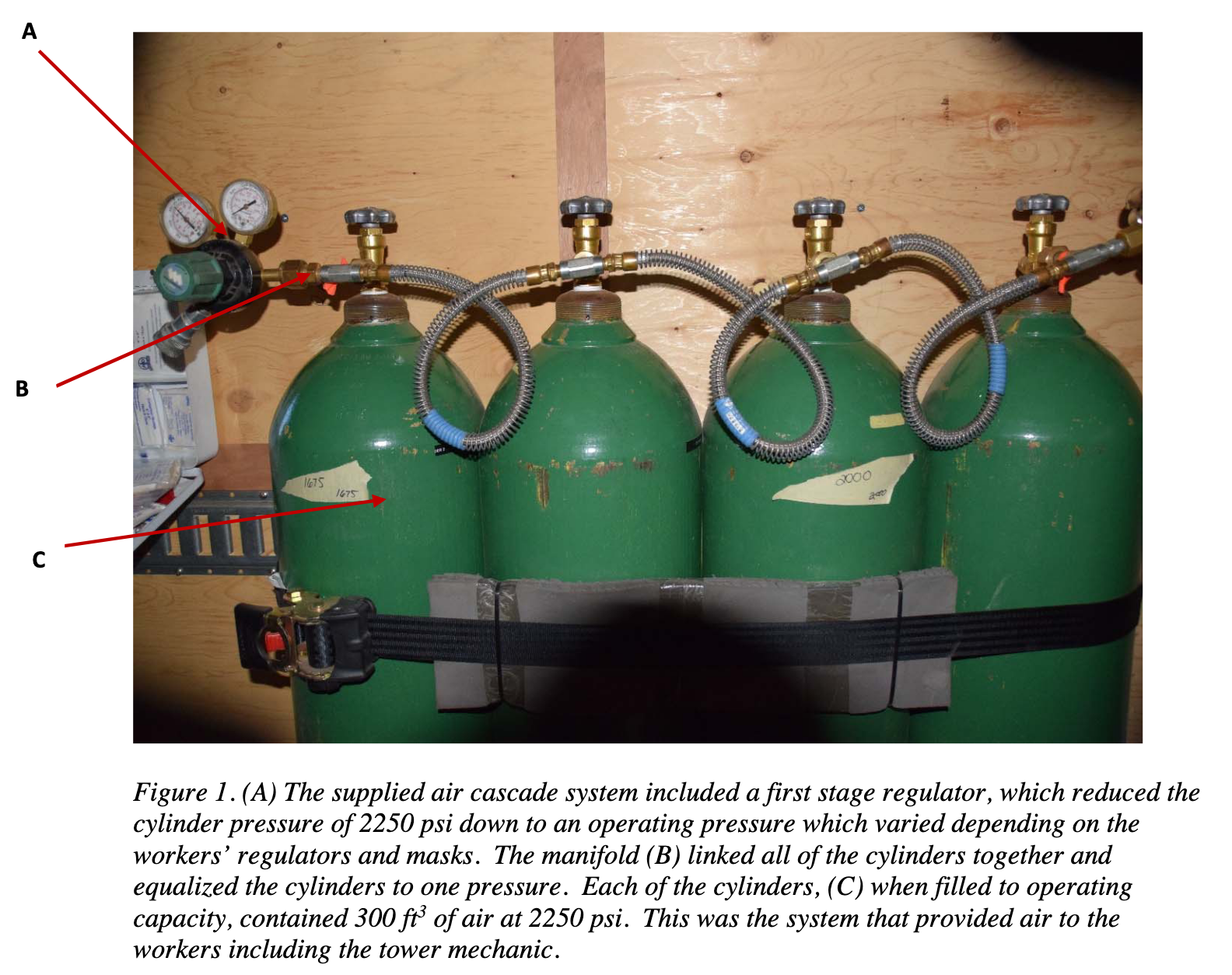
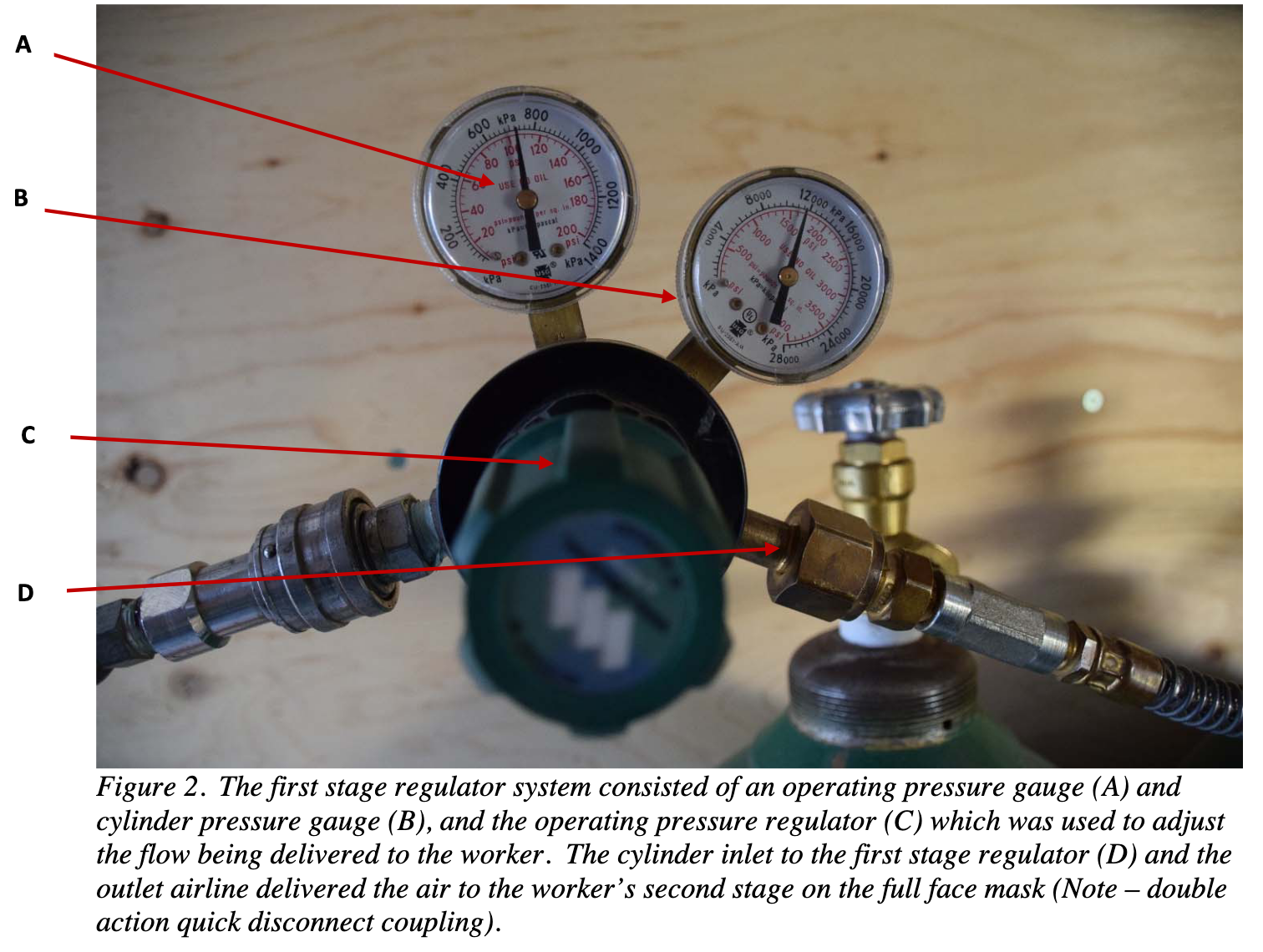
The cascade system that was used to supply air to the contractor’s workers was owned by the contractor; however, the cylinders were filled through another contractor. The system consisted of 2 air banks of 4300 cubic foot (ft3) cylinders that were initially filled to approximately 2250 pounds per square inch (PSI) (Figure 1). The last air analysis was conducted on April 13, 2016, by a 3rd party laboratory and met the standards as per the CS z180.1-13 Breathing Air Analysis. The cascade system that was in use at the time had approximately 1700 psi in each of the 4 cylinders and was operating at the first stage at 105 psi (Figure 2).
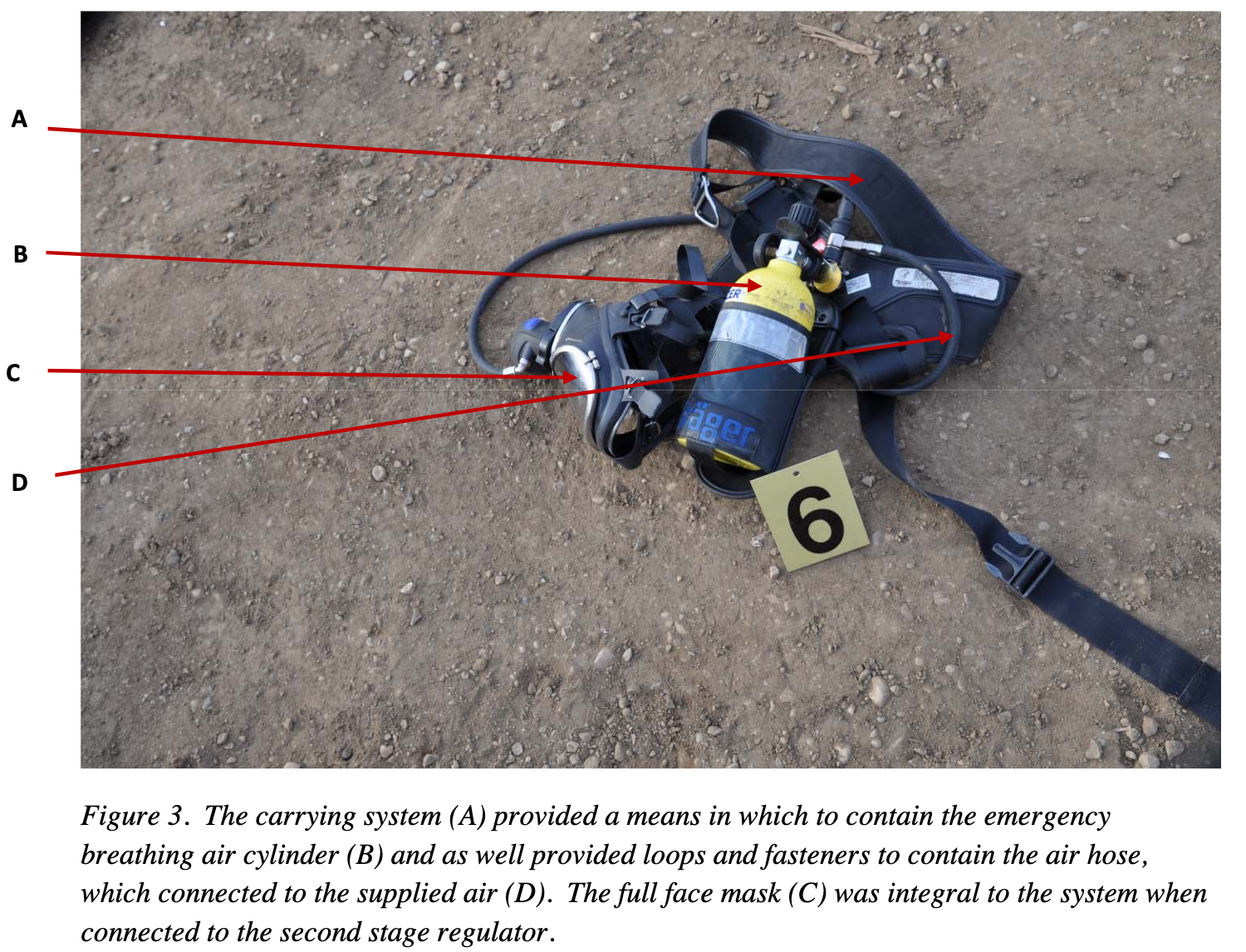
The airlines, which connected the cascade system to the worker, were in approved 100-foot increments and connected using positive, double action, quick disconnect couplings. The full face mask (Figure 3), which was used by the workers, was a highly reputable brand. The mask was made from ethylene propylene diene monomer (EPDM) rubber with a polycarbonate visor and chloroprene rubber head strap. In this job, the mask was part of the supplied air breathing apparatus (SABA) system. They used a hip-mounted emergency escape unit constructed of anti-static material and was inert to chemicals and oils and impervious to most acids and alkalis (Figure 3). The carrying system met the requirements of the National Institute for Occupational Safety and Health (NIOSH) and European Standards (EN137). The carrying system was used to accommodate the emergency escape cylinder, which was integral to the system providing up to five minutes of air. The carrying system had various loops and fasteners to keep the hoses contained and for ease of accessibility for the airline connections and the emergency escape cylinder.
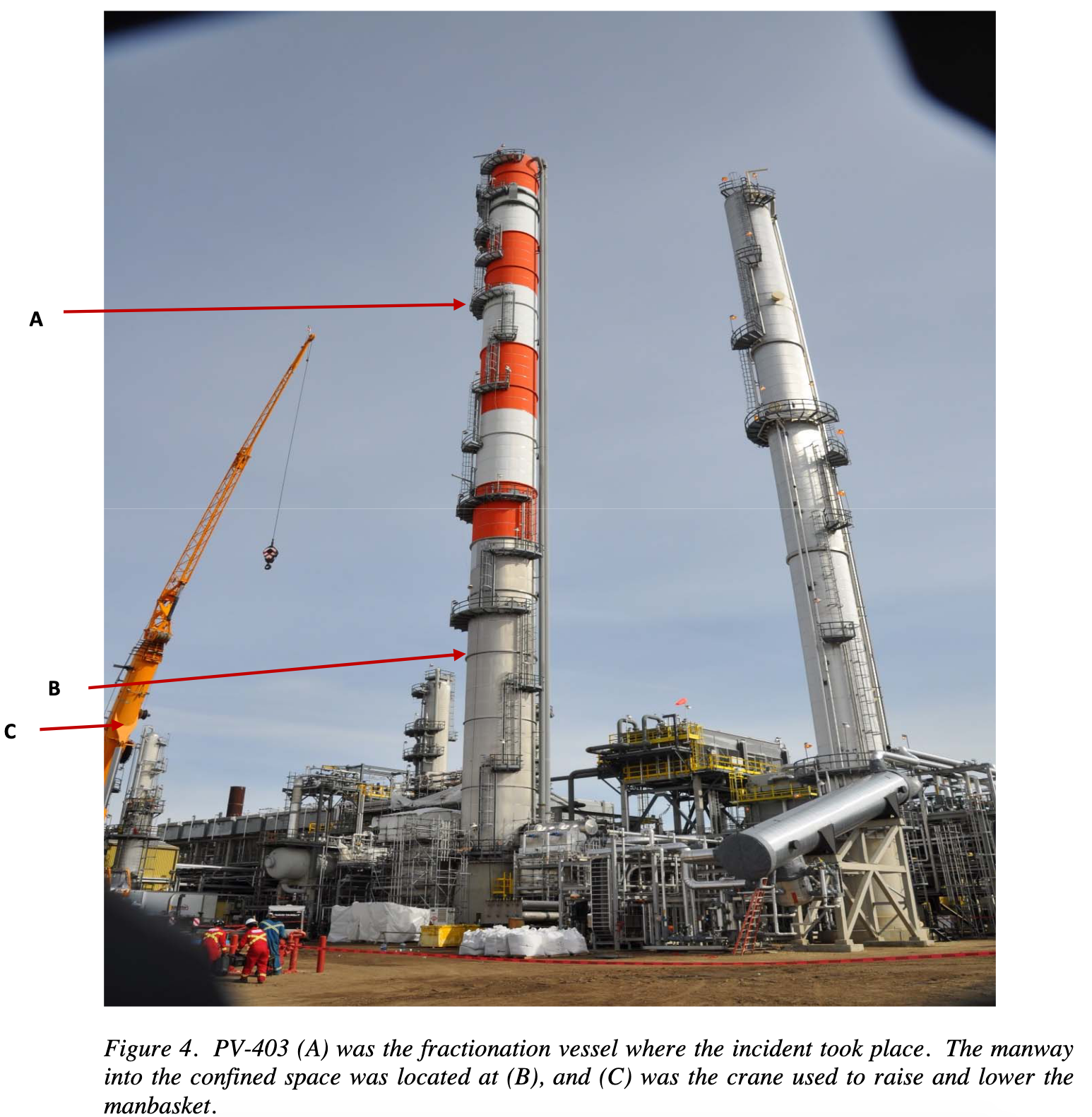
The pressure vessel 403 (PV-403) (Figure 4), which was the vessel being cleaned and inspected, was used to fractionate propane from propylene. Propylene was second in importance to ethane as a lefin raw material for petrochemical manufacture of plastics, fibres, lubricants, and gels. The pressure vessel used the process of distillation via heat and an internal mechanical design to provide a high-grade product. PV-403 was 94 m in height. The entrance to the manway was located 40 m above ground level.
Sequence of events
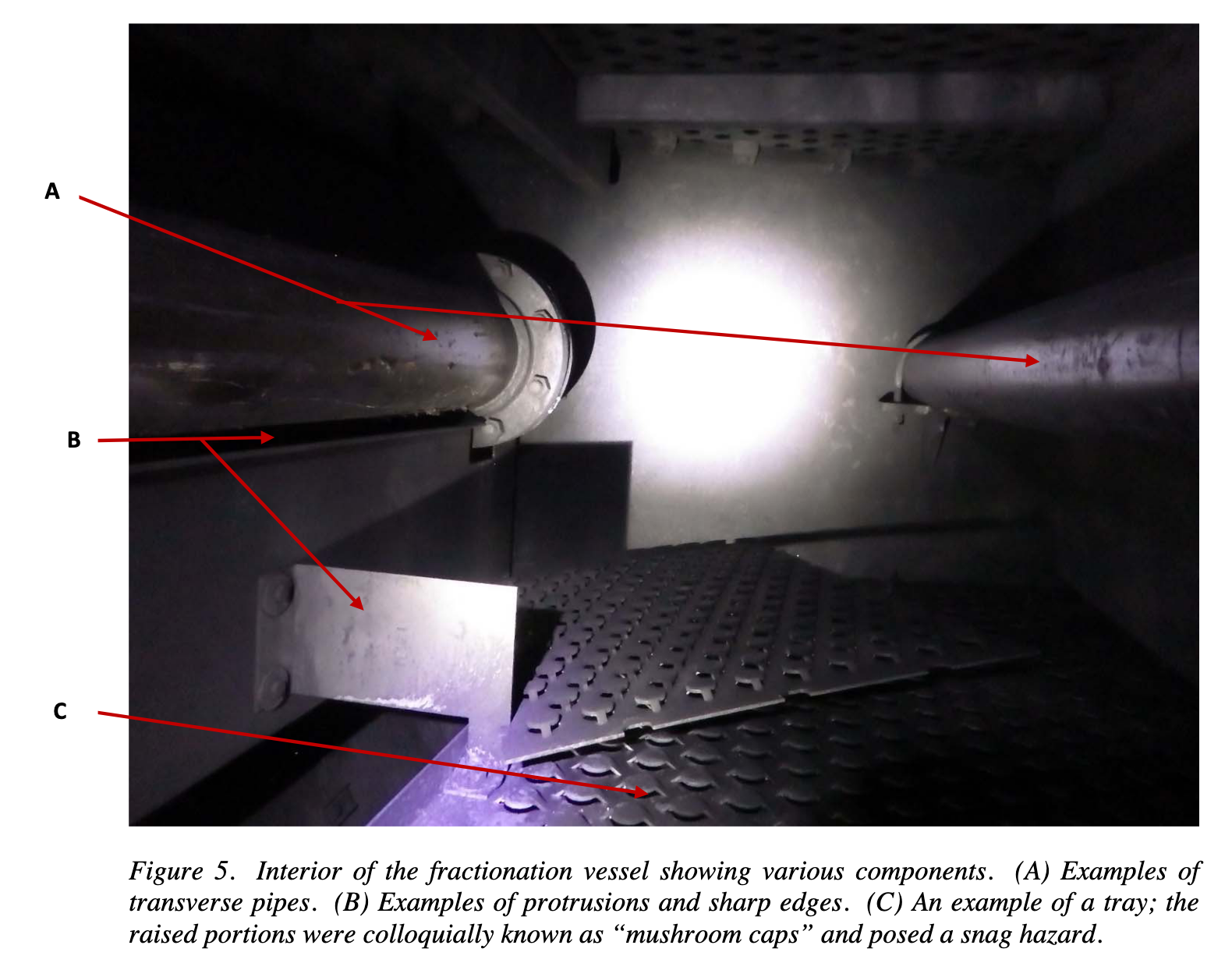
The contractor had been contracted to conduct tower maintenance in the PV-403 fractionation tower operated by the fractionation facility. Work on PV-403, which was under a 100% nitrogen blanket, comprised of entry into the vessel by the workers wearing SABA to remove, clean, and re-install trays. The trays were part of the integral design for fractionation (Figure 5).
On April 27, 2016, workers arrived for work and attended the daily safety meeting with all of the involved crews. The workers obtained the work permit from facility personnel and reviewed their confined space package documentation. The tower mechanic and the two ERT personnel were hoisted in a man-basket to the working platform by the crane. The atmosphere around the manway was tested with a 4-head gas monitoring instrument. A call was made to the cascade system watch worker (monitored pressure and airflow) to verify the supplied air pressure and air pressure in the system.
The two ERT personnel stood in the safe zone while the tower mechanic and the spotter donned the SABA and unbolted the four bolts securing the tower manway. The tower mechanic opened the manway and entered the vessel while the spotter fed the airline in after the tower mechanic. The spotter fed the airline into the confined space and then entered the vessel. The spotter saw that the tower mechanic was slumped over a 20 centimetre (cm) pipe; the spotter called out and tapped the tower mechanic on the foot. The spotter did not get a response from the tower mechanic and immediately radioed emergency and called out to the ERT personnel. The spotter remained inside the PV-403 vessel and attempted to free the tower mechanic. The spotter noted that the tower mechanic’s mask was off.
Once ERT 1 had donned the SABA, they replaced the spotter in the vessel. ERT 1 managed to extricate the tower mechanic from the confined space and on to the tower platform. The tower mechanic was not breathing at that time.
The superintendent responded to the emergency and ascended the exterior tower ladders to the working platform; the superintendent donned a self-contained breathing apparatus and assisted in the rescue. ERT 1 and the superintendent applied a Genesis II oxygen system, which automatically provided cardiopulmonary resuscitation (CPR) once applied. Rescue personnel were hoisted to the platform with a stretcher. The tower mechanic was secured to the stretcher and lowered to the ground. Rescue efforts continued until emergency medical services (EMS) arrived at the incident site, and the tower mechanic was transferred to an ambulance. The tower mechanic was pronounced deceased at the incident site.
CLICK HERE for the full report (pdf)