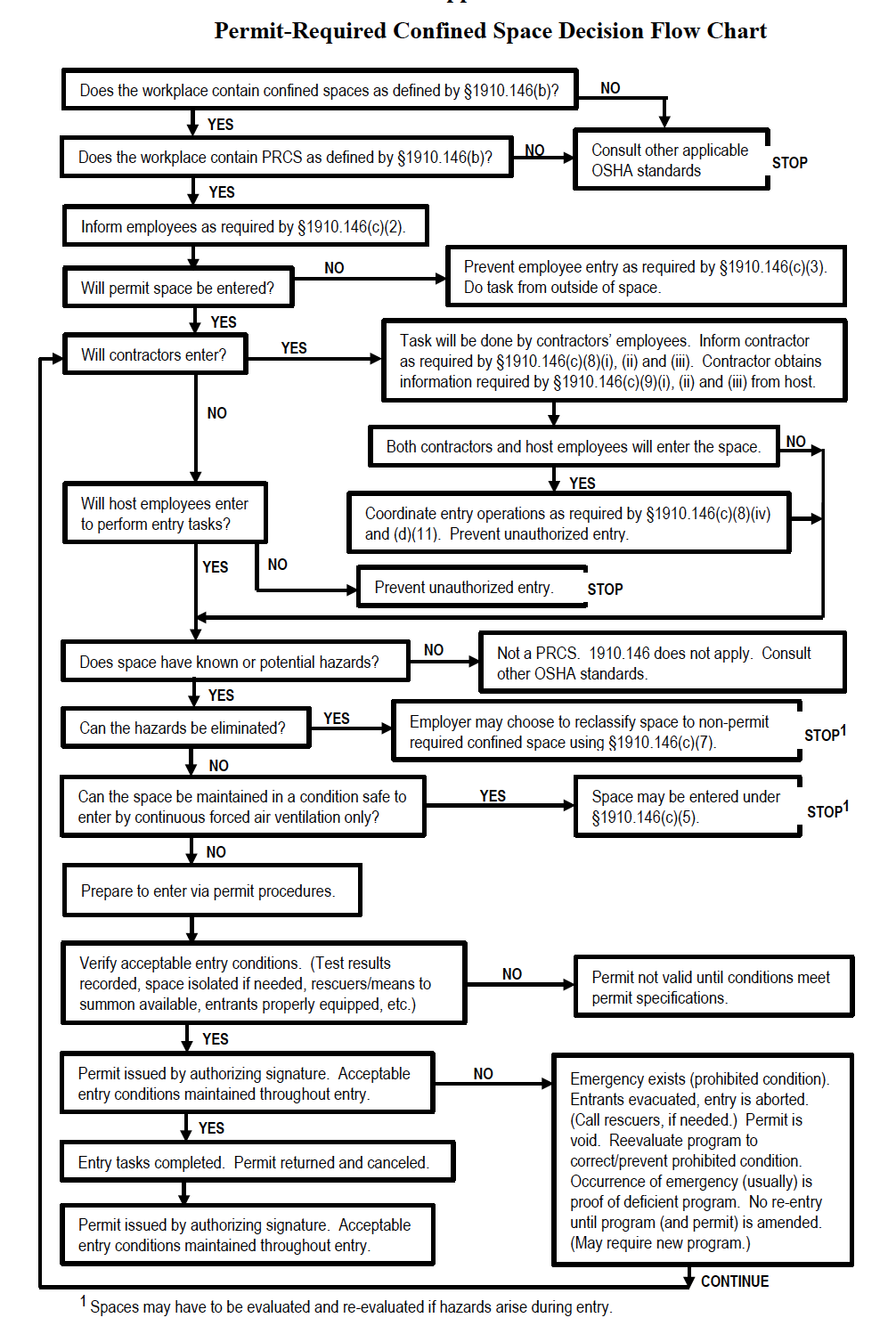
OSHA’s Permit Required Confined Space standard has been around since the mid 1990’s and the requirement(s) to perform “program reviews” has been part of the standard from its very beginning. In a recent OSHRC case, both the Administrative Law Judge and the full commission took issue with a company’s efforts in how they did (or did not do) their “program reviews” and from this case we get an inside view of how OSHA, the ALJ and the OSHRC expects these annual reviews should be done AND how management should respond to the results of the reviews. So lets take a look at these two (2) program review requirements and what’s been established as a baseline for compliance:
In this case, BOTH 1910.146(d)(13) and (14) are in question. Here is what these two (2) requirements state, as well as their “Note”:
1910.146(d)(13) Review entry operations when the employer has reason to believe that the measures taken under the permit space program may not protect employees and revise the program to correct deficiencies found to exist before subsequent entries are authorized; and
NOTE: Examples of circumstances requiring the review of the permit space program are: any unauthorized entry of a permit space, the detection of a permit space hazard not covered by the permit, the detection of a condition prohibited by the permit, the occurrence of an injury or near-miss during entry, a change in the use or configuration of a permit space, and employee complaints about the effectiveness of the program.
1910.146(d)(14) Review the permit space program, using the canceled permits retained under paragraph (e)(6) of this section within 1 year after each entry and revise the program as necessary, to ensure that employees participating in entry operations are protected from permit space hazards.
NOTE: Employers may perform a single annual review covering all entries performed during a 12-month period. If no entry is performed during a 12-month period, no review is necessary.
Here’s some background from the case:
Towards the end of the overnight shift on January 28, 2009, an employee supervising that shift’s tank washing crew (Supervisor A) began cleaning a tank that contained a pasty residue. He observed that the residue was not draining properly out of the bottom of the tank, so he decided to enter the tank to clear any obstruction. It is undisputed that Supervisor A did not conduct any atmospheric testing, complete a permit before entering the tank, or use his harness and the non-entry rescue system. Once inside the tank, Supervisor A lost consciousness and had to be rescued by the Summit Fire Department. Emergency personnel took Supervisor A to the hospital where doctors diagnosed him with “Syncope and Collapse, Toxic Effect of Unspecified Gas, Fume, or Vapor.” XXXXXXX’s Facility Manager formally disciplined Supervisor A in writing on the day of the accident.
OSHA alleges three violations based on Supervisor A’s conduct before and during his entry into the tank on the day of the accident:
- Serious Citation 1, Item 13, based on Supervisor A’s failure to attach himself to a non-entry rescue system before entering the tank, in violation of § 1910.146(k)(3);
- Willful Citation 2, Item 2, based on Supervisor A’s entry into the tank without first testing the conditions inside to ensure that it was safe for entry, in violation of § 1910.146(d)(5)(i); and
- Willful Citation 2, Item 3, based on Supervisor A’s failure to complete an entry permit documenting the measures taken to ensure safe entry, in violation of § 1910.146(e)(1).
At issue on review was the judge’s finding that the company had knowledge of the conditions alleged under all three (3) items. The argument that OSHA made was that these required “program reviews”, had they been done properly, should have been a RED FLAG that the PRCS entry program was NOT functioning as intended and that management should have intervened long BEFORE the night the supervisor entered the trailer!
According to OSHA, the deficiencies on the entry permits, particularly the failures to record periodic testing when staying in the tanks for over an hour and failing to specify an attendant gave the Facility Manager who reviewed them “reason to believe” that “measures taken under the facility’s PRCS program may not protect employees. OSHA also took the position that under the plain language of the standard, this requires the employer to take corrective action. The companies position was that none of the permit deficiencies triggered the requirement to revise the program because they do not indicate defects in the written program itself rather, they show failures to follow that program. The OSHRC disagreed.
Although OSHA had not identified any deficiency in the facility’s written PRCS program that correlates with the errors on the entry permits, the distinction the facility suggests – that implementation failures are not covered by the cited provisions lacks merit. Sections 1910.146(d)(13) and (14) BOTH require the employer to review and revise “the program” to ensure employees are adequately protected from PRCS hazards. The standard defines a Permit-required confined space program (permit space program) broadly as:
the employer’s overall program for controlling, and, where appropriate, for protecting employees from, permit space hazards and for regulating employee entry into permit spaces.
Indeed, under 1910.146(d), which is titled “Permit-required confined space program (permit space program),” the first provision, 1910.146(d)(1), requires the employer to:
implement the measures necessary to prevent unauthorized entry
In addition, in the “Note” following 1910.146(d)(13), one of the listed “examples of circumstances requiring the review of the permit space program” is of an implementation problem – “any unauthorized entry of a permit space” – as such entries by definition do not comply with the terms of a compliant program. See 1910.146(d)(13), Note;
NOTE: Examples of circumstances requiring the review of the permit space program are: any unauthorized entry of a permit space, the detection of a permit space hazard not covered by the permit, the detection of a condition prohibited by the permit, the occurrence of an injury or near-miss during entry, a change in the use or configuration of a permit space, and employee complaints about the effectiveness of the program.
The very purpose of the cited provisions is to ensure that employees are protected from permit space hazards. They are not protected if they do not follow the requirements of the standard and the employer’s PRCS program. Therefore, The OSHRC found that compliance with paragraphs (d)(13) and (14) REQUIRES a facility to revise its PRCS program, either:
- immediately under (d)(13) once it had reason to believe the program may not be protecting employees, or
- after an annual review of the permits under (d)(14)
The cited facility did neither.
The OSHRC also rejected the facility’s argument that the Facility Manager reviewed the program periodically and made changes as needed, as reflected in memoranda he issued in 1997, 2003, and 2008. Although these memoranda discuss new work rules for entering confined spaces (i.e., prohibiting entry into dirty tanks, prohibiting entry into tanks with nitrogen blankets, and prohibiting entry into tanks containing less than 20.9% oxygen), NONE of them address the other issues raised by the deficient permits; namely, staying in tanks for over an hour without periodic testing and entering tanks without an attendant. Thus, these memoranda were NOT program revisions that complied with the requirements of paragraphs (d)(13) and (14).
The Facility Manager acknowledged that he reviewed the entry permits, and deficiencies were evident on the face of these permits; yet, he did NOT point out errors to employees or discipline employees for permit violations. The OSHRC found that in these circumstances, not only must the Facility Manager have known of the permit deficiencies, he also must have known of the failure to revise the facility’s PRCS program in response to these deficiencies. The OSHRC concluded that there is a sufficient basis for imputing to the Facility Manager’s knowledge of the failure to revise its PRCS program to correct deficiencies documented on tank entry permits.
The record shows that the facility had work rules designed to prevent the violations and had communicated those rules to its employees. The facility’s program bars entry into “dirty” tanks (i.e., those that have not been washed). The program does allow entry into “clean” tanks (i.e., those that have gone through a mechanical wash) but employees must treat washed tanks as PRCSs. This includes requiring employees to wear a harness and attach it to a retrieval line to enable non-entry rescue, to test the atmospheric conditions within the tank, and to complete an entry permit before entering a PRCS. These rules were included in the PRCS training program used to train employees and were communicated to employees, including Supervisor A. The record also shows that the facility had a reasonable method to discover violations of its rules.
First, as the ALJ pointed out, the facility could readily discover such violations by reviewing the tank entry permits, which the Facility Manager acknowledged he did.
Second, as described in the table below, each of the 28 entry permits provided to OSHA at their request had an error or omission, and 11 of those deficient permits, nearly 40%, were completed by Supervisor A.
| Tank Entry Permit Deficiencies | ||||||||||
|
Permit Number |
Supervisor A Involved? |
Lack of Post-Entry Air Monitoring |
Duration of Authorization Not Specified |
Duration of Authorization Exceeded |
Entry and/or Exit Times Missing |
No or Missing MSDS Review |
Entrant Not Listed |
Attendant Not Listed |
No supervisor approval and/or permit cancellation |
No Toxicity or LEL Levels Recorded |
| 649 | No | x | x | |||||||
| 650 | No | x | x | |||||||
| 651 | No | x | x | |||||||
| 652 | No | x | x | |||||||
| 653 | No | x | x | |||||||
| 654 | Yes | x | x | x | x | x | ||||
| 655 | No | x | x | |||||||
| 656 | No | x | x | |||||||
| 657 | No | x | x | |||||||
| 658 | No | x | x | |||||||
| 659 | No | x | x | x | ||||||
| 660 | Yes | x | x | x | x | |||||
| 661 | Yes | x | x | x | ||||||
| 662 | Yes | x | x | x | ||||||
| 663 | Yes | x | x | |||||||
| 664 | Yes | x | x | x | x | |||||
| 665 | Yes | x | ||||||||
| 666 | No | x | x | x | ||||||
| 667 | No | x | x | |||||||
| 668 | Yes | x | x | x | x | x | ||||
| 669 | No | x | x | x | ||||||
| 670 | Yes | x | x | x | x | x | ||||
| 671 | No | x | ||||||||
| 672 | Yes | x | x | |||||||
| 673 | Yes | x | x | x | ||||||
| 674 | No | x | x | |||||||
| 675 | No | x | x | x | ||||||
| 676 | No | x | x | |||||||
While none of these deficiencies show the specific violations at issue here with regard to Supervisor A’s entry, evidence relating to an employer’s entire safety program, not just those aspects specific to the citations at issue, is relevant to assessing the program’s adequacy for foreseeability purposes. The deficiencies evident in all 28 tank entry permits show that employees were violating safety rules. For instance,
- the facility’s PRCS program REQUIRES employees to conduct air monitoring SUBSEQUENT to entry AND record the monitoring results on the permits, yet NO such results appear on ANY of the 28 permits in evidence.
- BOTHthe company’s PRCS program and PRCS training program also state that permits MUST specify the duration for which they are valid, yet seven (7) of the permits show entries exceeding the 20 minutes that the permits specify as the maximum duration – including one showing a 1-hour, 40-minute entry; one showing a 1-hour, 30-minute entry; and one showing a 2-hour entry.
- the facility’s PRCS training program requires employees to review material safety data sheets (MSDSs), but tweleve (12) permits either have no indication of whether MSDSs were reviewed or affirmatively indicate that they were not reviewed at all.
- BOTH the PRCS program and the PRCS training program REQUIRE the entrant and the attendant to be listed on the permits before entry. Nonetheless, six (6) permits, ALL completed by Supervisor A, do NOT name an entry attendant, and two (2) additional permits, also completed by Supervisor A, name the attendant but not the entrant.
- One (1) permit indicates that an employee entered a dirty tank which, if true, would have been a clear violation of the facility’s work rule prohibiting such an entry.
Even if the permits are only facially deficient and the required actions were in fact taken, the permits plainly show that employees were violating the work rules the facility had for completing them and, at least in some cases, indicate that employees were failing to comply with other entry work rules as well.
The Facility Manager testified that he reviewed these completed permits, and while that demonstrates the facility had a reasonable method of discovering deficiencies, OSHA found that the Facility Manager’s failure to follow up on the permit deficiencies he observed demonstrates a failure to enforce the company’s program. Moreover, Supervisor A admitted that he violated the work rules at issue here because he “was tired, it was cold, and [he] wanted to try to just finish that trailer.” Supervisor A’s own permits, on their face, show numerous violations of work rules, and his conduct on the day of the accident is consistent with those previous violations, all of which support the conclusion that he did not fear disciplinary action for violating the facility’s safety rules. This misconduct, combined with the company’s apparent acceptance of deficient entry permits without repercussions, establishes that the facility failed to enforce its safety program. Accordingly, we conclude that Supervisor A’s misconduct was foreseeable, and thus his knowledge of his own misconduct would be properly imputable to the facility even under Third Circuit precedent. As no other elements of the violations are at issue, the OSHRC affirmed Serious Citation 1, Item 13, and Willful Citation 2, Items 2 and 3.