
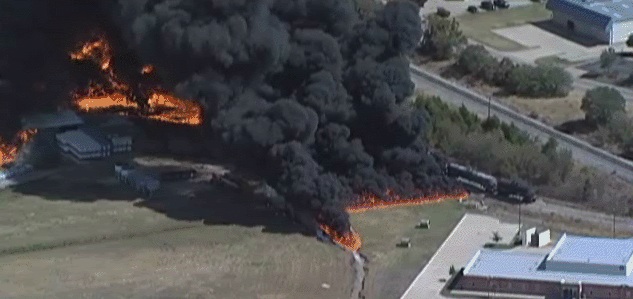
As many of you know I have written extensively about flammable liquids safety, a true passion of mine within the safety field. But there is this SMALL detail that too many facilities are overlooking, but relying on in a very BIG way. Secondary Containment, or a “dike” as it is often called. Here are just some quick notes for those with secondary containment to consider… and you may just be able to avoid your plant making national news as was the case in the photo above!
This week’s Photo of the Week shows the circumventing of a flammable liquid dike and that is just the tip of the iceberg. In this article I will be mostly speaking to secondary containment for flammable liquids, but these some errors can be applied to secondary containment for toxics. Secondary containment plays a crucial last line of defense, but it does more than just protect the environment. In the case of flammable liquids it also lessens the surface area of a catastrophic spill, thus slowing the creation of a vapor cloud. The smaller the surface area of the spilled flammable liquid the less surface area there is to flash off the vapor!!! But in order to work properly the containment system MUST be sized properly and maintained properly! Every PSM covered process with a flammable liquid HHC will have secondary containment, but many that we have seen had serious issues and this is what I want to discuss.
Sizing
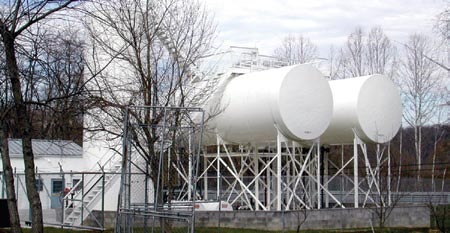
Flammable liquid standards and codes require some type of containment/impounding system, with open top diking being the most common. But in these codes there is a requirement for how much the containment system must hold. Although EPA has requirements that the dike hold 110% of the largest tank, the safety codes only require that it be large enough to contain the entire contents of the largest tank. And I must state up front that we have to assume the tank is FULL. We cannot use engineering controls or administrative controls to reduce the quantity within the largest tank in order to build a smaller volume dike! But the code also requires us to deduct the volume taken up by anything below the dike walls, specifically the other tanks and/or their foundations. This can get tricky as many containment systems have multiple tanks, pump platforms, etc. and these objects can cause the sizing to be incorrect. The newer flammable liquid codes also require a slope of NOT LESS THAN 1.0 percent away from the tank for at least 50 ft (15 m) or to the dike base, whichever is less. In large dikes, this slope can add up, but in a good way; however, if the person taking the measurements only measures the depth of the dike at the wall(s) and they do not take into account the 1% slope up towards the tank, their calculations will be OFF in a bad way. And most engineers will measure the height of the dike wall and use that in their volume calculations. Another error that is often made is that changes made to the dike or inside the dike that could impact the dike volume are not made using Management of Change Procedures. We have seen some “minor changes” that ended up having a major impact on the secondary containment system. For example, we came across a situation where a facility had a 90-day action item from a VPP assessment that involved their fixed ladders on their vertical tanks not extending down far enough. So in order to make the rungs a consistent distance throughout the length of the ladder they needed to add two rungs to the bottom of the ladder. Not wanting to do hotwork in their flammable liquid tank farm (SMART MOVE!) they instead purchased some concrete steps (3′ wide and three risers tall), a total of 18 step units, and they placed them at the base of the ladders. An ingenious move to solve the ladder issue; however, these concrete steps took up quite a bit of volume and when calculated out, the dike was no longer capable of holding the contents of the largest tank. How about the company that did not want to pay for the pumps rated for a HAZLOC so instead they poured these massive concrete pads that extended well above the dike walls so that the pump motors would be above the HAZLOC. These pump foundations also caused the dike to fail it’s volume calculations. And neither one of these changes underwent an MOC review! Another topic that deserves mentioning is the containment system and the fire water protection. Standards and codes require any structures within the dike that could be exposed to a pool fire event be either fire proofed (e.g. insulated) or have a fire water spray under the tank to cool the metal supports (see photo below). It is the water spray systems that can cause a significant concern. If these fire water system are employed instead of insulating, additional dike volume will be needed or a closed drainage system will need to be employed to ensure that the dike is not overflowed. And let me be clear here, INSULATE the support metal or protect it with fire water! Doing neither can cause SERIOUS issues. I have personally seen a 500 gallon elevated diesel tank collapse in a pool fire and totally destroy a wall of the dike releasing the pool fire to spread well beyond the dike. These tanks can also collapse and land outside the dike, creating serious problems.
Integrity
I learned a very valuable lesson very early in my career from an OSHA CSHO… any item listed in a PHA as a safeguard had better be in the facility’s mechanical integrity program. There are not many PHAs done on flammable liquid processes where secondary containment is not listed as a safe guard for overflowing tank scenarios or pump seal leaks. But ask a facility for their integrity testing of their dikes and watch their reaction. I have actually been laughed at, thinking I was joking when I asked. This is a REAL and it is serious business. It is easy for an auditor or a CSHO to identify questionable issues with a dike when there is grass/weeds sprouting up through the cracks in the concrete, or they can line up the cracks on the inside of the dike wall with the cracks on the outside of the dike wall to show evidence of “loss of integrity”. We also need to steer clear of using asphalt as the material of construction for our diking. Not only is this material somewhat porous, solvents will eat away at the binding agent and cause significant damage. I am also puzzled why an engineer would spend thousands of dollars to have their flammable liquid tanks painted white then put them inside a black dike. This is especially puzzling when the tanks are horizontal tanks over a black asphalt dike; the two concepts conflict with each other. This is one of those items that I cannot show a specific line item in a code or standard that says this cannot be done, but that does not make it right! A really good idea that I have done several times is to functionally test the containment system. Now this needs to be run through the environmental group engineering, and management as this test can create some issues. First, do this during a major turnaround when the tanks are empty or at least the majority of tanks are empty or very low inventory levels. Secondly, the water bill will INCREASE as there could be upwards of 10’s of thousands of gallons of water being used. We also need to have a plan on what we will do with the water after the test. As long as it is clean we can pump it to a safe location (be careful with erosion!). We also need to have engineering approve this functional test, as some dikes may have some serious design flaws and a full dike could float tanks or destroy pumps! But I have to admit, each of my tests identified major issues with capacity and integrity. I like to meter the flow into the dike so that I am getting an accurate measurement of the volume being pumped into the dike to ensure that it will actually hold what the design says it will hold. We then let the water sit in the dike for 30 minutes to ensure the level is not dropping and that the walls can support the head. At a minimum, a facility should have their secondary containment system on some set PM schedule, even if it is just a visual inspection by a trained worker. Lastly I want to warn folks about sealing their dikes with some type of coating to ensure its integrity. Any sealant used should NOT be an “insulator” which would insulate a worker walking through a Class I Div 1 location from being “grounded”. This can create significant static issues in a high risk area! Be sure to get it in writing that the sealant will NOT increase the “resistant to ground”! Hope these ideas are of use to you. Let me know if you have any questions.