
Although this “guidance” is provided by Ohio EPA and is meant for ONLY facilities located in the state of Ohio, this guidance is an EXCELLENT breakdown of how a facility should view “co-located” containers of their Extremely Hazardous Substances to determine if their “co-located containers/vessels” are actually a “process” that would fall under the CAA’s Risk Management Plan.
This guidance is for industry to determine whether non-interconnected vessels are to be considered a single process for the Risk Management Plan (RMP) regulations. This guidance will maintain consistency throughout the state of Ohio for the RMP program. Ohio Administrative Code (OAC) 3745-104-01(B)(30), as well as OSHA and Federal EPA, defines a “process” as
“any activity involving a regulated substance, including any use, storage, manufacturing, handling, or on-site movement of the substance or any combination of these activities. Any group of vessels that are interconnected, or separate vessels that are located in such a manner that a regulated substance potentially could be involved in a release, shall be considered a single process.”
Ohio EPA Division of Air Pollution Control (DAPC) interprets this definition to mean that all catastrophic events must be considered when determining whether non-interconnected vessels are a single process. This includes a fire which could spread from one vessel to others or an explosion that could rupture multiple vessels. The explosion does NOT necessarily need to be a covered process. In addition, a collapse of storage racks could
lead to multiple vessels/containers breaking open.
Example 1. Drum Storage
A facility has 70% hydrofluoric acid that is stored in four 55-gallon drums. Each drum holds approximately 460 pounds of hydrofluoric acid which are a total of1840 pounds. Since all four drums are stored in the same room, they would be considered a single process. The threshold for hydrofluoric acid is 1,000 pounds. Therefore, this facility would be subject to the RMP program.
If the same facility were to separate drums (i.e., separate rooms or buildings) so that the regulated substance was never over the threshold in a single process, the facility could potentially not be required to submit an RMP. However, written procedures are required to be in place which describes the maximum number of drums of regulated substances allowed in a room or building at any one time.
For drums that are stored outside it is more difficult to determine what constitutes a single process. Generally, drums that are stored in a rack or in close proximity to each other would be considered a single process. However, there are no set distances for this determination. It is up to the owner or operator to use their best judgment and provide inspectors with reasonable assumptions for these distances.
Example 2. Cylinder Storage
A water treatment plant has two 1-ton chlorine cylinders stored in a building, only one of which is connected to the chlorinator at one time. The two cylinders are considered a single process and the facility would be subject to the RMP regulations. The same would be true if the facility stored more than 16 150-lb chlorine cylinders in the same area. For the facility not to be subject to the RMP regulations, there are two options:
- The owner or operator could administer written controls so that the threshold is below 2500 pounds. By employing administrative controls, the owner/operator could establish a system whereby a new chlorine cylinder is not delivered to the same location until the other cylinder is below 500 pounds.
- The second option is to separate the two 1-ton chlorine cylinders located in the chlorine room. If the walls of the chlorine room meet the definition of a firewall or barricade, then one cylinder could potentially be outside of the chlorine room until the cylinder connected to the chlorinator is empty.
Example 3. Tanks
If a facility has several tanks of RMP regulated substances located side-by-side, all of the tanks (with RMP substances) are considered one process. However, a regulated toxic substance is never aggregated with a different regulated toxic substance to determine threshold quantities. If the process consists of co-located vessels with different toxic substances, it must be determined whether each substance exceeds its threshold quantity.
For example, a facility has a tank farm (all tanks located within close proximity of each other) with the following amounts of toxic substances:
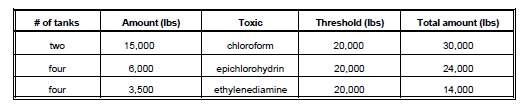
All three toxins in the tank farm are RMP regulated substances and the tank farm is considered one “process”. However, ethylenediamine is below the threshold and the facility would list only the two regulated toxic substances over the threshold within the subject process. A flammable substance in one vessel is never aggregated with a different flammable substance in another vessel to determine applicability. However, if a flammable mixture has a National Fire Protection Association (NFPA) flammability hazard rating of 4 and contains differently regulated flammables, it is the mixture, not the individual substances, that is considered in determining if a threshold quantity is present.
For example, a facility has the following RMP regulated flammables in their tank farm:
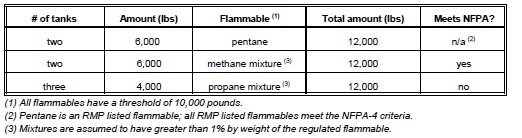
This facility would have one process with two regulated flammable substances since the propane mixture does not meet the NFPA-4 criteria.
The General Duty Clause
Whether a facility decides to separate drums, cylinders, or tanks to reduce RMP regulated substances in a single process, facilities with extremely hazardous substances are subject to the General Duty Clause, Clean Air Act Section 112(r)(1). Facilities subject to the General Duty Clause are responsible for, among other things:
- Knowing the hazards posed by the chemicals and assess the impacts of possible releases;
- following codes, standards and other business practices to ensure the facility is properly constructed and maintained – and the chemical is managed safely; and
- having a contingency planning process, which would involve community responders, if necessary to aid in an adequate response in the event of an accident.
CLICK HERE for the 2002 Guidance Document