
This memorandum responds to your request regarding facilities that submit risk management program (RMP) plans to the U.S. Environmental Protection Agency (EPA). You requested an analysis of RMP facilities within the United States by potentially affected population. You also requested an analysis of the number of facilities required by regulation to resubmit their information to the EPA that had not yet done so.
Under the Clean Air Act, Section 112(r),1 the EPA established an RMP requiring facilities possessing greater than certain threshold quantities of 140 listed chemicals to provide RMP plans to the EPA.2 As part of this reporting requirement, EPA requires facilities to determine the worst-case scenario release for each individual chemical process, using EPA criteria and guidelines.3 Facilities also must estimate the population potentially at risk from this worst-case scenario chemical release by calculating the population that resides within a circle surrounding the facility. The radius of this circle represents the distance the worst-case scenario chemical release might travel.4
In the event of an actual catastrophic chemical release, meteorological effects would determine the direction of the release and therefore the number and location of those potentially affected. Furthermore, how such a release would affect those exposed would vary depending on many factors, such as the properties of the specific chemical, the concentration and duration of exposure, the demographics of the population (e.g., age and overall health at the time of exposure), and the surrounding geography. In addition, worst-case scenarios do not take into account emergency response measures that facility operators or others might take to mitigate harm. Therefore, it is unlikely that the entire population within the circle would be physically affected by any single chemical release, even if it is a result of a worst-case accident.
1 P.L. 101-549, the Clean Air Act Amendments of 1990, established, among other things, Section 112(r) to provide for the prevention and mitigation of accidental releases of extremely hazardous substances.
2 The list of 140 chemicals, including 77 toxic and 63 flammable chemicals, and their threshold quantities is found at 40 CFR 68.130.
3 The criteria and guidelines for determining the worst-case scenario release are found at 40 CFR 68.25. Some facilities have submitted information on multiple worst-case scenario releases.
4 This requirement is found at 40 CFR 68.30. The criteria for determining the distance a worst-case scenario release might travel are found at 40 CFR 68.22.
Facilities may register and deregister from the program as their chemical processes and the amounts of chemicals they store and use change above and below the regulated threshold amounts. If a facility no longer possesses a regulated chemical above the threshold quantity, EPA requires the facility to inform EPA and deregister from the program.5 The regulation requires facilities to review and update RMP plans filed with the EPA at least once every five years.6 For the purposes of this memorandum, facilities that have not reviewed and updated their RMP plans within five years of their last submissions are called facilities with overdue updates. The deadline for initial submissions under the program was June 21, 1999.7 The EPA maintains submitted information in the RMP*National Database.
In 1999, Congress passed the Chemical Safety Information, Site Security and Fuels Regulatory Relief Act (CSISSFRRA, P.L. 106-40). This act removes from program coverage any flammable fuel used as fuel or held for sale as a fuel at a retail facility. In implementing this act, the EPA allowed facilities that had previously filed under the program the options of withdrawing from the program, which would delete facility information from the EPA database, or taking no further action, which would leave facility information in the EPA database as a voluntary submission.8 Facilities exempted under CSISSFRRA that voluntarily submitted information need not update these submissions. Facilities not excluded by CSISSFRRA that does not review and update the RMP plan are not in compliance with the RMP regulation.
These facilities may be subject to enforcement actions by the EPA under the Clean Air Act, Section 113. The data available in the RMP*National Database are not sufficient to determine the actual scope of compliance or noncompliance with the program. Some facilities may not have submitted an RMP plan even though EPA requires them to do so. These facilities would not be present in the RMP*National Database. Conversely, some out-of-date entries in the EPA database may be facilities exempted under CSISSFRRA. The RMP*National Database does not identify such facilities.9 Thus, the number of facilities identified in this memorandum as having overdue updates is likely not equal to the actual number of facilities failing to comply with the program.
Further, facilities might not review and update their filed RMP plans for several reasons: the facility is out of regulatory compliance; the facility is no longer in business; the facility has reduced the amount of reportable chemical to below threshold levels, but not informed the EPA of their current operating status or the facility falls under CSISSFRRA and is no longer covered by the RMP requirement. Data provided by EPA are insufficient to distinguish these possibilities. These conditions limit the reliability of these data and the conclusions that may be drawn from the analysis.
At your request, CRS searched the December 2014 update of the RMP*National Database (with off-site consequence analysis (OCA) data) for facilities that have registered under the program. Facilities that have deregistered from the program were excluded. You requested that the facilities be classified alphabetically by state and by the population potentially affected by a worst-case release (according to the EPA worst-case scenario criteria) using thresholds of 1,000 people, 10,000 people, 100,000 people, and 1,000,000 people. Additionally, you requested that facilities with overdue RMP plan updates be identified for each population category. Facilities with an RMP plan filing due to be updated on November 30, 2014, but that had not been updated by this date were considered overdue for the purposes of this analysis. These facilities include CSISSFRRA-exempted facilities as well as facilities that are covered by
the regulation. All of the information in this memorandum is drawn from the RMP*National Database (with off-site consequence analysis (OCA) data). This information is presented in Table 1.
5 This requirement is found at 40 CFR 68.190. Facilities must deregister from the program within six months after ceasing possession above the threshold quantity.
6 This requirement is found at 40 CFR 68.36.
7 61 Federal Register 31668, June 20, 1996.
8 65 Federal Register 13247, March 13, 2000.
9 Personal communication with EPA staff, September 25, 2007.
Table 1. Number of Compliant, Update Overdue, and Total RMP Facilities in Each State,
by Potentially Affected Population in EPA-Defined “Worst Case” Scenarios (Parameters Designated by Requester)
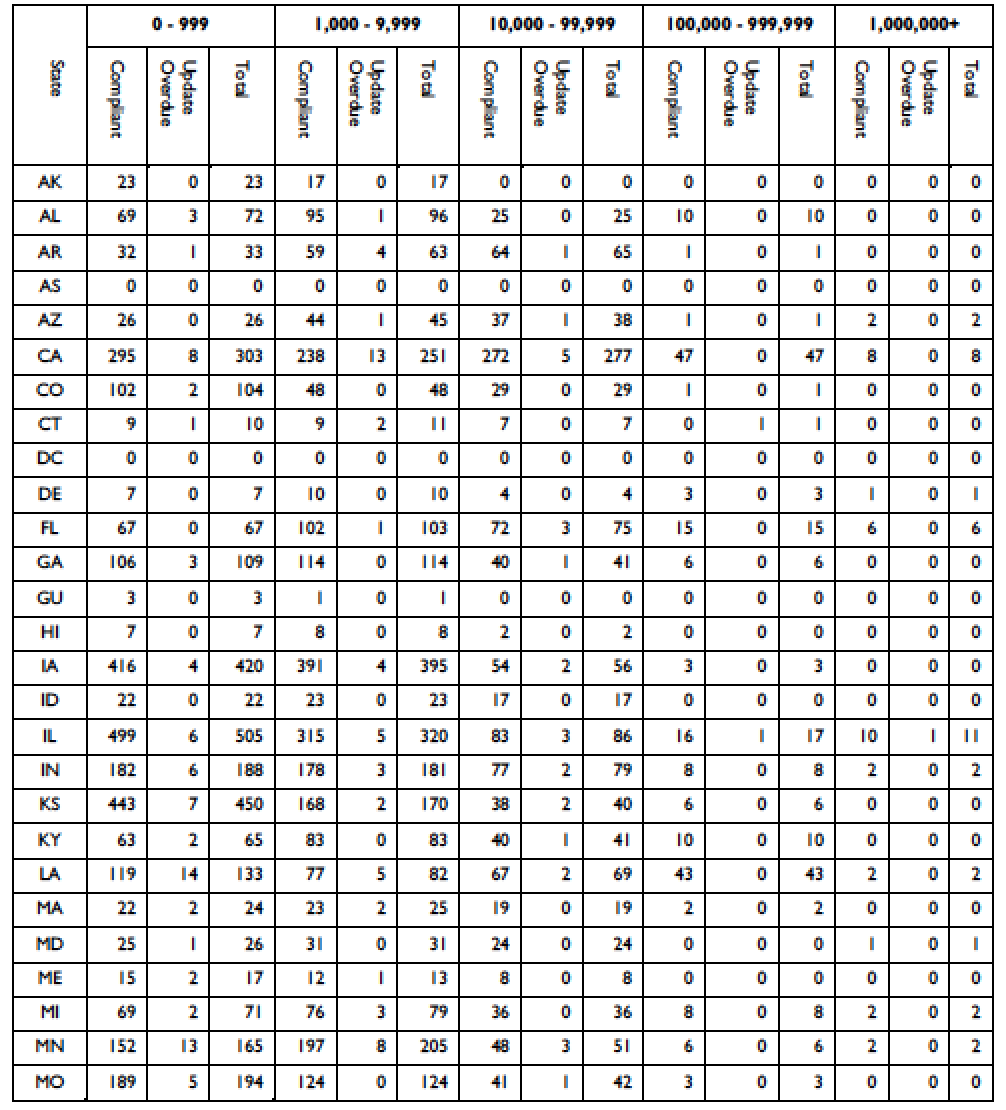
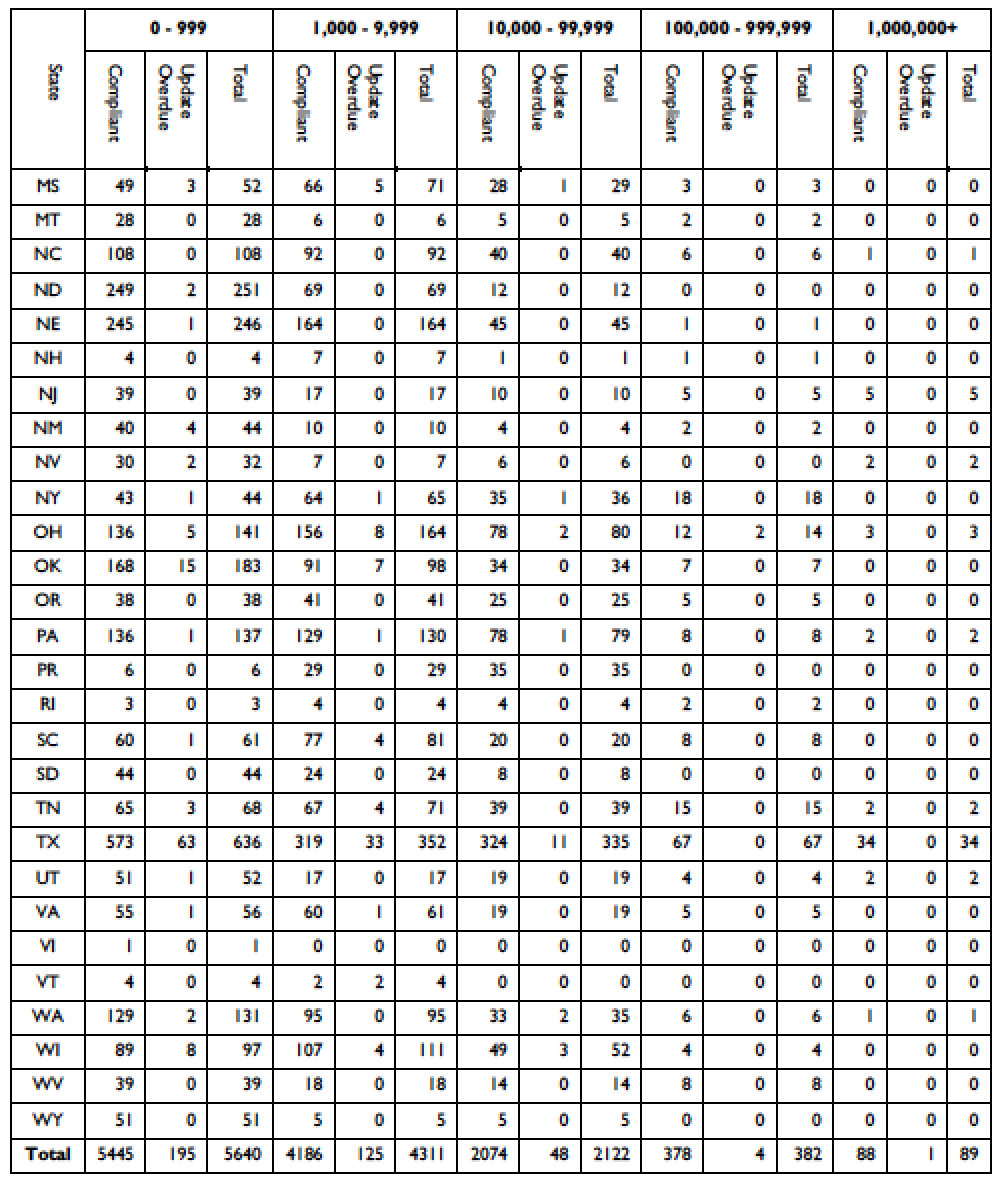
Source: CRS analysis of the EPA RMP*National Database (with off-site consequence analysis (OCA) data), updated
December 1, 2014.
Notes: Facilities due to update their RMP filing by November 30, 2014, that had not done so are categorized as “update overdue.” Some of those facilities may be exempted from regulation by CSISSFRRA or may no longer be in business and have not informed the EPA of their current operating status. These conditions limit the reliability of these data and the Congressional Research Service 5 conclusions that may be drawn from this analysis. In cases where facilities report multiple worst-case scenario releases, the worst-case scenario potentially affecting the most people has been included in the data. The column labeled “State” also includes American Samoa (AS), Guam (GU), Puerto Rico (PR), the U.S. Virgin Islands (VI), and the District of Columbia (DC).
Because facilities may register and deregister from the program as chemical processes and amounts of chemicals stored and used change, the number of facilities listed in Table 1 should be considered as illustrative of a single point in time.
You also requested that facilities with overdue RMP plan updates be classified by EPA region according to the above-described population criteria. EPA has ten regional offices, each responsible for several states and, in some cases, territories.10 This information is provided in Table 2.
Table 2. Number of RMP Facilities with Overdue Updates in Each EPA Region,
by Potentially Affected Population in EPA-Defined “Worst Case” Scenarios (Parameters Designated by Requester)
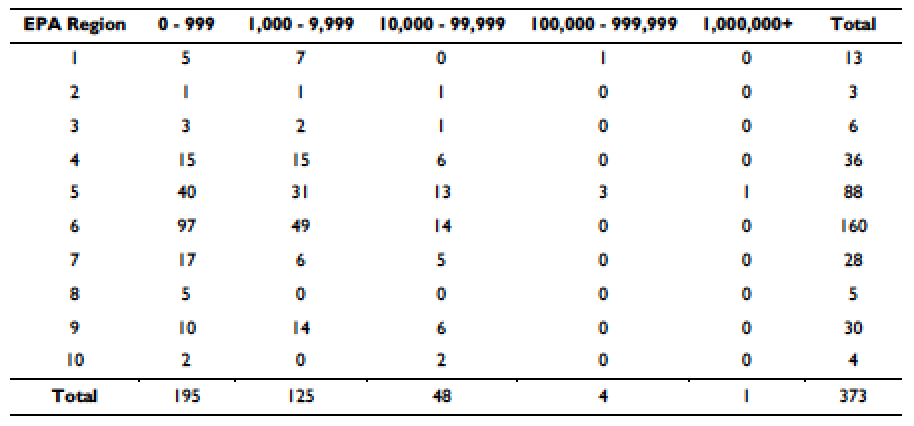
Source: CRS analysis of the EPA RMP*National Database (with off-site consequence analysis (OCA) data), updated December 1, 2014.
Notes: Facilities due to update their RMP filing by November 30, 2014, that had not done so were considered as “update overdue.” Some of those facilities may be exempted from regulation by CSISSFRRA or may be no longer in business and have not informed the EPA of their current operating status. These conditions limit the reliability of these data and the conclusions that may be drawn from this analysis. In cases where facilities report multiple worst-case scenario releases, the worst-case scenario potentially affecting the most people has been included in the data.
For more information regarding this topic or if you have further questions regarding the information in this memorandum, please contact me at XXXXXXXXX.
10 For a description of the various EPA regions, including the states and territories located in each region, see online at http://www.epa.gov/epahome/locate2.htm.
CLICK HERE for the memo (pdf)