
Anyone who has submitted an RMP or maybe done a Worst Case Scenario (WCS) using EPA’s modeling software “RMP* Comp” will recognize this little checkbox at the bottom of the data page just above the SUBMIT button…

But when is this little checkbox, which can have a large impact on your scenario, allowed to be checked? When should it be checked to be technically accurate? I wish there was a way I could search the RMP database of those submittals that used RMP*Comp to see how many plans claimed this PASSIVE mitigation measure in their WCS; but since that is not possible I was wondering how many of you, in your RMP WCS, have claimed the WCS occurred in “enclosed space, in direct contact with outside air” when using RMP* Comp?
The software defines “enclosed space, in direct contact with outside air” as…
“An enclosed space in direct contact with outside air would be a building or shed with openings to the outside (as opposed to a room inside a building or a very airtight building). For a release of a toxic gas in an enclosed but not air-tight space, this program assumes that the rate of release of the gas to the atmosphere is 55 percent of the release rate if the release were happening outdoors.”
This little assumption in our WCS can impact the WCS distance, which can also translate into the number and type of off-site receptors impacted.
In the petrochem and refining, we use “enclosures” that cocoon the high volume process equipment (e.g. bulk storage) and these enclosures typically vent to a process scrubber for normal processing/breathing and to an emergency scrubber for a leak within the enclosure. But how many RMP covered processes that have a WCS involving a vessel inside a structure, an “enclosure” as defined by EPA RMP*Comp? HINT: to find this in your RMP, it will be documented as a “mitigation measure” (i.e. PASSIVE) in your WCS documentation.
Since this debate has come about concerning an Ammonia Refrigeration process and whether the “engine-room” is an “enclosed space, in direct contact with outside air”, let’s use this process as the basis for this article. So…
- Is an engine-room built to IIAR or ASHRAE standard/code “enclosed”?
- Is the “enclosed” engine-room in “direct contact with outside air”?
If you answered BOTH questions YES, then I would argue that an engine-room is an “enclosed space, in direct contact with outside air” and thus the scenario SHOULD “check the box”. I have, to be honest, so far I have been shocked at EPA’s lack of clarity on this issue. Three of us spent a couple of hours playing musical chairs with EPA’s RMP Hotline and Help Desk
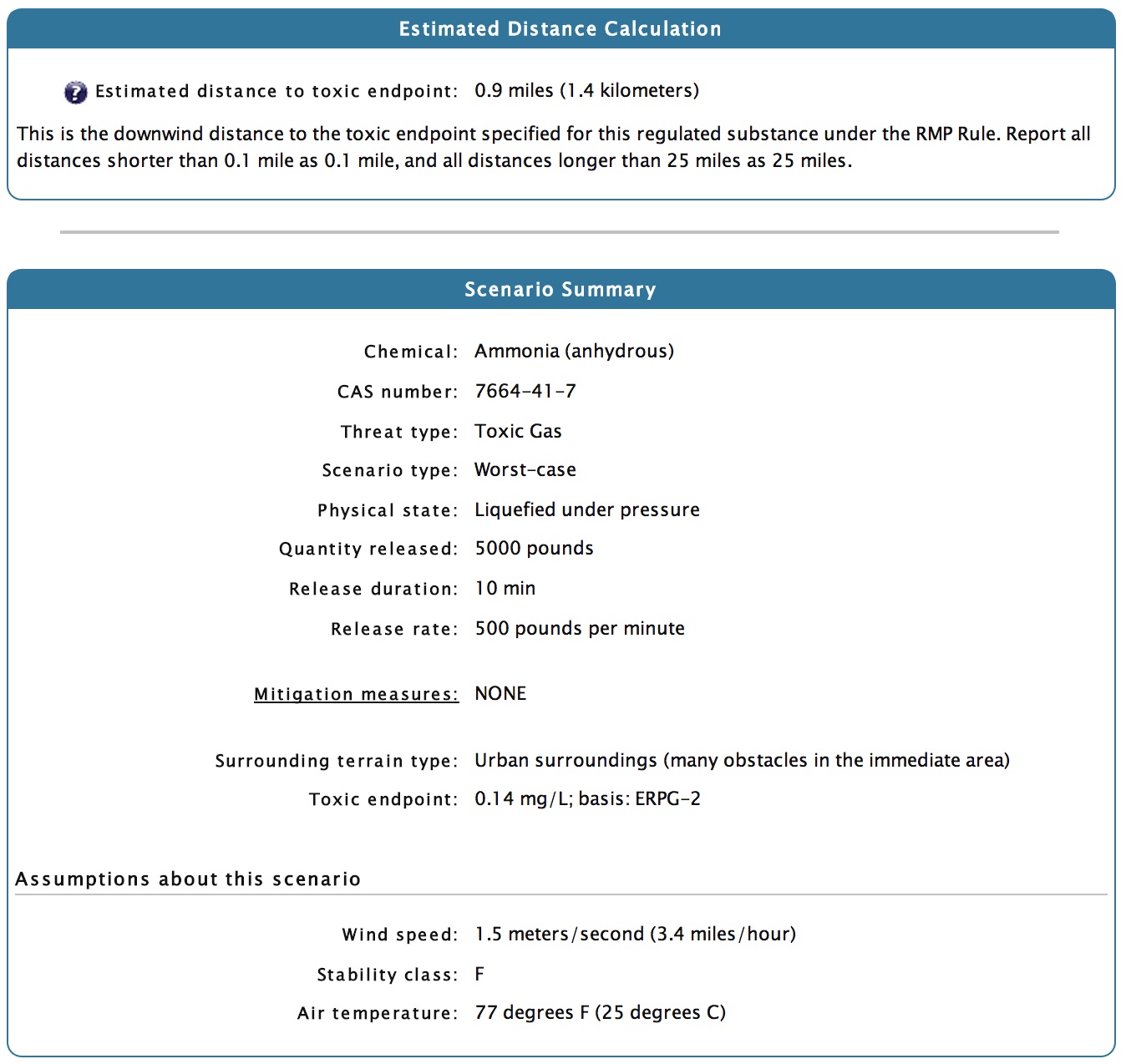
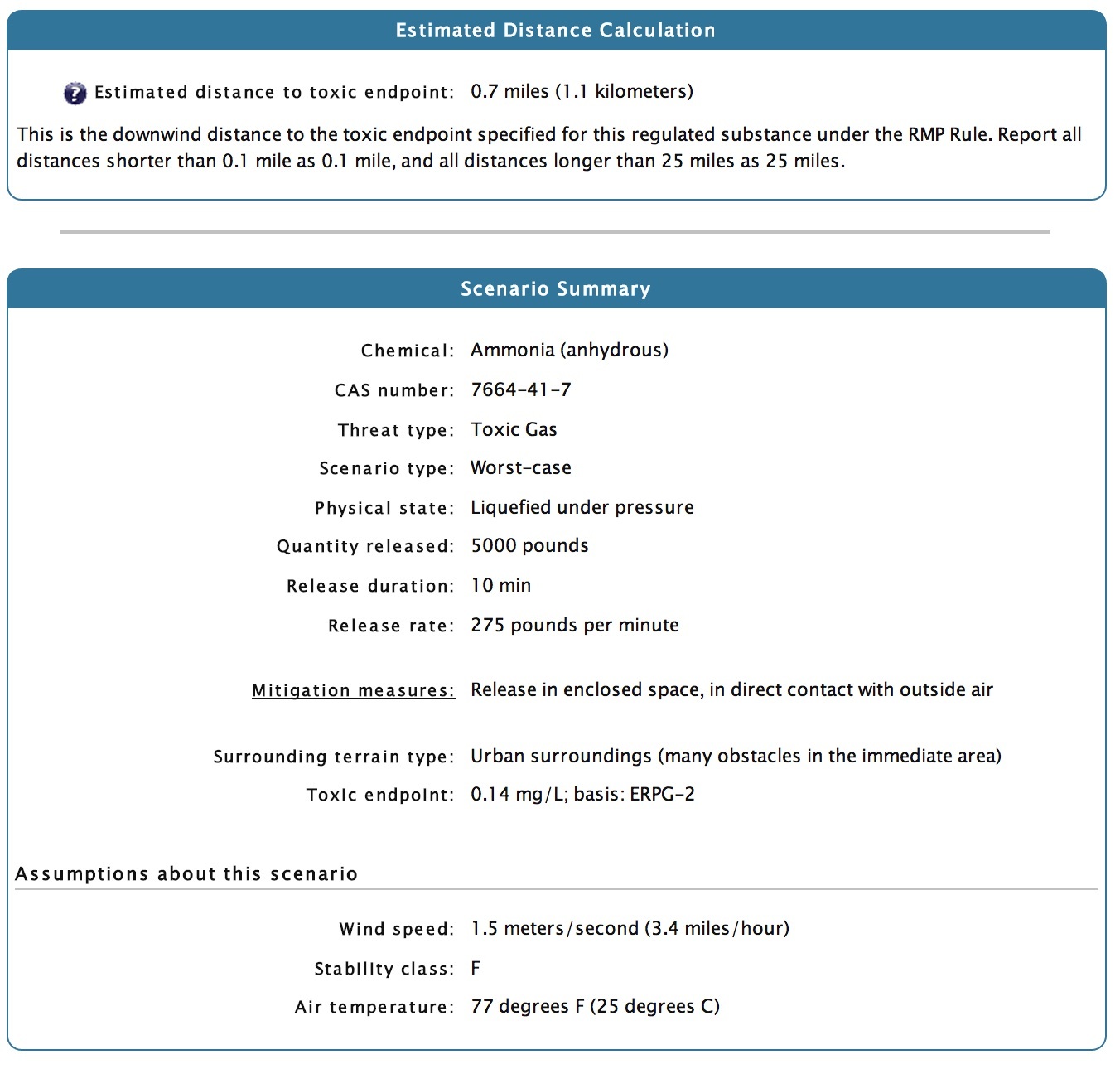
Here is a side by side comparison to illustrate the potential impact this passive mitigation could have on your RMP WCS. Using a release of 5,000 pounds of NH3 as the WCS here is the results:
| WCS w/o Enclosure | WCS with Enclosure |
 |
 |
But here is the trick… engine-rooms are “an enclosed space in direct contact with outside air”, but engine-rooms have ventilation systems (per ASHRAE 15 or IIAR) which are not discharging to an environmental control device and are designed with the intent to remove the ammonia from the room and put it to the atmosphere. So with a properly designed, built, and maintained ventilation system should we be able to “assume that the rate of release of the gas to the atmosphere is 55 percent of the release rate if the release were happening outdoors”?
Since the evolvement of RMP* Comp, I have always considered a fully enclosed building/engine-room (with ventilation) as “an enclosed space in direct contact with outside air” and checked the box when running the WCS. Now there are a few that are stating this is incorrect, yet they are struggling to re-define “an enclosed space in direct contact with outside air”. As in truth, the “enclosures” I had around my chlorine and phosgene bullets were NOT “in direct contact with outside air” so these “enclosures” are actually farther from the current definition than an engine-room!
What say you? Is a properly designed, built, and maintained ventilated engine-room “an enclosed space in direct contact with outside air” and should a WCS scenario occurring within an engine-room utilize this passive mitigation control?
UPDATE on 11/7/13
MANY THANKS to Jim Belke at US EPA for finally answering my question. After a countless number of people I have spoken with and written to, Jim finally answered my question. Here is his response to my question…
Mr. Belke,
I was referred to you by Sherri Swihart with OH EPA. I have contacted just about ever resource within EPA (RMP help center, written to the RMP FAQs, and talked with countless EPA personnel) so I am hoping you can address this question/scenario for me.
I help about 20 refrigeration businesses with their process safety matters and it came to my attention that many refrigeration processes were claiming their engine rooms as “passive mitigation” and were “checking the box” within RMP Comp that their WCS occurred indoors but with contact with outside air since most refrigeration processes have their receivers located within the engine room. However, in the refrigeration industry, it is very common to find engine rooms equipped with ventilation systems so that the engine room can be exempt from Article 500 of the NEC and this allows the engine room from becoming a class 1 Div 2 hazardous location. So with a ventilation system of such magnitude built into the “inside room” how can one then claim the room as “passive mitigation”? The system is designed to remove the NH3 from the room and put it outside at very high rates; would this NOT defeat the benefits of any mitigation the enclosure would provide??? Is it proper for a refrigeration process to “check the box” in RMP Comp when doing their OCA’s? This passive mitigation credit can have huge impacts on both distance and population in Urban areas.
I just want them to help facilities get an honest picture of their impact footprint and it seems the industry has figured out that by “checking the box” will reduce your distance and this also lessens your population.
Your thoughts?
Bryan Haywood
Founder and CEO, SAFTENG
PO BOX 405
Milford, OH 45150
(513) 238-8747
[email protected]
Sent from my iPhone
Hi Bryan,
It’s okay to check that box for a refrigeration system where the receiver is the worst case vessel and is located indoors. We assumed a very leaky building in setting that mitigation factor (it basically multiplies the release rate by 0.55). Our modeling was based on release testing indicating that releases from pressurized ammonia vessels inside buildings involve a significant portion of ammonia raining out of the release jet due to obstacle impingement, reducing the overall release rate even in a well-ventilated building.
Jim Belke
EPA