
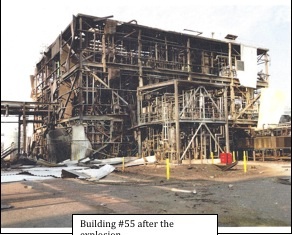
 Two chemical plant operators, 40 and 50, died after suffering burns to their bodies when a runaway reaction caused an explosion of flammable liquids. The two victims were working in a building which contained several tanks of chemicals. An employee in an adjacent area reported an ammonia odor coming from the building. The two victims and their supervisor searched the building and discovered a puffing/venting from a feed tank. They further determined that a tank (#302) adjacent to the feed tank was heating up. Tank #302 contained flammable chemicals.
The supervisor directed the two operators to transfer the product in tank #302 to reactor #103 to cool it and reduce pressure in tank #302. A chemical hose was initially used to transfer the product, but they heard bubbling and popping and saw the hose blistering and expanding. They stopped the transfer after 200 gallons had been moved and used a stainless steel hose to transfer another 200 gallons of the product to tank #103. This left 2,400 gallons in tank #302. A 14-psi rupture disk then blew at tank #302. An employee in an adjacent area reported to the supervisor, who had left the building momentarily to file a report, that a big yellow cloud had appeared over building #55. One operator went to the control room on the second floor to monitor the temperature and pressure of the reactor #103. The supervisor was talking from the cab of his truck to the other operator who was standing in the door of building #55, about 10 feet from the supervisor. Tank #302 then exploded and fire spread through the building. Both operators were severely burned, one over 92% of his body and the other over 74% of his body. The supervisor escaped and immediately called for help. The first operator died 5 days after the explosion and the other expired 39 days after the explosion.
Citations as Originally Issued
A complete inspection was conducted of the facility.
Citation 1
|
Item 1a 1910.119(d)(1)(iv) |
Information pertaining to the hazards of the highly hazardous chemicals in the process did not consist of at least reactivity data. |
|
Item 1b 1910.119(d)(1)(vii) |
Information pertaining to the hazards of highly hazardous chemicals in the process did not consist of at least the hazardous effects of inadvertent mixing of different materials that could foreseeably occur. |
|
Item 1c 1910.119(d)(2)(i)(D) |
Information concerning the technology of the process did not include safe upper and lower limits for such items as temperature, pressures, flows, or compositions. |
|
Item 1d 1910.119(d)(2)(i)(E) |
Information concerning the technology of the process did not contain at least an evaluation of the consequences of deviations, including those affecting the safety and health of employees. |
|
Item 1e 1910.119(d)(3)(i)(D) |
Information pertaining to the equipment in the process did not include relief system design and design basis. |
|
Item 2 1910.119(e)(3)(i) |
The process hazard analysis did not address the hazards of the process. |
|
Item 3 1910.119(e)(3)(iii) |
The process hazard analysis did not address engineering and administrative controls applicable to the hazards and their interrelationships such as appropriate application of detection methodologies to provide early warning of releases. |
|
Item 4a 1910.119(e)(3)(iv) |
The process hazard analysis did not address consequences of a failure of engineering and administrative controls. |
|
Item 4b 1910.119(e)(3)(vii) |
The process hazard analysis did not address a qualitative evaluation of a range of the possible safety and health effects of the failure of controls on employees in the workplace. |
|
Item 5a 1910.119(f)(1)(i)(E) |
The employer did not develop and implement written operating procedures that addressed steps for emergency operations. |
|
Item 5b 1910.119(f)(1)(ii) |
The employer did not include operating limits in the operating procedures. |
|
Item 5c 1910.119(f)(1)(ii)(A) |
The employer did not develop and implement written operating procedures that include consequences of deviation in the operation procedures. |
|
Item 5d 1910.119(f)(1)(ii)(B) |
The employer did not develop and implement written operating procedures that provide clear instructions for safely conducting activities to accomplish steps required to correct or avoid deviation. |
|
Item 5e 1910.119(f)(4) |
The employer did not develop and implement safe work practices to provide for the control of hazards during operations. |
|
Item 6a 1910.119(g)(1)(i) |
Each employee presently involved in operating a process was not trained in the operating procedures and the training did not include an emphasis on the specific safety and health hazards, emergency operations including shutdown, and safe work practices applicable to the employee’s job. |
|
Item 6b 1910.119(g)(3) |
The employer did not prepare a record which contains the identity of the employee, the date of training, and the means used to verify that the employee understood the training. |
|
Item 7 1910.119(l)(1) |
The employer did not implement written procedures to manage changes to process chemicals, equipment, and procedures that affect a covered process. |
CLICK HERE (doc) to download the TN-OSHA report.