
On August 27, 2016, about 8:26 a.m. EST, a railroad tank car sustained a 42-inch long crack in its tank shell shortly after being loaded with 178,400 pounds of liquefied compressed chlorine at a chlorine manufacturing plant in West Virginia. Over the next 2.5 hours, the entire 178,400-pound load of chlorine was released and formed a large vapor cloud that migrated south along the Ohio River valley. The railroad tank car, AXLX1702, built in June 1979 was a 17,388-gallon US Department of Transportation specification-105J500W tank car, also known as a class DOT-105 tank car, with a stenciled load limit of 178,400 pounds and a maximum gross rail load of 263,000 pounds.
By 8:15 a.m., the tank car was filled with its maximum authorized load of 178,400 pounds. After personnel removed the loading lines and sealed the valves and fittings, they used a Trackmobile® railcar mover to move the tank car forward at a walking pace about 30 to 40 yards north of the loading shed on track 10.4 The personnel set the handbrake and chocked the wheels. At 8:26 a.m., loading personnel heard a loud bang as AXLX1702 experienced a 42-inch long crack in the lower portion of the tank shell. Plant surveillance video showed a yellow-green chlorine vapor cloud quickly growing in the vicinity of the tank car. The tank car had not been offered into transportation at the time nor was it coupled to other railcars.
As the gas cloud grew, one chlorine-loading employee notified the guard station to initiate a chlorine release alarm. Both chlorine-loading employees shut down other railcar-loading equipment and evacuated the area. All nonessential employees and contractors immediately evacuated to the guard station or the dispensary for exposure treatment. Figure 2 shows where the chlorine release occurred north of the railcar loading shed on track 10.
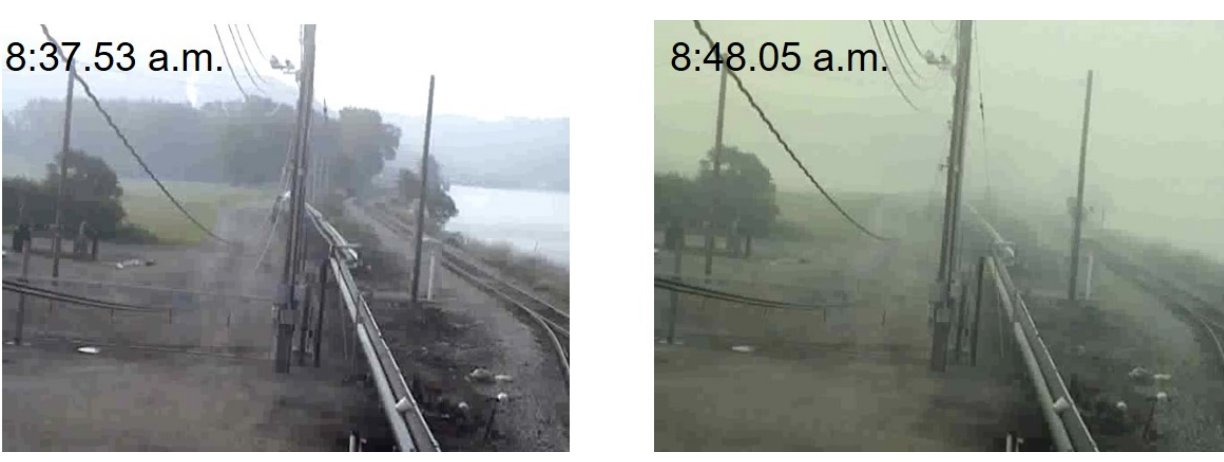
Chlorine gas sensors positioned at several locations within the plant first detected the release and alarmed about 8:28 a.m.5 Between about 8:29 a.m. and 11:07 a.m., several in-plant gas sensors near the point of release and downwind of the release (south), near the plant’s southern perimeter, recorded chlorine concentrations above the level the National Institute for Occupational Safety and Health (NIOSH) has identified as immediately dangerous to life and health (IDLH) concentration. The perimeter gas sensors also measured chlorine concentrations that exceeded the US Environmental Protection Agency Acute Exposure Guideline Level 3; thus, chlorine concentrations at the plant perimeter were above that at which it is predicted the general population could experience life-threatening health effects or death (NRC 2004). The entire 178,400-pound load of chlorine was released from the tank car and migrated south toward the town of New Martinsville, along the Ohio River valley. Figure 3 shows the visual evidence of the chlorine release beyond the facility’s property line. The photographs show the view near the south perimeter fence looking south toward a wooded area before and after the arrival of the chlorine vapor cloud. The wooded area is about 6,100 feet southeast of the incident site. The Ohio River is on the right side of the photographs.
Five employees and three contractors were treated for chlorine exposure injuries and released. Significant vegetation damage occurred downwind (south) from the release. The neighboring industrial facility, directly south, reported damage to stainless-steel piping, tanks, and operating equipment. In addition, some employees filed claims for damage to their vehicles that were in the parking lot at the time of the release. Total monetary damages have not been determined as of the date of this report.
At the time of the incident, fog was lifting after sunrise; the temperature was 72°F, and there was light wind from the north at 1 mph. The National Transportation Safety Board (NTSB) investigation into this incident focused on the condition and performance of the tank car. While examining these matters, NTSB investigators also discovered issues with the qualification and maintenance of the tank car and continued use of pre-1989 specification DOT-105 pressure tank cars constructed of non-normalized steel to transport materials that are poisonous inhalation hazard (PIH) or toxic inhalation hazard (TIH).
The National Transportation Safety Board (NTSB) determines that the probable cause of the chlorine release was an undetected preexisting crack near the inboard end of the stub sill cradle pad, that propagated to failure with the changing tank shell stresses during the thermal equalization of the car after loading with low temperature chlorine. Contributing to the failure was the facility’s insufficiently frequent stub sill inspection interval that did not detect the crack, the low fracture resistance of the non-normalized steel used in the tank car construction, and the presence of residual stresses associated with a companies’ tank wall corrosion repairs and uncontrolled local postweld heat treatment.
CLICK HERE for the NTSB Report