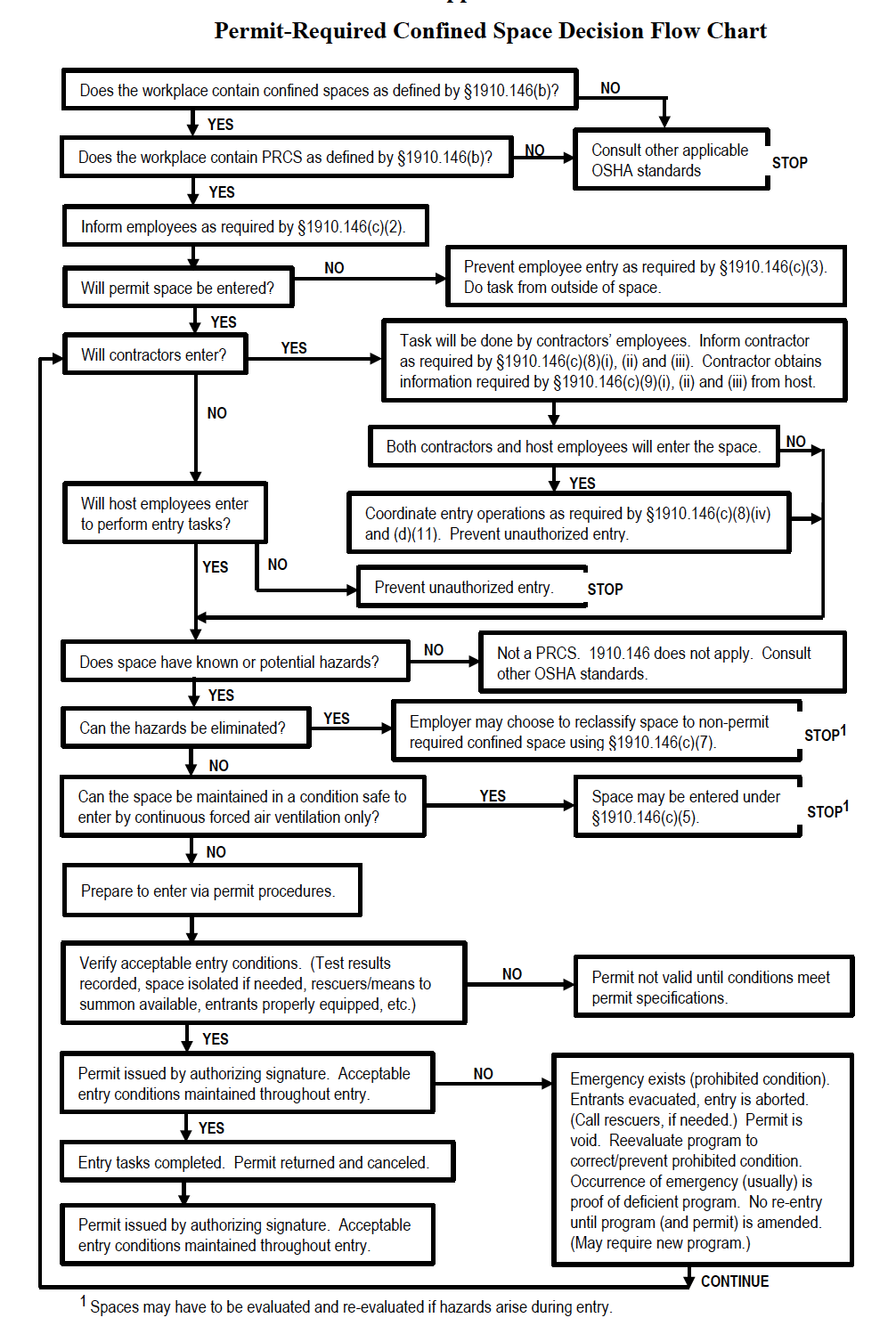
At approximately 0645 (UTC+1) on 26 May 2014, three crew members on board a cargo ship were found unconscious in the main cargo hold forward access compartment, which was sited in the vessel’s forecastle. The crew members were recovered from the compartment but, despite intensive resuscitation efforts by their rescuers, they did not survive.
The vessel was carrying a cargo of sawn timber and, at the time of the accident, shore stevedores were discharging the timber loaded on top of the forward hatch cover. Two of the ship’s crew were standing by to clear away the deck cargo’s protective tarpaulins as the timber discharge progressed aft. During this time, the two crewmen entered the forward main hold access compartment. The chief officer, who was looking for the two crewmen, found the compartment hatch cover open and shouted down to them before climbing into the space. A third crewman saw the chief officer enter the compartment. When he looked down the hatch, he saw the chief officer collapse.
The alarm was raised and an initially frantic rescue operation was undertaken by the vessel’s two remaining crew, and two stevedores. One of the two crew started the hold ventilation fan, and brought a breathing apparatus (BA) set and an emergency escape breathing device (EEBD) to the space. He donned the BA set, which did not have a face mask fitted, and entered the compartment. Despite having the breathing regulator in his mouth, it was not supplying him with sufficient air. Two stevedores also entered the compartment during the rescue: one using the EEBD and another without any breathing apparatus whatsoever. While there, they were able to pass lifting slings around the fallen crew so they could be recovered to the deck. The crewman and stevedores suffered severe breathing problems when they returned to deck.
Ambulance paramedics, fire and rescue services and the police subsequently attended. Despite the best efforts of all involved, none of the three crew who were recovered from the compartment survived.
Initial findings
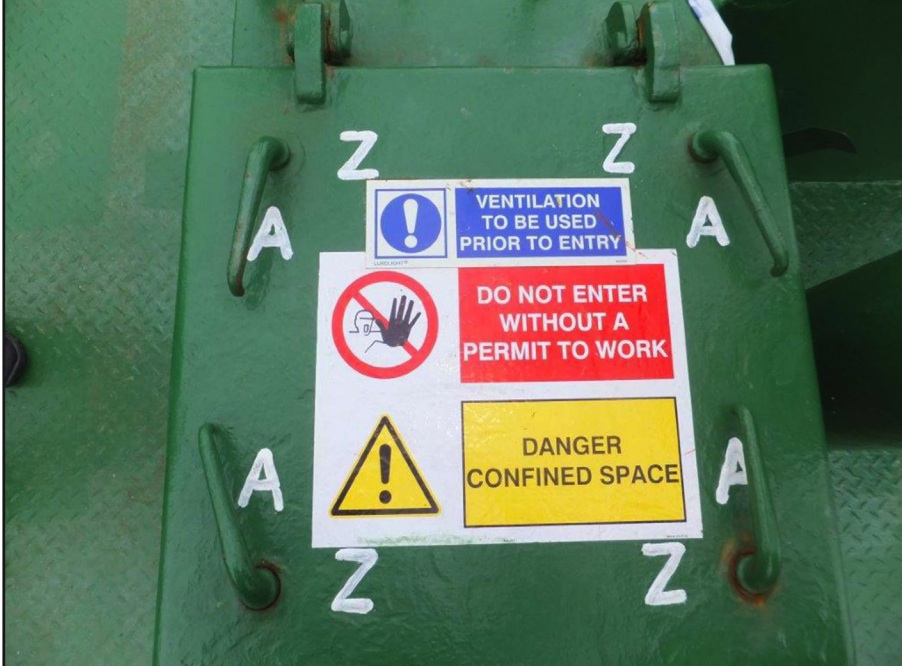
With a timber cargo loaded in the hold and the hatch covers closed, access to the compartment was subject to a permit-to-work and confined space entry procedures. The lid of the hatch into the compartment had signs indicating the potential dangers (Figure 1).
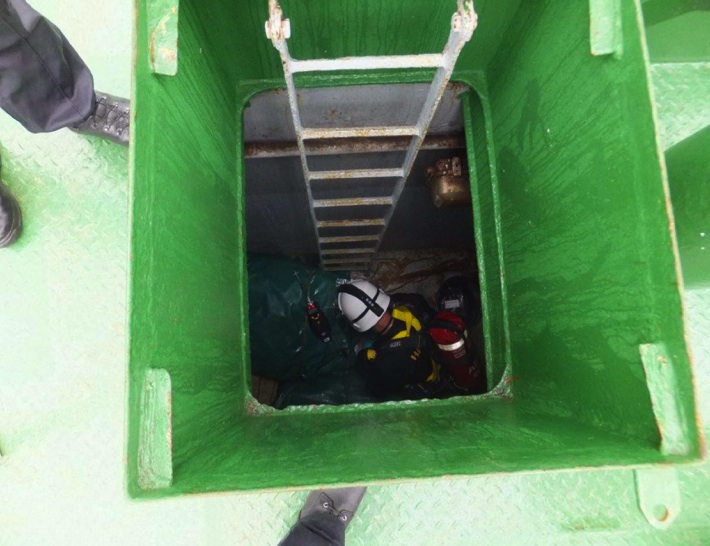
At this stage of the investigation no reason has been identified for the crew to enter the forward access compartment to undertake tasks they had been set. However, it is almost certain that the chief officer and, possibly one of the deceased crew entered the compartment in an attempt to rescue the other(s). The Fire and Rescue Service analysis of the atmosphere after the accident showed normal readings (20.9%) of oxygen content at the access hatch; the readings reduced to 10% just below main deck level inside the hatch opening and to between 5% and 6% at the bottom of the ladder into the compartment (Figure 2). Such low levels of oxygen cannot support life. Anyone exposed to such levels will faint almost immediately, followed by convulsions, coma and respiratory seizure within a few minutes. It is likely that the timber cargo caused the deprivation of oxygen in the cargo hold and access compartments.
Safety Lessons
- The atmosphere within an enclosed space, such as a ship’s cargo hold can change rapidly and become lethal dependent on the conditions inside and what is being stored or transported (as the tragic circumstances above illustrate).
- NEVER enter a confined space if safer alternatives for carrying out the work are available. If entry into a confined space is unavoidable, robust procedures should be put in place which should include emergency arrangements. These are often referred to as “Safe System of Work” or “Permit-to-Work”.
- Warning signs should not be ignored.
- If you are not part of the team designated to work in a confined space DO NOT ENTER. However compelling the desire to enter an enclosed or confined space to attempt to rescue an unconscious colleague is, it must be resisted.
- A ship should have a pre-arranged plan for the rescue of a person who has collapsed within an enclosed or confined space and regular drills should be conducted to test the plan and ensure the crew are familiar with it.
- BA is provided for fire-fighting and rescue; all crew should be trained, drilled and capable of using such critical safety equipment properly in an emergency.
- EEBDs provide a short term air supply to enable crew to escape to fresh air from a hazardous atmosphere. They should never be worn to enter, re-enter or work in a hazardous atmosphere.
Further guidance can be found in the Maritime and Coastguard Agency’s (MCA) Code of Safe Working Practices for Seamen (COSWP), Chapter 10, Emergency Procedures, and Chapter 17, Entering Confined Spaces.
Issued August 2014
CLICK HERE for the FULL Bulletin