
 One of the worst injury accidents of my career occurred in a PSM/RMP-covered process but involved a non-HHC/EHS. The chemical was “hot caustic,” a byproduct from the process used in another process’s scrubber. A sister facility had an incident in which it was discovered that the caustic was too weak. Thus in a process upset, the scrubber failed to perform correctly, leading to a “Reportable Release.” One of the corrective actions from the investigation was for all the similar processes to “sample and test their “hot caustic” streams to ensure the caustic concentration was greater than X.” This recommendation was handed down to the Unit and carried out that night. However, things went wrong, and we changed the life of a young operator forever.
Without a formal sampling station, a formal SOP, a certified PPE hazard assessment, or a hazard analysis, the young man was left to “grab a sample of caustic on _____ stream“. Which he did and was showered in 160F caustic at around 50% concentration. He could not locate the Safety Shower/EyeWash station and laid in the chemical for 20 minutes! The only way he was discovered was a low-pressure alarm on the unit (which was NOT a safety critical alarm, but the Team Lead on duty was able to put 2 and 2 together and went to investigate).
The operator had chosen the “easiest access” point to grab his sample (another flaw in the corrective action, as the sampling should have been done much further into the process stream where we knew the caustic could have been weaker). The operator removed a plug and opened a drain valve that he had used dozens of times before when draining the process as part of his energy control activities; however, on this occasion, the process was LIVE (at around 85 psi and ~160F of 50% NaOH).
This event changed my view on “process sampling” forever. I get accused of being a “safety natzi” on this topic alone more than any other topic, as I will just “not let it go.” Opening a live process may be one of the most hazardous tasks we ask our personnel to perform. Far too many envision this task as being a small risk simply because they envision the INTENDED SAMPLE size as being small, when in reality, there are hundreds of thousands of pounds of the HAZMAT in the process.
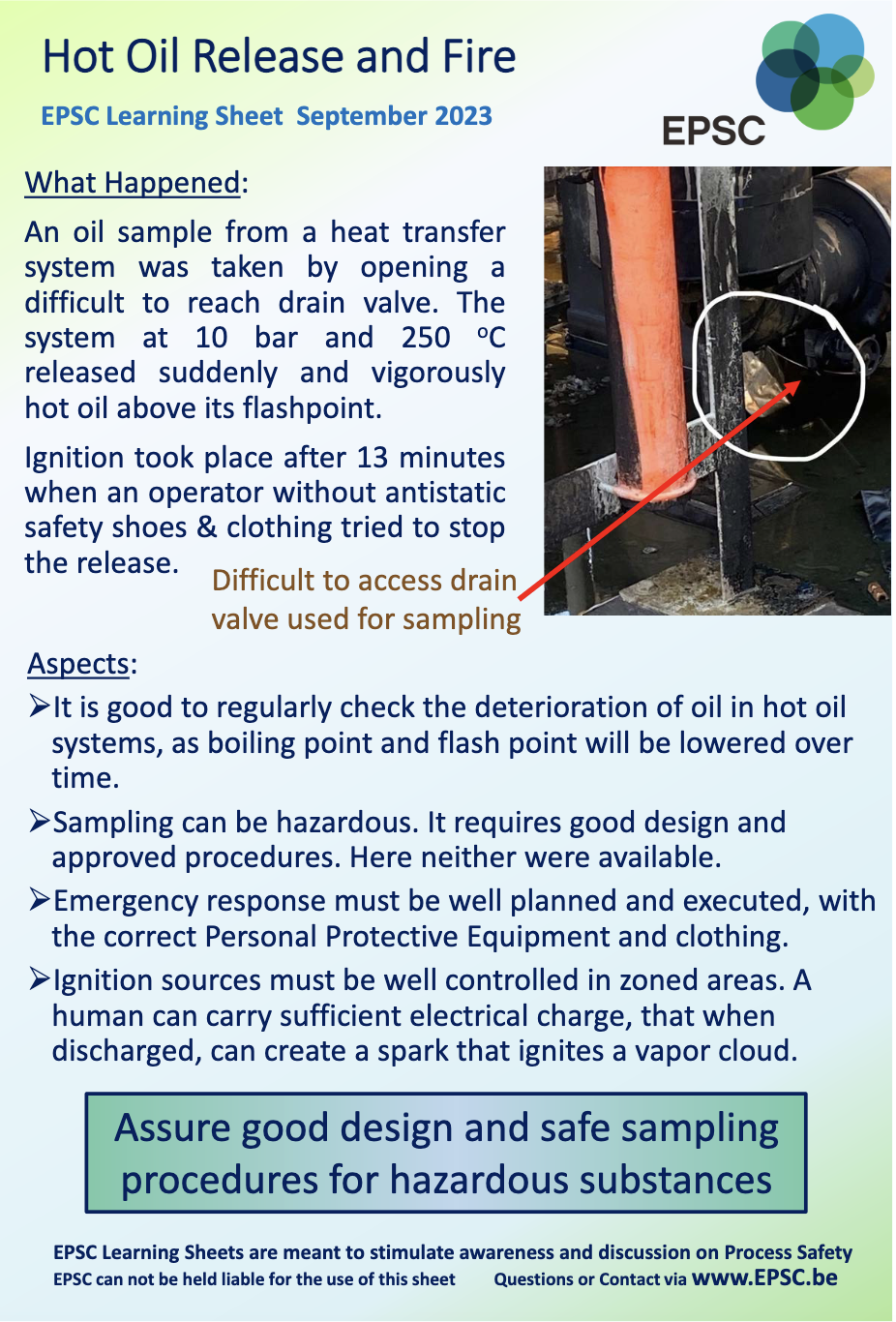
This month’s EPSC Learning Sheet – Hot Oil Release and Fire reminded me of my caustic event and SAMPLING A LIVE PROCESS hazards. This event was also sampling a “system” within a larger process.
The hot oil system, at 10 bar (145 psi) and 250C, released suddenly and vigorously hot oil above its flashpoint. Ignition took place after 13 minutes when an operator without antistatic safety shoes & clothing tried to stop the release.