
Just because we intend to handle minimal quantities of the HHC/EHS, the task of “catching a sample” from a covered process can, in fact be one of the more hazardous tasks our operators perform. Remember, Risk = Frequency X Severity, so operators catch many samples over their shift means this task is a high-frequency task. And as the picture below shows us, we need to ENSURE we are dealing with only smaller quantities of the HHC/EHS. It is this picture that caught my eye, and in the 1990s this may have been an acceptable means to “catch a sample,” but in today’s world of process safety, it should not be.
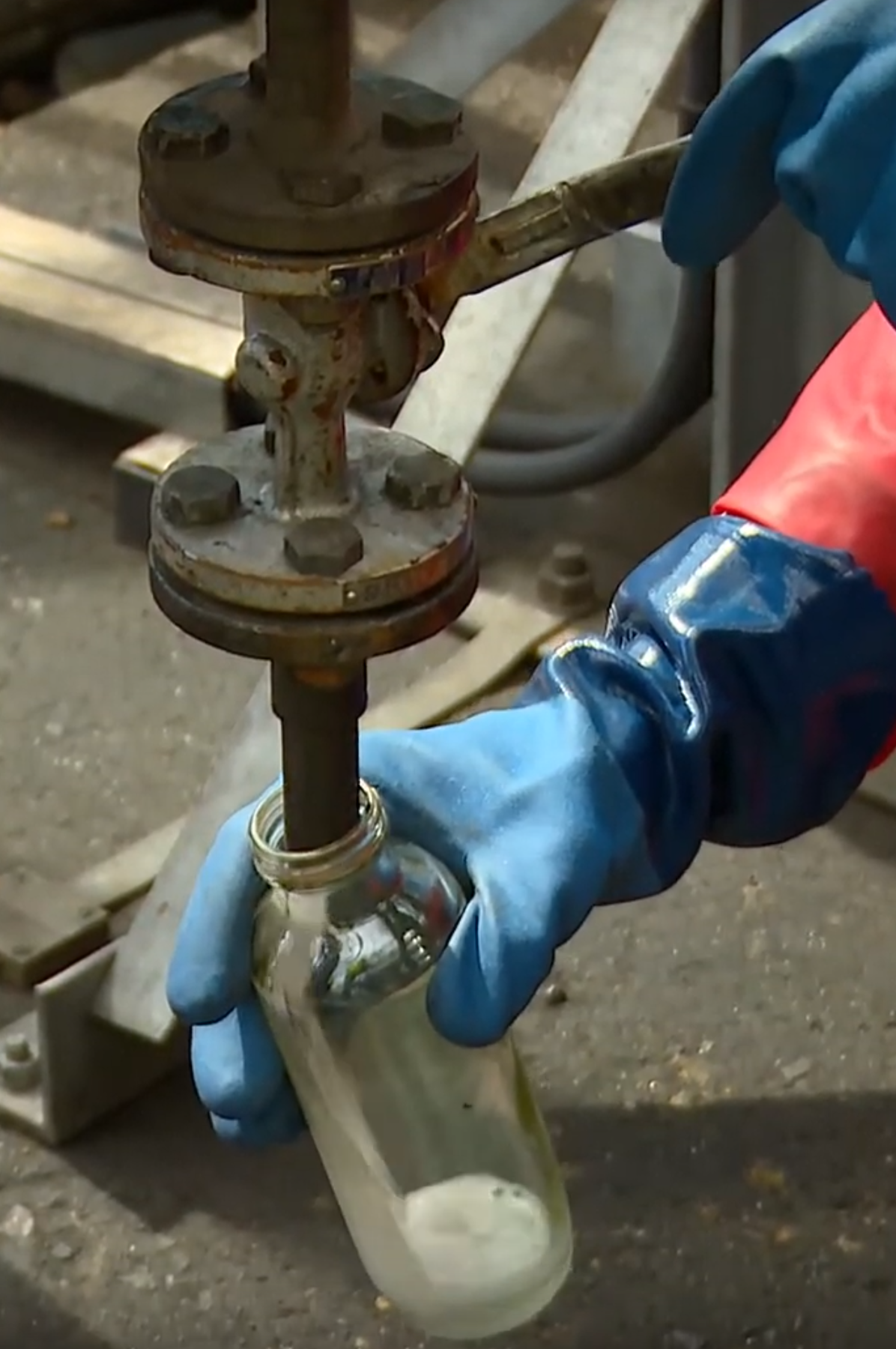
So the first thing I learned from one of my “sampling” incidents is that when things go bad, they tend to go bad quickly, and they can overcome all of our safety features. With that said, when we design a “sampling station,” we view the task as a “process opening,” and this automatically puts the task into a HIGH-RISK category requiring multiple independent layers of protection. So using our fundamental hierarchy of controls, we first look at the engineering of this station…
Deadman Valves
We always design our sampling stations with either a deadman valve (i.e., a springloaded fail-safe CLOSED valve). In the event, something should go wrong, and the operator needs to evacuate the area immediately, he/she can, and the valve will automatically close. Of course, the valve shown in the pic above is a 1/4-turn ball valve, and it has some simple safety characteristics. Still, it does not FULLY close automatically, which is our preferred state of the valve should something happen. For example, let’s say the sample collected in the picture is a flammable liquid (Note: the picture was taken from a video on collecting flammable liquid samples). For some reason, there is a flash fire during the collection. The natural tendency of the operator would be to drop the container and evacuate.
Sample Container
Notice the sample container is GLASS. When the operator drops it, it can break or spill the flammable liquid – feeding the fire with more fuel. Glass is also not a suitable collection container as it is an INSULATOR and not a conductor of the static generated during the task. Yes, I know, OSHA permits glass for flammable liquids in small quantities, and OSHA does not require bonding/grounding when transferring small quantities. But we do not design our sampling stations for OSHA; we design them to protect the personnel. So yes, we specify a CONDUCTIVE sample container, and we ground the container, and we require the container to be bonded to the process being sampled. We do this much like filling our vehicles with fuel; however, some designs will require operators to attach grounding/bonding cables, which we do not prefer. It is too easy to short-cut safety.
Sample Station Inhertent Desgin
This is our preferred design as it strictly limits the amount of HHC/EHS that can be released during sampling. We call it the “sample tube.” The tube is sized for the maximum size of the sample to be collected. It has a ball valve at the top, then the tube, and a deadman valve on the bottom. There is a sight glass at the top and the bottom of the tube; we want fluid in the bottom glass, but NOT the top glass. This tells us our sample size will fit into our sample container. Our sample container (vented) will have a receiving port that will marry to our sample station discharge port. The sample container will be CONDUCTIVE, and once it is connected to the sample station, we have a continuity of a ground path and bonding between the process and our container. We have verified, using the top sight glass, that our sample size will fit into our prescribed sample container. The operator will open the “deadman valve” and fill the sample container. This system is a CLOSED system, but the sample container is vented minimally to allow for flow into the container.