
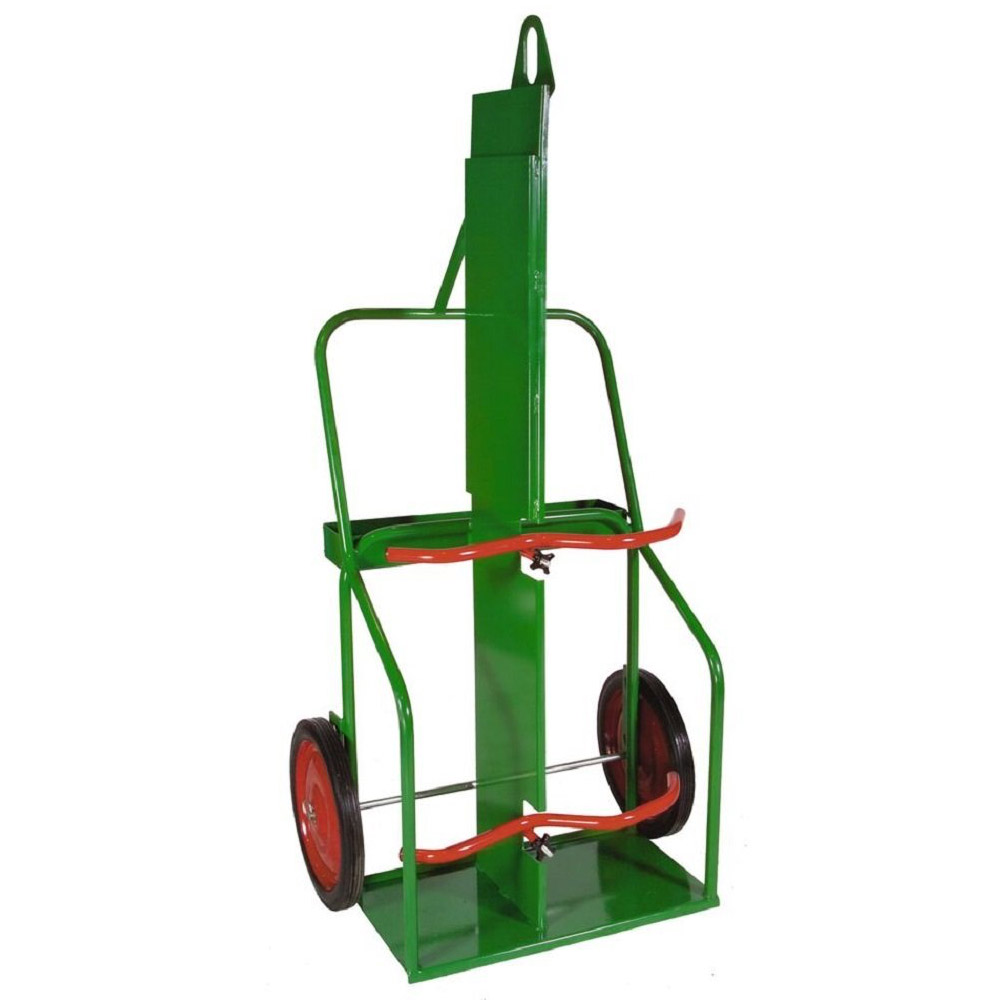
 Over my career in safety I have seen the use of “welding carts” spin out of control as if they are all the “almighty” in fire prevention. These carts can now be purchased with a 30-minute “fire wall” between the fuel gas (e.g. acetylene, propane, etc.) and the oxidizer (e.g. oxygen) and in fact do comply with both OSHA and NFPA storage requirements. But these carts are not keeping up with the newest code requirements and may be on their way out. Many states utilize the International Fire Code (IFC) as a baseline “fire safety code” within their state. The IFC has had a unique separation requirement for fuel gases and oxidizers for several of the last revisions that now make the vast majority of these carts obsolete when it comes to 100% compliance – 100% of the time. Now don’t get me wrong, I am in NO WAY suggesting that we trash our carts today as they still comply with OSHA and NFPA requirements, but just like any other safety/control device – we MUST MANAGE them properly and understand their LIMITATIONS.
I quit counting the number of times we have come across multiple carts stored in the same area with the fuel gas and oxygen cylinders on different carts but touching, as two carts have been stored next to each other (side-to-side or front-to-back)! And by the way, the newest code revision addresses the storage of these “carts”…
3505.2.1.1 Individual cart separation.
Individual carts shall be separated from each other in accordance with Section 5003.9.8. (see below)
5003.9.8 Separation of incompatible materials.
Incompatible materials in storage and storage of materials that are incompatible with materials in use shall be separated where the stored materials are in containers having a capacity of more than 5 pounds (2 kg) or 0.5 gallon (2 L). Separation shall be accomplished by:
1. Segregating incompatible materials in storage by a distance of not less than 20 feet (6096 mm).
2. Isolating incompatible materials in storage by a noncombustible partition extending not less than 18 inches (457 mm) above and to the sides of the stored material.
3. Storing liquid and solid materials in hazardous material storage cabinets.
4. Storing compressed gases in gas cabinets or exhausted enclosures in accordance with Sections 5003.8.5 and 5003.8.6. Materials that are incompatible shall not be stored within the same cabinet or exhausted enclosure.
But in this article I want to point out the new code requirements for the “fire wall” design. It is true that both OSHA and NFPA require the fire wall have a 30-minute rating and be at least 5′ high, so again… these carts COMPLY with current OSHA and NFPA design requirements. However, when we look at the 2015 IFC – Chapter 35 Welding and Other Hotwork we see a bit different design requirement, most notably that the “fire wall” must extend at least 18″ higher than the highest cylinder AND 18″ horizontally. In other words, this is what our firewall should look like when complying with the latest fire code(s):
3505.2 Cylinder and container storage, handling and use.
Storage, handling and use of compressed gas cylinders, containers and tanks shall be in accordance with this section and Chapter 53.
Chapter 53 – Compressed Gases states the following:
5303.7 Separation from hazardous conditions.
Compressed gas containers, cylinders and tanks and systems in storage or use shall be separated from materials and conditions that pose exposure hazards to or from each other. Compressed gas containers, cylinders, tanks and systems in storage or use shall be separated in accordance with Sections 5303.7.1 through 5303.7.11.2.
5303.7.1 Incompatible materials.
Compressed gas containers, cylinders and tanks shall be separated from each other based on the hazard class of their contents. Compressed gas containers, cylinders and tanks shall be separated from incompatible materials in accordance with Section 5003.9.8.
5303.7.2 Combustible waste, vegetation and similar materials.
Combustible waste, vegetation and similar materials shall be kept not less than 10 feet (3048 mm) from compressed gas containers, cylinders, tanks and systems. A noncombustible partition, without openings or penetrations and extending not less than 18 inches (457 mm) above and to the sides of the storage area is allowed in lieu of such distance. The wall shall either be an independent structure, or the exterior wall of the building adjacent to the storage area.
Here is a visual aid for this requirement:
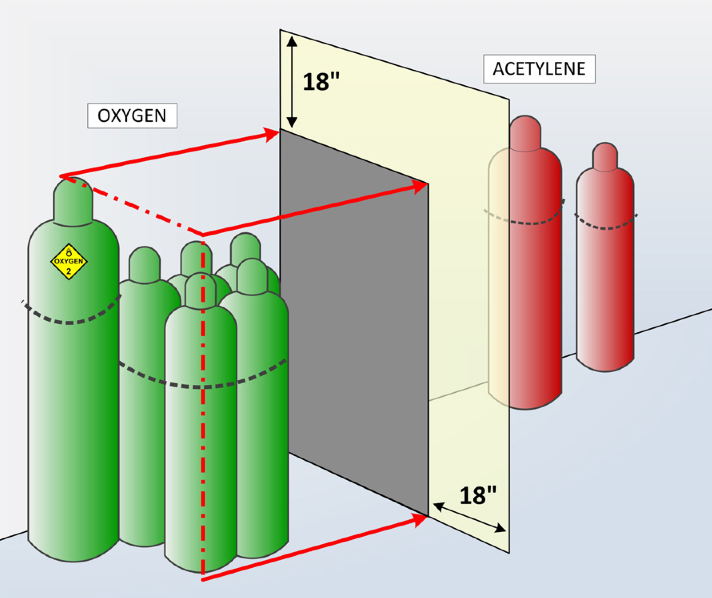
Source: OR-OSHA
So when our cylinders are NOT in use (i.e. in storage) we have to have them seperated by 20′ or we can use a fire wall with the above design in lieu of the distance. But to comply with the lastest and greatest code, this fire wall must extend at least 18 inches (457 mm) above and to the sides of the cylinders… which the fire wall on MOST of these carts do NOT do.
I should also point out that the new code also addresses the use of these carts when the cylinders are IN-SERVICE (e.g. connected for use)
3505.2.1 Cylinders connected for use.
The storage or use of a single cylinder of oxygen and a single cylinder of fuel gas located on a cart shall be allowed without requiring the cylinders to be separated in accordance with Section 5003.9.8 or 5003.10.3.6 when the cylinders are connected to regulators, ready for service, equipped with apparatus designed for cutting or welding and all of the following:
-
- Carts shall be kept away from the cutting or welding operation in accordance with Section 3505.5 or fire-resistant shields shall be provided.
- Cylinders shall be secured to the cart to resist movement.
- Carts shall be in accordance with Section 5003.10.3. (e.g. Handling and Transportation)
- Cylinder valves not having fixed hand wheels shall have keys, handles or nonadjustable wrenches on valve stems while the cylinders are in service.
- Cylinder valve outlet connections shall conform to the requirements of CGA V-1.
- Cylinder valves shall be closed when work is finished.
- Cylinder valves shall be closed before moving the cart.