
This paper presents a statistical analysis of 153 accidents attributable to static electricity in Japanese industry over the last 50 years. A more thorough understanding of their causes could help prevent similar incidents and identify hazards that could assist in the task of risk assessment. Most of the incidents occurred during operations performed by workers. In addition, more than 70% of the flammable atmospheres resulted from the presence of vapors. A noteworthy finding is that at least 70% of the ignitions were caused by isolated conductors including operators’ bodies leading to spark discharges, which could have easily been prevented with grounding. These tendencies indicate that, when operators handle flammable liquids with any conductors, the ignition risk is significantly high. A serious lack of information regarding fundamental countermeasures for static electricity seems to be the main cause of such hazards. Only organized management, including education and risk communication, would prevent them.
1. Introduction
Accidents involving fires and explosions attributable to static electricity still occur in industry even though controls are in place. Some accidents have been minor; however, others have been very serious, sometimes unfortunately involving loss of life and considerable damage to property. Accidents, however, offer an opportunity for learning that may prevent similar incidents as far as accident analysis permits proper cause identification and application of risk reduction measures to prevent future accidents. In addition, their results should lead to new knowledge, rules, and practices with the goal of higher reliability and safety. Since the analysis of a single case can give helpful information, comprehensive statistic analysis of a number of incidents would be even more useful. Accident trends could be identified to assist in the task of risk assessment, in particular, providing important insight into hazard identification. In this paper, 153 accidents attributable to static electricity in Japanese industry, in particular, the petroleum and chemical industries, over the last 50 years (1960–2010) are investigated. Although data from 310 accidents was collected, 157 cases were excluded because of a lack of information or a strong suspicion that ignition might have been caused by sources other than static electricity. It is noteworthy that some of these accidents were similar to those reported in other countries [1, 2, 3], which indicates that similar types of accidents occur repeatedly.
2. General scenario of static ignitions
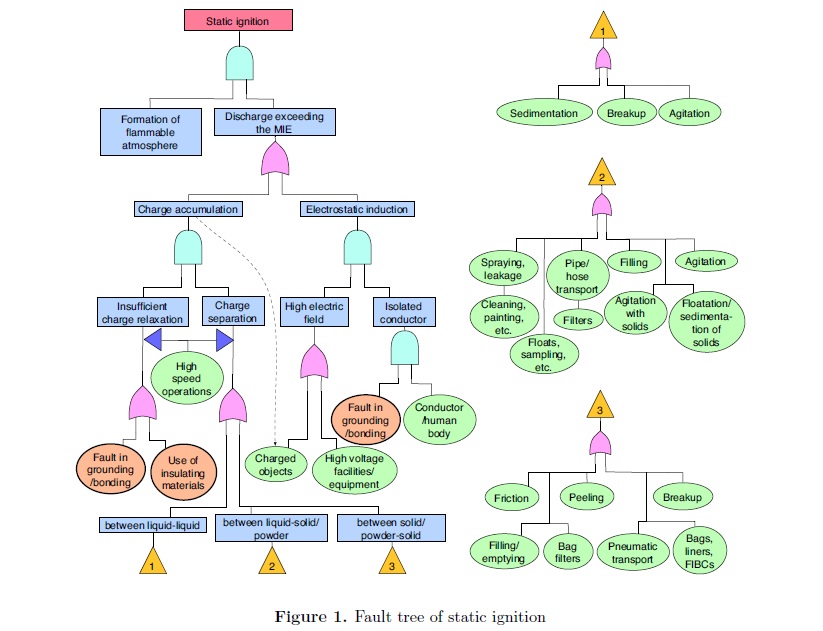
All the cases investigated in this paper fit the process (scenario) in a similar manner. A prerequisite for this process is the formation of a flammable atmosphere. If the rate of charge relaxation is lower than that of charge generation caused by charge separation, charge accumulation occurs. An electrostatic discharge may occur if the electric field generated by the charge is sufficient to cause an electrical breakdown of the air under the boundary conditions of the ground provided in the surrounding area. In addition, isolated conductors in the electric field generated by the accumulated charge may lead to spark discharges caused by induction. Ignition occurs when the released energy by the discharge is higher than the ignition energy of the flammable atmosphere. A fault tree of static ignition according to the scenario is shown in figure 1. It indicates that, if the fault events shown by thick circles, which correspond to failures in fundamental measures against electrostatic hazards, could be corrected, the top event, static ignition, would never occur. The events shown below the numbered triangles indicate examples of processes and operations that caused charge separation.
3. Formation of flammable atmospheres
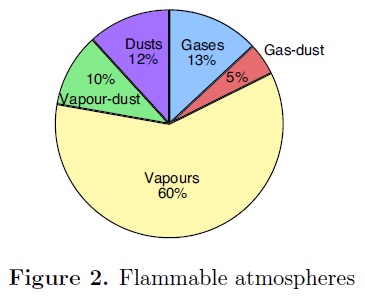
As shown in figure 2, most flammable atmospheres investigated (60%) were the results of the presence of vapours. In 13.1% of the cases investigated, flammable atmospheres were considered to be the result of the presence of flammable gases. Among them, as many as 14 cases (∼70% of flammable gas atmospheres) involved hydrogen, which is highly susceptible to ignition. In some cases, hydrogen was directly involved, while in others, hydrogen was generated by the reactions of hydrochloric acid, hydrogen peroxide, or hydrogen sulphide. Other gases causing the formation of flammable atmospheres were ethylene (4 cases) and LP gas (2 cases). In addition, most of the flammable gas atmospheres were formed due to gas leakage accompanied with liquid discharge, which can generate highly electrostatic charges.
In 60.1% of the cases investigated, flammable atmospheres were determined to have been created by the presence of flammable vapours. With the addition of hybrid mixtures containing flammable dusts, vapours formed 70.6% of the flammable atmospheres in those cases. The vapours include toluene (20 cases), gasoline (11), hexane (9), benzene (7), ethyl acetate (6), thinner (4), ethanol (4), xylene (3), methanol (3), acetone (2), naphtha (2), styrene (2), light oil (2 switch loadings), heavy oil, dioxane, and waste oil.The hazard identification of these vapours in terms of their potential to form flammable atmosphere can be estimated by the relationship between their flash points and temperatures.
In 11.8% of the cases investigated, flammable atmospheres were created by the presence of flammable dusts. The dusts were aluminium (3 cases), polyethylene (2 cases), poval, decaborane, para-octylphenol, bisphenol, anthracene, sulphur, and powders used in coating operations.
In all cases, ignition was caused either by sparks by isolated conductors or by propagating brush discharge that might have occurred in flexible intermediate bulk containers (FIBCs) and insulating pipes. In 15.0% of the cases, flammable atmospheres were estimated to be created by the presence of a hybrid flammable mixture of gases or vapours with dusts. The flammable gas-dust hybrid mixtures (4.6%) include ethylene-polyethylene mixtures (4 cases) and propylene-polypropylene mixtures (3 cases), which were formed due to insufficient degassing in a drying process. On the other hand, the flammable vapour-dust hybrid mixtures (10.5%) were created by solvents or materials such as s tyrene, heptane, alcohols, and ketone, which were used during the process of adding powder to a flammable liquid, filling powder into a container cleaned with solvent, or cleaning containers with solvent near the powder-filling site. Flammable dusts contained in those mixtures were polypropylene, polyethylene, polyvinyl alcohol, maleic anhydride, aluminium isopropoxide, rubber powders, hydrazine, and pharmaceutical agents.
4. Causes of charging
According to the cases investigated, the main factors responsible for the charging are:
- charge separation at the liquid-solid/powder interface resulting from the flowing
- agitating (specially, with powder)
- spraying
- accidental discharging of liquids
- charge separation at the solid/powder-solid interface resulting from the friction and collision caused by powders
- friction and peeling between adjacent solid materials.
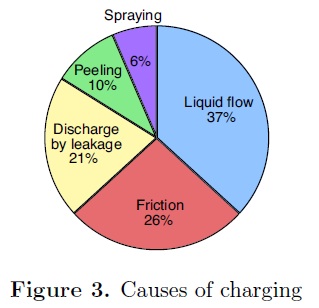
These findings are summarised in figure 3, which shows that the leading cause of the charging is the flowing of liquids (36.8%), followed by friction and collision mainly involving powders (26.5%), liquid discharge by leakage (20.6%), peeling (9.7%), and spraying (6.5%). In addition, the use of insulating materials in hoses/pipes and containers/bags increased the charging in many of the cases due to the loss of the charge leakage path to earth. Furthermore, these charges accumulated often caused induction in the presence of an isolated conductor, resulting in many spark ignitions. The charging of liquids occurred during any processes involving liquid flow, such as filling, transferring liquid via pipes/hoses, draining liquid from a tank or a pump, sampling liquid from a valve, and agitation. The use of a high flow rate, splash loading, filters (in particular at the proximity of receiving containers), and two-phase liquids (liquid-immiscible liquid or liquid-solid particles mixtures) was found to ACCELERATE the build-up of static charges. Powder charging was caused by the charge separation by friction and collision between powder particles and a solid object during the process of transporting powder (including pneumatic transport) and filling/emptying. Other causes of charging by friction were wiping and scraping actions during cleaning. Accidental discharges by leakage could also cause the charging of liquid, in which solid particles contained in discharged liquid accelerated the charge. Peeling was also responsible for the charging, such as pulling liner bags out of drums and transferring insulating film with rollers. In addition, charging hazards by spraying, accompanied with the processes of solvent spraying, steam spraying, spray painting, electrostatic powder coating, and tank cleaning could be identified.
5. Types and causes of electrostatic discharges
Ignitions were caused by four types of electrostatic discharge:
- spark,
- brush,
- propagating brush, and
- cone discharges.
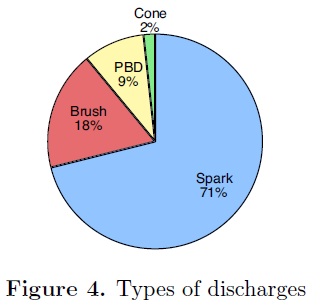
As shown in figure 4, sparks are responsible for the majority of static ignition sources. The spark discharges were caused by the presence of an isolated conductor, which accounts for 71.1% of the cases investigated. The following isolated conductors were identified: metal parts of cleaning tools, spatulas, small containers, hoppers, weighting scales, funnels, metal part of bag filters, sieves, rods, scoops, shovels, stool (resulting also in the isolation of a human body on it), plates for dividing pipelines, metal parts on insulating pipes/hoses, hose nozzles, platform trucks, a partially conductive FIBC, human bodies with insulating footwear/floor, highly conductive liquids in insulating containers, and a liquid level float (a design error). Most of the items listed above are either handled (e.g., treated with insulating gloves) or movable conductors or human bodies with insulating footwear/floor; therefore, earthing is frequently overlooked. It is noteworthy that over 70% of the accidents could have been prevented by earthing and bonding, which is the basic measure against electrostatic hazards. In the cases investigated, brush discharges occurred when a grounded conductor approached charged insulating objects (powders, liquids, and solid items) or when insulating objects in contact with a grounded conductor separated from one another (such as liner bags in grounded metal drums). The following brush discharges could be identified: discharges between insulating hoses or funnels and a grounded conductor (a container or a finger tip) during liquid filling, a discharge at a liquid surface due to improper insertion of a grounded dip pipe, and those regarding insulating bags or bag filters for powders in hybrid flammable atmospheres. Propagating brush discharges (PBDs) estimated as an ignition source were mostly caused by charging of insulating bags for powders, which occurred when charged powder was discharged from an insulating bag/FIBC or peeled from a bag filter. In addition, a PBD was generated in a PVC exhaust pipe used for a powder coating process. The use of insulating bags and pipes (including insulating coats) that can create a potential hazard of PBD should be avoided using appropriate bags and pipes. Three cases of cone discharge were identified, in which ignition occurred during the pneumatic filling of polymer powder into a silo in an atmosphere of a hybrid flammable gas-dust mixture caused by insufficient gas removal from the powder.
6. Operations
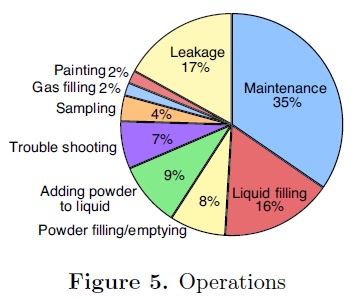
This section is a description of the types of operations that were carried out when accidents happened as summarised in figure 5.
In 94.1% of cases investigated, ignition occurred during operations performed directly by workers. Other cases of ignition occurred due to accidental liquid discharges, an abnormal spraying by pump cavitation, electrical isolation of a metal part of a bag filter and a liquid level float due to insufficient maintenance. In addition, it is noteworthy that over half of incidents occurred in except manufacturing operations. Maintenance, such as cleaning, is more susceptible to accidents than normal manufacturing operations. Cleaning operations resulted in 37 accidents, which included cleaning filters, containers, pipes, paint nozzles, and metal hand tools with water or a solvent that was sometimes pressurised. In the operations, the ignition sources were mainly spark discharge due to isolated conductors. In the cleaning of paint nozzles, the bottom of a container for solvent circulation was coated by the paint, resulting in its isolation even though it was placed on an earthed metal plate. In two cases of tank cleaning, a sensitive atmosphere was created due to insufficient removal of hydrogen before cleaning and charge accumulation was enhanced by the cleaning of a Teflon-lined container, or the use of an insulating hose.
Draining or sampling liquids from a valve, accompanied with the cleaning of tanks, pipes and pumps (17 cases), resulted in ignitions due to spark discharges from isolated conductors (mainly receiving containers).
Regarding the maintenance of bag filters, 7 accidents occurred while removing powder. The incidents were caused by a poking of a bag filter with a metal rod in one case and by poor maintenance resulted in ungrounded filters in others. In such cases, hybrid flammable gases/vapours-dusts mixtures were often created. In addition, many cases of leakage occurred at the flanges or valves on pipes; such cases were observed during maintenance or in trial operation and start-ups following maintenance.
On liquid filling, ignitions were caused by sparks from isolated conductors including conductive liquids and human bodies or by brush discharges between an insulating material and an earthed conductor. Such ignitions mainly occurred with small containers. Other cases regarding liquid filling took place during two switch loadings of light oil to road tankers, which had previously contained gasoline, and a ship tanker loading with a defect level float.
The majority of powder-filling cases were performed by pneumatic transport. In about half of these cases, a flammable hybrid mixture was created due to insufficient degassing, in which cone discharges also caused the ignitions. Other cases included emptying powder into an FIBC to clean a silo, emptying an FIBC to fill a hopper, manual-filling of drums with a PP liner bag, and filling a movable container (electrically isolated). In the cases involving FIBCs, the ignition source of PBD was estimated. Accidents related to the PP liners occurred in a hybrid flammable vapour-dust mixture which possibly led to ignition by brush discharge, in which some accidents occurred when the liner was extracted from a drum.
In the operations of adding powder to flammable liquid, powder poured into a container with entrained air potentially forms a hybrid flammable vapour-dust mixture. Therefore, ignitions were identified to occur not only by sparks from isolated conductors (a hopper on a glass lining container and human bodies) but also as a result of brush discharges (insulating bags and insulating liners of paper bags; in one case, a liner was pulled out of a paper bag with powder into a container).
Troubleshooting was also susceptible to accidents. For example, some cases involved steam spraying against leakage, and, in another, leakage occurred as a valve was opened to release an accidental rise in pressure. In addition, liquid sampling from a manhole or a valve led to accidents, in which ignitions were caused by a spark from an isolated metal container for sampling. Gas filling operations also led to accidents, in which an LP gas leakage due to improper inspection of hose connections and a hydrogen leakage due to a high-pressure hose being severed by a truck occurred. In one case of gas lighter filling, the ignition source was a spark discharge from an isolated operator. In powder coating processes, the isolation of a metal hook resulted in the isolation of the object to be coated, which caused a spark. Painting using a spray can while wearing insulating shoes led to a spark. A metal scoop treated with insulating by leakage caused by pipe corrosion over time, maintenance errors of flanges, pump cavitation, pressure increase due to abnormal reaction and decomposition, and valve mishandling were also susceptible to accidents, in which most ignition sources were sparks from isolated conductors.
7. Concluding remarks
More than 70% of the ignitions was caused by sparks from an isolated conductor or operator by induction; furthermore, well over 70% of the flammable atmospheres examined were formed by vapours. In addition, over 90% of all accidents occurred during work performed by operators. These findings suggest that any work performed by operators using any conductors or with insulating shoes/floor in areas where flammable liquids are handled can be extremely hazardous. However, thorough understanding and implementation of the principles of anti-static measures [4] based on proper risk assessment under organised management would have certainly prevented all these accidents from happening.
Acknowledgments
To see the original study, you can download it Here.
This work is a part of a study supported by Health and Labour Science Research Grants from Ministry of Health, Labour and Welfare of Japan.
References
[1] L¨uttgens G, Wilson N 1997 Electrostatic hazards (Butterworth-Heinemann, Oxford)
[2] Pratt T H 1997 Electrostatic ignitions of fires and explosions (Burgoyne Incorporated Consulting Scientists & Engineers, Marietta)
[3] Center for Chemical Process Safety of the American Institute of Chemical Engineers 2005 Guidelines for safe handling of powders and bulk solids (AIChE, New York)
[4] For example, CLC/TR 50404 (2003), IEC 60079-32 (to be published), JNIOSH TR-42 (2007), NFPA 77 (2007)