
There has been much written about the Ammonimum Nitrate (AN) stored at the West Fertilizer facility in West, TX. The investigation is still on-going; however, investigators have confirmed that AN was stored on site and it is their leading suspect in the explosion that killed a dozen emergency responders. Last week the media focus shifted to how the state of TX has no state codes to control/oversee the handling and storage of Ammonimum Nitrate. I want to show the contrast between a state that has its own codes and the state of TX which does not have a set of codes that pertain to AN. In the state of OH (my home state) there are a number of state HAZMAT codes that would come into play if a business wanted to store AN on site. These codes all require a “permit” from the SFMO, as well as some very prescriptive storage and handling requirements, very similar to PSM/RMP standards. PLEASE note that AN is a CLASS 4 Oxidizer in the state of OH Codes. Here they are…
The first code that is SPECIFC to storing OXIDIZERS is:
Ohio Administrative Code 1301:7-7-40 – Oxidizers‚ Oxidizing Gases and Oxidizing Cryogenic Fluids
(1) 4001.1 Scope.
The storage and use of oxidizing materials shall be in accordance with this rule and rule 1301:7-7-27 (Hazardous Materials – General Provisions) of the Administrative Code. Oxidizing gases shall also comply with rule 1301:7-7-30 of the Administrative Code. Oxidizing cryogenic fluids shall also comply with rule 1301:7-7-32 of the Administrative Code.
Exceptions:
1. Display and storage in Group M and storage in Group S occupancies complying with paragraph (C)(11)(2703.11) of rule 1301:7-7-27 of the Administrative Code.
2. Bulk oxygen systems at industrial and institutional consumer sites shall be in accordance with NFPA 55 as listed in rule 1301:7-7-47 of the Administrative Code.
3. Liquid oxygen stored or used in home health care in Group I-1, I-4 and R occupancies in accordance with paragraph (F)(4006) of this rule.
(2) 4001.2 Permits.
Permits shall be required as set forth in rule 1301:7-7-01 (Administration) of the Administrative Code.
SECTION 4002 DEFINITIONS (B)
(1) 4002.1 Definitions.
The following words and terms shall, for the purposes of this rule and as used elsewhere in this code, have the meanings shown herein.
“Bulk oxygen system.” An assembly of equipment, such as oxygen storage containers, pressure regulators, safety devices, vaporizers, manifolds and interconnecting piping, that has a storage capacity of more than 20,000 cubic feet (566 m3) of oxygen at normal temperature and pressure (NTP) including unconnected reserves on hand at the site. The bulk oxygen system terminates at the point where oxygen at service pressure first enters the supply line. The oxygen containers can be stationary or movable, and the oxygen can be stored as a gas or liquid.
“Liquid oxygen ambulatory container.” A container used for liquid oxygen not exceeding 0.396 gallons (1.5 liters) specifically designed for use as a medical device as defined by 21 USC Chapter 9 as listed in rule 1301:7-7-47 of the Administrative Code that is intended for portable therapeutic use and to be filled from its companion base unit (a liquid oxygen home care container).
“Liquid oxygen home care container.” A container used for liquid oxygen not exceeding 15.8 gallons (60 liters) specifically designed for use as a medical device as defined by 21 USC Chapter 9 as listed in rule 1301:7-7-47 of the Administrative Code that is intended to deliver gaseous oxygen for therapeutic use in a home environment.
“Oxidizer.” A material that readily yields oxygen or other oxidizing gas, or that readily reacts to promote or initiate combustion of combustible materials and, if heated or contaminated, can result in vigorous self-sustained decomposition.
“Class 4.” An oxidizer that can undergo an explosive reaction due to contamination or exposure to thermal or physical shock and that causes a severe increase in the burning rate of combustible materials with which it comes into contact. Additionally, the oxidizer causes a severe increase in the burning rate and can cause spontaneous ignition of combustibles.
“Class 3.” An oxidizer that causes a severe increase in the burning rate of combustible materials with which it comes in contact.
“Class 2.” An oxidizer that will cause a moderate increase in the burning rate of combustible materials with which it comes in contact.
“Class 1.” An oxidizer that does not moderately increase the burning rate of combustible materials.
“Oxidizing cryogenic fluid.” An oxidizing gas in the cryogenic state.
“Oxidizing gas.” A gas that can support and accelerate combustion of other materials more than air does.
SECTION 4003 GENERAL REQUIREMENTS (C)
(1) 4003.1 Quantities not exceeding the maximum allowable quantity per control area.
The storage and use of oxidizing materials in amounts not exceeding the maximum allowable quantity per control area indicated in paragraph (C)(1)(2703.1) of rule 1301:7-7-27 of the Administrative Code shall be in accordance with paragraphs (A)(2701) and (C)(2703) of rule 1301:7-7-27 of the Administrative Code and paragraphs (A)(4001) and (C)(4003) of this rule. Oxidizing gases shall also comply with rule 1301:7-7-30 of the Administrative Code.
SECTION 4004 STORAGE (D)
(1) 4004.1 Indoor storage.
Indoor storage of oxidizing materials in amounts exceeding the maximum allowable quantity per control area indicated in Table 2703.1.1(1) of rule 1301:7-7-27 of the Administrative Code shall be in accordance with paragraphs (A)(2701), (C)(2703) and (D)(2704) of rule 1301:7-7-27 of the Administrative Code and this rule.
Table 2703.1.1(1) of rule 1301:7-7-27
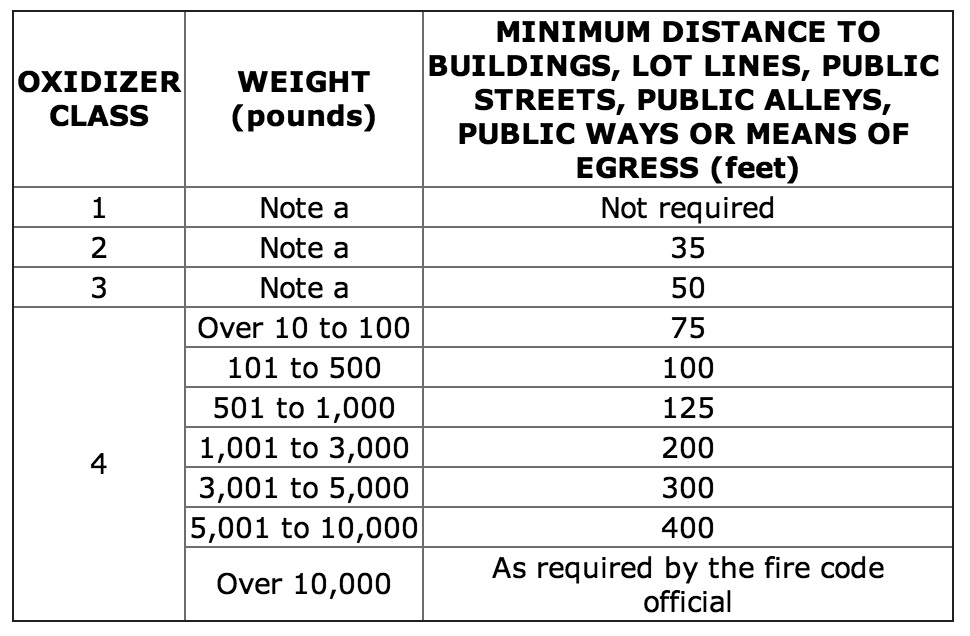
(2) 4004.2 Outdoor storage.
Outdoor storage of oxidizing materials in amounts exceeding the maximum allowable quantities per control area set forth in Table 2703.1.1(3)of rule 1301:7-7-27of the Administrative Code shall be in accordance withparagraphs(A)(2701), (C)(2703) and(D)(2704) of rule 1301:7-7-27 of the Administrative Code and thisrule. Oxidizing gases shall also comply with rule 1301:7-7-30 of the Administrative Code.
TABLE 2703.1.1(1) MAXIMUM ALLOWABLE QUANTITY PER CONTROL AREA OF HAZARDOUS MATERIALS POSING A PHYSICAL HAZARD a, j, m, n, p


For SI: 1 cubic foot = 0.02832 m3, 1 pound = 0.454 kg, 1 gallon = 3.785 L.
a. For use of control areas, see Section 2703.8.3.
b. The aggregate quantity in use and storage shall not exceed the quantity listed for storage.
c. The quantities of alcoholic beverages in retail and wholesale sales occupancies shall not be limited providing the liquids are packaged in individual containers not exceeding 1.3 gallons. In retail and wholesale sales occupancies, the quantities of medicines, foodstuffs, consumer or industrial products, and cosmetics containing not more than 50 percent by volume of water-miscible liquids with the remainder of the solutions not being flammable shall not be limited, provided that such materials are packaged in individual containers not exceeding 1.3 gallons.
d. Maximum allowable quantities shall be increased 100 percent in buildings equipped throughout with an approved automatic sprinkler system in accordance with Section 903.3.1.1. Where Note e also applies, the increase for both notes shall be applied accumulatively. This footnote shall not be applicable to Group L occupancies.
e. Maximum allowable quantities shall be increased 100 percent when stored in approved storage cabinets, day boxes, gas cabinets, exhausted enclosures, or listed safety cans. Listed safety cans shall be in accordance with Section 2703.9.10. Where Note d also applies, the increase for both notes shall be applied accumulatively.
f. Quantities shall not be limited in a building equipped throughout with an approved automatic sprinkler system in accordance with Section 903.3.1.1.
g. Allowed only in buildings equipped throughout with an approved automatic sprinkler system.
h. Containing not more than the maximum allowable quantity per control area of Class IA, Class IB or Class IC flammable liquids.
i. The maximum allowable quantity shall not apply to fuel oil storage complying with Section 603.3.2.
j. Quantities in parenthesis indicate quantity units in parenthesis at the head of each column.
k. A maximum quantity of 200 pounds of solid or 20 gallons of liquid Class 3 oxidizers is allowed when such materials are necessary for maintenance purposes, operation or sanitation of equipment when the storage containers and the manner of storage are approved.
l. Net weight of pyrotechnic composition of the fireworks. Where the net weight of the pyrotechnic composition of the fireworks is not known, 25 percent of the gross weight of the fireworks including packaging shall be used.
m. For gallons of liquids, divide the amount in pounds by 10 in accordance with Section 2703.1.2.
n. For storage and display quantities in Group M and storage quantities in Group S occupancies complying with Section 2703.11, see Table 2703.11.1.
o. Densely-packed baled cotton that complies with the packing requirements of ISO 8115 shall not be included in this material class.
p. The following shall not be included in determining the maximum allowable quantities:
1. Liquid or gaseous fuel in fuel tanks on vehicles.
2. Liquid or gaseous fuel in fuel tanks on motorized equipment operated in accordance with this code.
3. Gaseous fuels in piping systems and fixed appliances regulated by the California Mechanical Code.
4. Liquid fuels in piping systems and fixed appliances, regulated by the California Mechanical Code.
SECTION 4005 USE (E)
(1) 4005.1 Scope.
The use of oxidizers in amounts exceeding the maximum allowable quantity per control area indicated in Table 2703.1.1(1) or 2703.1.1(3) of rule 1301:7-7-27 of the Administrative Code shall be in accordance with paragraphs (A)(2701),(C)(2703) and (E)(2705) of rule 1301:7-7-27 of the Administrative Code and this rule. Oxidizing gases shall also comply with rule 1301:7-7-30 of the Administrative Code.
Some of the other State Codes that come into play are are ones that I have written about before (Ohio Fire Code Requirements for Mechanical Refrigeration facilities using Ammonia, Ohio’s PSM/RMP General Duty Clause, Process Safety and Ohio State Fire & HAZMAT Codes) calling them Ohio’s own Process Safety codes. For example, the code above states that the facility must also comply with Ohio Administrative Code 1301:7-7-27 – Hazardous Materials – General Provisions which contains the following requirements for a business storing solid, liquid, or gaseous oxidizers (which AN is an oxidizer).
(3) 2701.3 Performance-based design alternative. When approved by the fire code official, buildings and facilities where hazardous materials are stored, used or handled shall be permitted to comply with this paragraph as an alternative to compliance with the other requirements set forth in this rule, and rules 1301:7-7-28 to 1301:7-7-44 of the Administrative Code.
(a) 2701.3.1 Objective. The objective of paragraph (A)(3)(2701.3) of this rule is to protect people and property from the consequences of unauthorized discharge, fires or explosions involving hazardous materials.
(b) 2701.3.2 Functional statements. Performance-based design alternatives are based on the following functional statements:
(i) Provide safeguards to minimize the risk of unwanted releases, fires or explosions involving hazardous materials.
(ii) Provide safeguards to minimize the consequences of an unsafe condition involving hazardous materials during normal operations and in the event of an abnormal condition.
(c) 2701.3.3 Performance requirements. When safeguards, systems, documentation, written plans or procedures, audits, process hazards analysis, mitigation measures, engineering controls or construction features are required by paragraphs (A)(3)(c)(i)(2701.3.3.1) to (A)(3)(c)(xviii)(2701.3.3.18) of this rule, the details of the design alternative shall be subject to approval by the fire code official. The details of actions granting the use of the design alternatives shall be recorded and entered in the files of the jurisdiction.
(i) 2701.3.3.1 Properties of hazardous materials. The physical and health-hazard properties of hazardous materials on site shall be known and shall be made readily available to employees, neighbors and the fire code official.
(ii) 2701.3.3.2 Reliability of equipment and operations. Equipment and operations involving hazardous materials shall be designed, installed and maintained to ensure that they reliably operate as intended.
(iii) 2701.3.3.3 Prevention of unintentional reaction or release. Safeguards shall be provided to minimize the risk of an unintentional reaction or release that could endanger people or property.
(iv) 2701.3.3.4 Spill mitigation. Spill containment systems or means to render a spill harmless to people or property shall be provided where a spill is determined to be a plausible event and where such an event would endanger people or property.
(v) 2701.3.3.5 Ignition hazards. Safeguards shall be provided to minimize the risk of exposing combustible hazardous materials to unintended sources of ignition.
(vi) 2701.3.3.6 Protection of hazardous materials. Safeguards shall be provided to minimize the risk of exposing hazardous materials to a fire or physical damage whereby such exposure could endanger or lead to the endangerment of people or property.
(vii) 2701.3.3.7 Exposure hazards. Safeguards shall be provided to minimize the risk of and limit damage from a fire or explosion involving explosive hazardous materials whereby such fire or explosion could endanger or lead to the endangerment of people or property.
(viii) 2701.3.3.8 Detection of gas or vapor release. Where a release of hazardous materials gas or vapor would cause immediate harm to persons or property, means of mitigating the dangerous effects of a release shall be provided.
(ix) 2701.3.3.9 Reliable power source. Where a power supply is relied upon to prevent or control an emergency condition that could endanger people or property, the power supply shall be from a reliable source.
(x) 2701.3.3.10 Ventilation. Where ventilation is necessary to limit the risk of creating an emergency condition resulting from normal or abnormal operations, means of ventilation shall be provided.
(xi) 2701.3.3.11 Process hazard analyses. Process hazard analyses shall be conducted to ensure reasonably the protection of people and property from dangerous conditions involving hazardous materials.
(xii) 2701.3.3.12 Pre-startup safety review. Written documentation of pre-startup safety review procedures shall be developed and enforced to ensure that operations are initiated in a safe manner. The process of developing and updating such procedures shall involve participation of affected employees.
(xiii) 2701.3.3.13 Operating and emergency procedures. Written documentation of operating procedures and procedures for emergency shut down shall be developed and enforced to ensure that operations are conducted in a safe manner. The process of developing and updating such procedures shall involve participation of affected employees.
(xiv) 2701.3.3.14 Management of change. A written plan for management of change shall be developed and enforced. The process of developing and updating the plan shall involve the participation of affected employees.
(xv) 2701.3.3.15 Emergency response plan. A written emergency response plan shall be developed to ensure that proper actions are taken in the event of an emergency, and the plan shall be followed if an emergency condition occurs. The process of developing and updating the plan shall involve the participation of affected employees.
(xvi) 2701.3.3.16 Accident procedures. Written procedures for investigation and documentation of accidents shall be developed, and accidents shall be investigated and documented in accordance with these procedures.
(xvii) 2701.3.3.17 Consequence analysis. Where an accidental release of hazardous materials could endanger people or property, either on or off-site, an analysis of the expected consequences of a plausible release shall be performed and utilized in the analysis and selection of active and passive hazard mitigation controls.
(xviii) 2701.3.3.18 Safety audits. Safety audits shall be conducted on a periodic basis to verify compliance with the requirements of this paragraph.
(4) 2701.4 Retail and wholesale storage and display. For retail and wholesale storage and display of nonflammable solid and nonflammable or noncombustible liquid hazardous materials in Group M occupancies and storage in Group S occupancies, see paragraph (C)(1)(2703.11) of this rule.
(5) 2701.5 Permits. Permits shall be required as set forth in rule 1301:7-7-01 of the Administrative Code. When a permit is required to permanently close a storage, use or handling facility, the fire code official is authorized to require that the application be accompanied by a facility closure plan in accordance with paragraph (A)(6)(c)(2701.6.3) of this rule.
(a) 2701.5.1 Hazardous Materials Management Plan. Where required by the fire code official, an application for a permit shall include a “Hazardous Materials Management Plan” (HMMP). The “HMMP” shall include a facility site plan designating the following:
(i) Access to each storage and use area.
(ii) Location of emergency equipment.
(iii) Location where liaison will meet emergency responders.
(iv) Facility evacuation meeting point locations.
(v) The general purpose of other areas within the building.
(vi) Location of all aboveground and underground tanks and their appurtenances including, but not limited to, sumps, vaults, below-grade treatment systems and piping.
(vii) The hazard classes in each area.
(viii) Locations of all control areas and Group H occupancies.
(ix) Emergency exits.
(b) 2701.5.2 “Hazardous Materials Inventory Statement” (“HMIS”). Where required by the fire code official, an application for a permit shall include an “HMIS”, such as “Superfund Amendments and Reauthorization Act of 1986” (“SARA”) Title III, Tier II Report, or other approved statement. The “HMIS” shall include the following information:
(i) Product name.
(ii) Component.
(iii) “Chemical Abstract Service” (“CAS”) number.
(iv) Location where stored or used.
(v) Container size.
(vi) Hazard classification.
(vii) Amount in storage.
(viii) Amount in use-closed systems.
(ix) Amount in use-open systems.
As we can see, the state of Ohio requires the business to obtain a permit as well as have a frame work of safety procedures and management systems VERY SIMILAR to OSHA’s PSM and EPA’s RMP. Could these requirements have made a difference in West, TX? Who knows, but the state of Ohio does have these codes in place – now it is up to the employer to follow them.
To see all Ohio Fire Codes and HAZMAT Codes – CLICK HERE