
 After a boiler exploded at a refinery, OSHA cited the refinery’s owner for violating 29 C.F.R. § 1910.119, which sets forth requirements for the management of highly hazardous chemicals. The Occupational Safety and Health Review Commission (the Commission) upheld the violations. In doing so, it noted that the refinery had previously violated § 1910.119. But it determined that these prior violations occurred before the current owner owned the refinery and that they, therefore, occurred under a different employer. Accordingly, the Commission did not classify the violations as “repeat[] violations” under 29 U.S.C. § 666(a), which permits increased penalties for “employer[s] who willfully or repeatedly violate[]” the regulation.
The refinery appeals from the Commission’s order, arguing that § 1910.119 does not apply to the boiler that exploded. Because we find that § 1910.119’s plain text unambiguously applies to the boiler, we affirm the portion of the Commission’s order upholding the violations. Secretary of Labor Eugene Scalia (the Secretary) also appeals from the order, arguing that the Commission erred in failing to characterize the violations as repeat violations. Because we agree with the Commission that the current owner is not the same employer as the refinery’s previous owner, we also affirm the portion of the order concluding that these violations were not REPEAT violations.
NOTE: I always remove identifying information from my posts, but this case is so significant and when I used the simple phrase “refinery” rather than the name the post got confusing. So I have left the names of the businesses involved and left the name of the OSHA CSHO in this posting for MEMBERS ONLY.
Background
Before December 2011, Wynnewood Inc., a subsidiary of Gary-Williams Energy Corporation, owned the refinery. In December 2011, CVR Energy, Inc., (CVR Energy) “acquired all the stock of Gary-Williams Energy Corporation and its subsidiaries, including Wynnewood, Inc.” App. vol. 21, 1145. After the purchase, Wynnewood Inc. became Wynnewood LLC.
In September 2012, one of the refinery’s boilers— the Wickes boiler — exploded after too much natural gas entered its firebox, which burns gas to heat the boiler. As a result of the explosion, two employees died. Neither party asserts that the Wickes boiler contains highly hazardous chemicals. But it is connected to two other parts of the refinery that do—the fluid catalytic cracking unit (FCCU) and the alkylation unit.
Shortly after the explosion, OSHA began an inspection of the refinery. After investigating, OSHA cited Wynnewood for various violations of the Occupational Safety and Health Act (OSH Act). Relevant here, these citations included violations of § 1910.119, several of which OSHA characterized as repeat violations. An administrative law judge (ALJ) affirmed all but one of these violations. But because OSHA based its repeat-violations finding on violations that occurred under Wynnewood Inc. and not Wynnewood LLC, the ALJ changed the characterization of several of the violations from repeat to serious. The Commission affirmed the ALJ’s decision.
Analysis
Both parties appeal the Commission’s decision. Wynnewood argues that the regulation at issue does not apply to the Wickes boiler and that the Commission, therefore, erred in affirming these violations. The Secretary argues that the Commission erred by characterizing the violations as serious rather than repeat.
I. Application of § 1910.119 to the Wickes Boiler Wynnewood argues that the regulation, which creates a standard for process safety management (PSM) of highly hazardous chemicals, does not apply to the Wickes boiler.
The PSM regulation — which the parties also refer to as the PSM standard — sets out “requirements [employers must follow] for preventing or minimizing the consequences of catastrophic releases of toxic, reactive, flammable, or explosive chemicals.” § 1910.119. The regulation applies only to “process[es] which involve[]” a threshold amount of highly hazardous chemicals. § 1910.119(a)(1). And the regulation provides a specific definition of “process”:
Process means any activity involving a highly hazardous chemical including any use, storage, manufacturing, handling, or the on-site movement of such chemicals, or combination of these activities. For purposes of this definition, any group of vessels which are interconnected and separate vessels which are located such that a highly hazardous chemical could be involved in a potential release shall be considered a single process. § 1910.119(b).
Below, the Commission determined that the Wickes boiler could be part of a process even though it did not contain any highly hazardous chemicals. The Commission then analyzed the text of § 1910.119(b) and found that the Wickes boiler was part of a process covered by the regulation—in other words, that it was part of a “PSM-covered process” or was “PSM-covered” for two independent reasons. App. vol. 21, 1150.
First, the Commission determined that the Wickes boiler was interconnected with the FCCU and the alkylation unit, both of which are covered by the PSM standard.
Second, and alternatively, the Commission determined that the Wickes boiler “was covered by the PSM standard because it was located such that a highly hazardous chemical could be involved in a potential release.”
On appeal, Wynnewood argues that:
(1) the Wickes boiler was not PSM-covered because it did not contain any highly hazardous chemicals,
(2) the Wickes boiler was not PSM-covered because of either its interconnection with or location near a process, and
(3) we should not defer to the Secretary because his new interpretation deprived Wynnewood of fair notice.
And, citing Kisor v. Wilkie, Wynnewood urges us to interpret the regulation by examining its “text, structure, history, and purpose,” even if the text of the regulation is unambiguous.
At the outset, we note that Wynnewood’s proposed interpretive method rests on a misunderstanding of Kisor. There, the Supreme Court emphasized that a reviewing court should defer to an agency’s interpretation of its own regulations only where the regulations are “genuinely ambiguous.” In doing so, the Court reiterated that a reviewing court cannot conclude that a regulation is genuinely ambiguous until after it thoroughly considers “the text, structure, history, and purpose of a regulation.” But Kisor did not indicate that courts must consider these sources before finding a statute unambiguous. Thus, nothing in Kisor changes our longstanding approach to regulatory interpretation: begin with the text of the regulation, and, if the meaning is clear, look no further.
Accordingly, when interpreting the PSM regulation, we “begin by examining the plain language of the text, giving each word its ordinary and customary meaning. If, after engaging in this textual analysis, the meaning of the regulation[] is clear, our analysis is at an end, and we must enforce the regulation[] in accordance with [its] plain meaning.” If the meaning of the text is not plain, then we must look to sources outside of the regulation. And if after “resort[ing] to all the standard tools of interpretation” we find that the regulation is “genuinely ambiguous,” we may apply Auer deference to OSHA’s interpretation of its regulation. Id. (discussing deference owed to agency’s interpretation of its own regulation under Auer v. Robbins, 519 U.S. 452 (1997)).
A. Whether the Wickes Boiler must Contain Highly Hazardous Chemicals
With that understanding in mind, we return to Wynnewood’s arguments. Recall that the PSM standard applies only to processes involving a threshold amount of highly hazardous chemicals. § 1910.119(a)(1). And the term “process” is defined in relevant part as “any activity involving a highly hazardous chemical” and includes “any group of vessels which are interconnected and separate vessels which are located such that a highly hazardous chemical could be involved in a potential release.” § 1910.119(b) (emphasis added). Wynnewood first argues that the Wickes boiler could not have been part of a process because it did not contain highly hazardous chemicals. The Secretary agrees that the Wickes boiler does not contain any highly hazardous chemicals, but he argues that “the presence of [a highly hazardous chemical] in a vessel is not a precondition to coverage.”
In making its argument, Wynnewood insists that the definition of a process in § 1910.119(b) is ambiguous and urges us to rely on extratextual sources. Yet it claims ambiguity by asserting that both it and the Secretary propose two different, permissible interpretations of the text. Notably, Wynnewood never makes a text-based argument for its interpretation of this aspect of the PSM standard. Instead, in its opening brief, Wynnewood bases its interpretation on the regulation’s preamble. And in its reply brief, Wynnewood “concede[s] the standard’s text does not contain [the] explicit statement” that “all interconnected vessels must contain [highly hazardous chemicals] to be considered part of a covered process,” and it insists that “the purpose and structure of the standard imply it, and the history of the standard demand it.” Aplt. Rep. Br. 34. But we do not consider extratextual sources if the text is clear. Thus, we can’t reach Wynnewood’s arguments before first considering whether the text of the regulation is ambiguous. And so, we turn to the text of the regulation. Recall that the regulation contains two sentences.
The first sentence of the regulation defines a process as “any activity involving a highly hazardous chemical.” § 1910.119(b). Nothing on the face of this definition requires a vessel to contain a highly hazardous chemical in order to be part of a process. And its plain terms do not suggest that we should construe this definition to apply to such a narrow category of vessels. Instead, its terms suggest the opposite — the comprehensive phrase “any activity involving” captures a wide swath of vessels in that they need only be part of any activity that involves a highly hazardous chemical. Thus, the definition of process unambiguously includes vessels which do not contain a highly hazardous chemical. And because the text of the regulation is unambiguous, we do not consider Wynnewood’s arguments based on extratextual sources, including the preamble, and we conclude that the Wickes boiler may be considered part of a process even though it did not contain any highly hazardous chemicals. (“Here, the limitations that appear in the preamble do not appear in the language of the regulation, and we refuse to engraft those limitations onto the language.”).
NOTE: The dissent suggests that we should ignore the first sentence and “confine” our analysis to the second sentence. Dissent 9. But the critical question before us is whether the Wickes boiler is part of a PSM-covered process; thus, the first sentence—defining what process means—is clearly relevant to this question. Indeed, the Commission began its analysis by reciting both sentences. Further, we note that neither of the parties suggests we limit our consideration to only the second sentence.
Wynnewood does not meaningfully analyze either sentence because it fails to make a text-based argument when discussing the PSM standard. The Secretary, for his part, includes both sentences in his analysis. Additionally, he emphasizes that the first sentence defines a process as “any activity involving a highly hazardous chemical.” Aplee. Br. 27 (emphasis in original) (quoting § 1910.119). We, therefore, begin our analysis with the first sentence.
The dissent considers extratextual sources like the preamble because it concludes that the second sentence of the regulation “does not clearly say whether a vessel can constitute part of a PSM process even when the vessel itself does not contain any [highly hazardous chemicals].” Dissent 9. But this is not a genuine ambiguity. The plain text of the regulation does not require a vessel to contain a highly hazardous chemical. Accordingly, we will not “wave the ambiguity flag” to supplement an unambiguous text with an additional requirement.
B. Interconnection to PSM-Covered Units
Next, Wynnewood argues that the Commission erred by concluding that the Wickes boiler was part of a process because it was interconnected to the PSM-covered FCCU and alkylation unit. Wynnewood first asserts that a vessel cannot be part of a process simply because it is interconnected to a PSM-covered process. Instead, Wynnewood maintains, an interconnected vessel is not part of a process unless it poses a risk of a catastrophic release of highly hazardous chemicals. With this argument, Wynnewood focuses on the second sentence of the definition of process:
“For purposes of this definition, any group of vessels which are interconnected and separate vessels which are located such that a highly hazardous chemical could be involved in a potential release shall be considered a single process.” § 1910.119(b).
Wynnewood argues that the requirement that vessels be “located such that a highly hazardous chemical could be involved in the potential release” applies to both “separate vessels” and to “vessels which are interconnected” and that the text of the regulation supports its interpretation. In doing so, Wynnewood invokes the series-qualifier canon:
“[W]hen there is a straightforward, parallel construction that involves all nouns or verbs in a series, a prepositive or postpositive modifier normally applies to the entire series.”
Wynnewood then asserts that “any group of vessels which are interconnected” and “separate vessels which are located” are two items in a series that are both modified by “such that a highly hazardous chemical could be involved in the potential release.” But the series-qualifier canon does not support Wynnewood’s reading because, here, there is no “straightforward, parallel construction” of items in a series. To accept Wynnewood’s construction, we would have to treat the phrase “such that a highly hazardous chemical could be involved in the potential release” as a postpositive modifier. But doing so would require us to consider “separate vessels which are located” as a standalone item in a series, and this phrase cannot grammatically stand on its own as a separate item in the series. Thus, we find that the text of the regulation is unambiguous: the phrase “such that a highly hazardous chemical could be involved in the potential release” applies only to “vessels which are located.” And therefore, the Commission did not err in concluding that the Secretary need not demonstrate that the Wickes boiler posed a risk of a catastrophic release of highly hazardous chemicals in order to be part of a process. Rather, he need only prove that the boiler was interconnected with a PSM-covered process. And here, the Commission found that the Wickes boiler was interconnected to the FCCU and alkylation unit, both of which are “PSM-covered processes by virtue of the flammables contained in each.” In so doing, the Commission noted that “the Wickes boiler is physically connected to both units through [a] pipeline.” Relying on dictionary definitions of “interconnect” and “connect,” the Commission concluded that the “indirect, physical link between the Wickes boiler and the [units] is sufficient for PSM coverage.”
Although Wynnewood attempts to challenge this conclusion in its reply brief, it fails to do so in its opening brief. That is, in its opening brief, Wynnewood does not argue that the Wickes boiler was not interconnected with the FCCU or alkylation unit or that the Commission relied on the wrong definition of “interconnect.” Instead, Wynnewood’s opening brief focused on the argument discussed earlier in this section—that is, whether interconnected vessels must pose a risk of the release of a highly hazardous chemical. Thus, Wynnewood waived the argument that the Wickes boiler was not interconnected with the PSM-covered FCCU and alkylation unit, and we uphold the Commission’s decision on this point.
In sum, we conclude that the Wickes boiler can be part of a process as defined in § 1910.119(b) even if it does not contain highly hazardous chemicals. We also conclude that the Secretary was not required to demonstrate that the Wickes boiler posed a risk of releasing a highly hazardous chemical in order to be part of a process through interconnection. And Wynnewood waived its argument that the Wickes boiler was not interconnected with a PSM-covered process. We, therefore, hold that the text of the PSM regulation supports the Commission’s finding that the Wickes boiler is part of a process covered by the regulation because it is interconnected with the FCCU and the alkylation unit.
Accordingly, we affirm the portion of the Commission’s order upholding the PSM-standard violation.
II. Repeat Violation
The Secretary argues that the Commission erred in characterizing several of Wynnewood’s violations as serious instead of repeat. The OSH Act increases penalties for “[a]ny employer who … repeatedly violates” standards promulgated under the Act. § 666(a). Repeat liability can apply to successor entities as long as there is “‘substantial continuity’ between the two enterprises.” Here, the Secretary argues that for the purposes of § 666(a), the current iteration of Wynnewood — Wynnewood LLC — is the same employer as Wynnewood Inc., which was the refinery’s legal identity before its 2011 sale to CVR Energy. And therefore, the Secretary continues, the Commission should have considered pre-2011 violations when determining whether to characterize the violations at issue here as serious or repeat.
PLEASE SEE the decision for all the legal jargon debating whether this citation should have been a REPEAT or Serious citation. But be ready for a bunch of legal mumbo-jumbo that has very little to do with actual process safety!
Conclusion
Because the Wickes boiler was part of a PSM-covered process, we affirm the PSM-standard violations. And because the Commission correctly applied the substantial-continuity test and substantial evidence supports its finding that Wynnewood Inc. and Wynnewood LLC were not the same employer, we affirm the characterization of violations as serious rather than repeat.
BACHARACH, J., dissenting.
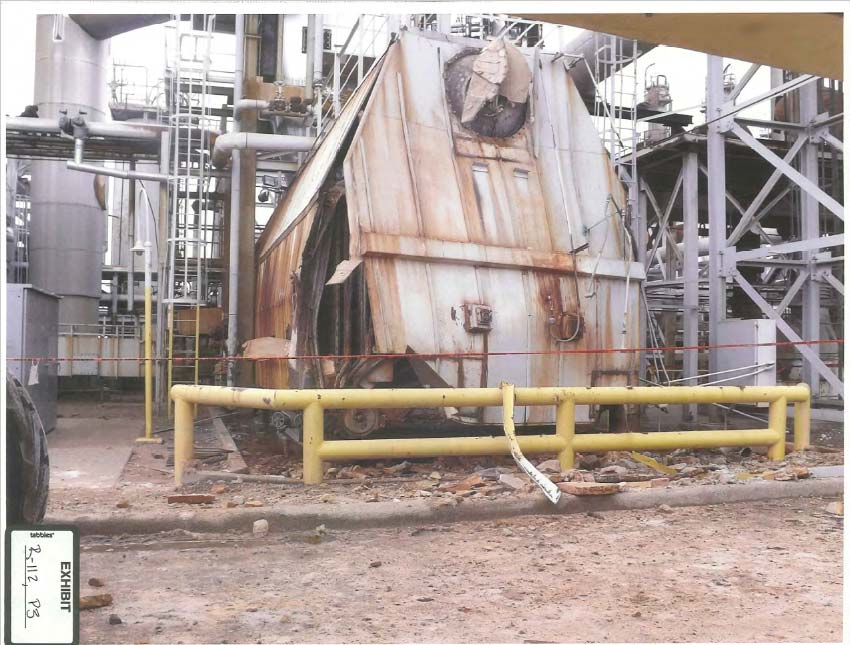
In 2012, a boiler at Wynnewood’s refinery exploded, killing two employees. (The boiler is pictured here shortly after the explosion.) The Secretary of Labor investigated and cited Wynnewood for twelve regulatory violations, eleven involving the boiler. The Secretary characterized five of the twelve violations as “repeat,” triggering heightened penalties.
The Occupational Safety and Health Review Commission upheld the citations involving the boiler. But the Commission rejected the Secretary’s characterization of the violations as “repeat,” reasoning that the previous violations had taken place when a different entity had owned the refinery.
Both parties have appealed.
Wynnewood’s appeal focuses on the eleven citations involving the boiler. Though the facts are largely undisputed, the parties disagree about the application of regulations known as the “Process Safety Management” (PSM) standard. The Secretary adopted these regulations to prevent and minimize the impacts of catastrophic chemical releases, imposing stringent requirements for employers to enhance safety. See 29 C.F.R. § 1910.119;
In appealing, Wynnewood argues that the PSM standard doesn’t apply to the boiler. The majority rejects this argument, concluding that the PSM standard applies because the boiler was connected to other vessels containing highly hazardous chemicals (HHCs). The Secretary’s appeal involves the applicability of heightened penalties for employers who commit repeat violations. When the previous violations were committed, the refinery was owned by a separate legal entity. Though the owner’s legal entity changed, the Secretary argues that the new entity is substantially the same as the old one and should be regarded as the same entity. The Commission rejected this argument, concluding that the new entity differs from its predecessor. The majority agrees with the Commission.
NOTE: When the PSM standard doesn’t apply, other regulations may apply. The employer’s duties may vary based on the applicability of particular regulations.
I respectfully disagree with the majority in both appeals.
First, I agree with Wynnewood that the Secretary hasn’t shown that the PSM standard applies to the boiler. In deciding the applicability of the PSM standard, we’re confined to the regulatory provision invoked by the Secretary and the Commission. Both relied solely on a provision that unambiguously encompasses only vessels that contain an HHC. But the boiler itself contained no HHC, so I would vacate the eleven violations involving the boiler.
Second, I agree with the Secretary in his appeal regarding the applicability of heightened penalties for repeat violations. For the twelfth citation, the Commission misapplied the legal test for determining whether the entity itself has changed after a change in ownership. So I would remand for the Commission to reconsider the applicability of heightened penalties for the twelfth citation.
I. The Secretary and the Commission relied on a provision that unambiguously applies only to vessels containing HHC. The Secretary and the Commission relied on a regulation, 29 C.F.R. § 1910.119, which regulates vessels constituting part of a covered “process.” We must ask: Does the boiler constitute part of a “process” covered by the PSM standard? The Commission answered “yes,” and the majority agrees. I do not.
The Commission relied on a provision in the PSM standard that applied only if the boiler contained at least some HHC. The boiler didn’t, so the PSM standard didn’t apply.
A. We apply deferential review of the Secretary’s regulatory interpretation only if the regulation is ambiguous. When reviewing the Secretary’s regulatory interpretation, we apply deference under the scheme described in Kisor v. Wilkie, ___ U.S. ___, 139 S. Ct. 2400 (2019). Under Kisor, however, courts should defer to an agency’s interpretation only if the regulation is genuinely ambiguous. In determining whether a regulation is ambiguous, we “must exhaust all the ‘traditional tools’ of construction,” including the regulatory text, structure, history, and purpose. Id. at 2415 (quoting Chevron U.S.A. Inc. v. Nat. Res. Def. Council, Inc., 467 U.S. 837, 843 n.9 (1984)).
Wynnewood also argues that the PSM standard doesn’t apply to the boiler because a risk of catastrophic release must exist for interconnected vessels and the Secretary must prove a “reasonable probability” that the vessel could contribute to a catastrophic release.
I would not reach these issues.
B. The applicability of the PSM standard turns on two sentences in the regulatory definition of “process.” The PSM standard defines “process” in two sentences. The first sentence states that “process” is “any activity involving [an HHC] including any use, storage, manufacturing, handling, or the on-site movement of such chemicals, or combination of these activities.” 29 C.F.R. § 1910.119(b). The second sentence explains what constitutes a single process: “For purposes of this definition, any group of vessels which are interconnected and separate vessels which are located such that a highly hazardous chemical could be involved in a potential release shall be considered a single process.”
The two sentences reflect two ways that a vessel can constitute part of a single PSM “process”:
1. if the vessel is used in an “activity” involving an HHC or
2. if a group of vessels is “interconnected” or “located such that [an HHC] could be involved in a potential release.”
The first sentence focuses on particular activities involving an HHC. For example, if the boiler had constituted equipment used to store or move HHCs, a process would exist under the first sentence. 29 C.F.R. § 1910.119(b). And if that process involved enough HHC, the PSM standard would apply. 29 C.F.R. § 1910.119(a)(1). If the first sentence had triggered the PSM standard, the boiler would constitute “process equipment.”
The second sentence focuses on the interconnection with or proximity to other equipment. In my view, the second sentence governs the applicability of the PSM standard to Wynnewood’s boiler.
C. The Secretary and the Commission relied solely on the second sentence of the PSM standard’s definition of “process.”
In considering the boiler part of a PSM process based on interconnection with or proximity to other equipment, the Secretary and Commission relied solely on the second sentence of the definition of “process.” Though the Secretary and Commission relied solely on the second sentence for the regulatory definition of “process,” the majority relies on the first sentence. According to the majority, Wynnewood frames its arguments around the first sentence. See Majority Op. at 8 (“Wynnewood first argues that the Wickes boiler could not have been part of any such activity … .”). But Wynnewood has consistently focused on the second sentence, not the first one. See R., vol. I, at 91 (arguing about the applicability of the PSM standard based on “interconnection” rather than the existence of a “process activity”); Appellant’s Opening Br. 11 (Wynnewood’s summary of its argument about the PSM standard, quoting only the second sentence). Wynnewood’s focus is understandable given the Secretary and Commission’s reliance on the second sentence.
The difference is decisive. The parties agree that the first sentence covers Wynnewood’s fluid catalytic cracking unit and alkylation unit because they contain HHCs. If the boiler had been used in a process with the fluid catalytic cracking unit or alkylation unit, the boiler would be subject to the PSM standard as a PSM “activity” under the first sentence.
NOTE: The designated representative testified that he was the agency’s representative who had decided that the PSM standard applied to the boiler. R., vol. I, at 1105–06.
But the Commission didn’t find that the boiler had been used in a PSM activity. The Commission instead applied the PSM standard based on the boiler’s interconnection with or proximity to two other vessels (the fluid catalytic cracking unit and alkylation unit). Interconnection or proximity of vessels could trigger the PSM standard only under the “process” definition’s second sentence, not the first sentence. The distinction is evident in the Commission’s order. The administrative law judge had concluded that the boiler was covered as a PSM “activity,” relying heavily on an administrative precedent (Delek Refining, Ltd.) that had focused on whether a piece of equipment was part of a covered activity. Delek had examined “the ‘activity’ involving” the covered process, concluding that the equipment was “part of a ‘process’ covered by the PSM standard because [the equipment was] an integral part of the ‘manufacturing, handling [and] on-site movement of [highly hazardous chemicals].” Delek thus rested on the first sentence of the regulatory definition of “process.”
But the Commission rejected the administrative law judge’s reliance on Delek, explaining that even though “Delek did address the PSM standard’s ‘process’ definition, it focused on the first sentence and whether the positive pressurization unit was involved in the ‘manufacturing, handling [and] on-site movement’ of HHCs . . . not whether vessels were interconnected pursuant to the definition’s second sentence.”
Given the Commission’s reliance on the second sentence, I would confine our review to the Commission’s reasoning.
D. The text of the second sentence is ambiguous without considering the regulatory preamble.
Wynnewood argues that the second sentence refers only to interconnected and co-located vessels that contain an HHC. To assess that argument, we apply the traditional tools of construction to the text of the regulation. Kisor, 139 S. Ct. at 2415.
Viewed in isolation, the second sentence does not clearly say whether a vessel can constitute part of a PSM process even when the vessel itself does not contain any HHC. The second sentence refers to “any group of vessels,” 29 C.F.R. § 1910.119(b), but the PSM standard doesn’t define “vessels.” So we must consider not only the regulatory text but also the interpretive tools involving the regulatory structure, history, and purpose.
These interpretive tools include the preamble, which shows that interconnection with or proximity to another vessel can trigger the PSM standard only if both vessels contain HHC.
E. The preamble shows that the second sentence covers vessels only if they contain an HHC.
The parties debate the value of the preamble in interpreting the PSM definition of “process.” Given the apparent ambiguity in this definition, we must consider the regulatory history and purpose. To consider the history and purpose, we may focus on the preamble if it does not override the plain text of a provision:
Some courts and commentators have said that the prologue cannot be invoked when the text is clear. This limitation is reasonable if it means that the prologue cannot give words and phrases of the dispositive text itself a meaning that they cannot bear. But . . . [i]f the prologue is indeed an appropriate guide to meaning, it ought to be considered along with all other factors in determining whether the instrument is clear. The factors undermining its reliability affect its weight, not its relevance.
The preamble shows that the Secretary added the second sentence to clarify when multiple vessels containing HHCs would constitute a single process:
[A] new sentence has been added to clarify the fact that interconnected and nearby vessels containing a highly hazardous chemical would be considered part of a single process and the quantities of the chemical would be aggregated to determine if the threshold quantity of the chemical is exceeded.
Process Safety Management of Highly Hazardous Chemicals; Explosives and Blasting Agents, 57 Fed. Reg. 6356, 6372 (Feb. 24, 1992) (emphasis added).
The preamble thus focuses on vessels “containing” an HHC. So the Secretary explained in the preamble that the agency would measure the quantity of HHC by combining the HHCs in each vessel:
The boundaries of a “process” would extend to quantities … which are interconnected and would include separate vessels located such that . . . an event such as an explosion would affect interconnected and nearby unconnected vessels which contain quantities of the chemical that when added together would exceed the threshold quantity … 57 Fed. Reg. at 6372 (emphasis added).
Given this explanation, the second sentence unambiguously applies only when HHCs exist in the interconnected or nearby vessels.
NOTE: The agency also reflected its focus in guidance materials published soon after adoption of the PSM standard. In these materials, the agency addressed the definition of the phrase “aggregate threshold quantities.” The agency explained:
In accordance with the second sentence of the definition of “process,” quantities of a particular hazardous chemical contained in vessels that are interconnected—and in unconnected vessels that may be adversely affected due to an incident at a nearby process—must be combined to determine whether the threshold level of a hazardous chemical has been reached.
F. The Secretary’s designated representative testified that the second sentence applies to an interconnected or nearby vessel only if it contains HHC.
At the hearing before the administrative law judge, the Secretary’s designated representative (Mr. Rick Hartung) testified. He acknowledged that he was the agency representative who had decided that the PSM standard applied to the boiler. In explaining that decision, he admitted that under the second sentence, the PSM standard would apply to the boiler only if it contained HHC:
Q. It says, “For purposes of this definition, any group of vessels which are interconnected and separate vessels which are located such that a highly hazardous chemical could be involved in a potential release shall be considered a single process”; correct?
A. Yes, ma’am.
Q. And since the term “vessel” isn’t defined in the standard, can you tell us what you interpret the term “vessel” to mean?
A. A vessel can be a container. It can also be in some instances a pressure vessel, but for the most part a container.
Q. I’m sorry?
A. For the most part, a container.
Q. Would it need to contain an HHC or flammable?
A. Yes, I believe so. Yes.
Given this concession by its designated representative, I would reject the Secretary’s current argument that the second sentence could apply even if the interconnected or nearby vessel contains no HHC.
G. Though the first sentence could apply even when the vessel contains no HHC, the Commission has not relied on the first sentence.
The Secretary argues that other provisions of the PSM standard show “that the presence of a HHC in a vessel is not a precondition to coverage.” The Secretary is right, but only under the “process” definition’s first sentence (when a vessel is used in an activity involving a covered process).
Here, though, the Secretary and Commission relied on the “process” definition’s second sentence, which considers the boiler’s interconnection or proximity to a covered process, not the boiler’s use in a process activity. For coverage under the second sentence, the presence of an HHC is required to trigger the PSM standard.
Because the boiler did not contain any HHC, I would reverse the Commission’s determination of PSM coverage as to the eleven citations involving the boiler.
II. The Commission committed legal error in applying the test of substantial continuity.
PLEASE SEE the decision for all the legal jargon debating whether this citation should have been a REPEAT or Serious citation. But be ready for a bunch of legal mumbo-jumbo that has very little to do with actual process safety!
III. Conclusion
In my view, the PSM standard applies to interconnected or nearby vessels only when each vessel contains an HHC. Because the boiler didn’t contain any HHC, I would vacate the eleven citations involving the boiler. I would also conclude that the Commission improperly applied the substantial-continuity test, so I would remand for the Commission to reconsider heightened penalties for the single repeat violation not involving the boiler. I thus respectfully dissent.