
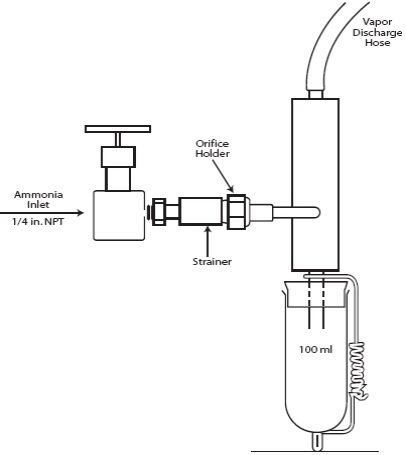
 A while back, I was participating in a PHA of a refrigeration process, and somehow, the discussion led to one that scared me a bit… collecting a liquid ammonia sample to test for water content. The actual art of ammonia refrigeration not being my area of expertise, I had always reserved Bulletin No. 108. Guidelines for Water Contamination in Ammonia Refrigeration Systems for a rainy day reading project (which never came). I focused more on the process safety-related items and thought water contamination was merely a production/energy issue and, therefore, no safety/health risks. That was MY IGNORANCE, and now I am kicking myself for missing this task in previous PHA/JHA’s and Audits. But having asked around of many of my friends and clients in the refrigeration industry, I have come to realize that I may not be the only ignorant ass safety professional when it comes to catching liquid ammonia samples! Here are my questions and concerns with the task…
1) IIAR’s Bulletin 108 is NOT a certified SOP that complies with 1910.119(f), nor are the operating instructions furnished for the USS Cold-Flo (or Airgas’s version) sampling converter
So far, I have asked over a dozen refrigeration clients since my educational experience, and all stated, “We use IIAR 108 as our procedure”. I have visited two plants since and asked both about their “sampling methods,” and both stated the same thing… “We follow IIAR Bulletin 108”. So I pulled out IIAR Bulletin 108 and asked to see the “Fume Hood” where they ran their test, the means and methods used to obtain and maintain the temperature in the 80-90 degree water bath, etc. They have NOT followed Bulletin 108! Instead, they “cowboyed” it and did it like they had done for decades, as the practice was handed down from generation to generation. So here is what IIAR states about the “safety” of this procedure…
X. SAFETY PRECAUTIONS
Safe working conditions and prudent concern for detail are absolutely necessary to avoid injury. In preparation for the taking of samples, locate a portable fan so that the working area will be well ventilated and free of ammonia fumes as the sample is being drawn. Personnel should protect themselves from direct contact with liquid ammonia when taking samples and performing the tests. Protective hats, glasses, gloves, and clothing should be worn. A source of water should be nearby.
As for where a sample can be taken, IIAR states the following…
SAMPLING LOCATIONS
Suggested locations from which to take samples are:
- Pump Systems – from pump discharge line
- Gas Pressure Systems – from transfer line between transfer drum and controlled pressure receiver
- Flooded Systems – from oil drain valve on liquid leg of surge drum
- DX Systems – from liquid transfer line from accumulator
I am sorry, but this even falls short of a “nice try” when it comes to a safety procedure – so anyone with the idea that Bulletin 108 is our “procedure” should have a rude awakening if OSHA or a decent auditor comes across this task during an inspection/audit. Of course, I say that with my tail tucked between my legs because it took me ten (10) years to realize this activity was taking place.
2) Written Procedure vs. Line Break Permit
The old debate as to whether a written procedure or permit is needed is one I have written about several times. This task is a perfect example of this debate. I would certainly prefer a certified and trained upon procedure for this task, but I could make the argument that my Line Break/Process Opening work permit for opening up the process is a perfect fit for this “NON-ROUTINE” task. Either way, we MUST recognize the hazards associated with opening up a process with several thousand pounds and draining liquid ammonia (with an expansion ratio of 1:850) into a glass sample container. I discuss the sampling station design below.
3) Using a sampling device vs. old school of catching a sample in a beaker
WITHOUT question, the cold-floTM sampling converter that both USS Cold-flo and Air Gas Specialty products have on the market will make this task MUCH SAFER. But so far, I have found ONLY two clients who use a sampling tool of this nature. Most were painfully honest and admitted to catching their sample the “old fashion way” (cracking open a vessel valve and draining to a container). DAMN SCARY stuff! The IIAR Bulletin 108 does contain cold-floTM sampling converter operating instructions; however, these procedures once again leave us wanting more. For one, there is a CONFLICT on where IIAR “suggests” the sample be taken and where these cold-floTM sampling converter procedures instruct us to catch a sample. The cold-floTM sampling converter operating instructions state the sample will be taken directly from a vessel with liquid ammonia.
Connect the sampling converter to a liquid outlet of the ammonia tank.
I must give credit in that this sampling device is equipped with an orifice plate to restrict the flow of liquid ammonia into the sample chamber, but as for a “safe design, ” the concept stops there. I find it hard to believe that using a dead man valve has not been included in this task. Deadman valves are so common in refrigeration that I know of no facility that drains oil in their process that does not utilize a deadman valve during this task. With our liquid ammonia sampling procedure, we are draining liquid ammonia and not a mention of any such safe design. Rather than rely on a 1/4″ needle valve as my only saving grace should something fail on my sampler or during the sample collection period? A dead man valve would ensure my flow of liquid could be stopped as I exited the release area should something go wrong. After all, we require a dead man valve when we drain oil as we know NH3 is there AND in MUCH SMALLER quantities than the practice of collecting a liquid ammonia sample!
3) If there was ever an ammonia refrigeration task needing an SCBA
This task is best suited for a JSA/JHA rather than a PHA methodology. In this JSA/JHA the team would most certainly discuss the PPE needed; however, some teams may overlook the POTENTIAL SEVERITY of this task. As I have written about before, egress from an area can dictate the need for higher protection factors when performing high-hazard tasks and the POTENTIAL HARM associated with the task. In the case of using the cold-floTM sampling converter, an ammonia refrigeration tech may actually crawl (not an exaggeration) under a vessel (which may contain several thousands of pounds of liquid NH3) and connect the cold-floTM sampling converter directly to a vessel drain (NOT something I would recommend, but if he/she was using the provided instructions…). Just the fact that the tech is removing the pipe plug from this drain MUST require adequate PPE, and to determine what “adequate PPE” would be needed, we have to consider both egress and potential hazards. Someone on their hands and knees, under a vessel surrounded by piping, can ONLY be considered to be in a limited egress situation. When we take a look at the “potential hazard,” we may see several thousand gallons of liquid ammonia that are being held back by a single valve that may be decades old. I would hope we can all agree the “potential” for serious injury – up to DEATH is there, and thus, we need to PREPARE for this potential. I would first require MANUALLY turning on the engine room emergency ventilation system as an engineering control just for the occasion when something does go wrong. This sampling should only take a few minutes and having the ventilation on for such a short period should be of NO CONCERN for the facility. Secondly, we have to have a WRITTEN operating procedure, or maintenance procedure, for this task. I would also go as far as calling this a POTENTIAL IDLH event, and thus, I would have a stand-by person observing from a safe distance (NOTE: Airgas also mentions the need for at least two employees to be on shift when the sample is collected!). These are my administrative controls. Lastly, I would require the person working at the point of the open process to be donned with an SCBA and ON BREATHING AIR during the sampling (none of this crap of having the “SCBA nearby”). An APR would be USELESS should something go wrong as with a liquid spill. We could pretty much go from 0-3 ppm nuisance odors to over 300 ppm in seconds in the aera of the failure. This worker would need to be donned in a FULL LEVEL B ensemble, which includes a full-body splash suit since there is the potential for liquid ammonia contact.
So what does a cold-floTM sampling converter look like? Have you ever seen one of these?
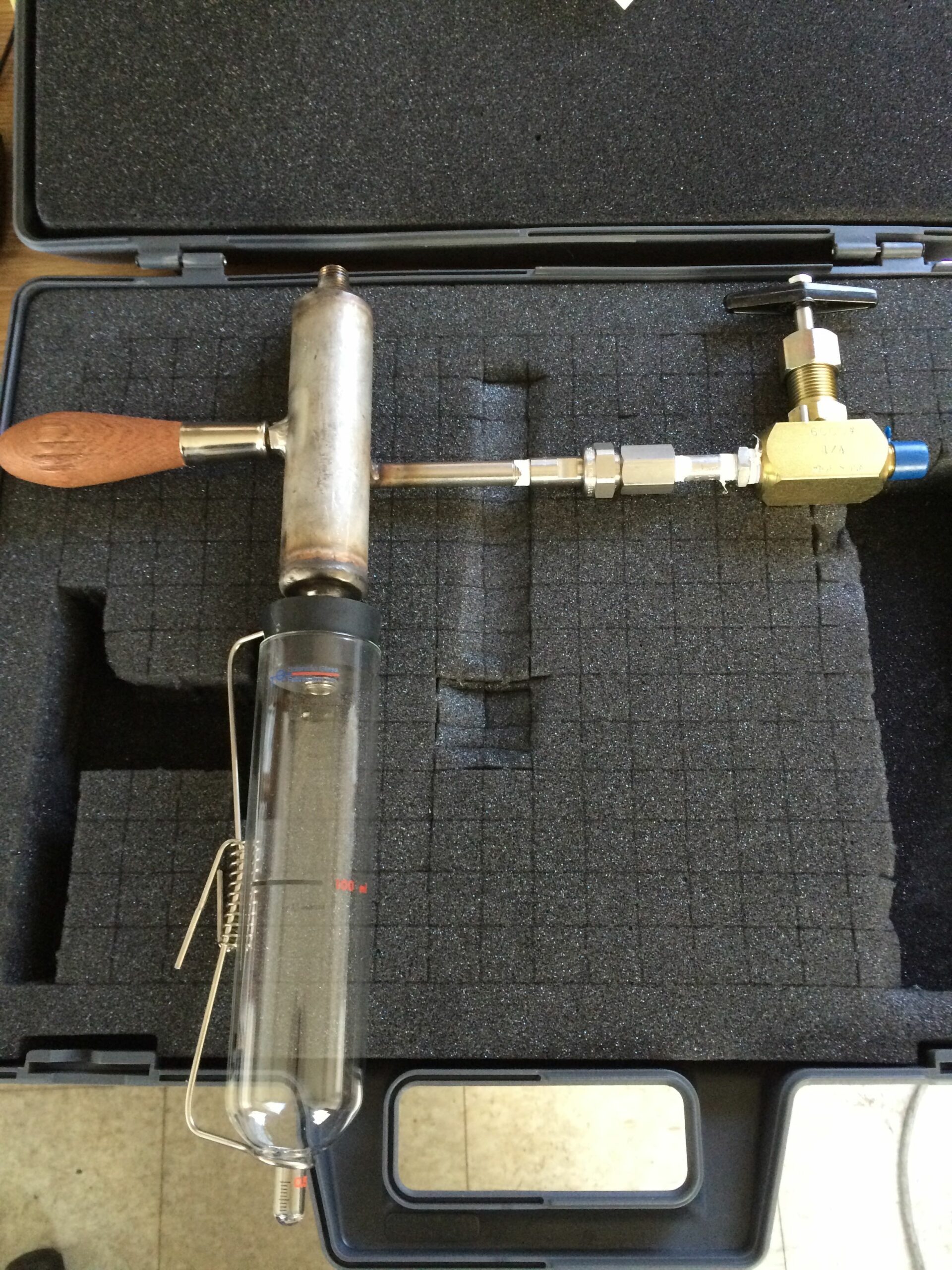
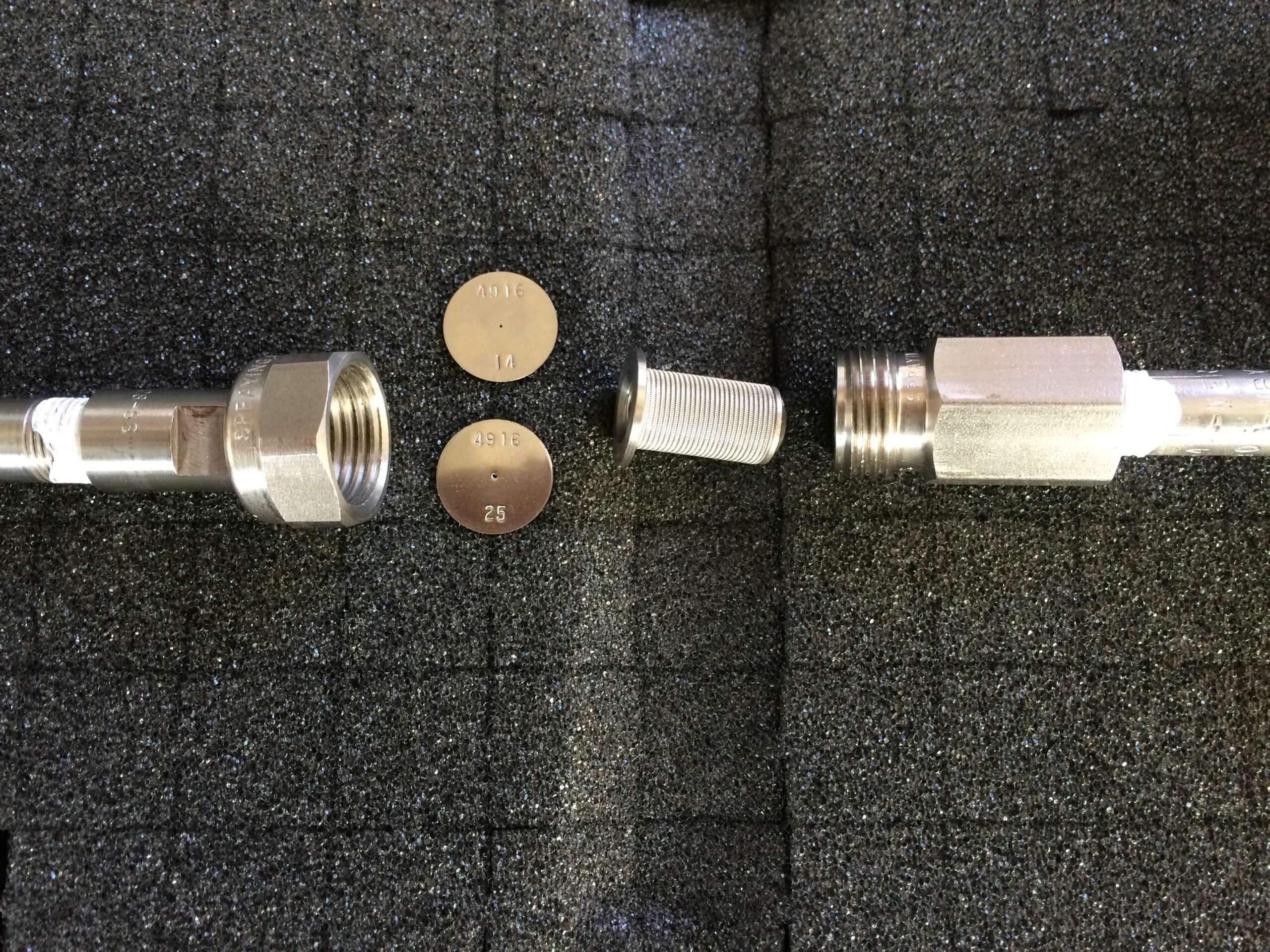
This is AirGas’s version, and although widely accepted and no one seems to know of any accidents involving these devices, there are a number of FAILURE modes that directly involve personnel involved in collecting the sample. So just to give a quick overview of how this device works. The blue cap is the threaded connection for the process connection. Then comes the needle valve- NOT a quarter-turn ball valve. This valve is turned approximately four (4) times to open/close, which is critical when trying to stop the flow of liquid ammonia. Then you see the connection between the valve and chamber (the picture below shows the connection between the strainer and the two orifice plates). This is where we install our strainer and orifice plate. There are two different sizes of orifices, and their use is based on the pressure of the process where we collect our sample. On top of the chamber (see picture above), you can see a threaded connection for a “vent hose”; however, neither manufacturer’s procedure ever instructs the user to attach a hose/tube, ONLY that the vent must be kept clear to prevent the sample converter from being over pressured. The liquid ammonia will flow into the converter sample chamber and fall into the glass collection tube, and we have our sample.
(NOTE: the Airgas Bulletin http://www.airgasspecialtyproducts.com/files/TB_Cold_Flo.pdf does show a hose attached and states their kit comes with a hose; however, the kit I worked with in the writing of this article says the user must provide their own hose)
A couple of CRITICAL steps in the use of this device:
1) Installing the Orifice – Installing the CORRECT orifice
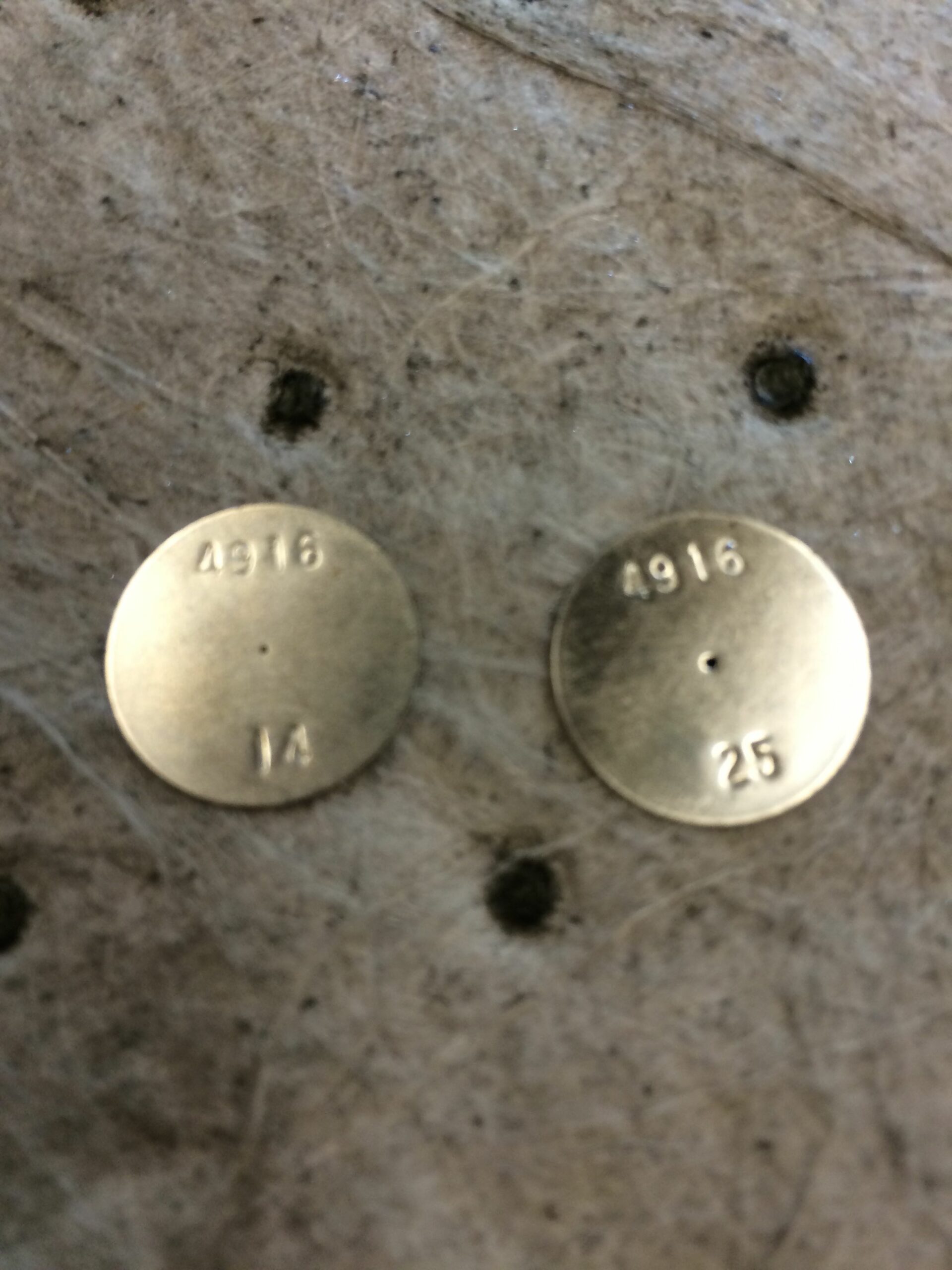
When purchased, this device will arrive with two (2) orifice plates as shown above and below. They are extremely small and delicate plates. If someone was to use this device and assemble it WITHOUT either orifice plate nor their strainer, the flow of liquid ammonia to the glass tube MAY be too much and have negative consequences – I can NOT say for sure as the manufacturer does not state the outcome and I have not tested this to determine the outcome. The instructions state to use the 0.014” orifice when the sample location has pressures above 100 psig and that the 0.025” orifice is to be used when the pressure is BELOW 100 psig at the sample location. The instructions do not state what the outcome would be if the strainer and orifice plate are not installed within the connection; or if the operator installs the incorrect orifice based on the pressures at the sampling location. Here is a close up photo of the two orifice plates that comes with the device:
We should undertsand that if a facility chooses to use their Line Break/Process Opening procedures to connect this device to their process, personnel will still need training on how to assemble this cold-floTM sampling converter and how to use it. So maybe the Line Break/Process Opening procedures and permit get us to the point of SAFELY connecting this device to our process, it does NOT get us through the entire sampling task safely. Having stated earlier that neither manufacturer covers all the needed bases, nor does IIAR Bulletin 108 – we will need to create our OWN PROCEDURE. I just wanted to get that said.
2) Even though neither manufacturer requires, nor provides, a vent hose for the sample chamber I would HIGHLY recommend that ammonia rated tubing be attached and the vapor vented to a safe location away from personnel. I am not sure I would use a water bucket to discharge into, but instead just vent it away from your personnel and into a WELL VENTILATED area. I am assuming that most would catch this sample in their engine room(s), and thus, we should have more than enough ventilation; however, if someone samples their process in areas where other personnel may be present and space is not equipped with the necessary ventilation – additional protections may be warranted.
The bottom line is these devices are DESIGNED to allow for a safe collection of liquid ammonia, and if they are used PROPERLY, I have a high level of confidence this task can be executed safely. My concern here is NOT about the device so much, but the fact that only two facilities have been able to produce the Cold-floTM Sampling Converter device out of a dozen facilities challenged, and NO facility had written procedures or training for conducting this task (using the sampler or some other means). Some lay claim they bought one years ago but can not find it and many have stated they had one, but the last sample collected was done so WITHOUT using this device. If you need to sample your ammonia for water content, then, by all means, it should be done using a cold-floTM sampling converter, a written and trained procedure, along with the PPE prescribed in the facility’s certified PPE hazard assessment for this task. But a few simple human errors could produce a situation where personnel is placed at risk, which no one is expecting, thus the need to have multiple layers of protection – using all three layers of protection (engineering, administrative, and PPE). This task should be viewed as a HIGH-RISK task, one that we call a HIGH SEVERITY – LOW-FREQUENCY task, and should be managed as such. I doubt my recommendations would put any refrigeration business or contractor out of business for the few times this task is carried out over the life of a refrigeration process. And keep in mind that if for some reason, this task is done more frequently then the RISK RISES based on the FREQUENCY increasing and SEVERITY remaining the same.
NOTE: I am in no way a sales rep for the Cold-FloTM sampling converter and this is NOT an advertisement for the device. I mention the two providers ONLY because it appears these are the only two providers in the market currently. Both are trusted and respected companies and their professional assistance are HIGHLY recommended BEFORE the use of their device.
I came across this discussion online in a refrigeration group, and although the responses are limited, we can get a picture of those who are sampling their ammonia may not be doing it based on any prescribed practice!!!!
https://groups.google.com/forum/#!topic/alt.hvac/xpTavCYK3-Q