
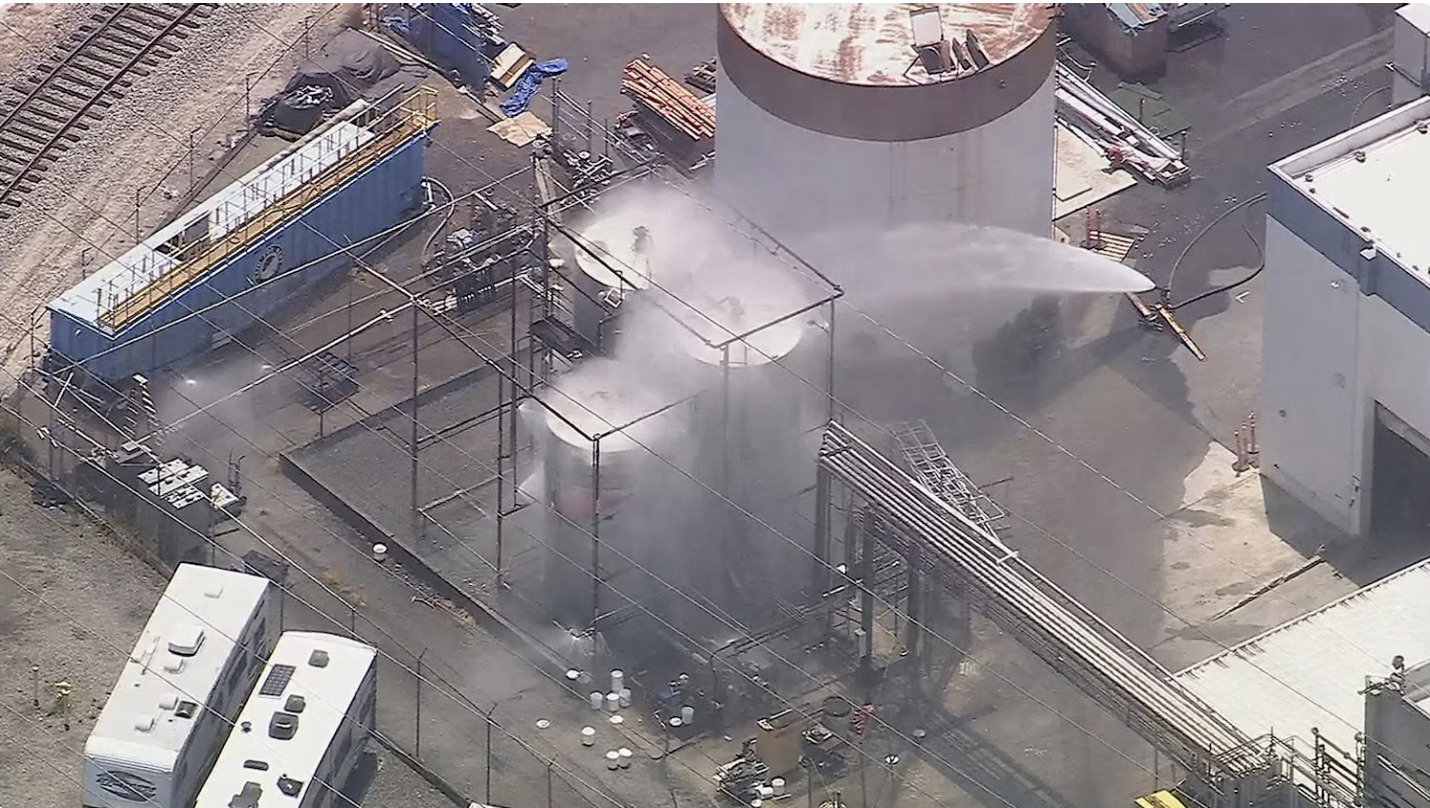
For those curious, it will take around 27 pounds of Phenothiazine (PTZ) to successfully QUENCH the reaction, or, as some may call it, “short-stopping”. But these events usually occur in a “process vessel” that has an agitator. These tanks in CA do NOT appear to have agitators; however, they may be able to “mix” the contents to ensure the inhibitor remains well distributed in the solution. I was curious about this after examining the image below from ABC News:
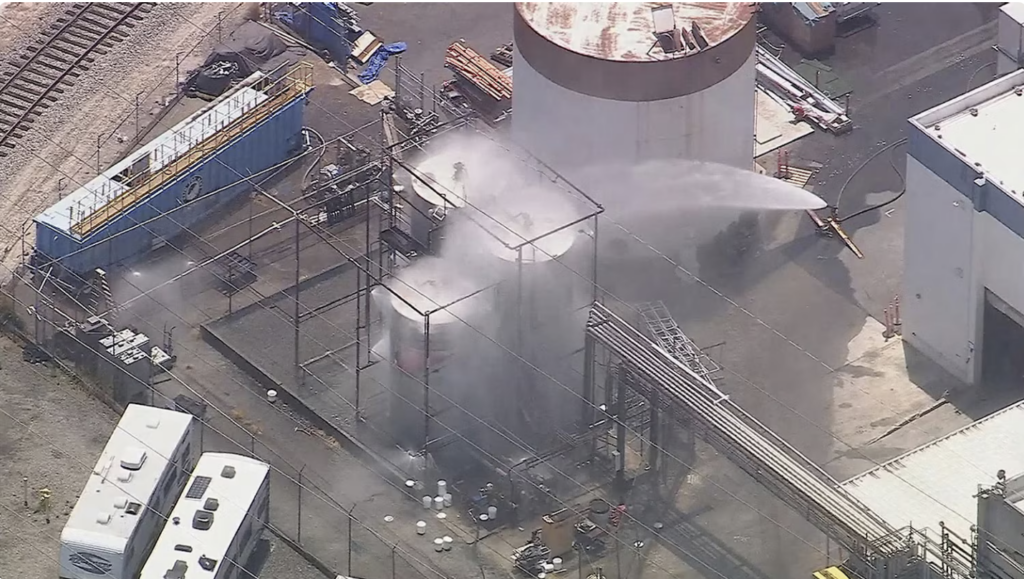
Do you see all the 5-gallon buckets sitting on the ground? My bet is that those were a Quenching Agent, and the facility was trying to get things under control before calling the FD. They are all in the vicinity of the pumps, which could be used as an “injector and mixer.” So I asked Gemini+, “How much Phenothiazine (PTZ) is needed to quench 7,000 gallons of MMA?“
To determine the required amount of inhibitor to “short-stop” or neutralize 7,000 gallons of Methyl Methacrylate (MMA), you must first establish the target concentration. The Methacrylate Producers Association (MPA) generally recommends designing emergency short-stop systems to achieve a target concentration of 100 to 500 ppm of active inhibitor in the bulk liquid.
Assuming a conservative, high-end target of 500 ppm, you would need approximately 27.4 pounds of active inhibitor.
Here is the mass calculation:
- Calculate the Total Mass of MMA: MMA has a specific gravity of roughly 0.94, meaning it weighs about 7.84 lbs per gallon at standard temperature.
- 7,000 gallons × 7.84 lbs/gal = 54,880 lbs of MMA
- Calculate the Required Inhibitor Mass (at 500 ppm):
- (500 / 1,000,000) × 54,880 lbs = 27.44 lbs
However, from a process safety and engineering standpoint, successfully short-stopping an MMA tank involves two critical operational hurdles:
- the chemical limitation of Hydroquinone (HQ) and
- the physical challenge of mixing
1. The Danger of Using HQ (The Oxygen Paradox)
While HQ is commonly used as the day-to-day storage inhibitor for MMA, it is widely considered the wrong chemical to use for emergency short-stopping during an active runaway.
HQ and MEHQ (Mequinol) strictly require dissolved oxygen to function. When a tank of MMA begins to polymerize and enter a thermal runaway, the temperature rises rapidly. As the liquid heats up and approaches boiling, it outgasses and physically strips the dissolved oxygen out of the monomer.
If you inject HQ into an oxygen-starved runaway tank, it will do absolutely nothing, and the polymerization will continue uninterrupted. Because of this, industry standards heavily favor using Phenothiazine (PTZ) for emergency short-stop systems. PTZ functions anaerobically; it does not require dissolved oxygen to scavenge free radicals and halt the polymerization.
2. The Delivery and Mixing Challenge
You cannot simply dump 27 pounds of dry HQ or PTZ powder into a 7,000-gallon tank during an emergency. It will simply float on the surface or sink to the bottom, leaving the vast majority of the reactive monomer uninhibited.
A properly designed short-stop system requires:
- A Liquid Solution: The 27.4 lbs of active inhibitor must be pre-dissolved in an appropriate, compatible solvent (such as a designated volume of MMA monomer itself or ethyl acetate) to create a highly concentrated liquid payload.
- Pressurized Injection: The solution must be rapidly injected into the tank using a pressurized nitrogen accumulator.
- Agitation: The system relies on an active tank agitator or a dedicated nitrogen sparging system at the bottom of the vessel to violently roll the liquid and disperse the inhibitor evenly throughout the 7,000 gallons BEFORE the viscosity of the polymerizing mass becomes too thick to mix.
Source: Gemini+