
The Evolution of the Hydrogen Sulfide IDLH: From Lethality to Escape Impairment
The history of the Immediately Dangerous to Life or Health (IDLH) value for Hydrogen Sulfide (H2S) reflects a critical evolution in industrial safety. It highlights a shift from focusing purely on survival to understanding the physiological “tipping points” that prevent a worker from escaping a toxic environment.
The 1974 Standards Completion Program: The Original 300 ppm
When the IDLH values were first established in 1974, the limit for H2S was set at 300 ppm.
- The Basis: This figure was derived from foundational industrial hygiene texts, including Patty’s Industrial Hygiene and Toxicology and Noxious Gases by Henderson & Haggard.
- The Logic: At the time, data suggested that concentrations between 170 ppm and 300 ppm could be endured for up to one hour without permanent physiological damage. The safety philosophy of the era assumed that as long as a worker was conscious and mobile, they could detect the “rotten egg” odor and self-rescue.
The 1994 Revision: Addressing the “Silent Killer”
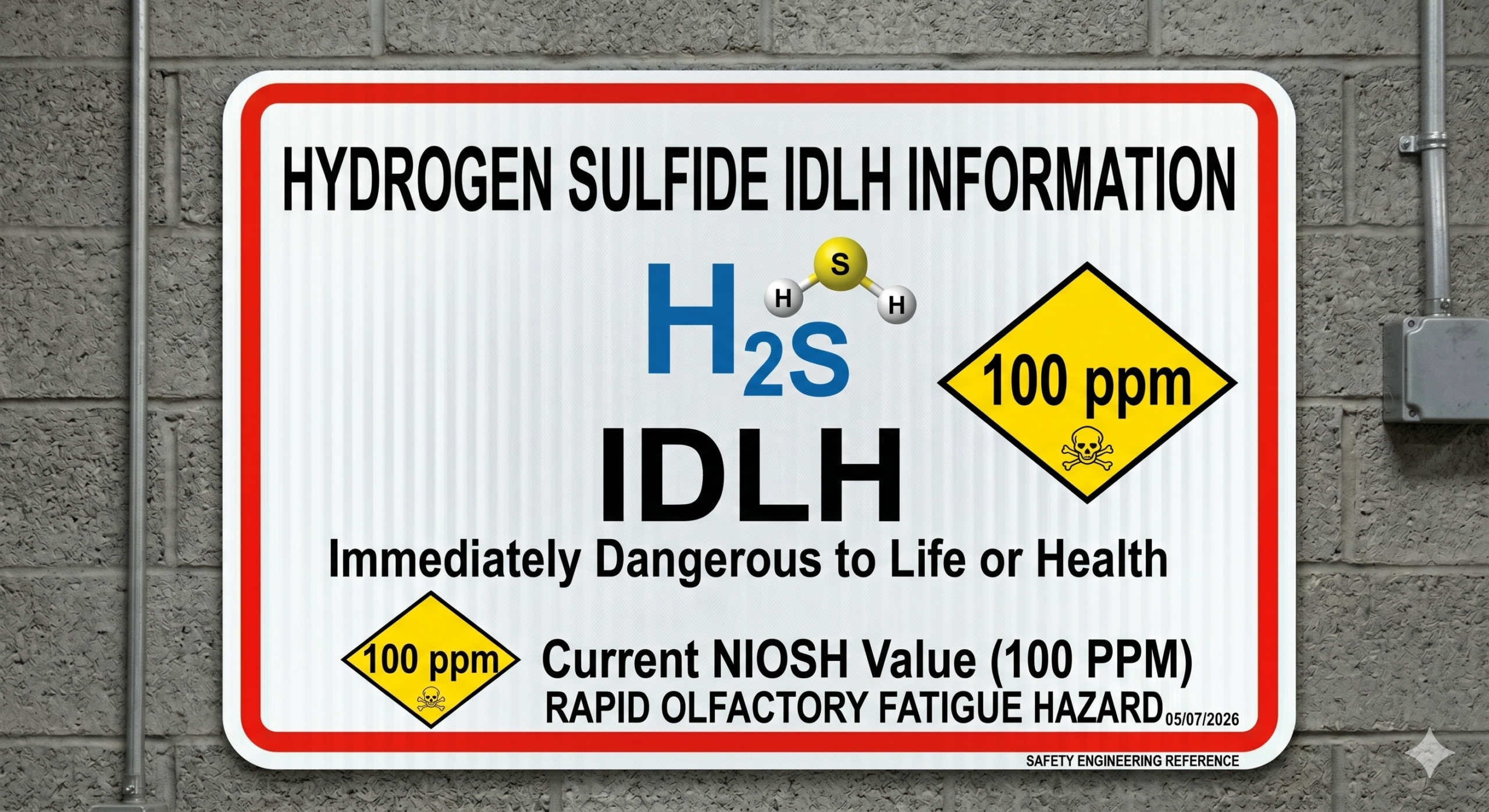
In 1994, NIOSH significantly slashed the IDLH from 300 ppm to 100 ppm. This 66% reduction was not just a change in numbers; it was a fundamental shift in how NIOSH defined “danger.” The revision focused on escape impairment—the point at which a worker loses the physical or mental ability to save themselves.
The Rationale for 100 ppm
Two primary physiological factors drove this reduction:
- Olfactory Fatigue: NIOSH recognized that at 100 ppm, H2S rapidly paralyzes the olfactory nerve. A worker entering a 100 ppm environment might smell the gas for a few seconds before the scent “disappears.” This creates a deadly false sense of security, leading the worker to believe the hazard has cleared while the systemic dose continues to rise.
- Severe Physiological Distress: Human data indicated that exposures at 100 ppm cause severe eye irritation (conjunctivitis) and respiratory distress within 15 to 30 minutes. These symptoms are severe enough to blind a worker or cause disorientation, making it impossible to navigate an exit or properly don a respirator.
Physiological Impact by Concentration
Today, the 100 ppm limit is the global benchmark for H2S emergency response. It represents the “red line” where H2S transitions from a nuisance irritant to a systemic toxin.
| Concentration | Effect & Historical Context |
| 0.01 – 1.5 ppm | Odor threshold (strong “rotten egg” smell). |
| 10 ppm | Modern NIOSH REL (10-minute ceiling). |
| 100 ppm | Current IDLH. Olfactory paralysis; severe eye/lung irritation. |
| 200 – 300 ppm | Original 1974 IDLH. Risk of pulmonary edema and marked conjunctivitis. |
| 500 – 700 ppm | “Knockdown” effect. Rapid unconsciousness and respiratory failure. |
| 1,000+ ppm | “The Gulp.” Immediate respiratory arrest and death. |
Comparison of Regulatory Limits
Because of its high toxicity and flammability, $H_2S$ is one of the most strictly regulated gases in the industrial sector.
| Agency / Organization | Value | Limit Type |
| NIOSH | 100 ppm | IDLH (Immediate Danger) |
| OSHA | 20 ppm | Ceiling Limit (Never to be exceeded) |
| ACGIH | 1 ppm | TLV-TWA (8-hour work shift) |
| AIHA (ERPG) | 100 ppm | ERPG-3 (1-hour emergency limit) |
Summary
The history of the $H_2S$ IDLH serves as a cautionary tale in process safety. It reminds us that a hazard’s danger is not defined solely by its lethality, but by its ability to deceive the human senses. In an H2S environment, the moment you stop smelling the gas is the moment you are in the most danger.